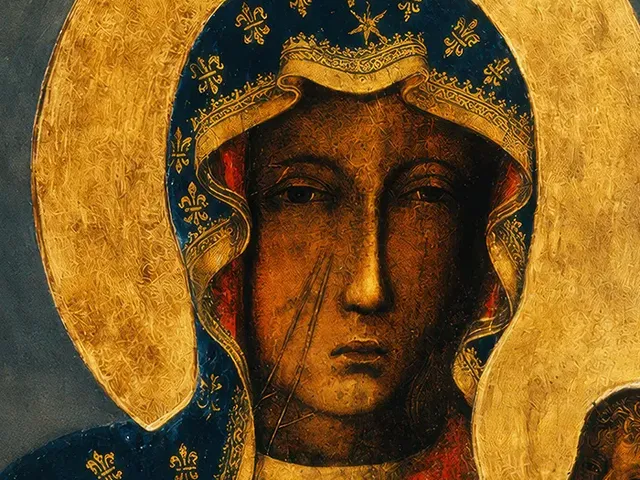
Paolo Uccello: Perspective Magic in Religious Paintings
Paolo Uccello (1397–1475), born Paolo di Dono in Pratovecchio near Florence, was one of the most original and paradoxical figures of the Florentine Early Renaissance. Trained as a craftsman in Ghiberti’s workshop and shaped by the great innovations of Brunelleschi and Masaccio, he became obsessed with the new science of linear perspective to a degree that, according to Vasari, consumed his sleep and his conversations. “What a delightful thing this perspective is!” he is said to have exclaimed, a remark that captures both his delight and his monomania.

Uccello’s perspective was not the serene, rational perspective of Piero della Francesca or Domenico Veneziano. It was an active, almost aggressive force in his compositions, the foreshortened bodies of the dead soldiers in the Battle of San Romano, the receding lances and broken shields, the impossible mazzocchi (wire-frame hat forms) rotating in perfect three-dimensional space. In his religious paintings, the same geometric intelligence shapes the frescoes of the Chiostro Verde, the Green Cloister, at Santa Maria Novella, where the green-earth monochrome of the sinopie-like painting gives the scenes of Genesis a quality of dreamlike, mathematical clarity unlike any other sacred painting of the fifteenth century.
Adoration of the Child

This Adoration of the Child is a devotional panel that shows Uccello applying his perspective intelligence to the intimate sacred subject of the Nativity. The Virgin kneels in adoration before the newborn Christ in the traditional posture, the figure rendered with the angular precision and strong contour line that characterize Uccello’s figure style. The composition is simpler and more direct than his major narrative works, but the underlying geometric discipline, the careful recession of the ground plane, the clear spatial relationships between the figures, reflects the same obsessive attention to spatial order that animates all his painting.
Beccuto Madonna

The Beccuto Madonna in the Museum of San Marco in Florence is a rare example of Uccello’s devotional panel painting at its most conventional and tender. The Virgin holds the Child in the traditional Florentine format, the face modeled with the careful attention to form that he brought from Ghiberti’s workshop. The painting shows that alongside his more extreme formal experiments, Uccello was capable of producing works of genuine devotional warmth, the Madonna’s gaze has a gentleness that contrasts with the hard-edged angularity of his more ambitious compositions. It is a reminder that his geometric obsessions existed alongside a more conventional Florentine training in sacred imagery.
Creation of Adam, Animals, and Eve, and the Original Sin

The frescoes of the Chiostro Verde, the Green Cloister, at Santa Maria Novella in Florence represent Uccello’s most sustained and ambitious sacred program. Painted in green earth monochrome (terra verde), the scenes from Genesis have a quality unlike any other paintings of the period: dreamlike, geometric, and haunted by a perspective that creates space in strange ways. The Creation scenes, God forming Adam from the earth, the creation of the animals, the rib-birth of Eve, the Fall, are rendered with a combination of formal invention and theological seriousness that represents Uccello’s unique synthesis of the new Renaissance science of space and the older tradition of monumental sacred narrative.
Crucifixion of Christ

This Crucifixion demonstrates Uccello’s approach to the central event of Christian salvation: the figure of Christ on the cross is rendered with his characteristic strong contour and angular body modeling, the cross set in a landscape that recedes with the careful precision of his perspective studies. Uccello gives the Passion scene a quality of formal austerity that makes it feel not cold but concentrated, a painter thinking very hard about how the geometry of space can express the gravity of the event. The mourning figures at the foot of the cross are rendered with the linear dignity that is Uccello’s signature emotional register.
Saint George and the Dragon

Saint George and the Dragon in the National Gallery in London is one of Uccello’s most famous and appealing paintings, a small panel that concentrates all his geometric fantasy into a single image of chivalric combat. The knight charges the dragon on a horse that seems almost mechanical in its precise, rocking-horse perfection; the dragon curls its serpentine body in perfect foreshortened coils; the princess holds the dragon on a leash as if it were a pet. The cave behind them is a cone of pure geometry. The whole scene has the character of a mathematical problem solved with unusual delight: this is what sacred chivalric narrative looks like when a mathematician decides to paint it.
The Annunciation

The Annunciation in the Ashmolean Museum in Oxford shows Uccello applying his perspective intelligence to one of the most studied subjects in Italian sacred painting. The angel and the Virgin are placed in an architectural setting whose recession in space is organized with the care of a demonstration drawing, the tiles of the floor, the receding arcade, the column that separates Gabriel from Mary all calculated with Uccello’s characteristic precision. Within this geometric framework, the sacred exchange, the divine message and the human acceptance, unfolds with a formal clarity that transforms perspective science into devotional argument: the architecture of space as an image of the architecture of salvation.
The Crucifixion with the Virgin, Saint John the Baptist, Saint John the Evangelist and Saint Francis

This Crucifixion panel in the Thyssen-Bornemisza Museum in Madrid groups the standard mourners and witnesses at the foot of the cross, the Virgin, John the Baptist, John the Evangelist, Saint Francis, in a composition that shows Uccello organizing sacred figures in space with his characteristic precision. The cross rises in the center of a landscape whose recession has the careful, measured quality of all his spatial constructions. Each saint is rendered with the angular, contour-driven figure style that makes his religious paintings instantly recognizable, and the emotional austerity of the scene, the grief controlled rather than expressed, is characteristic of his approach to Passion subjects.
Summary Table
| Name | Date | Medium | Location |
|---|---|---|---|
| Adoration of the Child | c. 1440–1460 | Tempera on panel | Private / Church collection |
| Beccuto Madonna | c. 1430–1440 | Tempera on panel | Museum of San Marco, Florence |
| Creation of Adam, Animals, and Eve, and the Original Sin | c. 1430–1440 | Fresco (green earth) | Chiostro Verde, Santa Maria Novella, Florence |
| Crucifixion of Christ | c. 1440–1460 | Tempera on panel | Private collection |
| Saint George and the Dragon | c. 1455–1460 | Oil on canvas | National Gallery, London |
| The Annunciation | c. 1430–1440 | Tempera on panel | Ashmolean Museum, Oxford |
| The Crucifixion with the Virgin, Saint John the Baptist, Saint John the Evangelist and Saint Francis | c. 1460–1470 | Tempera on panel | Thyssen-Bornemisza Museum, Madrid |
Important Facts About Paolo Uccello
- Paolo Uccello (1397–1475), born Paolo di Dono, trained in Lorenzo Ghiberti’s workshop before developing his obsession with linear perspective, which Vasari describes as consuming his sleep and social life in pursuit of mathematical solutions.
- His three Battle of San Romano panels (Uffizi, National Gallery London, Louvre) are his most famous works and among the most extraordinary exercises in foreshortening and perspective demonstration in Western art.
- His frescoes in the Chiostro Verde (Green Cloister) of Santa Maria Novella in Florence, painted in green-earth monochrome, represent one of the most unusual and haunting sacred fresco cycles of the Early Renaissance.
- Despite the revolutionary nature of his perspective experiments, his career was not financially successful: in his 1469 tax return he described himself as old, infirm, and without money.
- His later works show a retreat from the most extreme perspective experiments toward a more conventional figure style, but his best paintings remain among the most intellectually distinctive in the history of Italian sacred painting.
Frequently Asked Questions
Who was Paolo Uccello?
Paolo Uccello (1397–1475), born Paolo di Dono, was a Florentine painter obsessed with the new science of linear perspective. Trained in Ghiberti’s workshop, he spent his career pushing the foreshortening and spatial recession of Renaissance perspective to its mathematical and visual limits, producing some of the most unusual and intellectually ambitious paintings of the fifteenth century.
What is Paolo Uccello most famous for?
He is most famous for his three Battle of San Romano panels, in the Uffizi, the National Gallery in London, and the Louvre, which are extraordinary demonstrations of foreshortened soldiers, horses, and weapons in a unified perspective space. Among his religious works, the frescoes of the Chiostro Verde at Santa Maria Novella in Florence are his most ambitious sacred program.
Why was Uccello obsessed with perspective?
According to Vasari, Uccello found in the new science of linear perspective developed by Brunelleschi and codified by Alberti a mathematical problem of inexhaustible fascination, a system by which three-dimensional space could be perfectly rendered on a flat surface. He is said to have spent nights working on perspective problems, reportedly saying “What a delightful thing this perspective is!”, a remark that captures both his delight and his inability to set the problem aside.
What is the Chiostro Verde?
The Chiostro Verde (Green Cloister) is the cloister of the basilica of Santa Maria Novella in Florence, named for the green-earth monochrome fresco technique used to decorate it. Uccello painted scenes from Genesis there in the 1430s–40s, including the Creation of Adam, the Creation of Animals and Eve, and the story of Noah. The frescoes survive in damaged condition but remain among the most unusual sacred paintings of the Early Renaissance.
Where can I see Paolo Uccello’s paintings?
His Battle of San Romano panels are in the Uffizi in Florence, the National Gallery in London, and the Louvre in Paris. The Saint George and the Dragon is in the National Gallery, London. The Chiostro Verde frescoes are visible at Santa Maria Novella in Florence. Other works are in the Ashmolean Museum in Oxford (Annunciation), the Thyssen-Bornemisza Museum in Madrid (Crucifixion), and the Museum of San Marco in Florence (Beccuto Madonna).
Where can I buy a canvas reproduction of a Paolo Uccello painting?
The shop at jesuschrist.pictures offers museum-quality canvas reproductions of the great Christian paintings, and the collection keeps growing; it is the best place to look for a canvas reproduction of a Paolo Uccello painting.