Teresa of Avila: The Mystic Who Was Also a Builder
Everyone knows the face Bernini gave her: head fallen back, mouth open, a marble nun undone by an angel with a golden arrow. It is one of the most reproduced images in Western art, and it was carved in Rome in the 1640s by a sculptor who never met Teresa of Avila, more than sixty years after she died in a Castilian village. The woman in the archives is harder to carve. She spent twenty years founding convents across Spain, arguing with provincials, hiring masons, signing deeds and moving by mule cart in weather that nearly killed her. She kept accounts. She wrote four books because her confessors ordered her to. She was investigated by the Inquisition. The ecstasy was real, and she described it herself in a single paragraph. The rest of her life was work.
Avila, 1515: A Family With Something to Hide
Teresa Sanchez de Cepeda y Ahumada was born on 28 March 1515 in Avila, a walled town on the Castilian plateau. Her family were prosperous, and they were conversos. Her grandfather, Juan Sanchez de Toledo, was a Jewish merchant who had converted to Christianity and who in 1485 was reconciled by the Inquisition in Toledo for having relapsed into Jewish practice. His penance was public: he walked in procession through the churches of the city wearing the yellow penitential garment, with his sons beside him. The family moved to Avila and bought their way into the minor nobility. The documents of that lawsuit survive, which is how we know. A girl raised in that house learned early that respectability is fragile, that paperwork matters, and that the wrong kind of religious enthusiasm can destroy a family. She would spend her adult life under suspicion and she was never naive about it. The most famous story of her childhood is her own. At about seven, she and her brother Rodrigo left the house to go to the land of the Moors and be beheaded for Christ. An uncle met them on the road out of town and brought them home. She tells it against herself, in the register of a woman describing a child she finds slightly ridiculous.
Twenty Years of Bad Health and Half-Hearted Prayer
She entered the Carmelite convent of the Incarnation at Avila in 1535, at twenty, against her father’s wishes. The Incarnation was not a severe house. It held well over a hundred women, many of them there because their families could not or would not marry them off. Nuns kept servants, owned property, received visitors in the parlour and left for long stays with relatives. Teresa was popular in the parlour and she later blamed it for wasting two decades of her life. Then she got sick. In 1538 and 1539 she suffered an illness violent enough that she lost consciousness for several days and was thought dead. A grave was dug. She recovered, but remained largely paralysed for around three years and never had reliable health again. What it was is genuinely unknown. Malaria, a neurological disorder and epilepsy have all been proposed, and none can be confirmed at five centuries’ distance from a patient who described symptoms rather than signs. Anyone who tells you the diagnosis with confidence is guessing.
The illness matters because it sets the terms of everything that follows. Teresa prayed, badly and intermittently, for about twenty years. She says so plainly. She was not a prodigy of holiness who arrived fully formed. She was a woman in her forties who had been a mediocre nun for half her life.
The Conversion at Forty
The turn came in 1554, when she was thirty-nine. Walking through the convent she came on a statue that had been brought in for a feast, a battered image of the wounded Christ. She had passed such things a thousand times. This time she sat down on the floor in front of it and wept, and something in the arrangement of her life gave way. What followed was not calm. Over the next years she experienced visions, voices and raptures, sometimes in public, which was the worst possible thing to happen to a woman of converso descent in the Spain of Philip II. The Inquisition was actively prosecuting the alumbrados, the illuminists, whose claim to direct interior enlightenment looked from outside exactly like hers. Her confessors were divided. Several told her the visions came from the devil. One ordered her to make an obscene gesture at Christ when he appeared, to test the source. She obeyed, and recorded her distress.
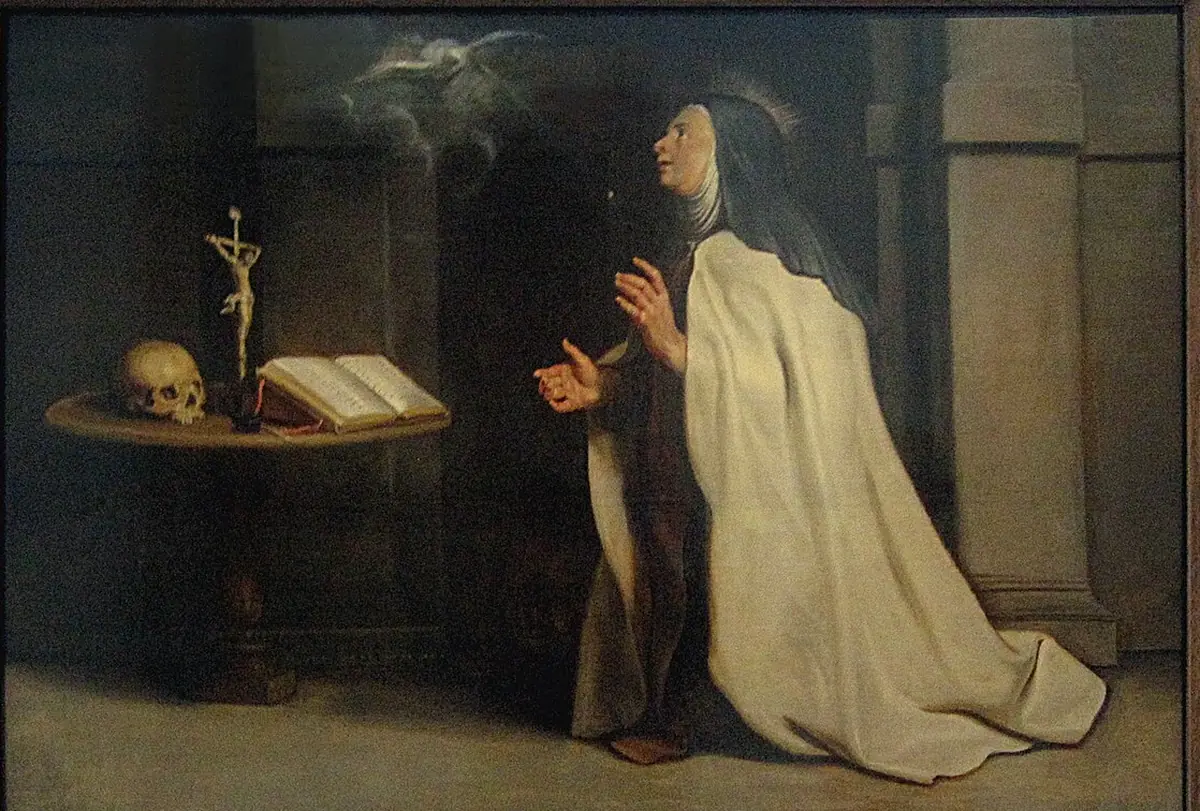
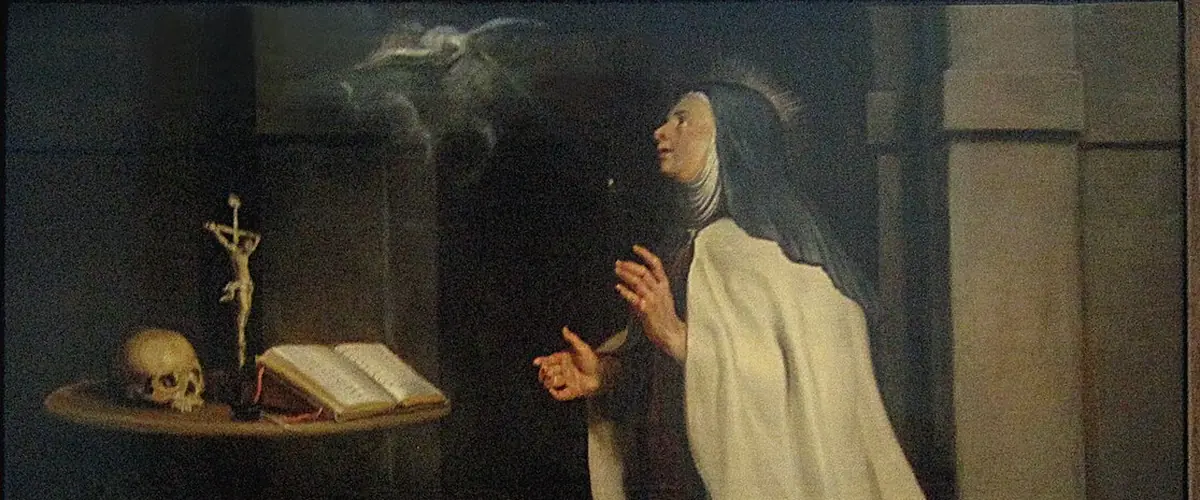
Rubens painted that period of her life as an event in a plain room. A skull, a crucifix and an open book on a table, and a dove of light. He gets something right that most painters miss: nothing about the setting is grand. Teresa’s visions happened in ordinary Castilian interiors, in the middle of the working day.
The Arrow, and What Rome Made of It
The transverberation belongs to these years. Teresa describes it once, briefly, in her Life: an angel, small and beautiful, holding a long golden dart with a point of fire, which he drove into her heart repeatedly. She reports pain so great that she moaned aloud, and a sweetness she could not separate from the pain. She adds, in the manner of a woman who knows how this will sound, that the pain was spiritual although the body has its share. That paragraph became, ninety years later, the Ecstasy of Saint Teresa in the Cornaro Chapel of Santa Maria della Vittoria in Rome, where Gian Lorenzo Bernini set the angel and the swooning nun in a marble niche lit from a hidden window, with sculpted members of the Cornaro family watching from theatre boxes on either side. It is a masterpiece and it is also a piece of Counter-Reformation stagecraft, commissioned by a Venetian cardinal, which frames a Spanish nun as a spectacle for an audience.
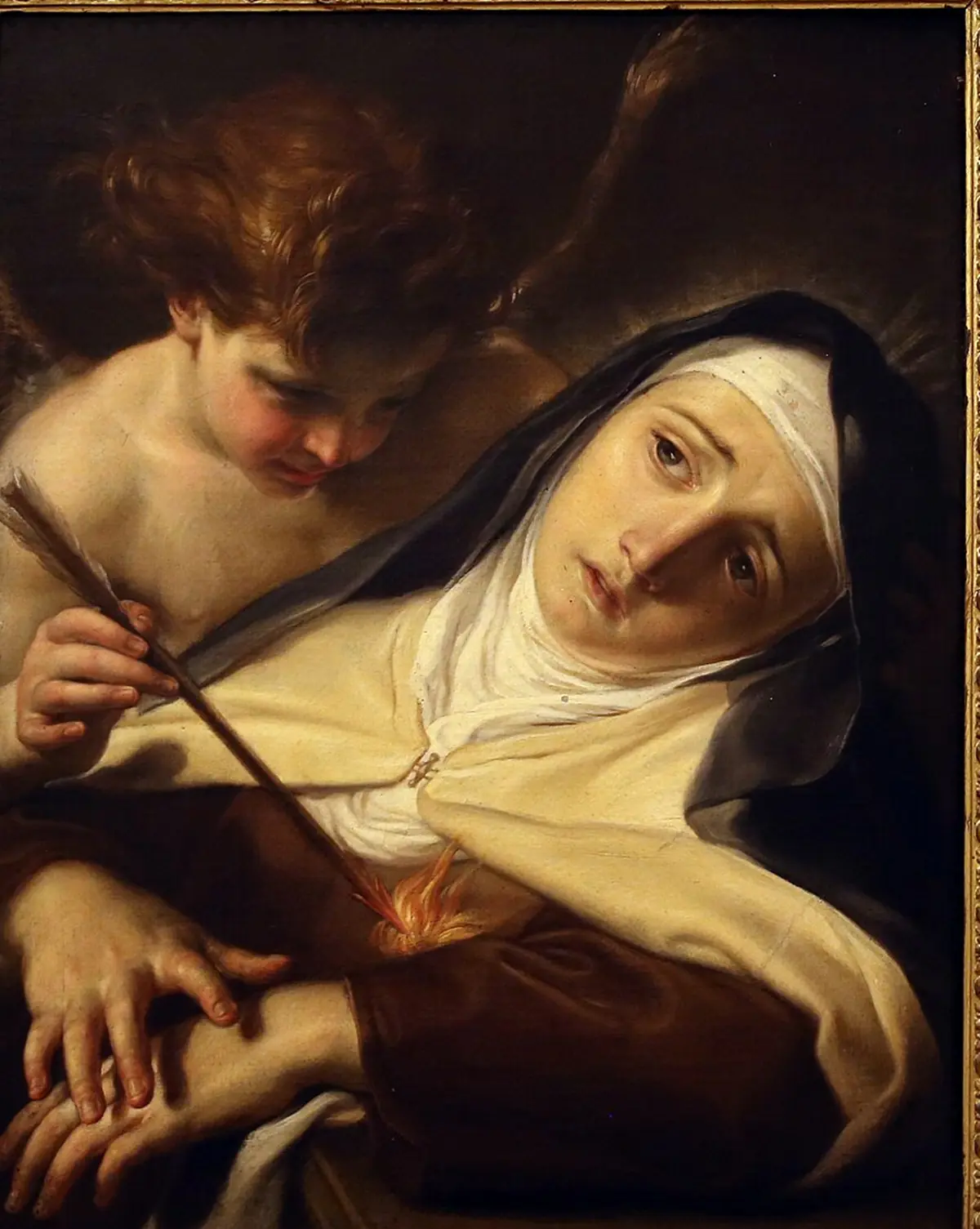
Painters were often closer to the text. Pompeo Batoni gives the angel, the arrow and the point of fire, and a Teresa whose face is tired rather than transported. That is nearer to what she wrote.
San Jose, 1562: The Part Nobody Sculpts
Here is where the other Teresa appears. In 1562 she founded a new convent in Avila, San Jose, with four nuns. It was small on purpose. It was poor on purpose, refusing the endowed income that made houses like the Incarnation comfortable and crowded. The nuns went unshod, which is where the name Discalced comes from. She had to obtain a papal brief, find a house, buy it quietly through relatives to avoid opposition, and defend the foundation against the town council, which sued to have it closed on the grounds that a convent without income would become a burden on the city. She won. Then she did it sixteen more times.
Seventeen Foundations in Twenty Years
Between 1567 and her death in 1582 Teresa founded convents at Medina del Campo, Malagon, Valladolid, Toledo, Pastrana, Salamanca, Alba de Tormes, Segovia, Beas, Seville, Caravaca, Villanueva de la Jara, Palencia, Soria, Granada and Burgos. She travelled to almost all of them, in her fifties and sixties, in covered carts on Castilian roads, in summer heat and winter mud, with the chronic ill health she never lost. Her Book of the Foundations is the record, and it is startlingly unmystical. It is about money, lawsuits, unreliable benefactors, houses with bad drains, the difficulty of finding a chaplain, and the problem of what to do when a postulant’s family arrives to take her back by force. She is funny in it, and she is exasperated, and she is a manager.
John of the Cross, and What Reform Cost
In 1567 the Carmelite general authorised her to found houses for friars as well. At Medina del Campo she met a small, intense young friar named Juan de Yepes, twenty-five years old and about to leave for the Carthusians. She talked him out of it. He became John of the Cross, and with him the reform acquired its greatest writer and its most serious casualty. The Carmelite order split over the reform, and the split turned ugly. In December 1577 friars of the unreformed observance seized John of the Cross, took him to Toledo and imprisoned him in a cell barely larger than his body for nine months, with regular public floggings. He escaped in August 1578. He wrote the first stanzas of the Spiritual Canticle in that cell. Teresa’s letters from those years are the letters of someone fighting an institutional war and losing sleep over it. The Discalced were granted their own province in 1580, two years before she died.
The Books She Was Ordered to Write
Teresa did not set out to be an author. Every one of her major works was written under obedience, because a confessor told her to put her experience on paper so it could be examined. The Life was written for that purpose and was promptly denounced to the Inquisition, which held the manuscript for years. The Way of Perfection was written for her own nuns. The Interior Castle was written in 1577, at the height of the crisis over John of the Cross, in a few months.
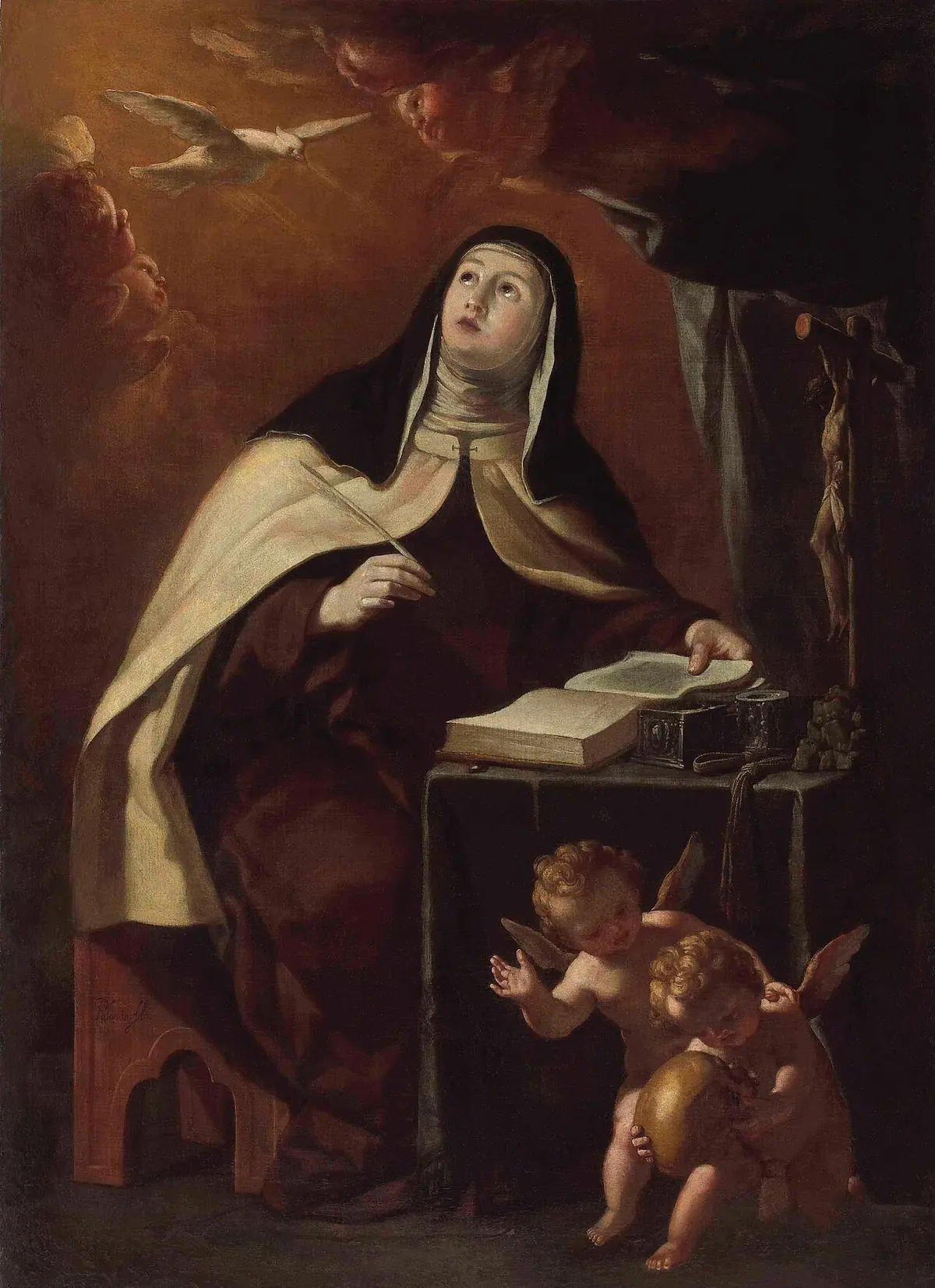
The Interior Castle is the one that lasted. Its structure is a single image: the soul as a castle of clear crystal with many rooms, and God in the innermost one, and a life spent moving inward through seven dwelling places. She writes in the voice of a woman explaining something to people she knows, with digressions, apologies for her poor memory, and sudden precision. It is a technical manual for interior prayer written by someone who assumed her readers would actually try it.
Alba de Tormes, 1582, and the Dividing of the Body
She died at Alba de Tormes on the night of 4 October 1582, at sixty-seven, worn out after a final journey. Her death sits on a calendrical seam: the Gregorian reform took effect the next morning, and the day after 4 October 1582 was 15 October. That is why her feast is kept on 15 October rather than on the anniversary of the night she died. What happened next is hard to read at this distance. Her body was exhumed several months later, found to be uncorrupted, and thereafter progressively divided. A hand went one way, an arm another, the heart stayed at Alba de Tormes, fingers and smaller fragments were distributed across Spain and beyond. Her left hand spent the middle of the twentieth century in the private possession of Francisco Franco, who kept it by his bedside, and it was returned to the Carmelites after his death in 1975. The cult of relics was doing exactly what it was designed to do, and the results are still unsettling.
Doctor of the Church, 1970
She was beatified in 1614 and canonised on 12 March 1622, in a ceremony that also raised Ignatius of Loyola, Francis Xavier, Isidore the Farmer and Philip Neri. Three of those five were Spanish, and two of them were the Jesuits with whom she shares this cluster of the Spanish saints. On 27 September 1970 Paul VI named her a Doctor of the Church, the first woman ever given the title. Catherine of Siena followed a week later. The decision was not a courtesy. It was a formal judgement that the Interior Castle is theology, and that a nun who apologised in her prologues for being an ignorant woman had in fact written something the Church needed.
Teresa of Avila Paintings Featured in This Article
| Painting | Artist | Date | Museum |
|---|---|---|---|
| The Vision of Saint Teresa of Avila | Peter Paul Rubens | 17th century | Museum Boijmans Van Beuningen, Rotterdam |
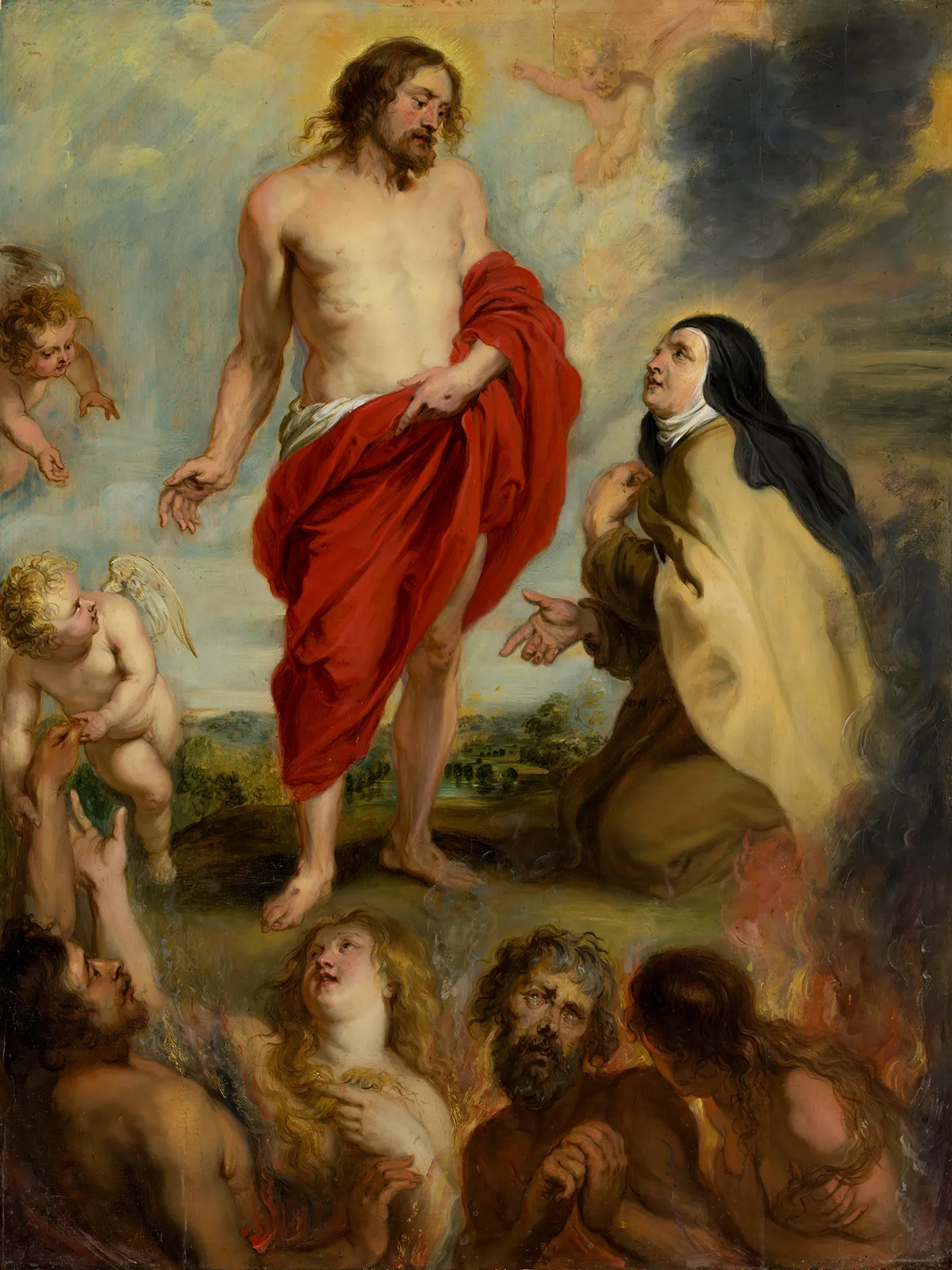
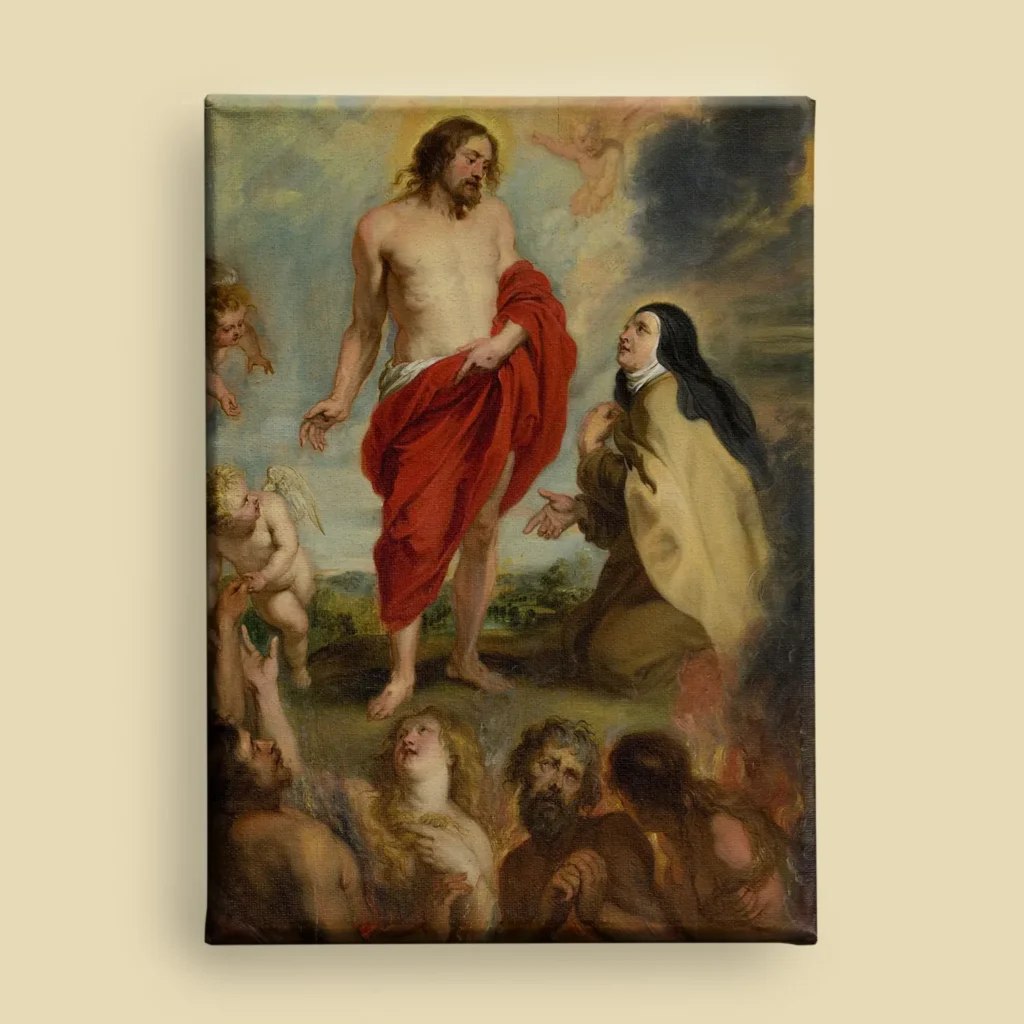
| Saint Teresa of Avila Interceding for Souls in Purgatory | Peter Paul Rubens | about 1630-1635 | The Metropolitan Museum of Art, New York |
| Santa Teresa de Jesus, after Fray Juan de la Miseria | Alfred Dehodencq | 1850-1860 | Casa Consistorial, Seville |
| The Ecstasy of Saint Teresa | Pompeo Batoni | about 1743 | Museo Nazionale di Villa Guinigi, Lucca |
| Santa Teresa de Jesus escribiendo | Antonio Palomino | about 1700 | Location not recorded |
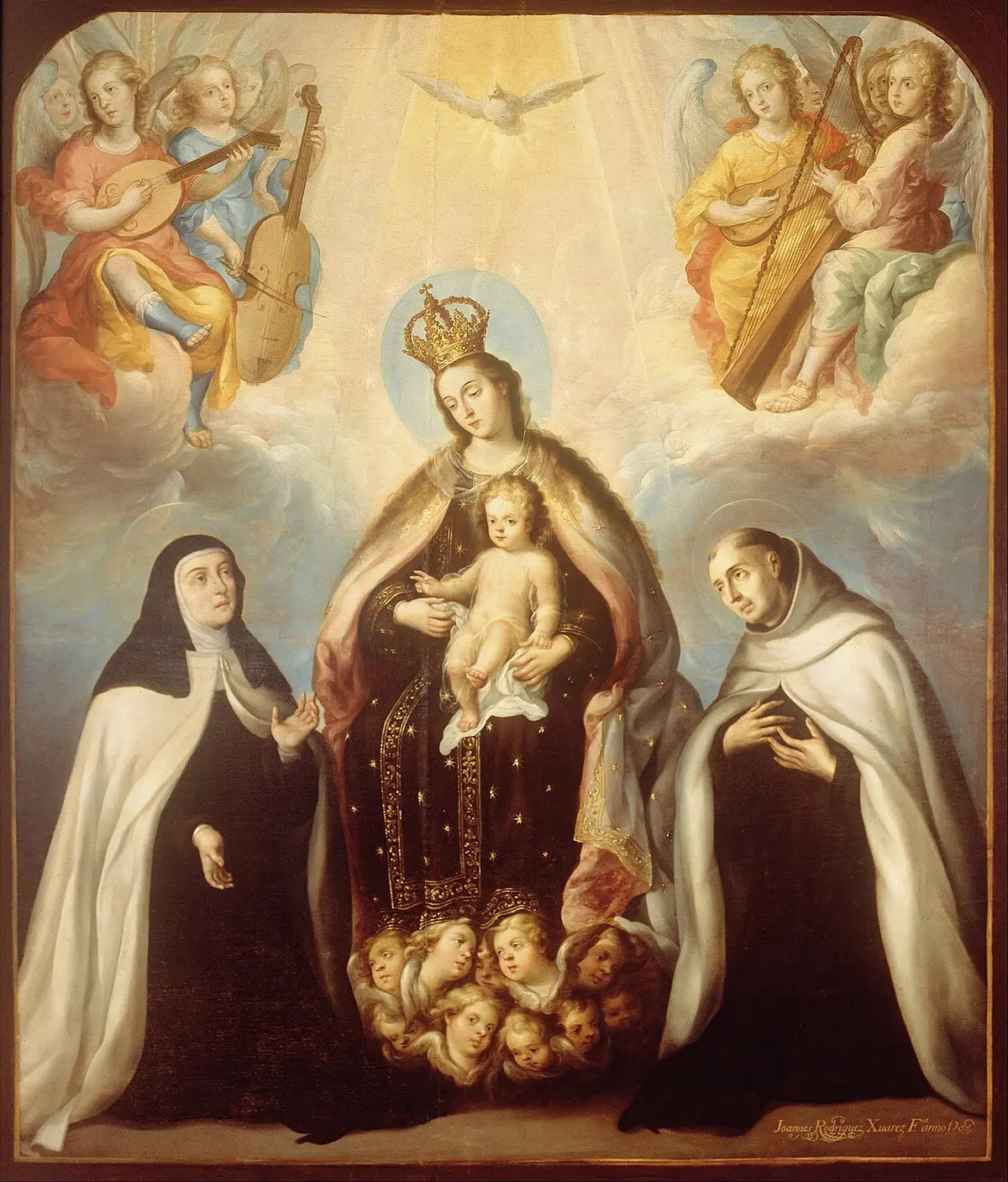
| The Virgin of Carmel with Saint Teresa and Saint John of the Cross | Juan Rodriguez Juarez | early 18th century | Museo Nacional de Arte, Mexico City |
Two Teresas, and Only One of Them Is Marble
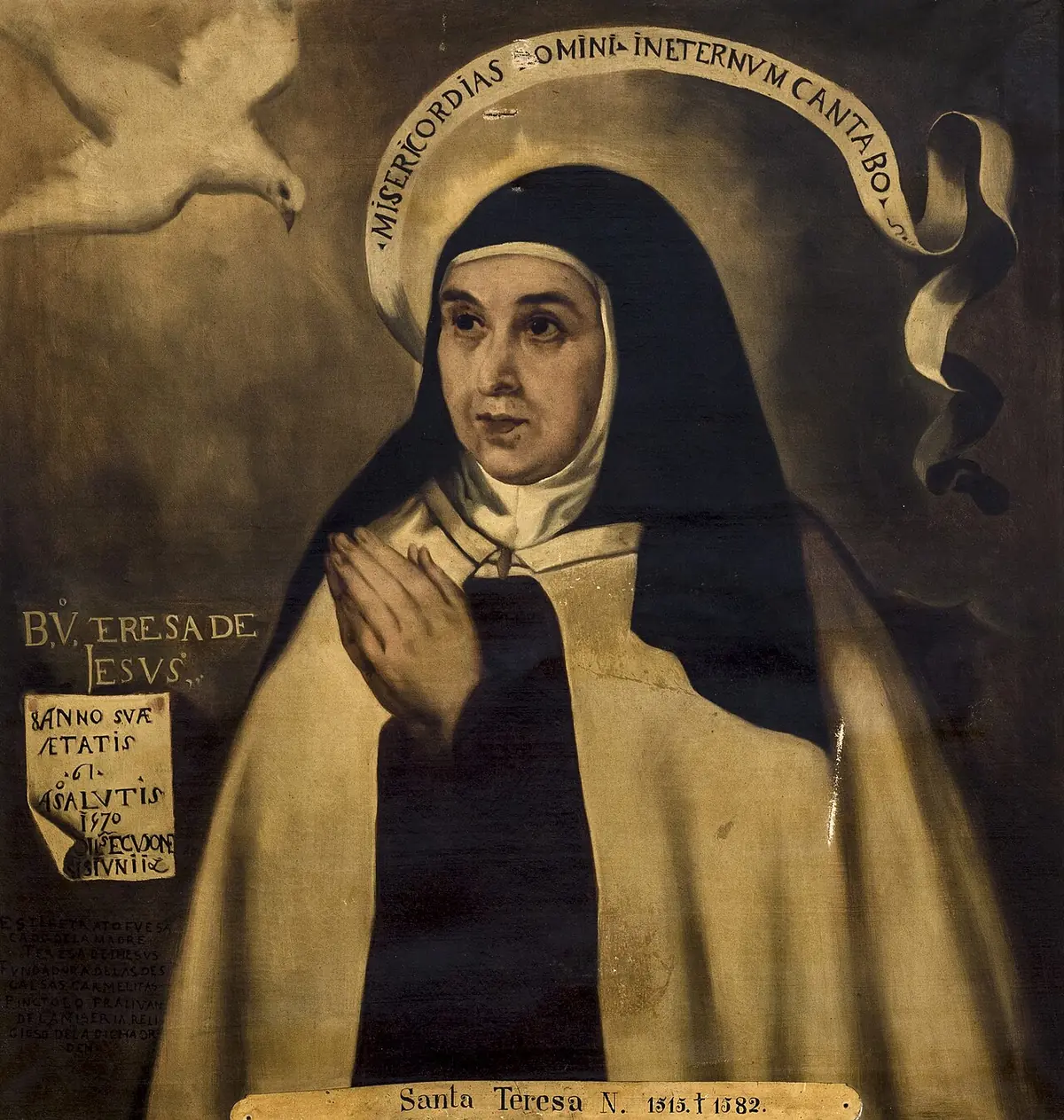
The mystic and the builder are the same woman, and the reason her writing still works is that she never pretended otherwise. The Interior Castle was written by someone who that same year was dealing with a kidnapped friar, a hostile provincial and a house in Seville she could not pay for. She moves between the seventh dwelling place and the price of bricks without changing her tone, because for her they were not different subjects. Bernini’s marble tells you what the seventeenth century wanted a female mystic to look like. The portrait Fray Juan de la Miseria painted from life in 1576, which Teresa herself thought unflattering, tells you something else: a heavy-featured woman of sixty-one with steady eyes, who by then had founded eleven convents and had six more to go.
Important Facts About Teresa of Avila
- Born: 28 March 1515, Avila, Castile. Her paternal grandfather was a Toledo converso reconciled by the Inquisition in 1485.
- Died: the night of 4 October 1582, Alba de Tormes, aged 67.
- Feast day: 15 October. The gap is caused by the Gregorian calendar reform, which took effect the morning after her death.
- Religious name: Teresa of Jesus. She entered the Carmelite convent of the Incarnation at Avila in 1535.
- Founded: the Discalced Carmelite reform, beginning with San Jose in Avila in 1562, and seventeen convents in twenty years.
- Wrote: the Life, the Way of Perfection, the Interior Castle (1577) and the Book of the Foundations, all under obedience to her confessors.
- Canonised: 12 March 1622, on the same day as Ignatius of Loyola and Francis Xavier.
- Doctor of the Church: 27 September 1970, the first woman to receive the title.
- Patron of: Spain, headache sufferers, people in need of grace, and lace makers.
Frequently Asked Questions
What was Saint Teresa of Avila known for?
For two things that are usually kept apart. She was a mystic who described interior prayer more precisely than almost anyone before her, above all in the Interior Castle. She was also the founder and administrator of the Discalced Carmelite reform, who established seventeen convents across Spain between 1562 and 1582 and handled the deeds, the lawsuits and the finances herself. The visions made her famous. The foundations are why the reform survived her.
Why was John of the Cross imprisoned, and what did Teresa have to do with it?
Teresa recruited him in 1567 to extend her reform to the Carmelite friars. The order split over it, and in December 1577 friars of the unreformed observance seized John of the Cross and held him in a cell in Toledo for nine months with regular floggings. He escaped in August 1578 and had written the first stanzas of the Spiritual Canticle while imprisoned. Teresa spent those months lobbying anyone who might intervene.
What disease did Teresa of Avila have?
Nobody knows. In 1538 and 1539 she suffered an illness that left her unconscious for several days, apparently dead, and then largely paralysed for around three years, and she was never in reliable health afterwards. Malaria, epilepsy and various neurological conditions have all been proposed. None can be verified from a sixteenth century account written by the patient, and confident retrospective diagnoses of Teresa should be treated with caution.
What is the famous quote of Saint Teresa of Avila?
The best known is the short poem found in her breviary after her death, which begins Nada te turbe, nada te espante: let nothing trouble you, let nothing frighten you, everything passes, God does not change, patience obtains all things, whoever has God lacks nothing, God alone is enough. It is often printed as Teresa’s bookmark.
Where is the hand of Saint Teresa of Avila?
Her body was exhumed after her death, found uncorrupted, and divided into relics that were distributed across Spain and beyond. Her heart remains at Alba de Tormes. Her left hand was held privately by Francisco Franco for much of the twentieth century and was returned to the Carmelites after his death in 1975. It is now kept at Ronda, in Andalusia.
Why is Teresa of Avila a Doctor of the Church?
Paul VI declared her a Doctor of the Church on 27 September 1970, the first woman to be named one in the history of the title. The judgement rests on her writing, particularly the Interior Castle, which is treated as a work of theology rather than devotion: a systematic account of the stages of interior prayer, written by someone who had made the journey and could describe the route.
What did Bernini’s Ecstasy of Saint Teresa actually depict?
The transverberation, an episode Teresa described in a single short passage of her Life, in which an angel pierced her heart with a golden dart tipped with fire. Bernini carved it for the Cornaro Chapel in Santa Maria della Vittoria, Rome, in the 1640s, more than sixty years after her death. It is the most famous image of her and it is an interpretation, made in Rome for a Venetian patron, not a portrait.
Can you buy Teresa of Avila paintings?
You can buy Teresa of Avila paintings at jesuschrist.pictures, in our shop, alongside the wider Spanish Golden Age collection. The works associated with her come mostly from the Baroque, when the Counter-Reformation put Spanish mystics at the centre of religious painting, and the same period produced the artists in our Rubens, Murillo, El Greco and Zurbaran collections. If you are drawn to Teresa specifically, the Rubens paintings above are the place to start, and our female saints in art and Spanish Baroque selections extend the theme. You can also browse the wider saints pages, or read about the Christ of Saint John of the Cross, the painting Dali built from a drawing by Teresa’s closest collaborator.