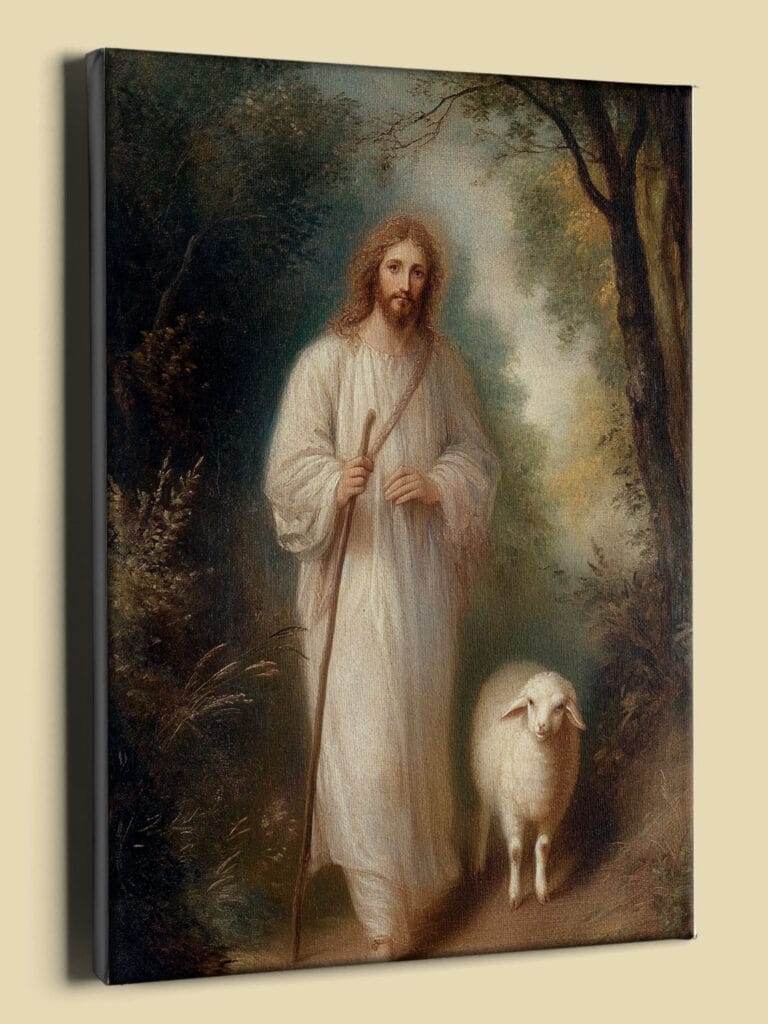
Jesus and the Lamb: 7 Good Shepherd Paintings of Christ and His Sheep
The Good Shepherd is one of the oldest and most beloved images in Christian art, and among the very first icons of Christ ever made. It is the tender picture of Jesus and the lamb that so many people know and love, Christ the shepherd holding a lamb in his arms or carrying the lost sheep home on his shoulders. It comes from the Gospel of John, where Christ says, “I am the good shepherd. The good shepherd lays down his life for the sheep.” The picture it calls up, a shepherd who carries the lost lamb home on his shoulders and stands between the flock and every danger, was so tender and so clear that early Christians painted it on the walls of the catacombs long before they dared to show the Cross. Its roots reach back further still, to the twenty-third Psalm and its promise, the Lord is my shepherd. For seventeen centuries painters have returned to the theme, and the seven works below trace its long journey. It begins in a glowing fifth century mosaic, passes through the tender Spanish Baroque of Murillo and the calm French classicism of Champaigne, and arrives at the quiet, modern dusk of Henry Ossawa Tanner. Along the way the shepherd changes from a beardless youth to a grown man in a shining robe, but the meaning holds: a love that goes out to find the one sheep that is lost.
Jesus and the Lamb: Why Christ Is Shown Carrying a Sheep
Almost every image in this gathering turns on a single gesture, the one most people picture when they think of Jesus and the lamb: Christ the shepherd with a sheep held close, either cradled in his arms like Murillo’s Christ Child or carried across the shoulders like the figures of Champaigne, López and Plockhorst. The pose is very old. It goes back to an ancient Greek statue type, the Kriophoros or ram bearer, which the first Christians borrowed to show the Saviour who carries the weak to safety.
The meaning comes straight from the Gospel. In the parable of the lost sheep, Christ leaves the ninety-nine to search for the one that has strayed and brings it home rejoicing. That is why paintings of Jesus with lambs feel so tender: the sheep is the soul in danger, and the shepherd is the God who goes out to find it rather than waiting for its return. From a gold mosaic in Ravenna to a quiet English field, the works below all say the same thing about a mercy that reaches down and lifts the lost.
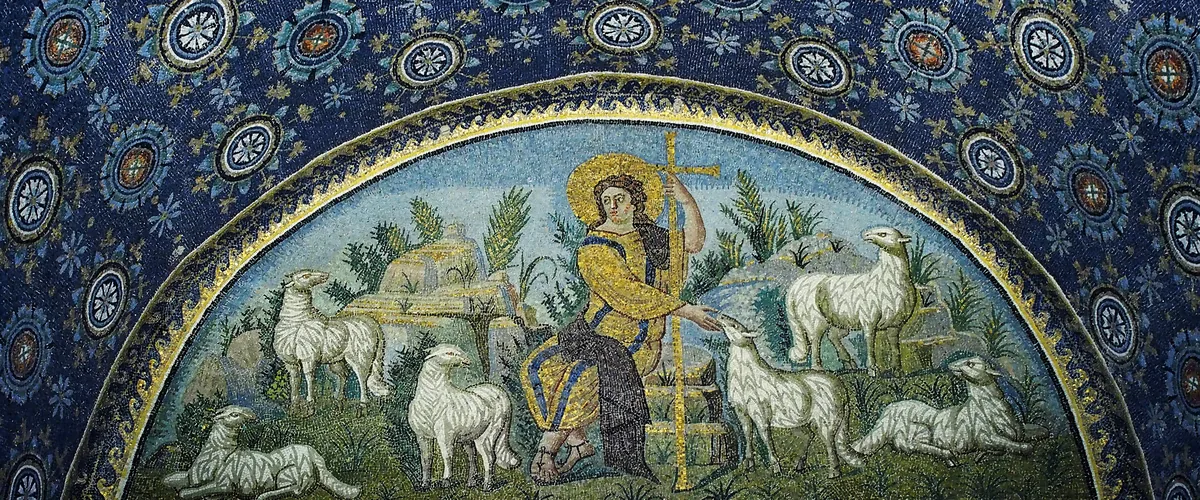
1. The Good Shepherd mosaic, Ravenna (c. 425)
The oldest and most famous early image of the subject glitters on the wall of a small tomb in Ravenna. In the Mausoleum of Galla Placidia, a young, beardless Christ sits among six white sheep on a hillside of gold, a long golden cross resting on his shoulder as he reaches out to touch one of the flock. There is no violence and no suffering here, only calm majesty and care.
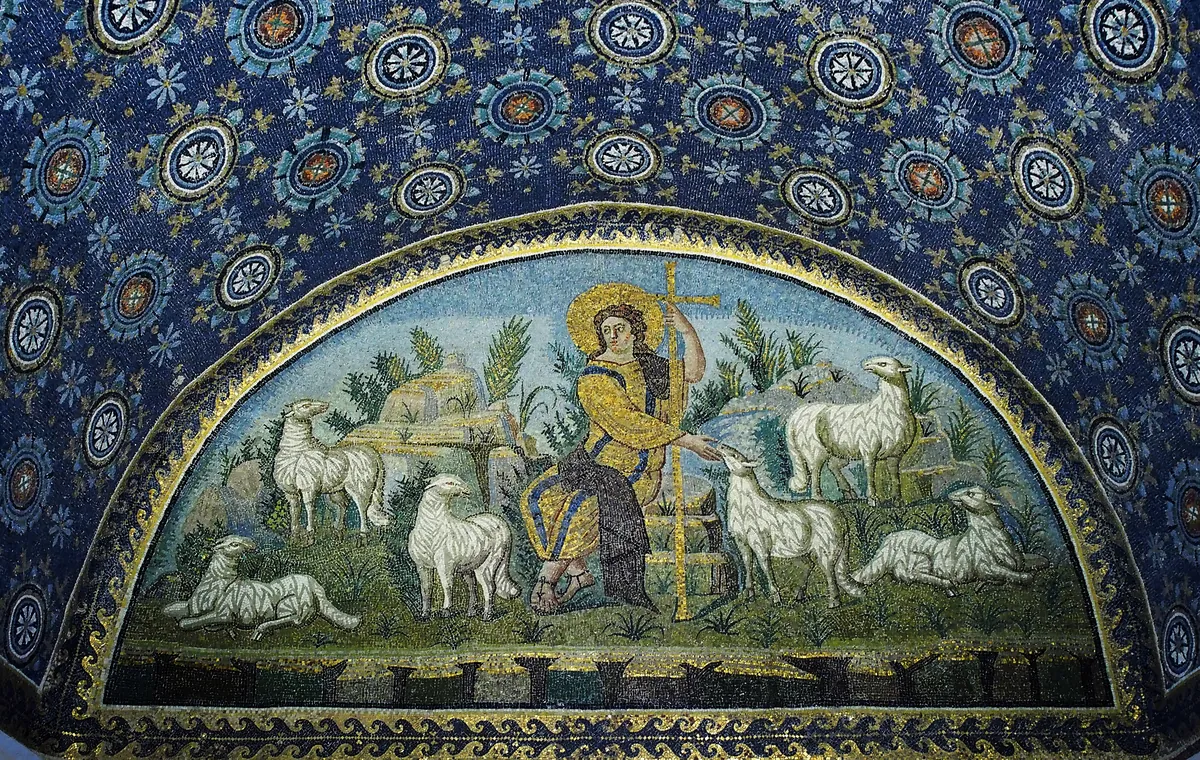
Set against a deep blue sky scattered with stars, the mosaic turns the humble shepherd into a king. It belongs to the world of early Christian and Byzantine art, and it fixed the iconography of the Good Shepherd for centuries to come, showing Christ not on the Cross but as the gentle guardian of souls. The same image had already appeared in the Roman catacombs of the third century, which makes the Good Shepherd one of the earliest icons of Christ in existence. Fifteen hundred years later the mosaic still shines, one of the great treasures of Ravenna.
2. The Good Shepherd by Murillo (c. 1660)
The most famous painting of the subject is by the Spanish master Bartolomé Esteban Murillo, and it takes a surprising form. His Good Shepherd is not a grown man but the Christ Child, a curly haired boy who sits among broken classical columns, a shepherd’s crook in one hand and the other resting gently on a lamb. He looks straight out at the viewer with large, dark, trusting eyes.
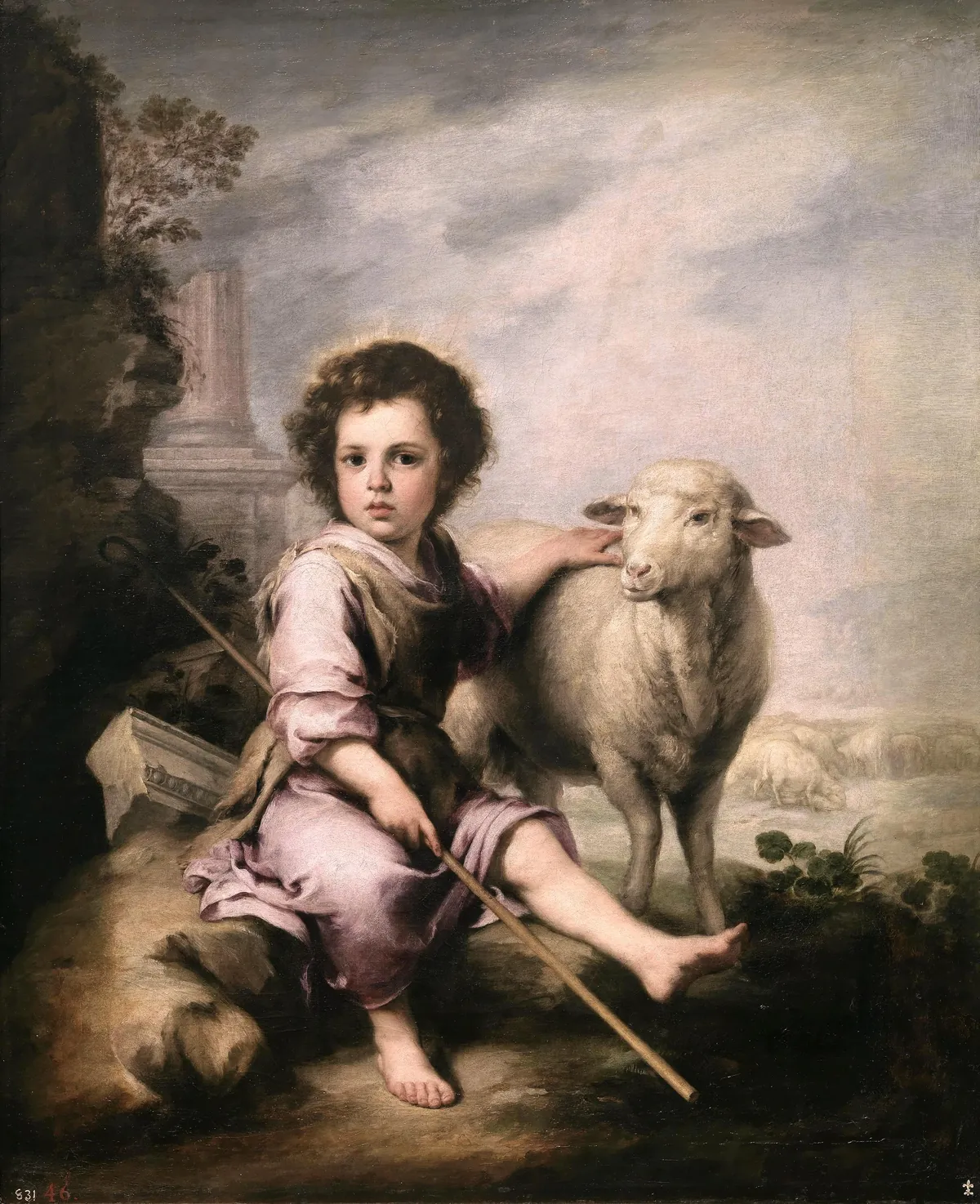
Murillo combined two ideas dear to Spanish devotion, the sweetness of the holy child and the promise of the Good Shepherd, and the ruins behind allude to the fall of the pagan world. Painted with his famous soft warmth, it became one of the most loved religious images in Spain. It hangs in the Museo del Prado in Madrid, alongside his tender Immaculate Conception.
3. The Good Shepherd, attributed to Philippe de Champaigne (17th century)
This calm and stately picture shows the grown Christ as shepherd, striding through a wide landscape with a rescued sheep carried across his shoulders and another at his side. Dressed in a white tunic and a deep blue cloak, he is dignified and serene, the very image of the shepherd who has found what was lost and carries it safely home.
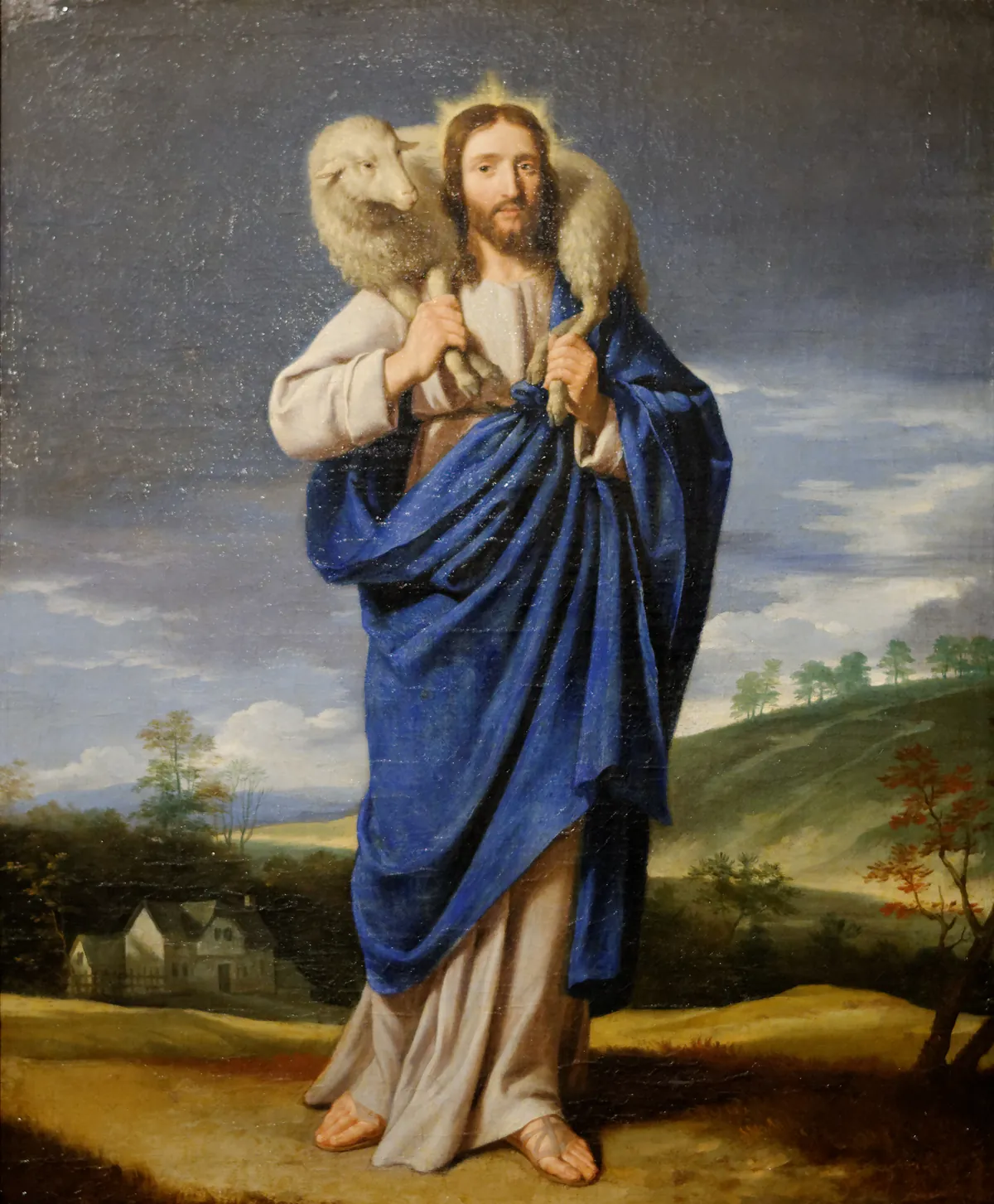
The painting is attributed to Philippe de Champaigne, the great painter of French classicism and of the austere spirituality of Jansenism. Its clear light and quiet gravity are very much in his manner. It is kept in the Musée des Ursulines in Mâcon, in eastern France.
4. The Good Shepherd by Vicente López Portaña (1800)
Two centuries after Murillo, another Spanish painter took up the theme. Vicente López Portaña, court painter in Madrid, shows Christ at half length, carrying a sheep around his shoulders in the age old pose known as the Good Shepherd, or in Greek the Kriophoros, the ram bearer. His face is grave and gentle, framed by long hair, and the animal rests trustingly against him.
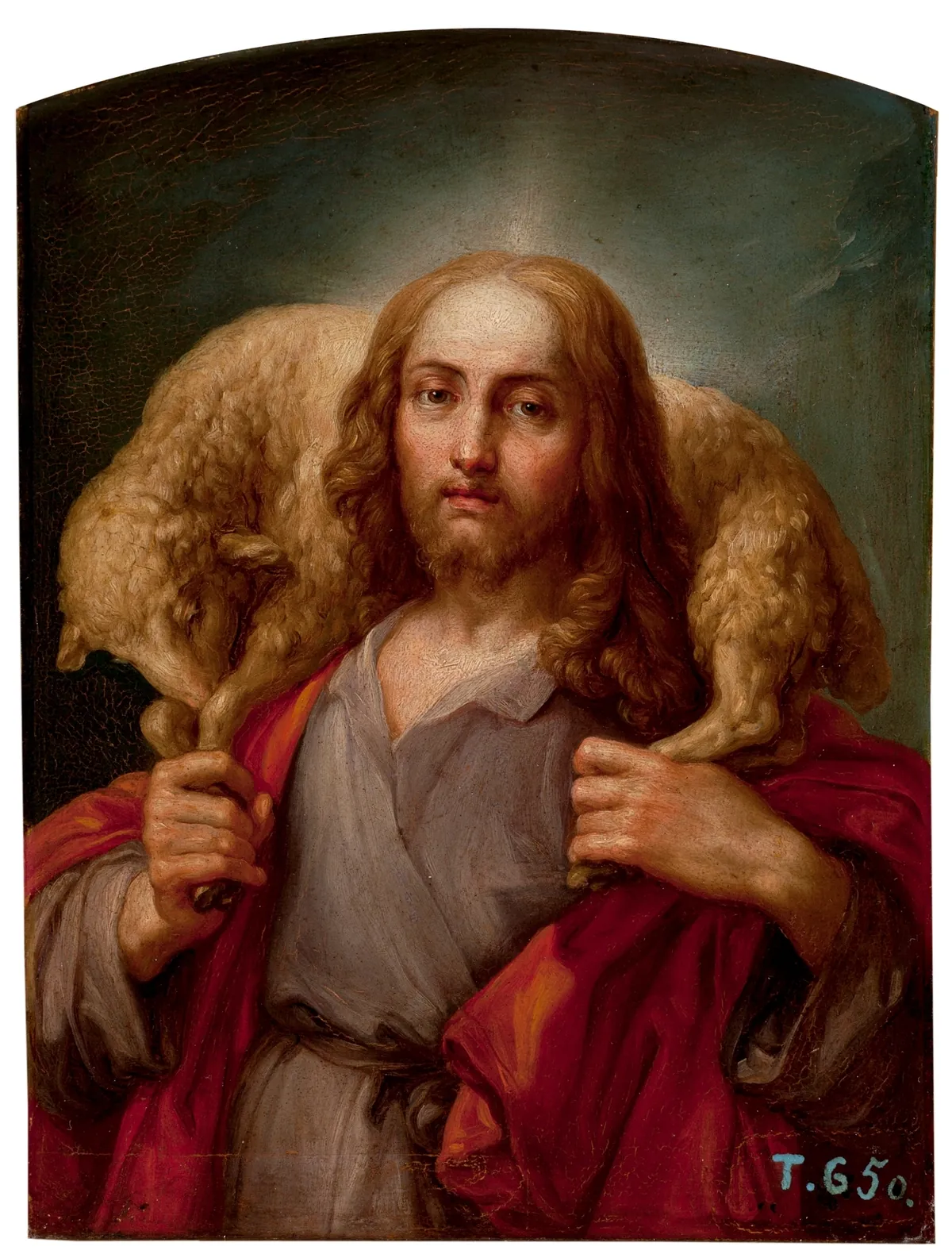
López was famous above all as a portraitist, and he gives Christ the solid, dignified presence of a portrait sitter. The result is intimate and direct, the sacred subject brought close. Like Murillo’s version, the painting belongs to the Museo del Prado in Madrid.
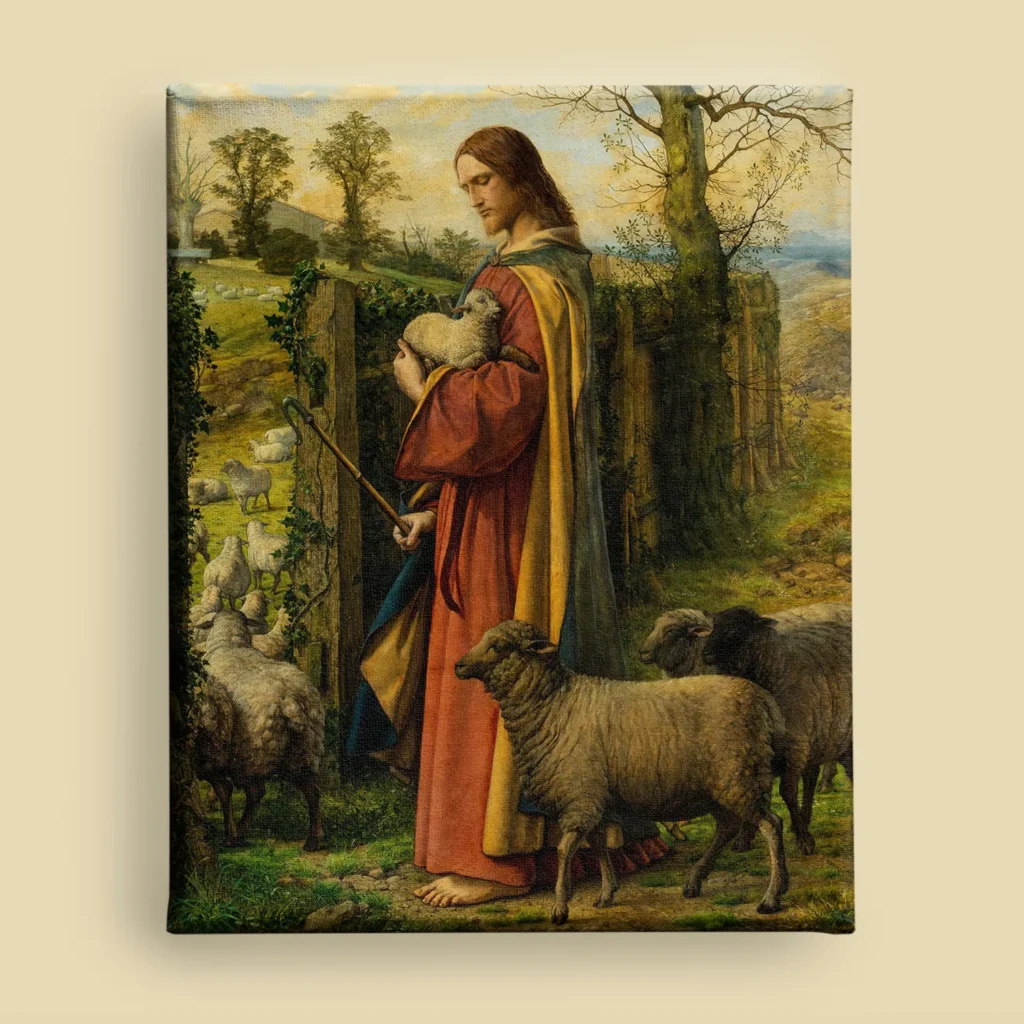
5. The Good Shepherd by William Dyce (c. 1856)
The Scottish painter William Dyce brought the sharp eyed realism of the Pre-Raphaelites to the subject. His Christ carries a lamb in the crook of his arm as he steps through a gap in a wattle fence, sheep gathered around his feet, in a landscape painted leaf by leaf with almost photographic care. Every blade of grass and strand of wool is observed.
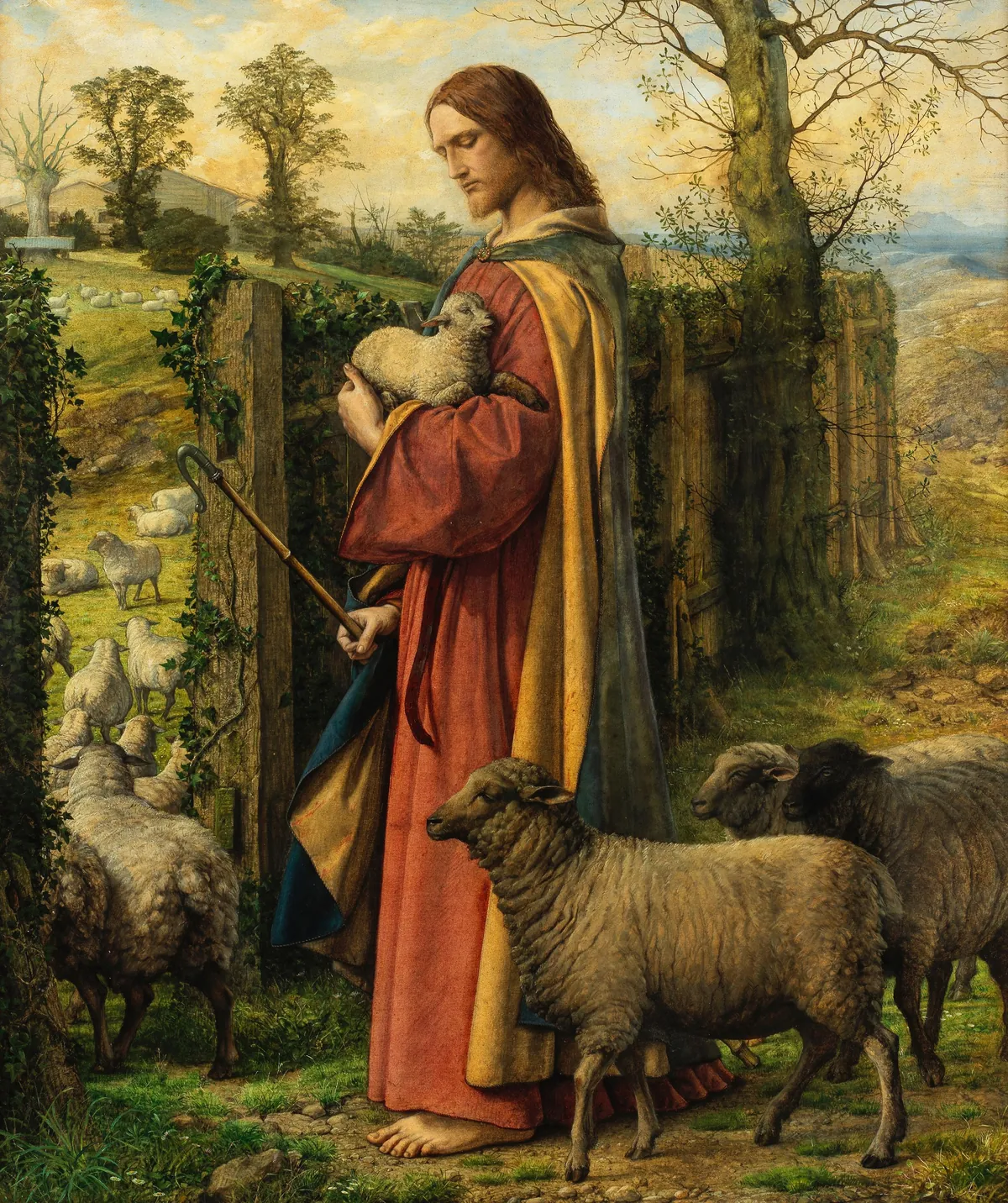
Dyce was a devout man and a close friend of the Pre-Raphaelite circle, and he set the ancient image in a real, tangible countryside. The effect is to make the parable feel present and true, as if the shepherd had just walked out of an English field. The painting is held in a private collection.
6. The Good Shepherd by Bernhard Plockhorst (c. 1880s)
No modern image of the Good Shepherd has travelled further than this one. The German painter Bernhard Plockhorst shows Christ in a white and crimson robe carrying a lamb in his arms and holding a shepherd’s crook, leading his flock over rough, rocky ground beneath a bright sky. It is warm, clear, and instantly readable.
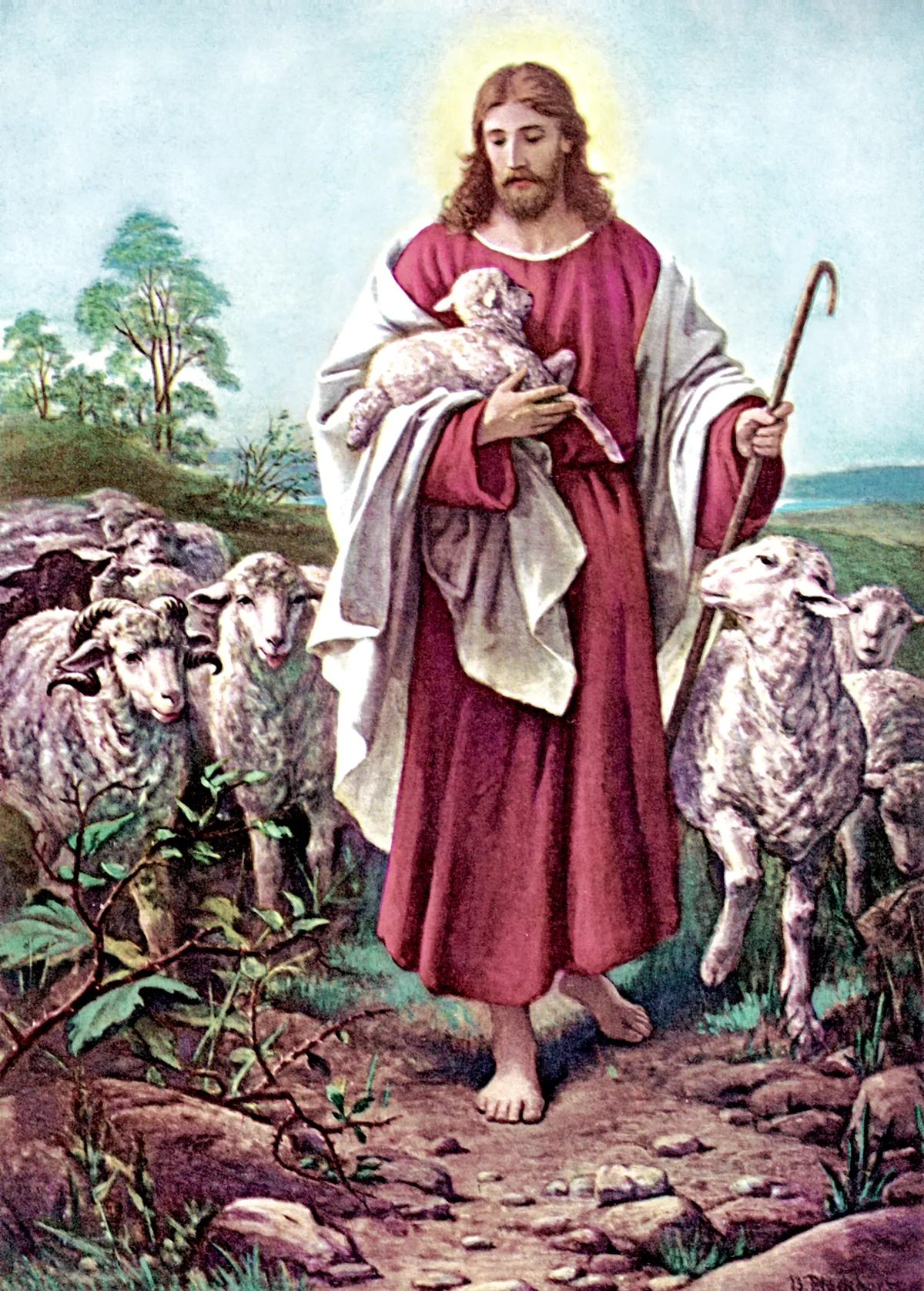
Plockhorst was one of the most reproduced religious painters of the nineteenth century, and this image, printed in countless Bibles, cards, and church halls, shaped how millions of people picture the Good Shepherd. Sentimental to some eyes and deeply comforting to others, it remains a classic of popular devotion.
7. The Good Shepherd by Henry Ossawa Tanner (1918)
The series ends in a very different mood. The American painter Henry Ossawa Tanner, the most celebrated African American artist of his day, painted the Good Shepherd not as a bright icon but as a hushed nocturne. A tiny shepherd and his flock move through the deep blue dusk beneath the dark mass of a great tree, almost dissolved in atmosphere and shadow.
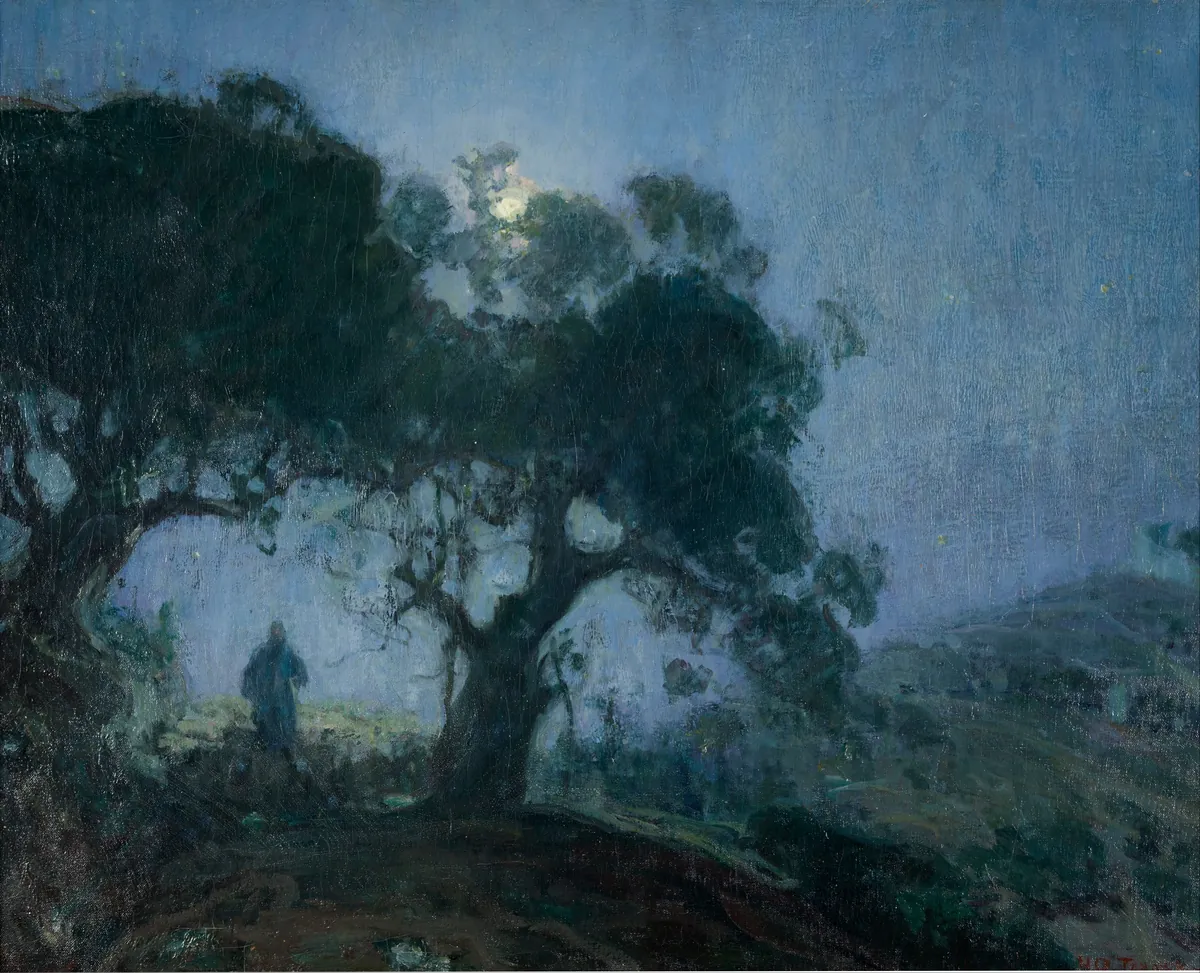
Tanner filled his late religious works with these glowing, mysterious blues, learned in France and in his travels to the Holy Land. Here the Good Shepherd is less a portrait than a feeling, the sense of a quiet presence watching over the flock in the dark. The painting belongs to the Zimmerli Art Museum at Rutgers University.
Summary of the Works
| Work | Artist | Date | Medium | Location |
|---|---|---|---|---|
| The Good Shepherd | Early Christian mosaic | c. 425 | Mosaic | Mausoleum of Galla Placidia, Ravenna |
| The Good Shepherd | Bartolomé Esteban Murillo | c. 1660 | Oil on canvas | Museo del Prado, Madrid |
| The Good Shepherd | Attributed to Philippe de Champaigne | 17th century | Oil on canvas | Musée des Ursulines, Mâcon |
| The Good Shepherd | Vicente López Portaña | 1800 | Oil on canvas | Museo del Prado, Madrid |
| The Good Shepherd | William Dyce | c. 1856 | Oil on canvas | Private collection |
| The Good Shepherd | Bernhard Plockhorst | c. 1880s | Oil on canvas | Widely reproduced |
| The Good Shepherd | Henry Ossawa Tanner | 1918 | Oil on canvas | Zimmerli Art Museum, Rutgers |
The Good Shepherd is one of countless subjects the masters drew from Scripture; discover more in our guide to biblical paintings.
Conclusion
From a gold mosaic in a fifth century tomb to a blue nocturne painted during the First World War, the Good Shepherd has never lost its hold on Christian imagination. Murillo made him a trusting child, Champaigne and López a grave and gentle man, Dyce a figure in a real English field, Plockhorst a comforting icon, and Tanner a presence half hidden in the dark. Each speaks to a different age, yet all return to the same few gestures: the carried lamb, the guarded flock, the search for the one that strayed. That is the heart of the image, and the reason it endures. It shows a God who does not wait for the lost to return but goes out to find them, and who lays down his life for the sheep. For the birth that the shepherds were first to witness, see our gathering of famous Nativity paintings, and for the sacrifice at the centre of that promise, our survey of famous Crucifixion paintings.
Important Facts About the Good Shepherd in Art
- The image comes from the Gospel of John, chapter 10, where Jesus says, “I am the good shepherd,” and from the wider biblical picture of God as the shepherd of his people, as in Psalm 23.
- The Good Shepherd was one of the very first images of Christ in art, painted in the Roman catacombs from the third century, long before the Crucifixion became common.
- The pose of Christ carrying a sheep on his shoulders derives from an ancient Greek figure type, the Kriophoros or ram bearer, adapted by early Christians.
- The mosaic in the Mausoleum of Galla Placidia in Ravenna, of about 425, is the most famous early depiction, showing a youthful, beardless Christ enthroned among his sheep.
- Murillo’s Good Shepherd of about 1660, in the Prado, is the most celebrated painting of the theme, unusual for showing the shepherd as the Christ Child.
Questions and Answers
What is the most famous Good Shepherd painting?
The best known painting is The Good Shepherd by Bartolomé Esteban Murillo, made around 1660 and now in the Prado in Madrid, which shows the shepherd as a gentle Christ Child with a lamb. Among earlier images the most famous is the fifth century mosaic in the Mausoleum of Galla Placidia in Ravenna. Later painters such as Philippe de Champaigne, William Dyce, Bernhard Plockhorst, and Henry Ossawa Tanner each left memorable versions of their own.
Why is Jesus called the Good Shepherd?
The title comes from the Gospel of John, where Jesus says, “I am the good shepherd. The good shepherd lays down his life for the sheep.” He contrasts himself with the hired hand who runs away when the wolf comes, and describes a shepherd who knows each of his sheep by name and would give his life to protect them. The image draws on a long biblical tradition, above all Psalm 23, that pictures God as the shepherd of his people.
What is the oldest image of the Good Shepherd?
The Good Shepherd was one of the earliest ways Christians pictured Christ, appearing in the Roman catacombs as early as the third century, when a figure carrying a sheep on his shoulders stood for the Saviour who rescues the soul. The most famous early example that survives in full colour is the mosaic of about 425 in the Mausoleum of Galla Placidia in Ravenna. These images come from a time before the Crucifixion became the central symbol of the faith.
What does the Good Shepherd carrying a lamb mean?
It illustrates the parable of the lost sheep, in which the shepherd leaves the ninety-nine to search for the one that has strayed and carries it home rejoicing on his shoulders. For Christians the lamb is the sinner or the endangered soul, and the shepherd is Christ, who seeks out the lost rather than waiting for their return. The pose expresses both tenderness and rescue, care carried to the point of sacrifice.
Where is Murillo’s Good Shepherd painting?
Murillo’s The Good Shepherd hangs in the Museo del Prado in Madrid, which holds one of the world’s great collections of his work. The Prado also owns a second Good Shepherd on the same theme by the later Spanish painter Vicente López. Other famous versions are spread more widely, from the mosaic in Ravenna to the Zimmerli Art Museum in the United States, which holds Tanner’s nocturne.
What is the painting of Jesus holding a lamb called?
A painting of Jesus holding or carrying a lamb is usually called the Good Shepherd, after the words of Christ in the Gospel of John. The pose, with a sheep cradled in the arms or slung across the shoulders, also has a formal name, the Kriophoros or ram bearer, taken from ancient Greek art. Famous examples include Murillo’s Christ Child resting a hand on a lamb, William Dyce’s shepherd carrying a lamb through a gap in a fence, and Bernhard Plockhorst’s widely reproduced image of Christ bearing a lamb over rocky ground.
Who painted Jesus and the lamb?
Many masters painted Jesus with the lamb. Among the best known are Bartolomé Esteban Murillo, whose Good Shepherd shows the Christ Child with a lamb, Vicente López and the painter of the Champaigne Good Shepherd, who both show Christ carrying a sheep across his shoulders, William Dyce in his Pre-Raphaelite version, and Bernhard Plockhorst, whose Jesus with a lamb became one of the most reproduced religious images of the nineteenth century.
What does a painting of Jesus and the lamb mean?
It stands for the love of Christ for every soul, told through the parable of the lost sheep. The lamb in his arms is the one that strayed and was carried home, so the picture is about mercy and rescue rather than judgement. In a wider sense the lamb is also a sign of Christ himself, the Lamb of God, gentle and given up for others, which is why the image feels at once protective and tender.
Can you buy Good Shepherd paintings as canvas prints?
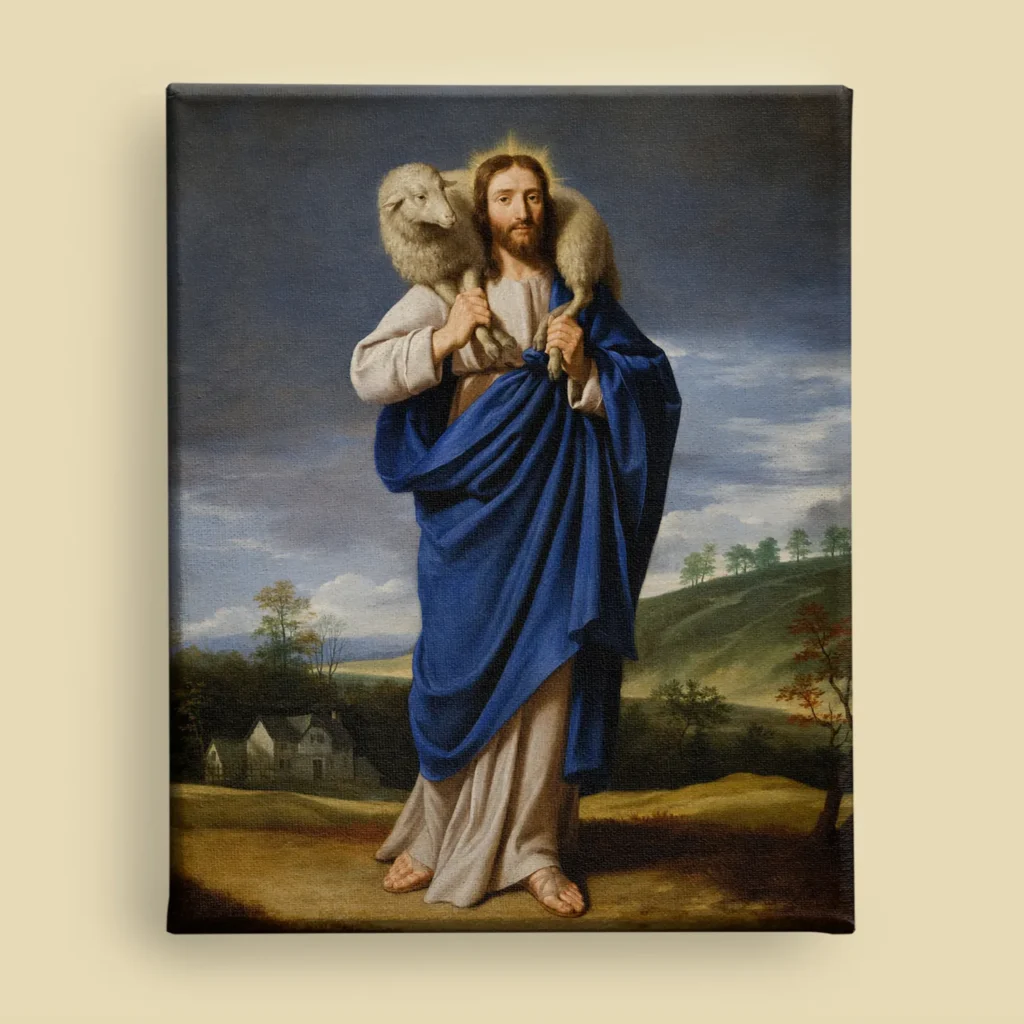
You can buy Good Shepherd paintings at jesuschrist.pictures, in our shop, where these classic works are offered as high quality canvas prints, including our own Jesus the Good Shepherd canvas. Because the image is so gentle and so loved, a faithful reproduction of Murillo’s child shepherd or Plockhorst’s comforting icon makes a warm gift for a home, a nursery, or a church. Browse our collection of Christian art reproductions on canvas to find a piece that speaks to you.