Raphael’s Transfiguration: His Final Masterpiece
The Transfiguration is the last painting by Raphael, one of the supreme masters of the Italian High Renaissance. Begun around 1516 and left unfinished at his death in 1520, it shows two moments from the Gospels in a single tall panel, the glory of Christ above and a scene of human helplessness below. The painting is in the Pinacoteca Vaticana, Vatican Museums. Its medium is oil on wood panel.
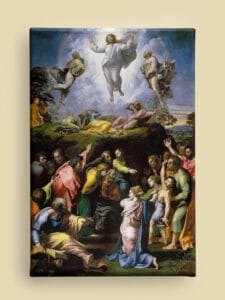
The image divides into two worlds. At the top, Christ floats in a blaze of white light, his arms open, lifted above the mountain between the prophets Moses and Elijah. Below, in shadow and confusion, the apostles struggle with a possessed boy they cannot heal. The contrast between the calm of heaven and the turmoil of earth is the heart of the work.
What gives the Transfiguration its weight is that Raphael did not live to finish it. He died at thirty-seven, and the panel was placed above his body as he lay in state. It became at once his final statement and a kind of farewell, admired from the moment it was unveiled.
Raphael had already given the age some of its most serene religious images. Readers who want to see more can read our overview of Raphael’s paintings or our article on his gentle Alba Madonna.
The History of the Transfiguration
The Transfiguration was commissioned around 1516 by Cardinal Giulio de Medici, the future Pope Clement VII, for the cathedral of Narbonne in France. The cardinal ordered two large paintings at once and set up a quiet contest. The Transfiguration went to Raphael, while the Raising of Lazarus, now in the National Gallery in London, went to Sebastiano del Piombo, who worked with designs from Michelangelo.

Raphael worked on the panel during his last years, while also running a vast workshop in Rome. When he died suddenly in 1520, the upper part was largely complete, but the lower scene was still unfinished. His pupils, above all Giulio Romano, brought it to completion soon after. Rather than send it to France, the cardinal kept the painting in Rome, and it eventually entered the Vatican collections.
The Vatican Museums note that the work was conceived as the pair to Sebastiano del Piombo’s Raising of Lazarus. Seen together, the two commissions show the rivalry between Raphael’s manner and the more muscular style associated with Michelangelo, a tension that shaped the next generation of painters.
The Meaning and the Two Scenes
The upper scene shows the Transfiguration described in the Gospel of Matthew. Christ takes Peter, James, and John up a mountain, and there his face and clothing turn radiant with light. Moses and Elijah appear beside him, and a voice from the cloud names him the Son of God. The three apostles fall back, dazzled, unable to look.

Raphael shows Christ not standing but rising, weightless, as if lifted by the light itself. The white robes, the open arms, and the bright cloud set him entirely apart from the world below. It is one of the clearest images of divine glory in Renaissance art.
The Lower Scene: The Possessed Boy
Beneath the mountain a very different drama unfolds. While Christ is transfigured above, the remaining apostles are trying, and failing, to free a boy from an evil spirit. The boy twists, his eyes rolled upward, his body rigid. The disciples gesture in confusion, and a kneeling woman turns to point from one group to the other.

The two scenes belong together. The apostles cannot heal the child by themselves. Their only hope is the Christ who shines on the mountain above. The woman at the center, often praised as one of Raphael’s most beautiful figures, links the earthly need below to the divine answer above.
Light, Color, and Raphael’s Design
The whole panel is built on contrast. The upper half is bright, open, and weightless. The lower half is crowded, dark, and full of strained movement. Raphael binds them with gesture and gaze, so that the eye is carried up from the chaos of earth to the calm of heaven.
This drama of light and shadow pushes beyond the gentle balance of Raphael’s earlier work. The strong emotion, the bold contrasts, and the twisting figures point ahead to the art of the Baroque. In his final painting Raphael was already opening a new door.
Raphael’s Bridge to the Baroque
The Transfiguration gathers everything Raphael had learned into one ambitious image. It joins two Gospel moments, two moods, and two ways of painting, and holds them in a single design. Few artists end their careers on so complete a statement.
It is also a turning point. Coming at the close of the High Renaissance, it carries the serenity of that age and the first signs of what would follow. That is why it has been counted, for centuries, among the greatest paintings in the world.
Conclusion
In the Transfiguration Raphael set the light of heaven against the trouble of earth and bound them into one unforgettable image. Christ rises in glory, the boy convulses below, and the whole panel reaches upward toward the answer in the light.
Left unfinished at his death and laid above his body, the painting became both his farewell and his triumph. It remains the final, and perhaps the fullest, expression of Raphael’s art.
Artwork Information
| Artwork | Artist | Date | Medium | Current Location |
|---|---|---|---|---|
| The Transfiguration | Raphael | 1516 to 1520 | Oil on wood panel | Pinacoteca Vaticana, Vatican Museums |
Five Facts About the Transfiguration
- The Transfiguration is the last painting by Raphael, left unfinished at his death in 1520.
- It was commissioned around 1516 by Cardinal Giulio de Medici, later Pope Clement VII, for Narbonne Cathedral.
- It is oil on wood panel, about 4.1 by 2.8 meters, now in the Pinacoteca Vaticana of the Vatican Museums.
- The painting joins two Gospel scenes: Christ transfigured in glory above, and the apostles failing to heal a possessed boy below.
- It was placed above Raphael’s body at his funeral and finished by his pupils, including Giulio Romano.
FAQ
What is the meaning of Raphael’s Transfiguration?
The painting sets the glory of Christ against human weakness. Christ shines in light above, while below the apostles cannot heal a possessed boy without him. The message is that the answer to earthly suffering lies in the divine Christ above.
Where is Raphael’s Transfiguration?
The Transfiguration is in the Pinacoteca Vaticana, part of the Vatican Museums in Rome.
When did Raphael paint the Transfiguration?
He worked on it from about 1516 until his death in 1520, which left the lower part to be finished by his pupils.
Was the Transfiguration Raphael’s last painting?
Yes. It is considered his final work, unfinished when he died at the age of thirty-seven, and it was displayed above his body as he lay in state.
What is happening in the lower part of the Transfiguration?
The apostles are trying to free a boy from an evil spirit and cannot do it on their own. They point toward the transfigured Christ above, the only one able to heal him.
What is the medium of the Transfiguration?
It is oil on a wood panel, a very large altarpiece about 4.1 meters tall.
Why is the Transfiguration important?
It is Raphael’s final masterpiece and one of the most admired paintings of the Renaissance. Its bold contrasts of light and emotion also point ahead to the drama of Baroque art.
Where can I buy Raphael’s Transfiguration as a canvas print?
You can buy Raphael’s Transfiguration as a canvas print at jesuschrist.pictures: see the canvas reproduction in our shop, printed on museum-grade canvas and available in several sizes.


