Archangel Remiel: The Angel Who Wakes the Dead
Archangel Remiel has the strangest job description in the whole of angelic literature. The Book of Enoch says that God set him over those who rise. Not over armies, or messages, or healing, but over the dead at the moment they come back. He is the angel of hope in the most literal sense available: the one who is waiting on the other side of it. He also has a problem. The same book that makes him a holy archangel names a Ramiel among the chiefs of the Watchers, the angels who fell. Search his name today and Google’s own knowledge panel will tell you he is a fallen angel, while Wikipedia’s article calls him the archangel of hope. Both are quoting the Book of Enoch. This article sorts that out, because it is the single most confused thing about him, and then follows what the tradition actually gives him to do.
Two Names, Two Meanings
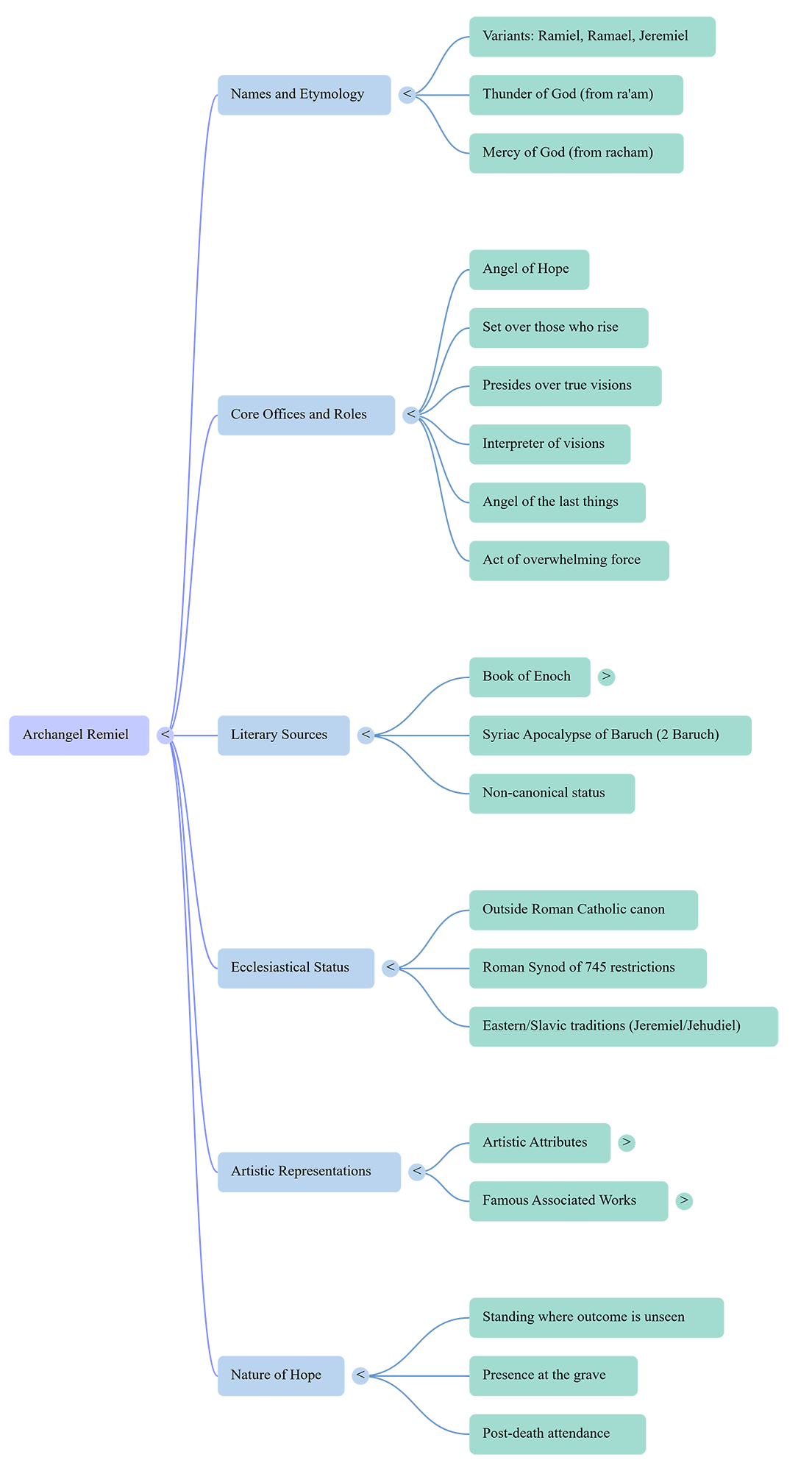
The name appears as Remiel, Ramiel, Ramael and Jeremiel depending on which text and which translation you are reading. Two Hebrew roots are proposed for it and the tradition has never fully chosen between them. From ra’am, thunder, you get Thunder of God. From racham, to have compassion, you get Mercy of God. It is an unusually wide spread for one name, and rather than treat it as a problem the tradition seems to have kept both. An angel stationed at the resurrection of the dead can reasonably be described as thunder, since that is the noise the end of the world makes, and as mercy, since that is what the event is for.
Set Over Those Who Rise
Chapter 20 of the Book of Enoch lists the seven holy angels and gives each an office. Uriel is over the world and Tartarus. Raphael is over the spirits of men. Michael is over the best part of mankind. Gabriel is over Paradise and the cherubim. And last on the list: Remiel, one of the holy angels, whom God set over those who rise. The Syriac Apocalypse of Baruch, another book from outside the canon, adds to it. There Ramael is the angel who presides over true visions, and it is he who explains to Baruch what the vision of the cloud and the waters means. In chapter 63 the same angel destroys the Assyrian host in a single night, which is the deed 2 Kings assigns to the angel of the LORD without a name. So the portfolio is coherent even across two books: visions, the wakening of the dead, and one act of overwhelming force. He is an angel of the last things, and of the sight that lets you bear them.

The Two Remiels of Enoch
Here is the tangle, and it is worth taking slowly. The Book of Enoch has two lists of angel names. Chapter 20 lists seven holy angels who watch, and Remiel is the seventh. Chapter 6 lists the chiefs of the two hundred Watchers who came down on Mount Hermon, took human wives and taught men forbidden things, and among those names is Ramiel. They are the same name in the same book, once holy and once fallen. Scholars generally treat them as two different figures whose names have collapsed together in transmission, which is easy to believe: the manuscripts pass through Aramaic, Greek and Ge’ez, and lists of twenty angel names are exactly the sort of thing copyists garble. Others read it as one angel who fell, though nothing in the text supports a story of that fall. What matters for a reader is simply this. When a search engine tells you Remiel is a fallen Watcher, it is quoting Enoch chapter 6. When an encyclopaedia tells you he is the archangel of hope, it is quoting Enoch chapter 20. Neither is inventing anything. The Book of Enoch is genuinely inconsistent on this name, and any source that gives you one half without mentioning the other is telling you less than it knows.
The Painting of What He Does
Remiel himself is almost never painted. His office, on the other hand, is one of the great subjects of Renaissance art, and you can look straight at it. In the San Brizio Chapel at Orvieto Cathedral, between 1499 and 1503, Luca Signorelli painted the Resurrection of the Flesh. The ground is bare and grey. Angels stand above it in armour, blowing long trumpets, and the dead are coming out of the earth: some already whole and standing, some still skeletons, one pair hauling themselves up through a crust of soil with their arms out. There is no landscape and no architecture. Signorelli removed everything except bodies, ground and sound.

It is the most physical treatment of the resurrection anyone painted, and Michelangelo studied it before he began work on the Sistine ceiling. The debt shows in the Last Judgment, where the same trumpeting angels appear at the centre of the wall, and the dead climb out of the ground on the lower left in poses Signorelli had worked out forty years earlier. Neither fresco names the angel who presides. But if you want to see what the Book of Enoch means by an angel set over those who rise, this is the picture of it.
Hope as a Position, Not a Feeling
Modern usage has worn the word hope down to optimism. The older meaning is nearer to a posture: standing where you cannot see the outcome and staying there. That is why an angel of hope belongs at the resurrection rather than anywhere pleasanter. Hope is only needed where the ending is not yet visible, and the grave is the limit case. Read alongside Raphael, who walks beside the living, and the other archangels whose errands are all in this life, Remiel is stationed at the far end, at the one moment nobody can prepare for. The office is not consolation. It is presence at the exact place where presence is hardest to imagine.
Where Remiel Stands in the Church
Outside the canon. Three angels are named in the canonical Bible, Michael, Gabriel and Raphael, and Remiel is not among them. The Roman synod of 745, under Pope Zachary, restricted the invocation of angels to those biblical names, which is why the West has no feast for him, no altar and almost no painting. In some Eastern and Slavic traditions an eighth archangel named Jeremiel or Jehudiel appears in icons of the Synaxis of the Archangels, and Jeremiel is often taken to be the same name in another spelling. There the figure survived. In the Latin West he did not.
Remiel in Art
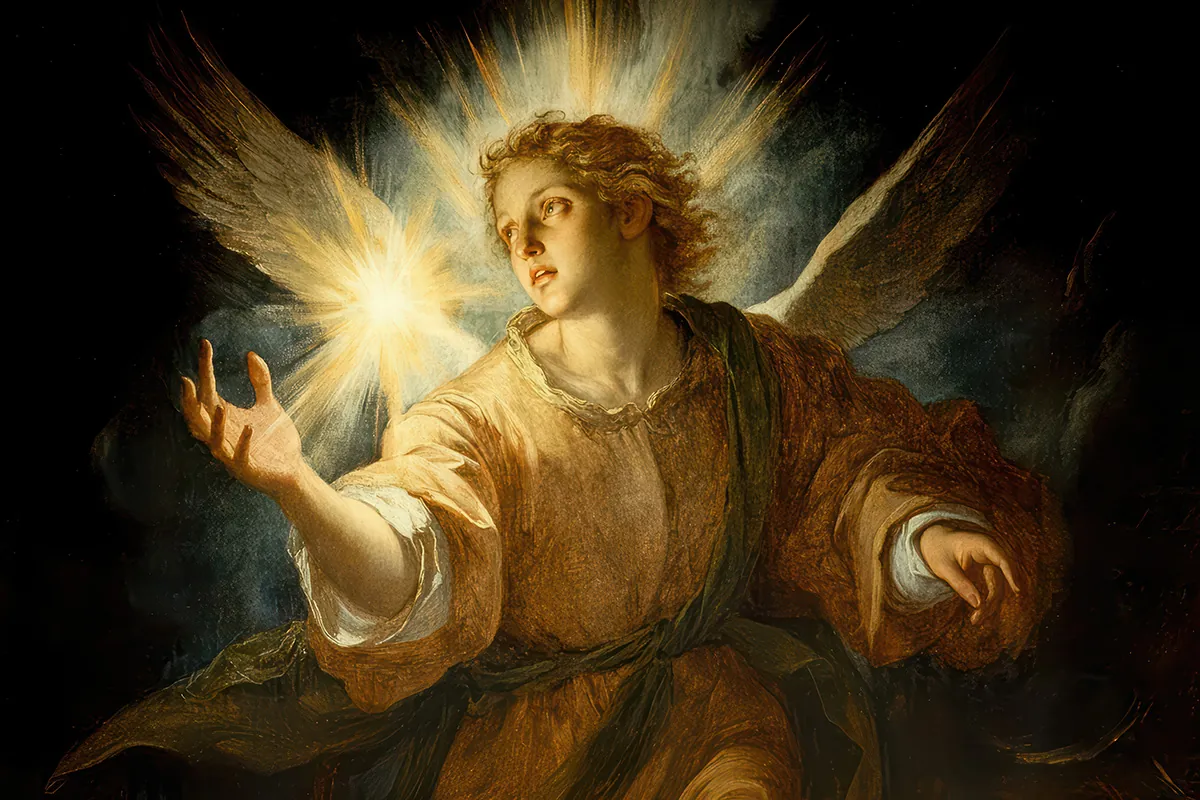
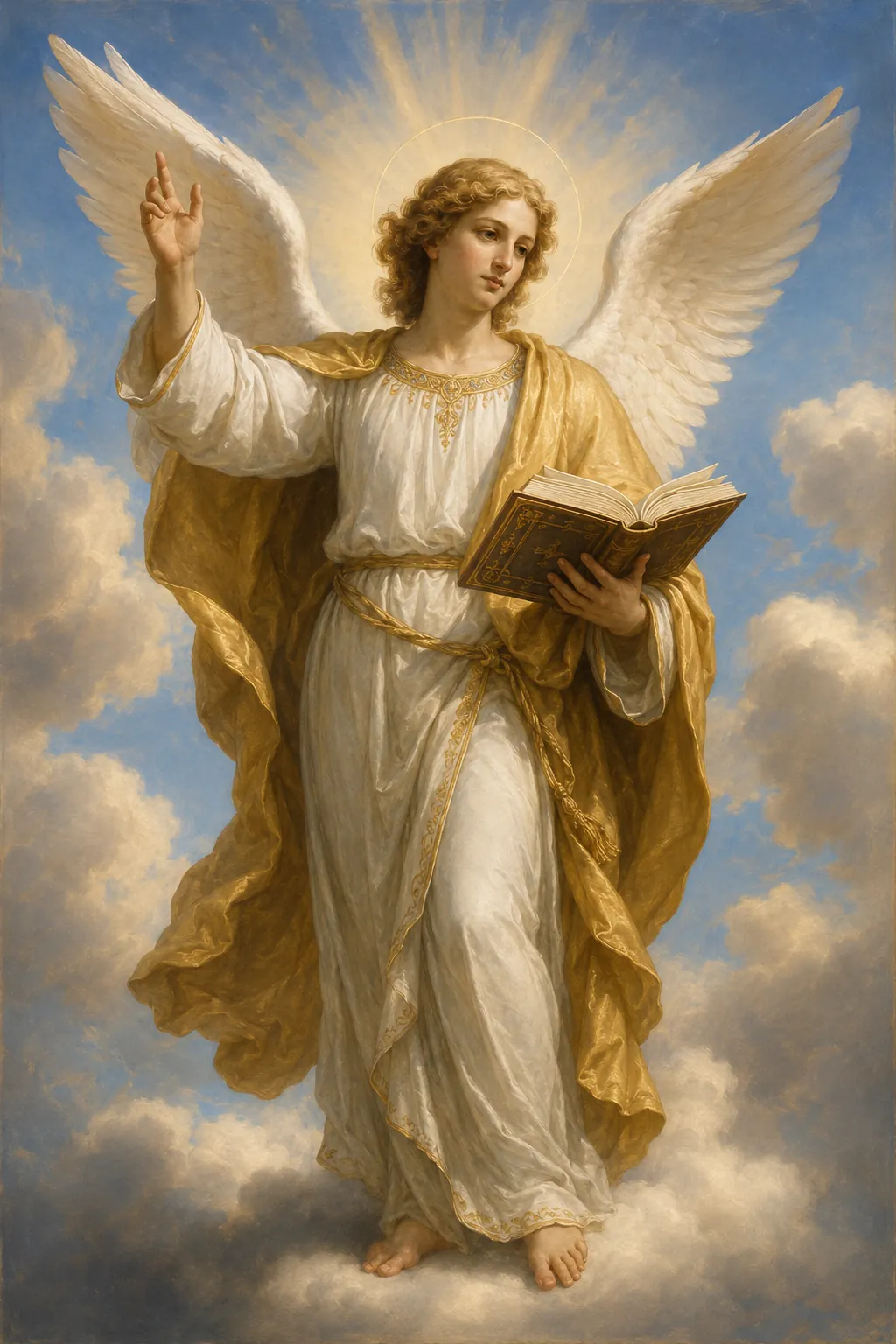
There is no established type, and where modern devotional painting shows him the attributes are chosen rather than inherited: a trumpet borrowed from the resurrection scenes, a lamp or a star for the light of visions, occasionally a crown for the risen. Our own paintings take the light and the book rather than the trumpet. In the first, at the head of this article, the angel holds a burst of white light in an open palm and looks up, not down at the viewer, out of a dark ground in the Baroque manner. The choice follows the texts: an angel of true visions and of those who rise is better shown carrying a light into a dark place than announcing the end of the world. The second gives him the other half of the office. He stands in the clouds with an open book in one hand, the other raised, and the book is not a prop. In the Apocalypse of Baruch it is Ramael who explains the vision of the cloud and the waters to a man who cannot read it himself. An angel of true visions is also an angel of interpretation.
Works Featured in This Article
| Work | Artist | Date | Location |
|---|---|---|---|
| The Resurrection of the Flesh | Luca Signorelli | 1499-1503 | San Brizio Chapel, Orvieto Cathedral |
| The Last Judgment (detail, angels with trumpets) | Michelangelo | 1536-1541 | Sistine Chapel, Vatican |
| Archangel Remiel, the Angel of Hope | Contemporary, jesuschrist.pictures | 2025 | Original artwork |
The Angel at the Far End
Remiel is a minor name in a book the Church did not receive, and half the internet has him confused with a fallen Watcher who shares his name. What survives the confusion is a single idea, and it is a large one: that the moment of rising is not unattended. Signorelli painted the ground opening and the trumpets sounding and nobody in the fresco looking frightened. Whether or not the angel standing over that is called Remiel, the tradition wanted someone to be there, and it chose to call him hope.
Important Facts About Archangel Remiel
- Name: Remiel, also Ramiel, Ramael or Jeremiel. From ra’am, thunder, or racham, compassion. Thunder of God or Mercy of God.
- Office: hope, true visions, and those who rise from the dead.
- Chief text: the Book of Enoch, chapter 20, where God sets him over those who rise. He is the seventh of the seven.
- Also in: 2 Baruch, where Ramael explains Baruch’s visions and destroys the Assyrian host.
- The confusion: Enoch chapter 6 lists a Ramiel among the chiefs of the fallen Watchers. Same name, different list, almost certainly a different figure.
- In scripture: not named. Only Michael, Gabriel and Raphael are named in the canonical Bible.
- Status in the Roman Church: no feast, no approved cult, after the synod of 745.
- In art: almost never depicted. His office, the resurrection of the dead, is painted constantly.
Frequently Asked Questions
What is Archangel Remiel known for?
Remiel is known as the angel of hope. The Book of Enoch says that God set him over those who rise, meaning the resurrection of the dead, and the Apocalypse of Baruch adds that he presides over true visions and interprets them. Between the two texts his portfolio is the last things: what can be seen truly, and what happens when the dead come back.
Is Remiel a fallen angel?
It depends which chapter of the Book of Enoch you are reading, which is why the answer is so contested. Chapter 20 names Remiel as the seventh of the holy archangels. Chapter 6 names a Ramiel among the chiefs of the Watchers who fell. Scholars generally treat these as two different figures whose names converged in transmission through Aramaic, Greek and Ge’ez. The archangel of hope and the fallen Watcher are best kept apart.
Is Angel Remiel in the Bible?
No. Remiel is not named in the canonical Bible. Only three angels are: Michael, Gabriel and Raphael. His name comes from the Book of Enoch and from 2 Baruch, neither of which is in the Hebrew, Catholic or Protestant canon, though the Ethiopian Orthodox Church receives Enoch as scripture and the Letter of Jude quotes it.
What does the name Remiel mean?
Two etymologies are given and the tradition has kept both. From the Hebrew ra’am, thunder, the name means Thunder of God. From racham, to show compassion, it means Mercy of God. For an angel stationed at the resurrection of the dead the two readings are less contradictory than they look, since the event is both.
What is the difference between Remiel and Ramiel?
Usually nothing but spelling. Both render the same Hebrew name, and the variants Ramael and Jeremiel belong to it too. The difficulty is not the spelling but the fact that the Book of Enoch uses the name twice, once for a holy archangel in chapter 20 and once for a fallen Watcher in chapter 6, so the same name carries two opposite characters in one book.
Is Remiel the same as the angel Israfil in Islam?
No, though they are often compared. Israfil is the angel of the trumpet in Islamic tradition, who will sound the blast that ends the world and raises the dead. The resemblance to Remiel’s office is real, but the two figures come from different scriptures and traditions, and Islamic sources do not identify them with each other.
How is Archangel Remiel shown in art?
Very rarely, and without a fixed type. Because the Western Church would not invoke the name, no painter received a commission for a Remiel and no attributes were settled. Where he appears in modern devotional imagery he is given a trumpet, borrowed from resurrection scenes, or a lamp or star for the light of true visions. His office, by contrast, is one of the great subjects of Renaissance painting: Signorelli at Orvieto and Michelangelo in the Sistine Chapel both painted the moment he is said to preside over.
Where can I buy Archangel Remiel wall art?
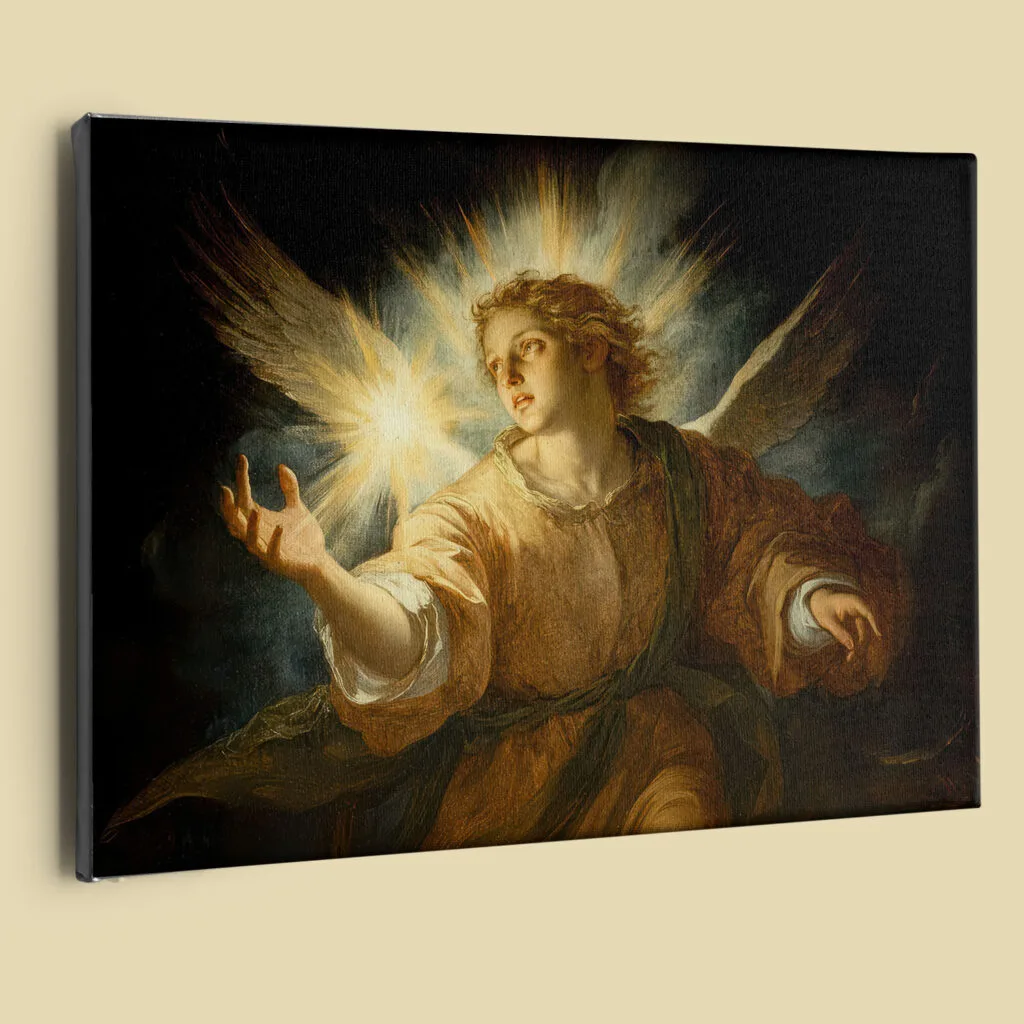
You can buy Archangel Remiel wall art at jesuschrist.pictures: our original Archangel Remiel canvas shows the angel of hope in the Baroque manner, holding the light of the resurrection. It is printed to gallery standard and ships ready to hang. Remiel is one of the least painted of all the archangels, which is why we made one.