Madonna of Foligno by Raphael: The Story Behind the Lightning Miracle
Madonna of Foligno is one of Raphael’s great Marian altarpieces and one of the most striking visions of the Virgin Mary in High Renaissance art. The Vatican Museums date the painting to 1511-1512 and identify it as “tempera grassa” on wood transferred onto canvas. Today it is preserved in the Vatican Pinacoteca, where it remains one of the major masterpieces of Raphael’s Roman period.
Unlike Raphael’s smaller and more intimate Madonna paintings, this work is monumental in scale and openly visionary in character. The Virgin and Child appear in glory above, surrounded by radiant clouds, while saints and the donor gather below in prayer. The painting was commissioned by Sigismondo de’ Conti, a distinguished humanist from Foligno, and the Vatican Museums explain that it was ordered in thanksgiving to the Virgin after his house in Foligno had been struck by lightning and he was miraculously spared. This dramatic origin gives the painting a devotional intensity that sets it apart from many other Marian works by Raphael.
One detail makes the composition especially memorable. In the center, a small angel holds a blank plaque with no inscription. The Vatican Museums note that it was probably intended to recall the favor granted by the Virgin. This empty tablet creates an unusual visual mystery inside an otherwise richly meaningful altarpiece. It is one of the details that makes the Madonna of Foligno so compelling to study today.
The painting also belongs to Raphael’s extraordinary series of Marian masterpieces. Readers interested in the wider context of these works can also read our article on Raphael’s 7 Most Beautiful Madonna Paintings.
The History of the Madonna of Foligno
The Madonna of Foligno was painted between 1511 and 1512, during the period when Raphael was working on the Room of Heliodorus in the Vatican. By this stage of his career, he had moved far beyond the smaller devotional Madonnas of his Florentine years and was creating large, ambitious works that combined spiritual grandeur with exceptional clarity of design. The Vatican Museums present the painting as one of the key works of this mature Roman phase.

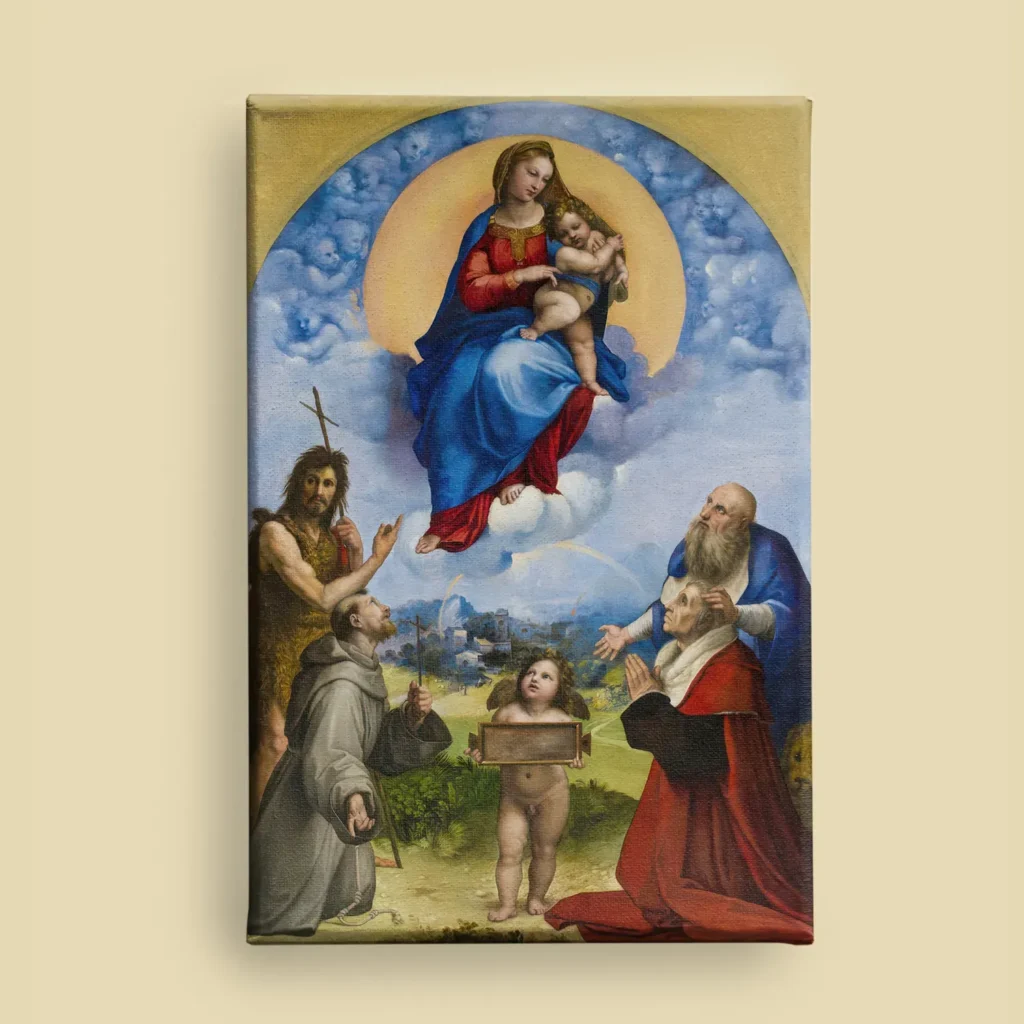
The altarpiece was commissioned by Sigismondo de’ Conti, who appears kneeling in prayer on the right side of the painting. Saint Jerome, dressed as a cardinal, presents him to the Virgin, while Saint John the Baptist and Saint Francis complete the sacred group below. The work was painted for the church of the Franciscan Observants in Foligno, which already tells us that this was not just a private devotional image but a public statement of gratitude and faith.
Today the painting is housed in the Vatican Museums, where it stands among the major masterpieces of Raphael’s religious art. Its present fame comes not only from its beauty, but also from the richness of its original purpose as a votive offering born from a moment of danger.
The Story Behind the Lightning Miracle
What makes the Madonna of Foligno especially distinctive is the story behind its commission. According to the Vatican Museums, Sigismondo de’ Conti ordered the painting in thanksgiving to the Virgin for having saved his house in Foligno after it was struck by lightning. This is one of the most dramatic origins of any Madonna painting by Raphael. The work is therefore not only a sacred image, but also a visual act of gratitude for divine protection.
This story gives the painting a very specific devotional meaning. Mary is not shown only as the mother of Christ, but also as a heavenly protector who intervenes in human danger. The painting becomes a testimony of trust in her intercession. This helps explain the strong vertical structure of the composition, with the donor and saints below and the Madonna above in radiant glory. Earth looks upward to heaven, and heaven responds with grace.
The Vatican Museums also note that the lightning episode is recalled in the splendid landscape in the background. This means the distant view is not a neutral decorative setting. It is part of the story. Raphael uses landscape not only for beauty, but also for memory and meaning.
The Meaning and Symbolism of the Madonna of Foligno
The Madonna of Foligno is rich in symbolism. At the top of the composition, the Virgin and Child appear on a luminous cloud, elevated above the world below. This heavenly placement emphasizes Mary’s exalted role while still presenting her as accessible to prayer. The Child is calm and blessing, while the Virgin seems both majestic and compassionate.

Below them, the saints create a bridge between the heavenly and earthly worlds. Saint John the Baptist points toward the vision above, guiding the viewer’s gaze to the Madonna and Child. Saint Francis kneels in devotion, reinforcing the spiritual humility of the scene. Saint Jerome presents Sigismondo de’ Conti to the Virgin, placing the donor within the sacred order of intercession and prayer. The arrangement is not accidental. It expresses the Christian belief that the saints lead the faithful toward divine grace.
The small angel in the center adds another layer of meaning. He holds a plaque without inscription. The Vatican Museums explain that it was probably meant to commemorate the grace received through the Virgin’s intervention. Because the plaque remains blank, it creates a curious tension in the painting. It feels at once specific and open, tied to a particular miracle yet capable of speaking to the prayers of many viewers.

Raphael’s Heavenly Altarpiece
From an artistic point of view, the Madonna of Foligno is one of Raphael’s most impressive altarpieces because it unites monumentality with clarity. The composition is divided between heaven and earth, but the two realms are not separated harshly. Light, gesture, and visual rhythm connect them. The saints below direct the viewer upward, while the glowing cloud above seems to descend gently toward the world.
This structure makes the painting very different from the more intimate Madonnas of Raphael’s Florentine period. Here the Virgin does not appear in a quiet domestic interior or seated in a meadow. She appears in glory, revealed as part of a sacred vision. Yet Raphael avoids heaviness or confusion. The whole scene remains lucid and harmonious, which is one of the defining qualities of his mature style.
The result is a painting that feels both theological and immediate. It is grand enough for an altarpiece, but clear enough to move the viewer emotionally. That balance helps explain why the Madonna of Foligno has remained one of Raphael’s most admired religious works.
The Mystery of the Blank Plaque
One of the most unusual details in the painting is the blank plaque held by the angel in the center. This feature often surprises viewers because it seems to invite an inscription that never appears. The Vatican Museums suggest that it was probably intended to recall the wish fulfilled by the Virgin. In other words, it may have been meant as a visible record of the miracle associated with Sigismondo de’ Conti’s house.
The absence of text makes the detail even more powerful. Instead of fixing the meaning in a single statement, Raphael leaves the plaque open. It becomes a silent sign of gratitude, memory, and fulfilled prayer. This blankness gives the painting a strange and memorable quality that many altarpieces do not have.
It also works compositionally. Positioned near the center of the painting, the plaque creates a visual pause between the world below and the glory above. It is almost like a suspended space for human response, a place where the miracle can be remembered without being fully explained.
Why the Madonna of Foligno Became One of Raphael’s Great Marian Masterpieces
The Madonna of Foligno became one of Raphael’s great Marian masterpieces because it combines narrative force, devotional intensity, and artistic control. The miracle story gives the painting emotional urgency. The saints and donor ground it in lived faith. The Virgin and Child above lift the whole scene into a vision of divine grace.
It is also one of Raphael’s most successful large religious compositions. Unlike some altarpieces that can feel crowded or overly theatrical, this one remains calm and legible. Every figure has a role, and every part of the painting contributes to its meaning. The landscape recalls danger, the angel holds memory in suspension, and the Virgin appears as protector and queen.
For these reasons, the painting holds a special place within Raphael’s Marian art. It is not simply beautiful. It is a masterpiece of gratitude, protection, and heavenly vision.
Conclusion
The Madonna of Foligno stands apart within Raphael’s Madonnas because it was born from a moment of danger and thanksgiving. The story of the lightning strike gives the work a rare human immediacy, while the altarpiece format allows Raphael to transform that event into a vision of heavenly grace.
Through its luminous composition, powerful saints, symbolic landscape, and mysterious blank plaque, the painting unites devotion and artistry at the highest level. It remains one of the most remarkable Marian masterpieces of the High Renaissance and a fitting final work in any cluster devoted to Raphael’s Madonnas.
Artwork Information
| Artwork | Artist | Date | Medium | Current Location |
|---|---|---|---|---|
| Madonna of Foligno | Raphael | 1511-1512 | Tempera grassa on wood transferred onto canvas | Vatican Museums, Vatican City |
FAQ
What is the Madonna of Foligno by Raphael?
The Madonna of Foligno is a large Marian altarpiece painted by Raphael around 1511-1512. It shows the Virgin and Child in heavenly glory above saints and the donor Sigismondo de’ Conti, and it is now in the Vatican Museums.
Why is it called Madonna of Foligno?
It is called Madonna of Foligno because the painting was connected to Sigismondo de’ Conti’s house in Foligno and was commissioned in thanksgiving after the famous lightning incident described by the Vatican Museums.
What miracle is connected to the Madonna of Foligno?
The painting is linked to the story that the Virgin saved Sigismondo de’ Conti’s house in Foligno after it was struck by lightning. The work was commissioned as an offering of gratitude for that protection.
Who commissioned the Madonna of Foligno?
The commissioner was Sigismondo de’ Conti, a distinguished humanist from Foligno, who is shown kneeling in prayer in the painting.
Where is the Madonna of Foligno today?
The painting is now in the Vatican Museums.
What does the Madonna of Foligno symbolize?
The painting symbolizes divine protection, gratitude to the Virgin, and the relationship between heaven and earth. Through the saints, donor, and heavenly vision above, Raphael presents Mary as a compassionate intercessor and protector.
Why is the plaque in Madonna of Foligno blank?
The Vatican Museums explain that the blank plaque held by the angel was probably meant to recall the favor granted by the Virgin. Its empty state gives the painting one of its most intriguing visual mysteries.
When was the Madonna of Foligno painted?
The painting is dated to 1511-1512.
Where can I buy a reproduction of the Madonna of Foligno by Raphael?
You can buy a reproduction of the Madonna of Foligno by Raphael at jesuschrist.pictures: see the canvas reproduction in our shop, printed on museum-grade canvas and available in several sizes.