Archangel Raguel: The Seventh Angel Rome Refused to Name
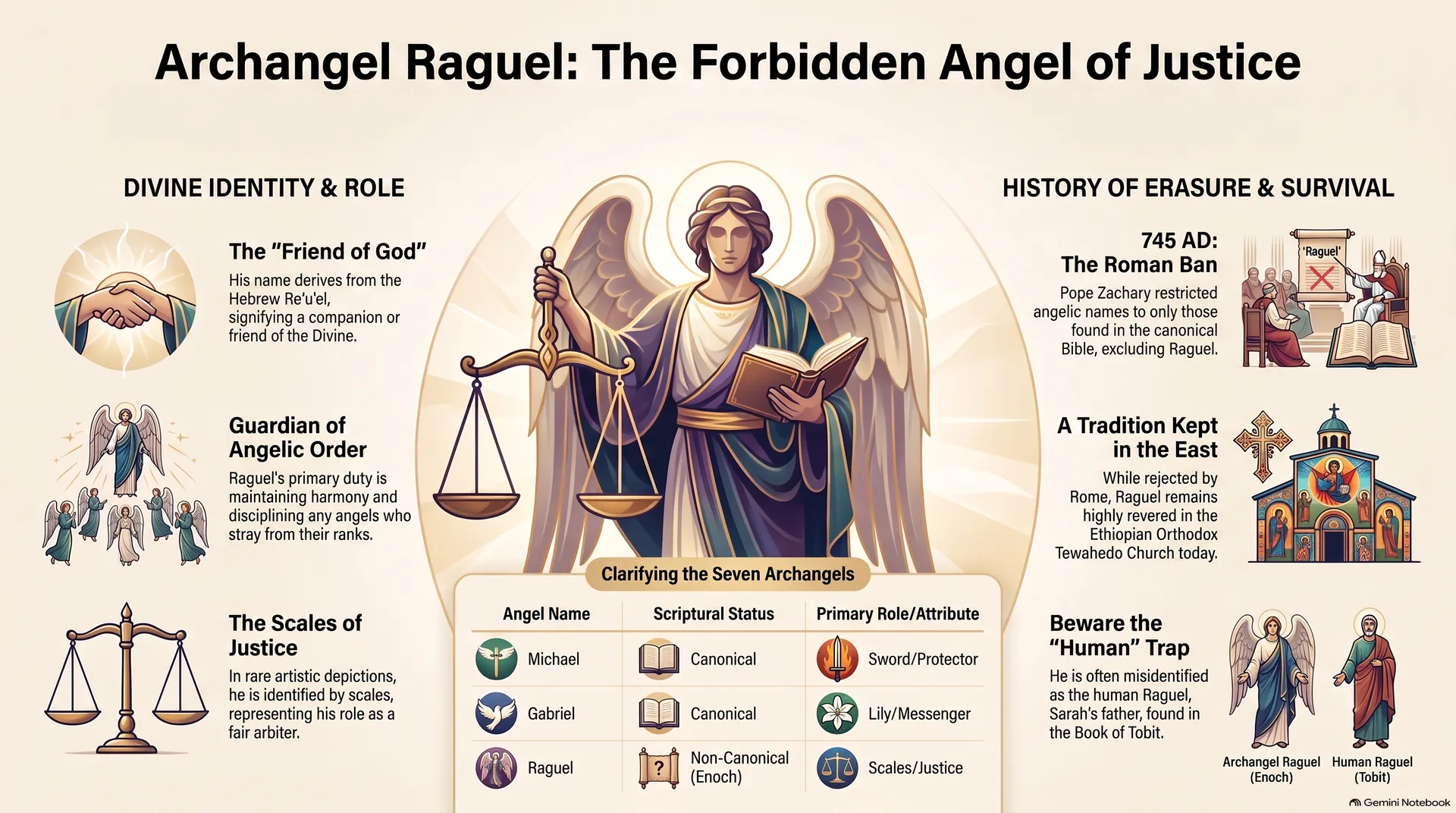
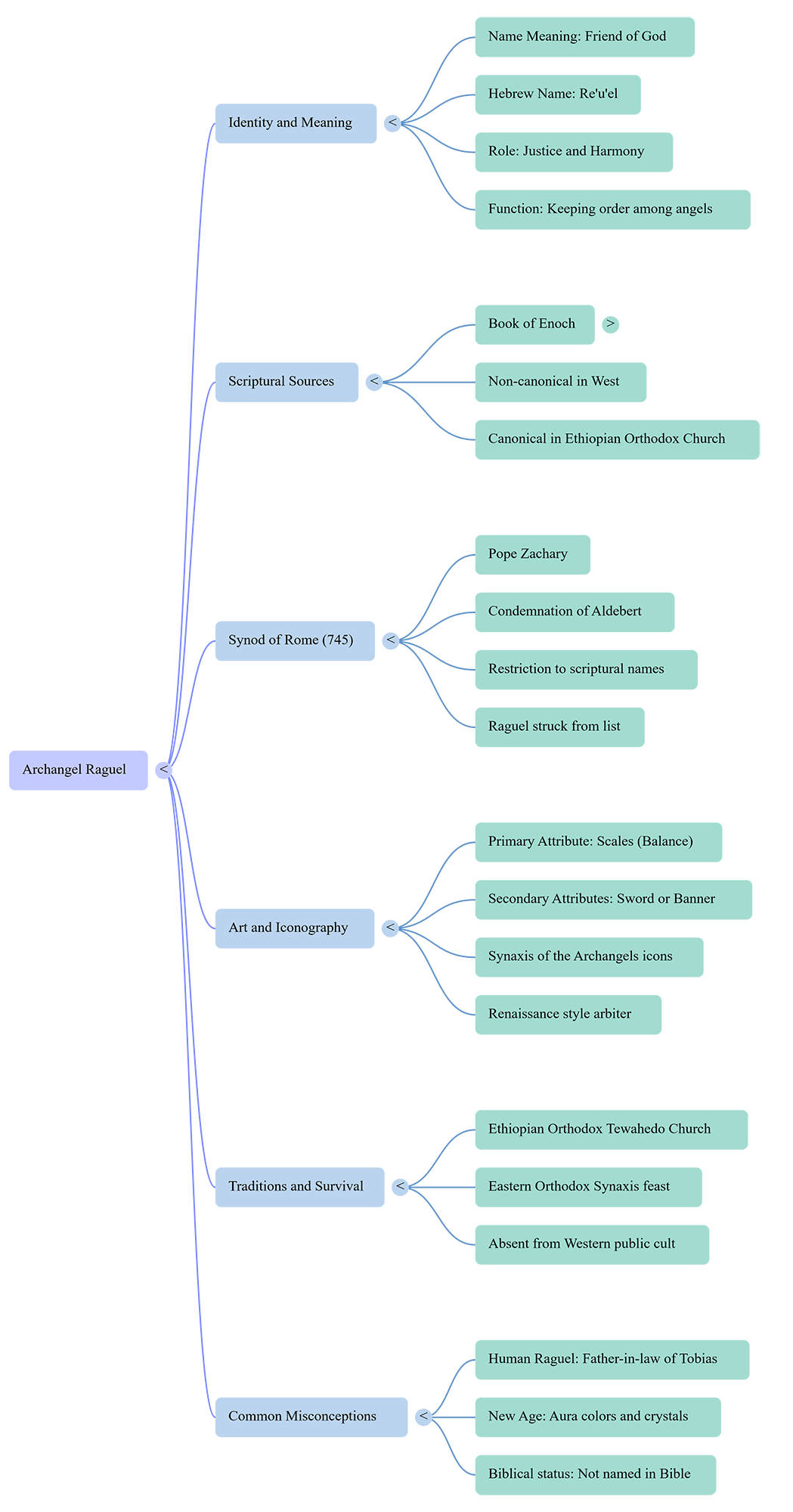
Archangel Raguel is the angel of justice and harmony, the one who keeps order among the other angels. His name means Friend of God. He appears by name in the Book of Enoch, where he stands seventh in a list of watching angels, and then he all but disappears from Christian art and prayer. In 745 a council held in Rome struck his name from the list of angels a Christian might invoke, and for most of Western history he stayed struck off.
That refusal is the most interesting thing about him, and almost nobody tells you about it. What follows is Raguel as the texts actually present him: where his name comes from, what the Book of Enoch says he does, why Rome would not have him, why he must not be confused with a second Raguel who was a man and not an angel, and how he survived in the Christian East long after the West had let him go.
The Name: Friend of God
Raguel comes from the Hebrew Re’u’el, built from a root meaning friend or companion and the divine name El. Friend of God is the usual English rendering, and it is a fair one. It places him in the same family as the better known angel names, all of which end in the same syllable and all of which say something about God rather than about the angel: Michael, who is like God; Gabriel, the strength of God; Raphael, God heals; Uriel, the light of God.
The pattern matters. In the Hebrew way of naming, an angel is not a personality with a name of its own. The name is a sentence about God, and the angel is the errand. Raguel’s errand, as the texts give it, is friendship in the sense of keeping the peace: the angel who holds the company together and calls to account those who break it. Justice and harmony are not two things here but one thing seen from either side.
What the Book of Enoch Says
The Book of Enoch is the source. It is not part of the Hebrew or Catholic canon, though the Ethiopian Orthodox Church keeps it, and the New Testament Letter of Jude quotes it. Written in the centuries before Christ, it is the text that gave later Judaism and early Christianity most of its detailed angelology, including the idea that there are exactly seven archangels with names.
Chapter 20 lists them. In the usual English rendering they are Uriel, Raphael, Raguel, Michael, Saraqael, Gabriel and Remiel. Of Raguel the text says that he is one of the holy angels who takes vengeance on the world of the luminaries. The line is compressed and strange, and it has been read in two ways: that he calls the heavenly bodies to account when they stray from their courses, or, more figuratively, that he disciplines those angels who have fallen out of their proper order. Either way the office is the same. Raguel is the angel who enforces the rule among the ranks.
He returns in chapter 23, where Enoch, carried west, sees a fire that runs without rest and pursues the luminaries. Raguel is the angel who explains it. It is a small part, but it is consistent: Raguel appears where order is being kept and where something must be accounted for.
The Seven, and Why Seven
The number seven did not come from nowhere. The Book of Tobit, which Catholics and Orthodox do read as scripture, has the angel Raphael say that he is one of the seven who stand before the glory of the Lord. The Book of Revelation speaks of seven angels who stand before God. Enoch supplies the names to fill those seven places, and from there they pass into Jewish and Christian tradition, into liturgical calendars, and eventually into painting.
Only three of the seven are named in the canonical Bible: Michael, Gabriel and Raphael. The other four, Raguel among them, arrive from outside the canon. That difference is the whole of the story that follows. For the wider picture of how the seven were understood and depicted, see our guide to the archangels and their mission.
745: Rome Refuses the Name
In the middle of the eighth century a wandering preacher named Aldebert was drawing crowds in Frankish territory. He built crosses in fields rather than churches, handed out his own fingernails and hair as relics, and taught a prayer that invoked eight angels by name. Saint Boniface, the missionary bishop then organising the Church in Germany, brought the matter to Rome.
A synod met in Rome in 745 under Pope Zachary. It condemned Aldebert, and it condemned his prayer in particular: the names he invoked, apart from the biblical three, were declared to be not angels at all. The Church’s position from then on was narrow and clear. Christians name the angels scripture names, and no others.
Raguel was on the wrong side of that line. So were Uriel, Saraqael and Remiel. The decision is why Western Christian art has thousands of paintings of Michael with his sword and Gabriel with his lily, and almost nothing of Raguel. He had no feast, no altar, no commission. An angel who cannot be named cannot be painted, because nobody is paying for the panel.
It is worth being exact about what the synod did and did not do. It did not teach that no other angels exist. It restricted what a Christian may invoke by name, on the ground that the names outside scripture came from texts the Church did not receive and could not vouch for. The ruling was about caution, not about arithmetic in heaven.
The Other Raguel: A Warning
There is a trap here that catches searchers, image libraries and even museum captions, and it is worth naming plainly.
The Book of Tobit contains a character called Raguel. He is not an angel. He is a man of Ecbatana in Media, the father of Sarah, and he becomes the father in law of the young Tobias. When Tobias arrives, guided by the archangel Raphael in disguise, it is this human Raguel who gives him his daughter and blesses the marriage.
That scene was painted. Andrea Vaccaro’s Raguel’s Blessing of her Daughter Sarah before Leaving Ecbatana is the best known example, and it turns up constantly in searches for the archangel. It shows a bearded patriarch blessing a young woman. It has nothing to do with the angel of justice. If you are looking for images of Archangel Raguel and you find a domestic farewell scene from Tobit, you have found the wrong Raguel.
Where Raguel Survived
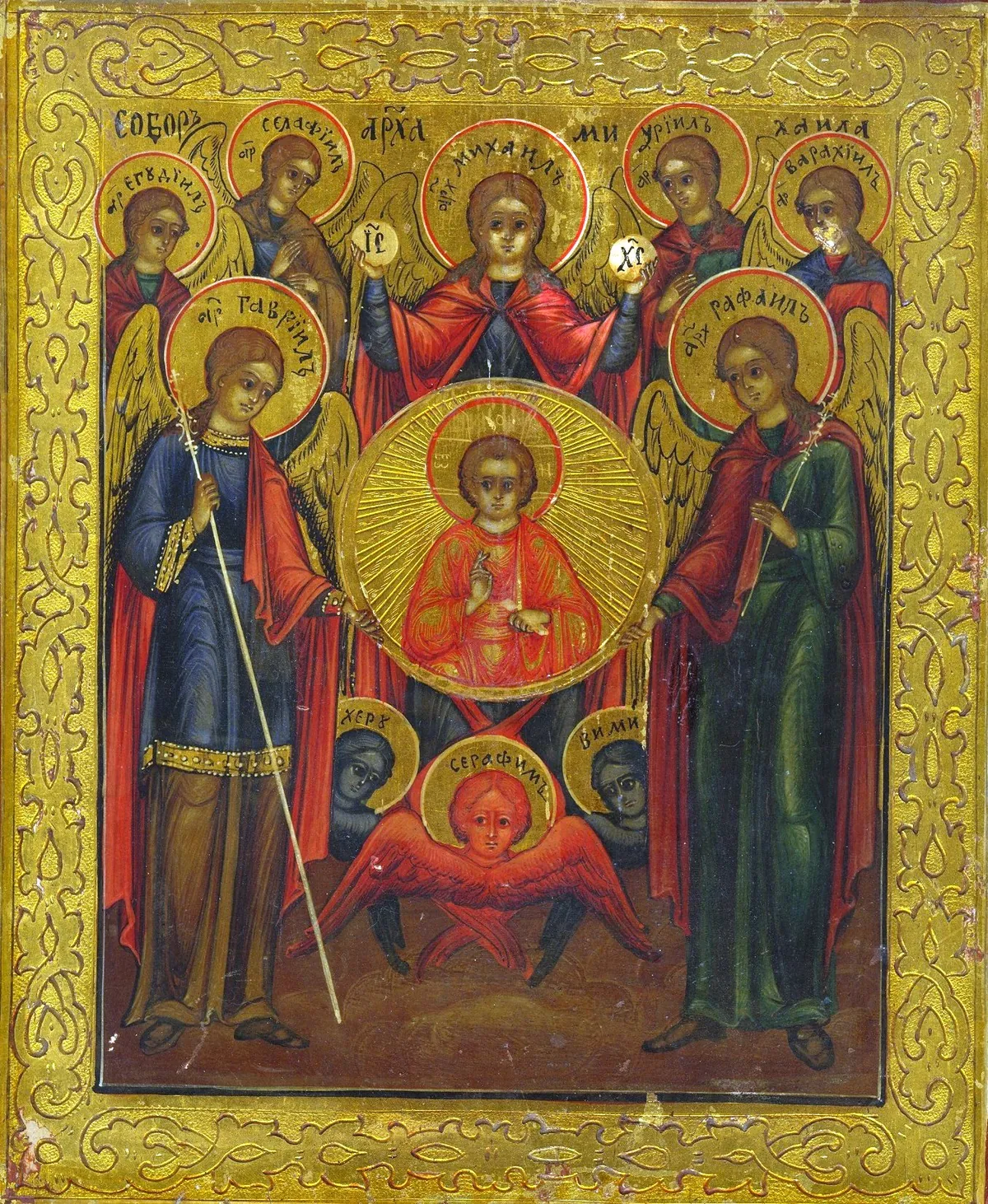
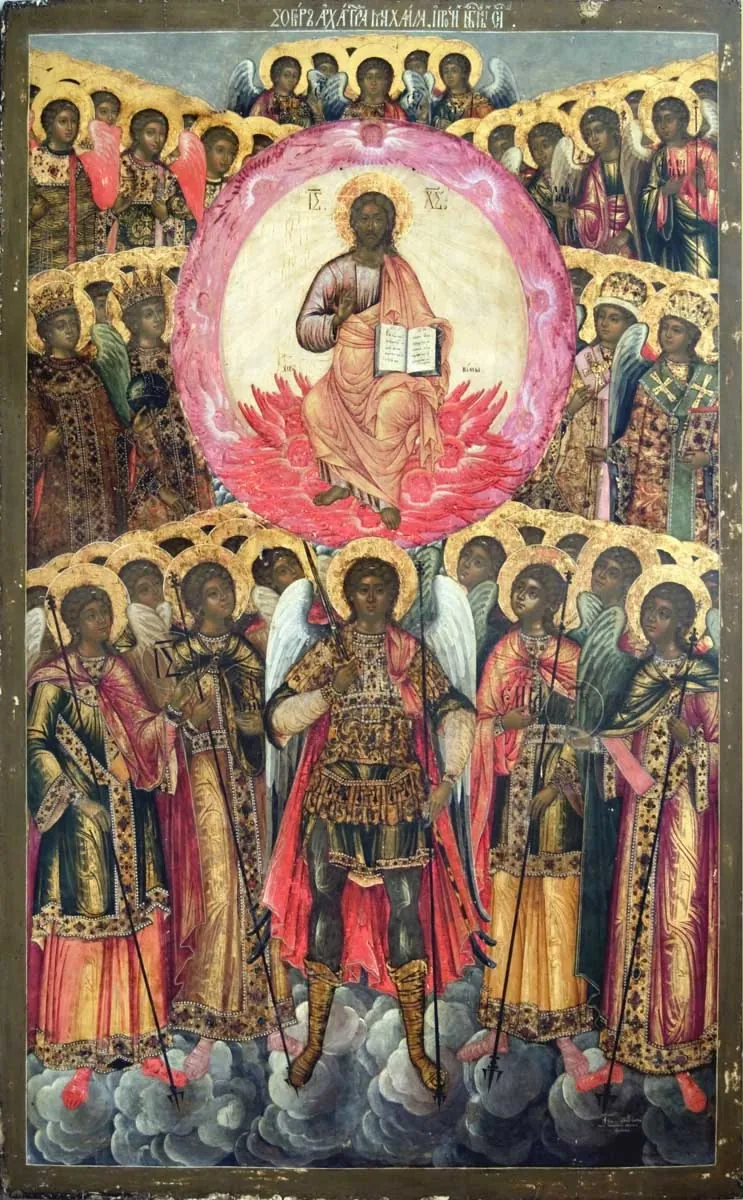
The Western refusal was not the end of him. In the Christian East the seven of Enoch kept their names much longer, and icons of the Synaxis of the Archangels, the feast that gathers the whole angelic host, sometimes range all seven in ordered rows around Christ. The Ethiopian Orthodox Tewahedo Church, which keeps the Book of Enoch as scripture, has the strongest surviving devotion to Raguel of any Christian body, with churches dedicated to him and a regular commemoration in its calendar.
This is the honest position for a Western Christian reader. Raguel is not a saint of the Roman calendar and there is no approved public cult of him. He is a figure from a text the Church did not receive, kept alive in traditions that did receive it. Reading him as scripture reads him, an angel whose office is order and accounting, is entirely reasonable. Building a private devotion on the colour of his aura, his number or his stone, as much of the internet now does, is something else, and it does not come from the Christian tradition at all.
Raguel in Art: Reading the Scales
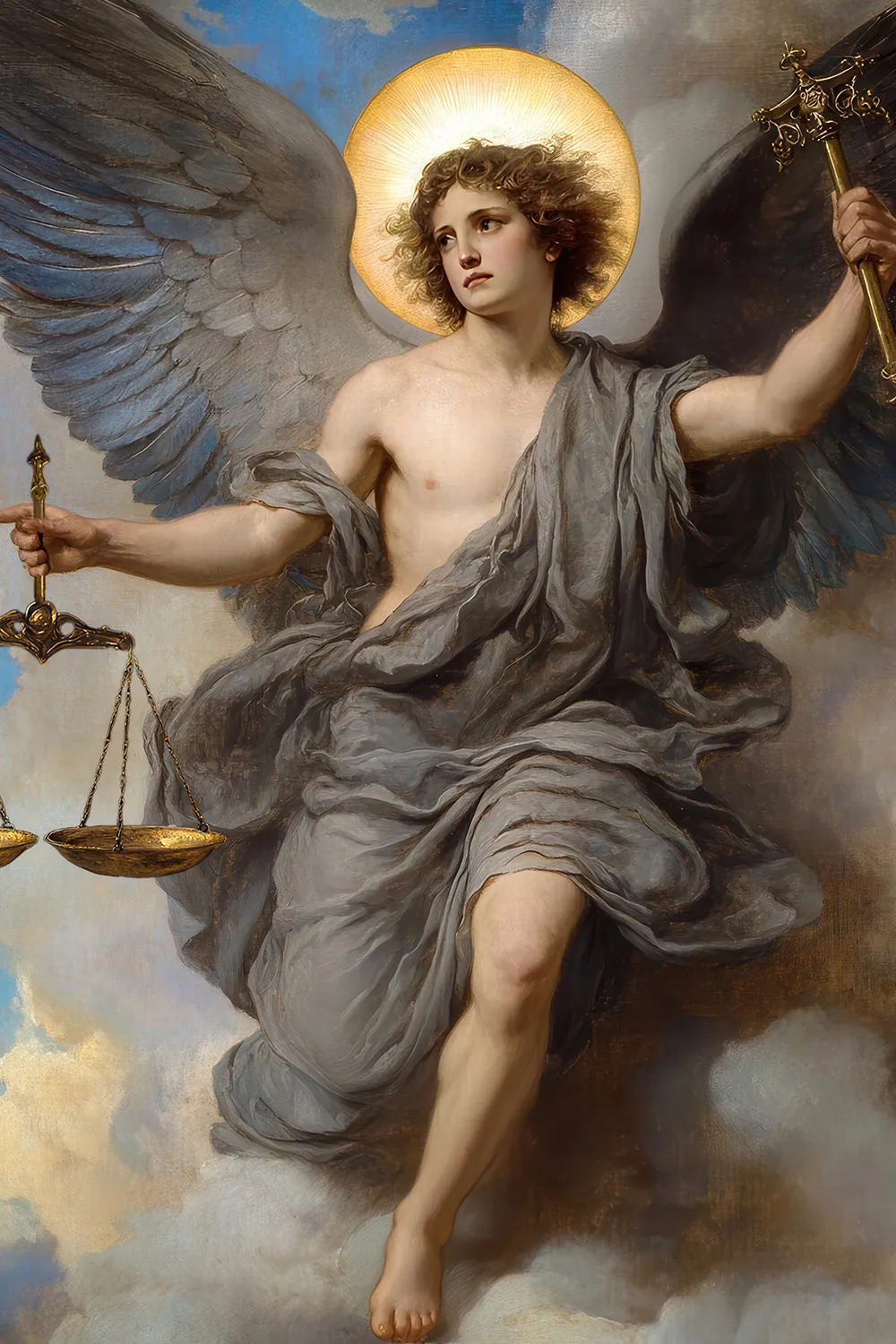
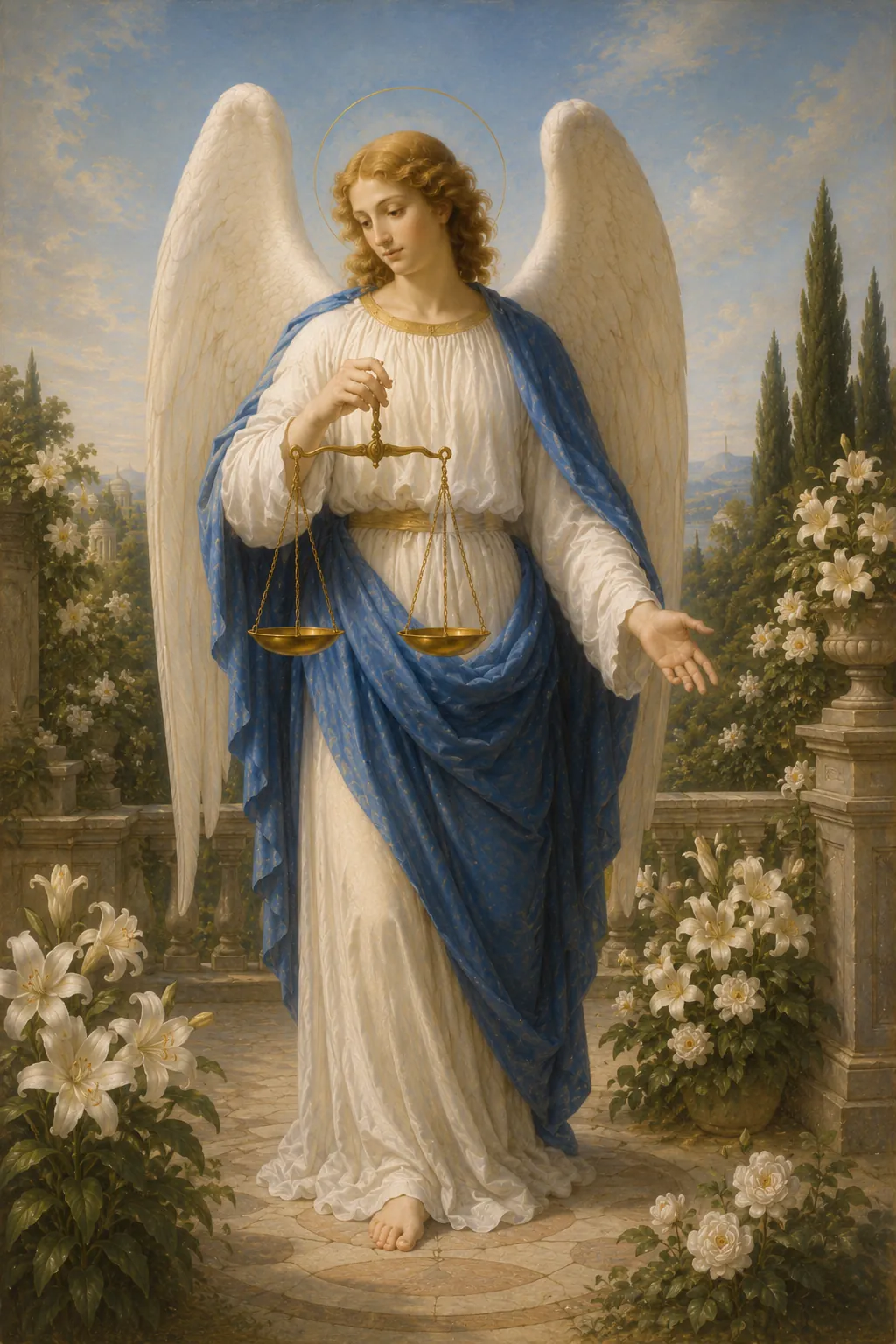
Because the West would not name him, there is no Raguel type in the way there is a Michael type. Where he is shown, in Eastern icons and in modern devotional painting, the attribute is almost always the balance: a set of scales, sometimes a sword alongside them, occasionally a banner. The scales are borrowed from the imagery of judgement, where Michael weighs souls, and they carry the same meaning here in a quieter register. Not the last weighing at the end of the world, but the constant one, the daily business of keeping the measure true.
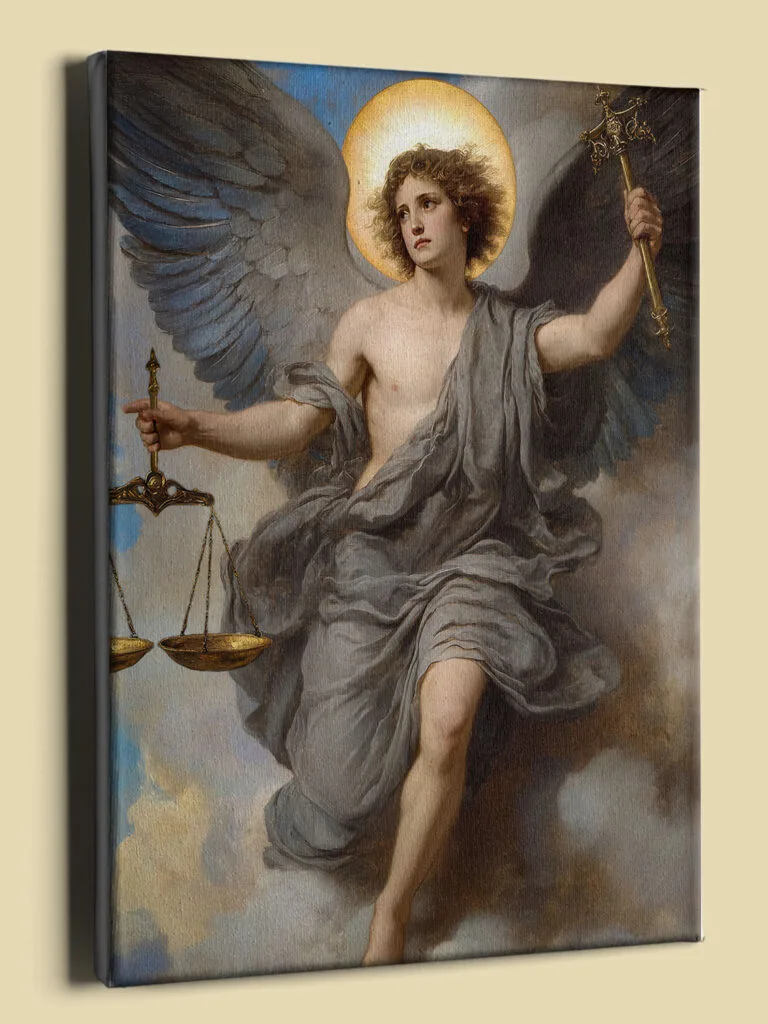
Our own painting of Raguel takes that reading. The angel is shown in the Renaissance manner, the scales held out rather than brandished, the face turned aside as though listening to a case being argued. It is a deliberate choice: the angel of justice as arbiter rather than avenger, since the texts give him both and the gentler reading is the more useful one.
Raguel and the Archangels Featured in This Article
| Work | Artist | Date | Location |
|---|---|---|---|
| Archangel Raguel, Angel of Justice | Contemporary, jesuschrist.pictures | 2025 | Original artwork |
| The Synaxis of the Archangels | Orthodox icon painter | 19th century | Private collection |
| Synaxis of the Archangel Michael and the Other Bodiless Powers | Kirill Ulanov | 1704 | Private collection |
An Angel Worth Recovering
Raguel is a small figure with a clear job. He keeps the ranks in order and calls to account what has slipped out of place, and his name says that this work is a form of friendship with God rather than a form of punishment. The eighth century did not deny that such an angel exists. It decided that Christians should not pray to names the Church could not vouch for, which is a different and more careful claim.
What is left, once the aura colours and the crystal correspondences are set aside, is a genuinely biblical idea wearing an extra name: that justice is not the opposite of peace but its condition, and that somewhere in the order of things the measure is being kept true. That is worth a painting, whatever Rome decided about the name.
Important Facts About Archangel Raguel
- Name: Raguel, from the Hebrew Re’u’el, meaning Friend of God.
- Office: justice, fairness and harmony; the angel who keeps order among the angels.
- Source: the Book of Enoch, chapters 20 and 23. He is not named in the canonical Bible.
- Rank: one of the seven archangels in the Enochic list, alongside Uriel, Raphael, Michael, Saraqael, Gabriel and Remiel.
- Status in the Roman Church: his name was rejected at the Roman synod of 745 under Pope Zachary. There is no feast and no approved public cult.
- Surviving devotion: strongest in the Ethiopian Orthodox Tewahedo Church, which receives the Book of Enoch as scripture.
- Attribute in art: the scales, sometimes with a sword or a banner.
- Not to be confused with: Raguel of Ecbatana in the Book of Tobit, a man, the father of Sarah and father in law of Tobias.
Frequently Asked Questions
What does Archangel Raguel do?
In the Book of Enoch, Raguel is the angel who takes vengeance on the world of the luminaries, which the tradition has read as the office of keeping order among the angels themselves and calling to account whatever has strayed from its proper course. He is therefore known as the archangel of justice, fairness and harmony. Where Michael fights and Gabriel announces, Raguel arbitrates: his work is the keeping of the measure rather than the winning of a battle.
Is Archangel Raguel in the Bible?
No. Raguel is not named in the canonical Bible. His name comes from the Book of Enoch, a text kept as scripture by the Ethiopian Orthodox Church but not received into the Hebrew, Catholic or Protestant canons. Only three angels are named in the canonical scriptures: Michael, Gabriel and Raphael. A man called Raguel does appear in the Book of Tobit, but he is Sarah’s father, not an angel.
Why is Archangel Raguel not recognised by the Catholic Church?
Because of a ruling made in 745. A synod in Rome under Pope Zachary condemned a preacher named Aldebert, who taught a prayer invoking eight angels by name, and declared that Christians should invoke only the angelic names given in scripture. Raguel, Uriel and the other Enochic names fell outside that limit. The ruling restricted what may be invoked by name; it did not claim to count the angels.
What color is Archangel Raguel?
Neither scripture nor the Christian tradition assigns a colour to any angel. The pale blue often given to Raguel online comes from twentieth century devotional and New Age writing, not from the Bible, the Book of Enoch or the Church Fathers. In Christian art an angel’s colours are the painter’s choice and the workshop’s pigments, and they carry no doctrine.
What is the prayer to Archangel Raguel?
There is no approved Catholic prayer to Archangel Raguel, and by the ruling of 745 the Roman Church does not invoke him by name. Christians who wish to pray for justice, reconciliation or peace in a quarrel are on firm ground praying directly to God, or invoking Saint Michael the Archangel, whose prayer is ancient, approved and concerned with exactly that protection.
How is Archangel Raguel shown in art?
Rarely, and almost always with a set of scales. Because the West would not name him, no fixed iconographic type developed as it did for Michael with his sword and dragon or Gabriel with his lily. Where Raguel appears, in Eastern icons of the Synaxis of the Archangels and in modern devotional painting, the balance identifies him, sometimes with a sword or a banner alongside.
Who are the seven archangels?
In the list given in chapter 20 of the Book of Enoch they are Uriel, Raphael, Raguel, Michael, Saraqael, Gabriel and Remiel. Other traditions give different names for the four beyond the biblical three, and the Orthodox churches commonly name Selaphiel, Jehudiel and Barachiel in their place. The number seven itself comes from the Book of Tobit and the Book of Revelation, both of which speak of seven angels who stand before God.
Where can I buy Archangel Raguel wall art?
You can buy Archangel Raguel wall art at jesuschrist.pictures: our original Archangel Raguel canvas shows the angel of justice with his scales, painted in the Renaissance manner. It is printed to gallery standard and ships ready to hang. Because Raguel is so rarely painted, images of him are hard to find, which is part of why we made one.