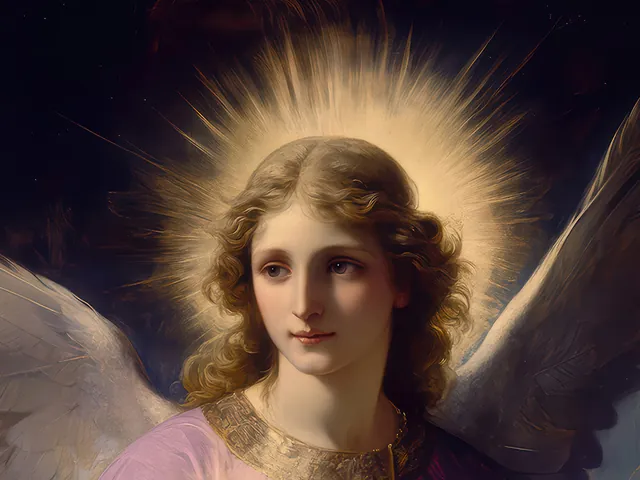
Who Is Archangel Gabriel? The Divine Messenger and Herald of the Annunciation
Archangels and Their Roles
Introduction to Archangels
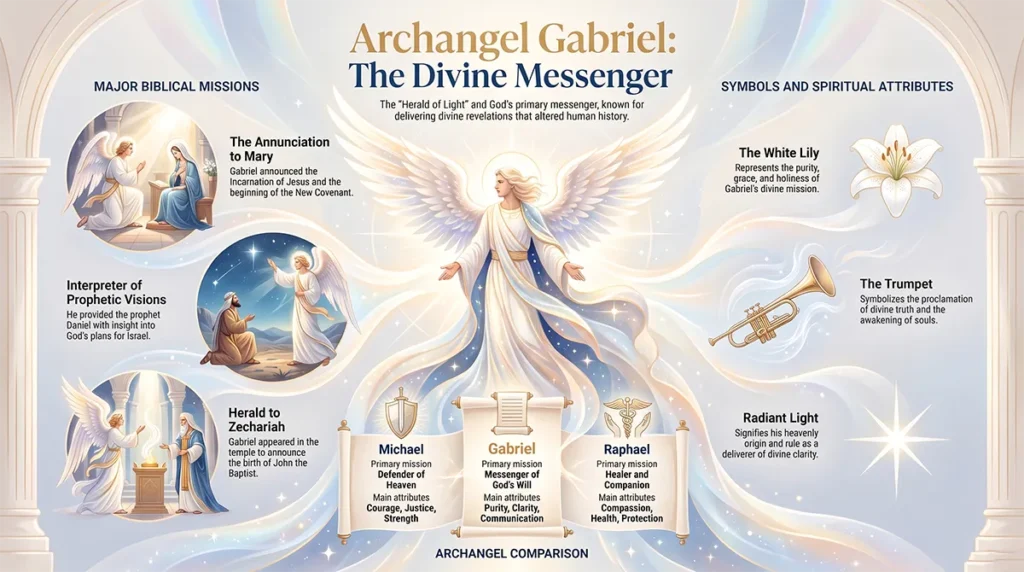
In Catholic theology, archangels are chief angels entrusted with major missions in salvation history. The Church recognizes Michael, Gabriel, and Raphael as the three archangels named in Sacred Scripture, each fulfilling a distinct divine role. Michael defends against evil, Raphael heals and guides, and Gabriel, the focus of this article, is the messenger of God’s will and the herald of the Incarnation. Through Scripture, sacred art, and liturgical devotion, the archangels remind the faithful that God’s presence and guidance remain active in the world. To explore their missions and symbolism in greater depth, visit our Archangels Explained collection. Now, let us focus specifically on Archangel Gabriel and his unique role in salvation history.
| Archangel | Mission | Main Attributes |
|---|---|---|
| Michael | Defender of Heaven and protector of the faithful | Courage, justice, spiritual strength |
| Gabriel | Messenger of God’s will and herald of the Incarnation | Purity, clarity, divine communication |
| Raphael | Healer and companion on spiritual journeys | Compassion, health, protection |
| Uriel | Bearer of wisdom and enlightenment | Light, insight, divine knowledge |
Archangels are not only theological figures but also beloved spiritual companions. Through prayer, sacred art, and liturgical devotion, they remind us that God’s presence is near and that His messengers are constantly at work in the world.
Who Is Archangel Gabriel?
Archangel Gabriel is the heavenly messenger of God in the Bible, best known for announcing the birth of John the Baptist and the Incarnation of Jesus Christ. In Catholic tradition, he represents divine communication, clarity, purity, and obedience to God’s will. Gabriel appears in the Book of Daniel and the Gospel of Luke, where he plays a central role in salvation history.
- Messenger of the Annunciation (Luke 1:26–38)
- Interpreter of prophetic visions (Daniel 8–9)
- Symbol of purity and divine proclamation
- Herald of the Incarnation
Listen to the Podcast Episode
Prefer listening? This episode explores the divine mission of Archangel Gabriel, his role in the Annunciation, and his symbolism as the herald of light in Catholic tradition.Gabriel in Scripture and Tradition
Among the three archangels named in the Bible, Gabriel holds a particularly exalted role as the divine herald. His name means “God is my strength,” a reflection of both his unwavering fidelity to God and the power of the messages he brings. Gabriel appears in the Old and New Testaments, delivering revelations that alter the course of salvation history. In the Book of Daniel (Daniel 8:16; 9:21), Gabriel is sent to interpret visions for the prophet, offering insight into God’s plan for Israel. His most celebrated appearance, however, comes in the Gospel of Luke. It is Gabriel who announces the birth of John the Baptist to Zechariah (Luke 1:11–20), and later, in one of the most important moments in Christian theology, he is sent to the Virgin Mary to proclaim the conception of Jesus Christ (Luke 1:26–38). This moment, known as the Annunciation, marks the beginning of the Incarnation and is commemorated with deep reverence in Catholic tradition. Gabriel’s role as divine messenger extends beyond Christianity. In Islamic tradition, Gabriel (Jibril) is recognized as the angel who delivered the Qur’an to the Prophet Muhammad, reinforcing his role as the bearer of God’s word across Abrahamic faiths.
| Religious Text | Appearance |
|---|---|
| Old Testament | Daniel receives visions interpreted by Gabriel |
| New Testament | Gabriel appears to Zechariah and the Virgin Mary (Luke 1) |
| Qur’an | Gabriel (Jibril) reveals divine messages to Muhammad |
Through these appearances, Gabriel is firmly established as the celestial ambassador of God’s providence. His words carry not just information but the grace and presence of the Holy Spirit, making him a revered figure in both theology and devotion.
Gabriel’s Symbolism and Characteristics
Throughout Christian iconography, Archangel Gabriel is depicted with symbols that express his mission, nature, and role as God’s messenger. These artistic and spiritual attributes are not mere decorations but convey profound theological meanings that have shaped how the faithful understand Gabriel’s place in salvation history.
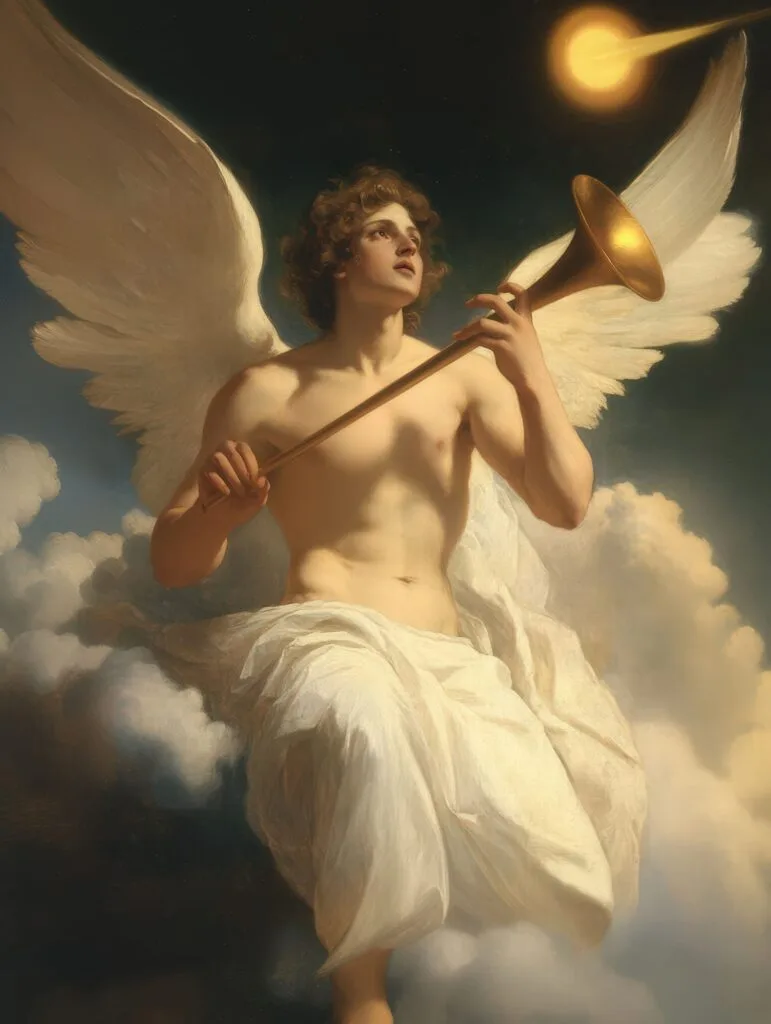

One of the most recognized symbols associated with Gabriel is the trumpet. Though not explicitly mentioned in Scripture in connection with Gabriel, the trumpet has become a traditional element in visual representations. It signifies divine proclamation and the awakening of the soul. In many artworks, Gabriel is seen blowing a trumpet to herald God’s message to humanity. Another common symbol is the white lily, especially in scenes of the Annunciation. The lily is a flower traditionally associated with purity, virginity, and grace, qualities that mirror both the nature of Gabriel and the immaculate purity of the Virgin Mary, to whom he was sent.
| Symbol | Spiritual Meaning |
|---|---|
| Trumpet | Proclamation of divine truth and awakening of souls |
| White Lily | Purity, grace, and the holiness of Gabriel’s mission |
| Radiant Light | Presence of divine illumination and heavenly origin |
| Scroll or Message | Gabriel’s role as a bearer of God’s word |
These symbols make Gabriel immediately recognizable in sacred art and serve as visual catechesis for the faithful. Whether appearing in Renaissance paintings or Gothic stained glass, Gabriel always brings a sense of peace, assurance, and holy clarity.
Gabriel’s Role as the Herald of Light
Bringing Messages of Light and Hope
Among the many spiritual gifts attributed to Archangel Gabriel, none is more central than his role as the Herald of Light. He is not merely a messenger of information but a deliverer of divine light, bringing clarity, courage, and hope to the hearts of those he visits. Every appearance of Gabriel in Scripture is marked by transformation: Zechariah is humbled, Mary is uplifted, and the world is forever changed. Gabriel’s messages are often connected with the unfolding of God’s redemptive plan. By announcing the births of John the Baptist and Jesus Christ, Gabriel serves as a bridge between the Old Covenant and the New. He does not speak on his own but transmits the will of God with purity and strength, encouraging those who listen to respond in faith. The themes conveyed by Gabriel include hope, renewal, and divine mission:
| Theme | Description |
|---|---|
| Hope | Reassures the faithful that God has not forgotten His people |
| Spiritual Awakening | Calls souls to deeper conversion and attentiveness to God’s will |
| Joy | Brings joyful news that points to salvation and life in Christ |
| Divine Calling | Encourages openness to one’s vocation in God’s plan |
When Gabriel speaks, it is not simply to inform, it is to inspire. His presence in the biblical narrative invites all Christians to remain open to God’s voice, to recognize the signs of divine grace, and to walk in the light of faith.
Spiritual Guidance and Protection
In addition to being the herald of God’s word, Archangel Gabriel is also venerated as a gentle guide and spiritual protector. Catholic tradition regards him not only as the announcer of great truths, but as a heavenly companion who offers comfort, direction, and reassurance in times of uncertainty. Gabriel’s guidance is particularly invoked when discernment is needed, whether in major life decisions, prayerful reflection, or times of interior darkness. Many Catholics turn to him for clarity, asking him to illuminate their hearts and help them hear the voice of the Holy Spirit more clearly. His presence is a spiritual light in moments of confusion, and a reminder that divine assistance is always near.
| Area of Guidance | Description |
|---|---|
| Discernment | Helps believers listen attentively to God’s call |
| Emotional Consolation | Brings comfort and peace to the troubled heart |
| Vocation | Encourages courage in accepting one’s mission in life |
| Spiritual Protection | Defends against fear and discouragement |
Through devout prayer and meditation, Gabriel becomes more than a biblical figure, he becomes a real spiritual companion. His presence encourages trust in God’s will, especially when life’s path is uncertain or difficult to see.
Connecting with Archangel Gabriel
Prayer and Meditation
To draw closer to Archangel Gabriel, Catholics are encouraged to open their hearts in prayer. Simple, sincere prayers asking for guidance, strength, and clarity are powerful ways to invite Gabriel’s presence. Whether in moments of solitude, during Eucharistic adoration, or within the Rosary, Gabriel’s assistance can be requested with reverence and confidence. Here is a traditional outline for a prayer to Archangel Gabriel:
| Prayer Element | Purpose |
|---|---|
| Invocation | Begin by respectfully calling on Gabriel’s name |
| Intention | State clearly what guidance or help is needed |
| Thanksgiving | Express gratitude for his intercession |
| Trust | Conclude with a statement of faith in God’s will |
Meditation is another profound method of connection. Sitting in quiet stillness while visualizing Gabriel surrounded in radiant light can create a spiritual space for his inspiration. Many believers light a white candle during these times, symbolizing the purity of his presence.
Signs of Gabriel’s Presence
God’s angels often work quietly, but the faithful believe that certain signs may point to Gabriel’s nearness. These signs are not to be seen as magical or guaranteed, but as possible graces that invite deeper prayer and reflection.
| Sign | Spiritual Meaning |
|---|---|
| Sudden Clarity | A clear thought or insight during prayer may indicate his inspiration |
| Recurring Symbols | Seeing lilies, trumpets, or angelic imagery during reflection |
| Inner Peace | A deep sense of calm and reassurance after asking for help |
| Dreams | Receiving uplifting or guiding messages in dreams |
Those seeking to develop a deeper relationship with Gabriel are invited to remain open and receptive to his subtle but powerful presence. For additional reading on the broader mission of the archangels, visit our article on Archangels and Their Sacred Mission.
Prayers to Each Archangel
Each archangel has a dedicated prayer page with the full prayer and a free printable prayer card: the St. Michael the Archangel prayer for protection, the St. Gabriel the Archangel prayer for God’s messages, the St. Raphael the Archangel prayer for healing and travelers, and the Archangel Uriel prayer for wisdom and light. Before the feast of Saints Michael, Gabriel and Raphael on September 29, many Catholics also pray the nine-day St. Michael novena.
Archangel Gabriel in Art and Culture
Gabriel in Sacred Art
Throughout the history of Christian art, Archangel Gabriel has been one of the most frequently depicted angelic figures, particularly in the scene of the Annunciation. Artists across centuries have rendered Gabriel’s divine mission with beauty, reverence, and symbolism, often portraying him with soft robes, graceful posture, and a countenance of peace and authority. Among the most iconic representations is Annunciazione di Cestello by Sandro Botticelli, painted around 1489–1490. This italian renaissance masterpiece, housed at the Uffizi Gallery in Florence, captures the moment Gabriel announces to the Virgin Mary her divine calling. The painting is rich in symbolism: Gabriel’s kneeling figure conveys humility and divine respect, while his outstretched hands show the urgency and tenderness of the message. Mary, shown in a moment of surprise and contemplation, mirrors the awe and obedience of the faithful in the presence of God’s will. The composition is harmonized by Botticelli’s flowing lines, golden light, and serene architectural setting, making this a powerful meditation on divine grace and heavenly encounter.

Annunciazione di Cestello by Sandro Botticelli – Uffizi Gallery, Florence
Gabriel’s portrayal in art is not limited to painting. He appears in sculptures, stained glass, illuminated manuscripts, and church architecture, often holding a scroll, trumpet, or lily, signs of his divine role. Each visual interpretation invites viewers to contemplate the mystery of the Incarnation and the presence of God’s messengers in human history.
Honoring and Invoking Archangel Gabriel
Prayers and Devotions
Catholics have long honored Archangel Gabriel through prayer and devotion, recognizing him as a powerful intercessor and guide. While there is no official “Feast of Gabriel” in isolation, he is honored together with Michael and Raphael on September 29, the Feast of the Archangels. This liturgical celebration includes Masses, special prayers, and blessings that invoke Gabriel’s presence in the life of the Church. Some traditional devotional practices include:
| Devotion | Description |
|---|---|
| Prayer to Archangel Gabriel | A prayer asking for clarity, strength, and openness to God’s will |
| Candle Offering | Lighting a white candle as a symbol of Gabriel’s divine illumination |
| Annunciation Meditation | Reflecting on Luke 1:26–38 to contemplate Gabriel’s message and Mary’s response |
These devotions are not empty rituals. They are intimate acts of faith that draw the soul closer to God through the example and help of His heavenly messengers. The full prayer to St. Gabriel the Archangel has its own page, with prayers for expectant mothers and for discernment, and a free printable prayer card.
Living in Gabriel’s Light
To honor Gabriel’s role in daily life, many believers integrate small acts of remembrance and spiritual discipline. These practices help the faithful stay connected to the archangel’s presence and receptive to divine guidance.
| Spiritual Habit | Purpose |
|---|---|
| Morning Prayer | Asking Gabriel for clarity in daily responsibilities and speech |
| Journaling | Recording insights and moments of guidance during prayer |
| Visual Reminders | Placing sacred images or symbols of Gabriel in one’s prayer space |
Incorporating these gestures into one’s spiritual life affirms a willingness to listen attentively to the voice of God and remain open to the angelic assistance He so generously offers.
A Visual Summary of Archangel Gabriel
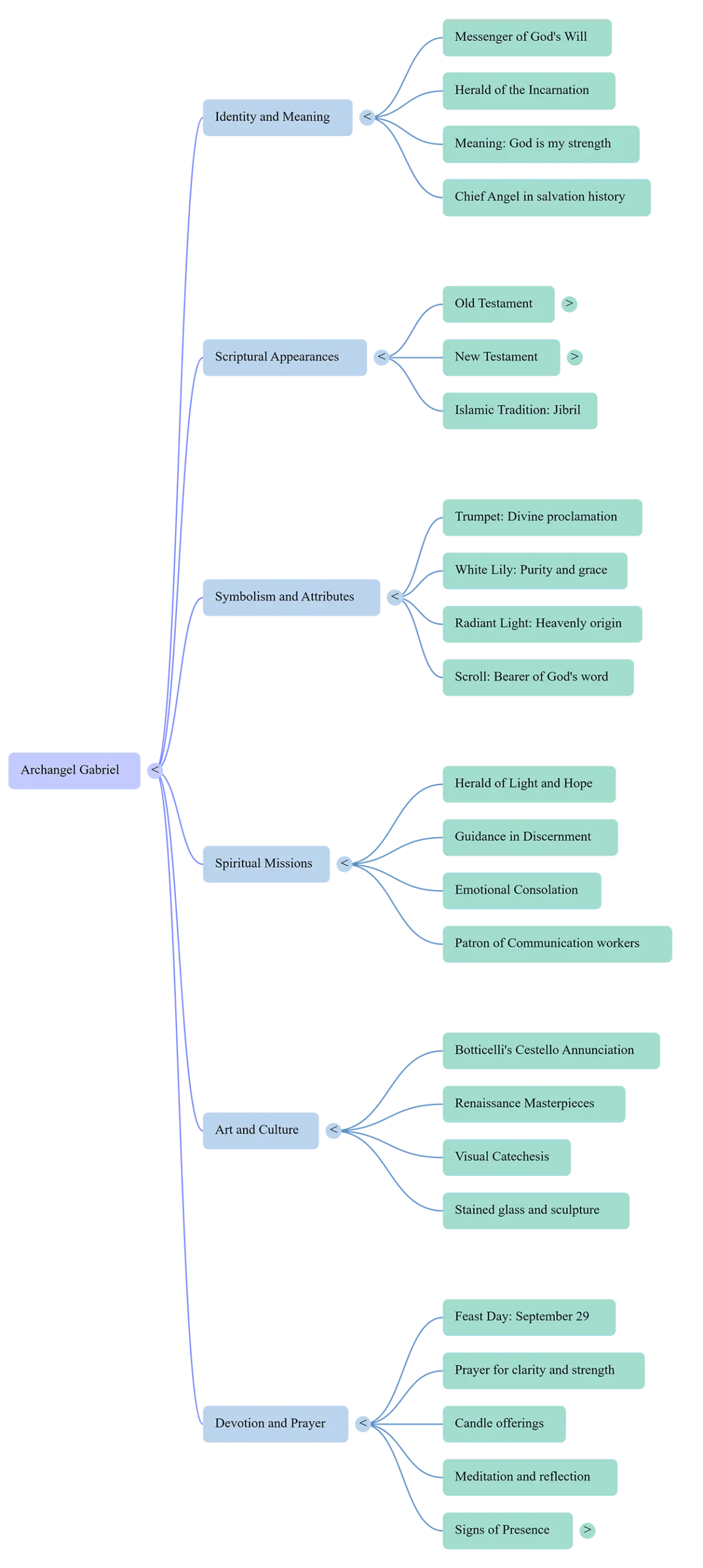
The mind map below summarizes the main theological, symbolic, and devotional elements related to Archangel Gabriel discussed throughout this article (click to enlarge).
Conclusion
Archangel Gabriel stands as one of the most radiant and reassuring figures in Catholic tradition. As the divine herald, he is entrusted with messages that have shaped salvation history, announcing the Incarnation, guiding prophets, and offering clarity in God’s plan for humanity. His voice resounds with purity and truth, calling the faithful to listen, to trust, and to follow God’s will with humility and courage. Through Scripture, sacred art, and centuries of devotion, Gabriel continues to inspire those who seek divine direction. His presence is a light for those walking in spiritual darkness, a gentle guide through seasons of uncertainty, and a faithful companion to all who strive to hear the voice of God. In honoring Gabriel, we do not merely admire an angelic figure, we respond to a call: to be open, to say “yes” like Mary, and to carry God’s message of hope into the world.
✦ Free Christian & Catholic Printables
Devoted to the archangels? Print their prayer cards at home — St Michael, St Gabriel, St Raphael and Uriel, plus the St Michael novena — free, in illuminated style, ready to print in one place.
Browse all free printables →Paintings Referenced in the Article
| Title | Artist | Date | Medium | Museum |
|---|---|---|---|---|
| Annunciazione di Cestello | Sandro Botticelli | c. 1489–1490 | Tempera on panel | Uffizi Gallery, Florence |
Frequently Asked Questions
Is Archangel Gabriel an angel or an archangel?
Gabriel is one of the three archangels named in the Bible. In Catholic tradition, archangels are chief angels entrusted with major missions in salvation history.
What did Archangel Gabriel say to Mary?
In Luke 1:28, Gabriel greets Mary with the words, “Hail, full of grace, the Lord is with you,” announcing that she would conceive and bear Jesus, the Son of God. This event is known as the Annunciation.
What is Archangel Gabriel the patron saint of?
Archangel Gabriel is traditionally considered the patron of messengers, communication workers, broadcasters, and those seeking clarity in speech and vocation.
What is Archangel Gabriel known for in the Bible?
Gabriel is known for delivering important messages from God, especially the Annunciation to the Virgin Mary (Luke 1:26–38) and the announcement of John the Baptist’s birth to Zechariah (Luke 1:11-20).
What does the name Gabriel mean?
Gabriel means “God is my strength,” reflecting the archangel’s role as a messenger of divine truth and strength.
How is Gabriel depicted in Catholic art?
Gabriel is often shown with a trumpet or lily, symbolizing his role as a messenger and his association with purity. He is frequently depicted in scenes of the Annunciation.
How can I pray to Archangel Gabriel?
You can pray to Gabriel by asking for clarity, courage, and guidance. Simple prayers or meditations invoking his presence help foster spiritual openness and discernment.
Is Gabriel mentioned in other religions?
Yes. Gabriel (Jibril) is also honored in Islam as the angel who revealed God’s word to the Prophet Muhammad.
Where can I buy an Archangel Gabriel poster or canvas print?
You can buy Archangel Gabriel art at jesuschrist.pictures: our shop offers the St. Gabriel prayer poster as well as canvas reproductions of the great angel paintings.