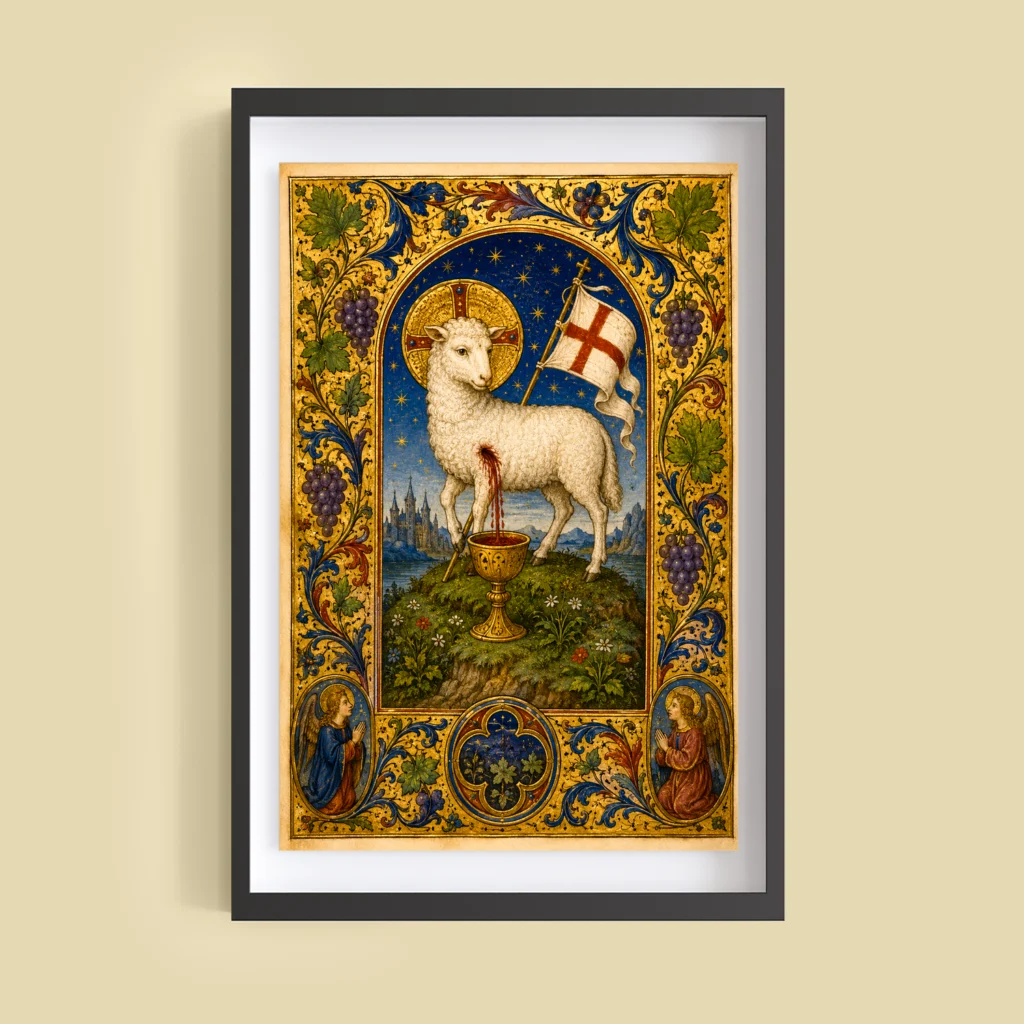
Agnus Dei: 7 Famous Lamb of God Paintings, From Van Eyck to Zurbaran
The Lamb of God, in Latin the Agnus Dei, is one of the oldest and richest images in Christian art. It comes from the Gospel of John, where John the Baptist sees Christ approaching and says, “Behold the Lamb of God, who takes away the sin of the world.” Where the Good Shepherd shows Christ carrying the lamb, the Agnus Dei turns the picture around: here Christ is himself the lamb, the innocent victim led to sacrifice, and in the Book of Revelation the same Lamb stands slain yet living, worshipped by all heaven. For more than a thousand years artists have painted this quiet, unsettling subject, and the seven works below trace its long history. It begins in a golden mosaic in Ravenna, passes through the mystic Lamb of Van Eyck and the harrowed Christ of Grunewald, and arrives at the bound, silent lamb of Zurbaran, one of the most moving religious pictures ever made. Along the way the Lamb is by turns a king in glory, a sacrifice on an altar, and a real animal with its legs tied, but the meaning holds: a love that gives itself away.
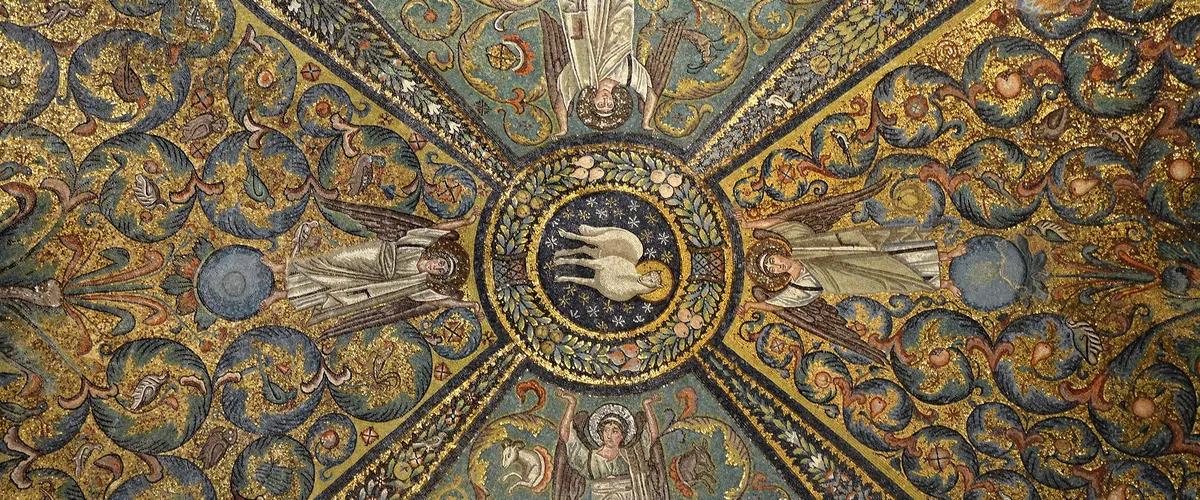
1. The Lamb of God mosaic, San Vitale, Ravenna (c. 547)
The earliest images of Christ were often not of a man at all but of a lamb. High in the vault of the presbytery of the Basilica of San Vitale in Ravenna, a small white Lamb with a golden halo floats in a ring of stars, held up by four angels who stand on globes at the corners of the vault. Around them spreads a paradise of gold scrollwork, birds, and fruit.
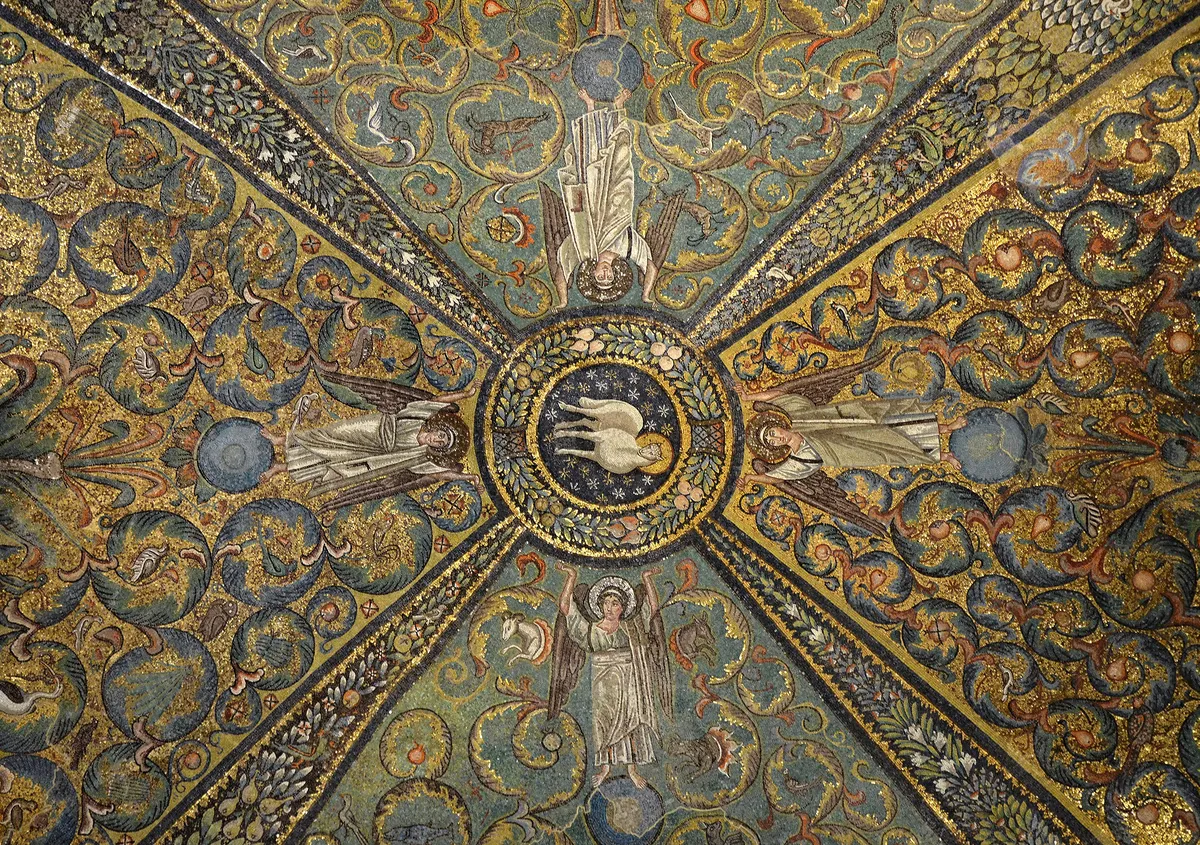
The mosaic dates from about 547, the great age of early Christian and Byzantine art, when the Lamb was one of the most common ways of picturing the Saviour. It was so common that in 692 a church council in Constantinople asked artists to show Christ in human form instead of as a lamb, so that the truth of his life would not be lost in a symbol. Images like this one survived, and the Lamb of God went on shining over the altar, where the sacrifice it stands for is renewed.
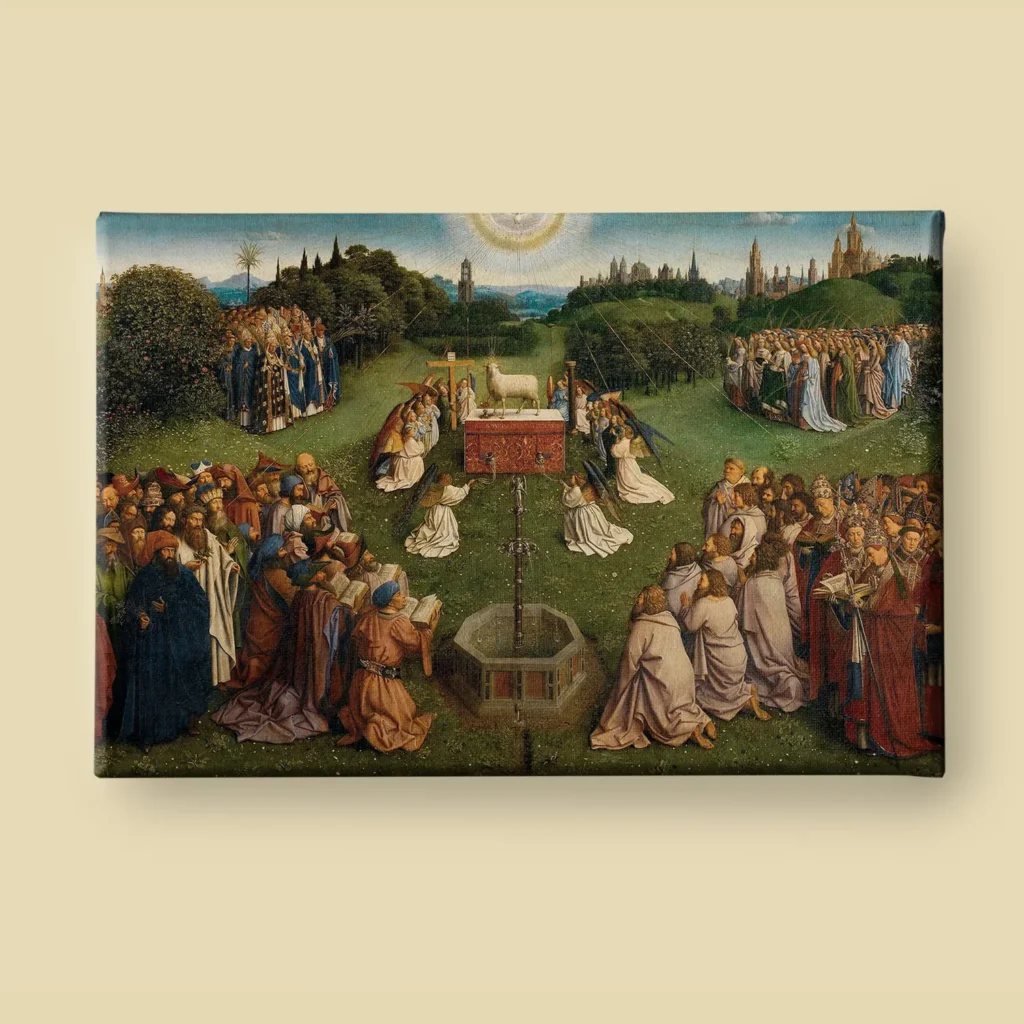
2. The Adoration of the Mystic Lamb by Jan van Eyck (1432)
The most famous Lamb of God in all of art stands at the centre of the Ghent Altarpiece, the vast polyptych finished in 1432 by Jan van Eyck and his brother Hubert. In a wide green meadow the white Lamb stands on an altar, blood streaming from its breast into a golden chalice, while angels kneel around it with the instruments of the Passion and crowds of prophets, apostles, martyrs, and virgins come from every side to adore.
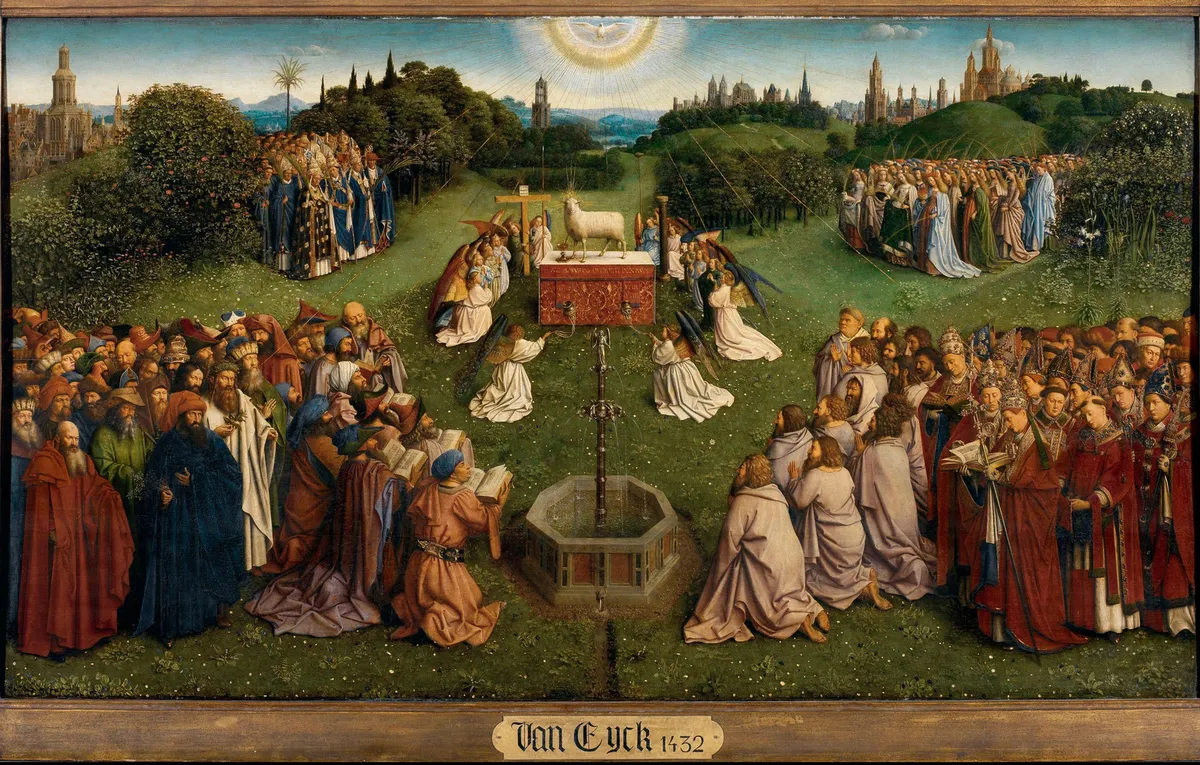
Above the Lamb hovers the dove of the Holy Spirit, and below it the Fountain of Life pours out over the grass. The whole scene is drawn from the Book of Revelation and from the words of the Mass. When the panel was cleaned in 2020, restorers removed centuries of overpaint and uncovered the Lamb’s original face, startlingly human and staring straight out at the viewer, a detail that made headlines around the world and reminded everyone that this gentle animal is meant to be Christ himself.
3. The Adoration of the Lamb by Albrecht Durer (c. 1496-1498)
The young Albrecht Durer gave the Lamb of God its most dramatic form in his series of woodcuts illustrating the Apocalypse. In this sheet the Lamb stands within a blazing sun at the top of the image, a slender cross on its shoulder, again bleeding into a chalice, while below it the elders cast down their crowns and the great multitude of the redeemed lift up palms and sing.
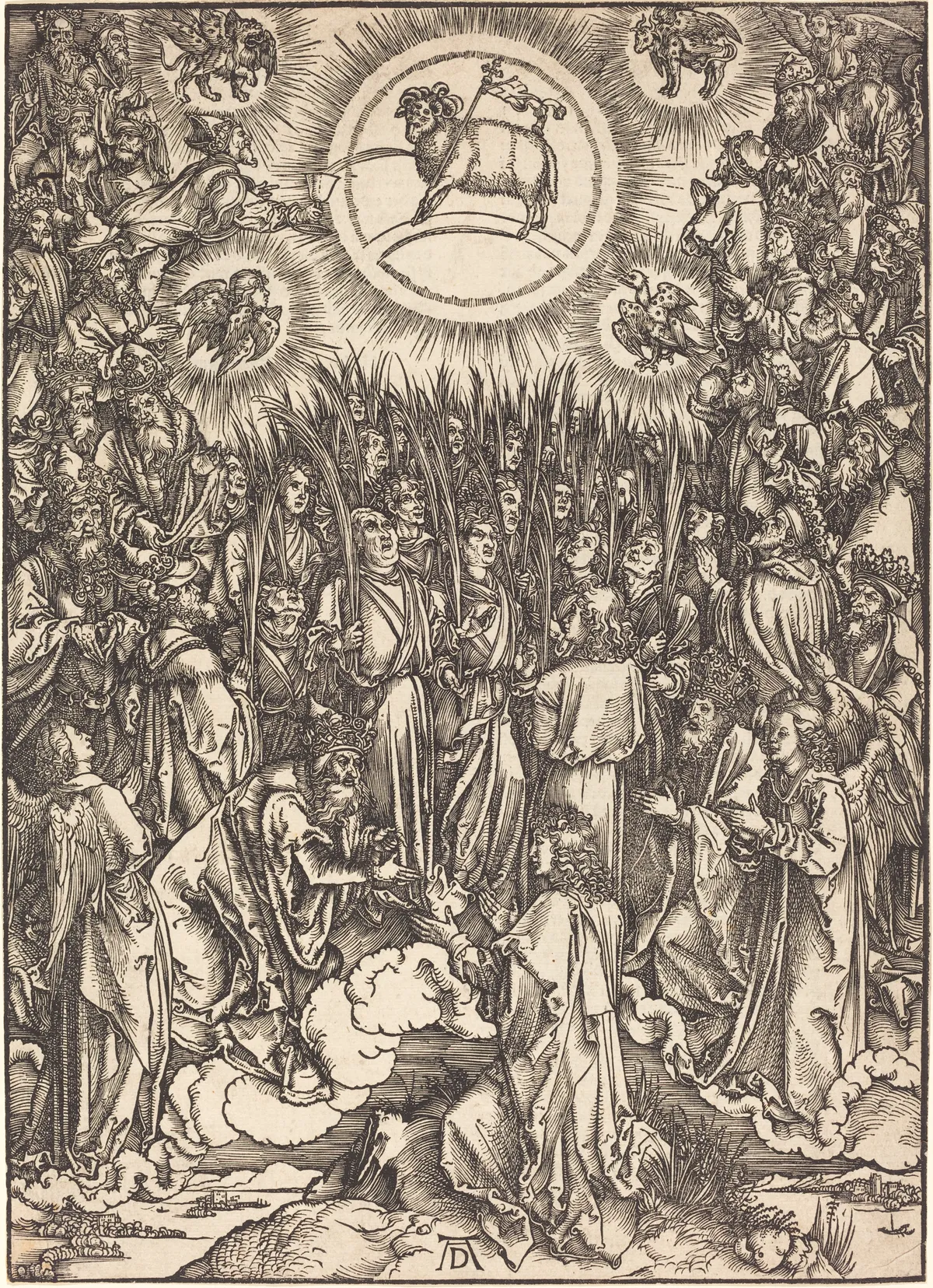
Printed in 1498, the Apocalypse woodcuts made Durer famous across Europe while he was still in his twenties. This is not a painting but a print, cut in wood and pulled in black ink, yet its power rivals any altarpiece. It shows the other side of the Agnus Dei: not only the victim slain on earth but the triumphant Lamb of heaven, worthy, as Revelation says, to open the scroll and receive the worship of all creation.
4. John the Baptist and the Lamb of God by Matthias Grunewald (c. 1512-1516)
On the closed wings of the Isenheim Altarpiece, Matthias Grunewald painted the most terrible Crucifixion in Western art, made for a hospital where patients dying of a burning disease could see their own suffering in the tortured body of Christ. At the right of the cross stands John the Baptist, calm and grave, pointing with a long finger, and beside the Latin words “He must increase, but I must decrease.”
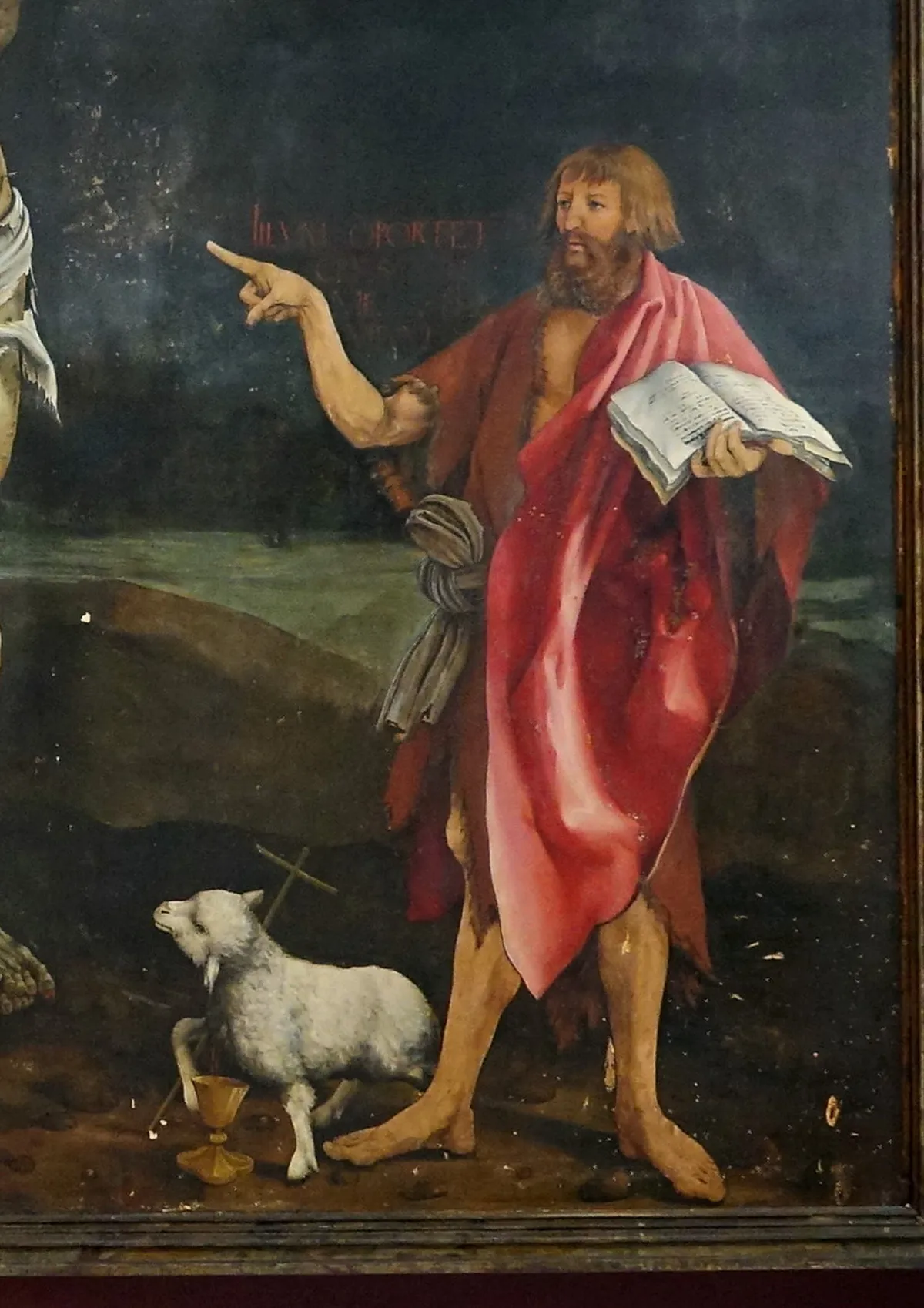
At the Baptist’s feet stands a small white Lamb, a slender cross against its shoulder, its blood running into a golden cup. The Baptist was long dead before the Crucifixion, so his presence here is not history but meaning: he is the one who first cried “Behold the Lamb of God,” and Grunewald sets him beside the crucified Christ and the sacrificial Lamb to say that the man on the cross and the Lamb on the ground are one and the same. The altarpiece is kept in the Musee Unterlinden in Colmar.
5. Agnus Dei by Francisco de Zurbaran (c. 1635-1640)
No painter ever said more with less than Francisco de Zurbaran in his Agnus Dei. A single young lamb lies on a bare grey ledge against a black ground, its four legs bound with cord, its head resting quietly, waiting. There is no halo, no inscription, no angel, only the animal, painted with such tender, unflinching truth that it seems to breathe.
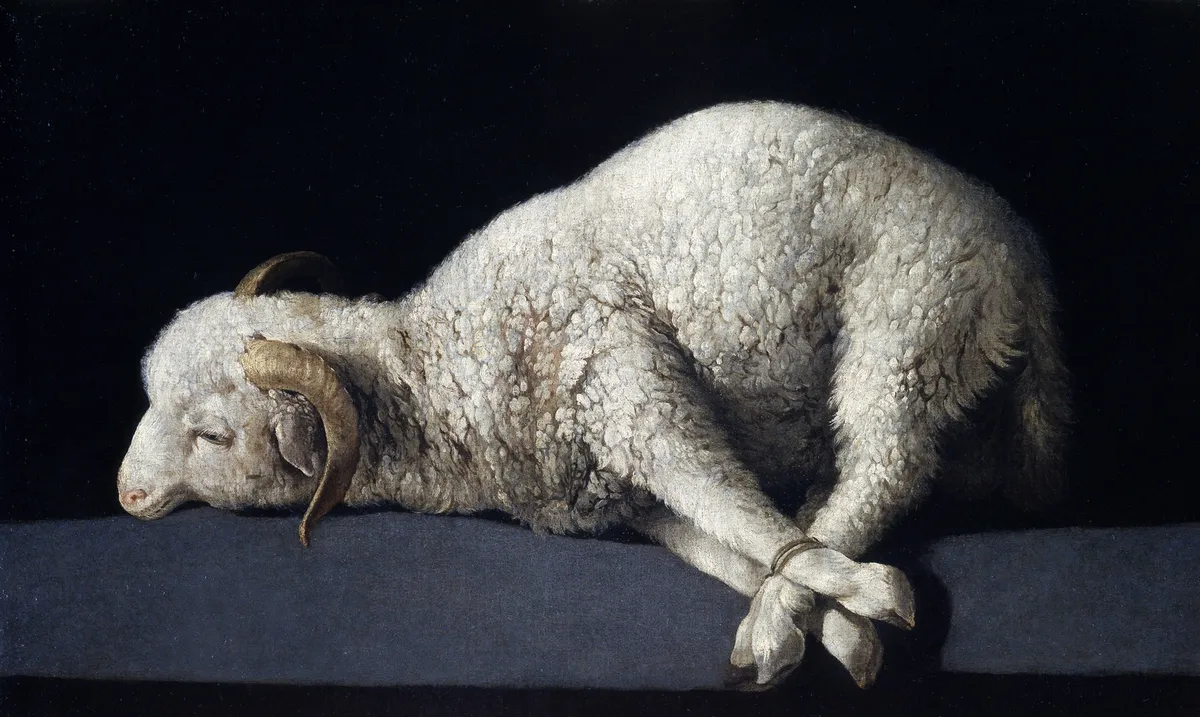
Zurbaran, the great painter of Spanish monastic life, returned to this subject several times, and the finest version hangs in the Museo del Prado in Madrid. He shows no violence at all, and that is why it is so moving: the lamb is simply tied and still, and the viewer is left to remember that this is a picture of Christ, silent before his accusers, giving himself up without a struggle. A second version of the same composition is now in the San Diego Museum of Art in the United States.
6. The Infant Saint John the Baptist with the Lamb by Murillo (c. 1660s)
The Spanish master Bartolome Esteban Murillo painted the Lamb of God at its gentlest. Here the Baptist is a small curly haired child, dressed in the camel skin of the desert, who leans forward to embrace a soft white lamb and holds a slender reed cross with a little banner. He smiles down at the animal with pure, untroubled love.
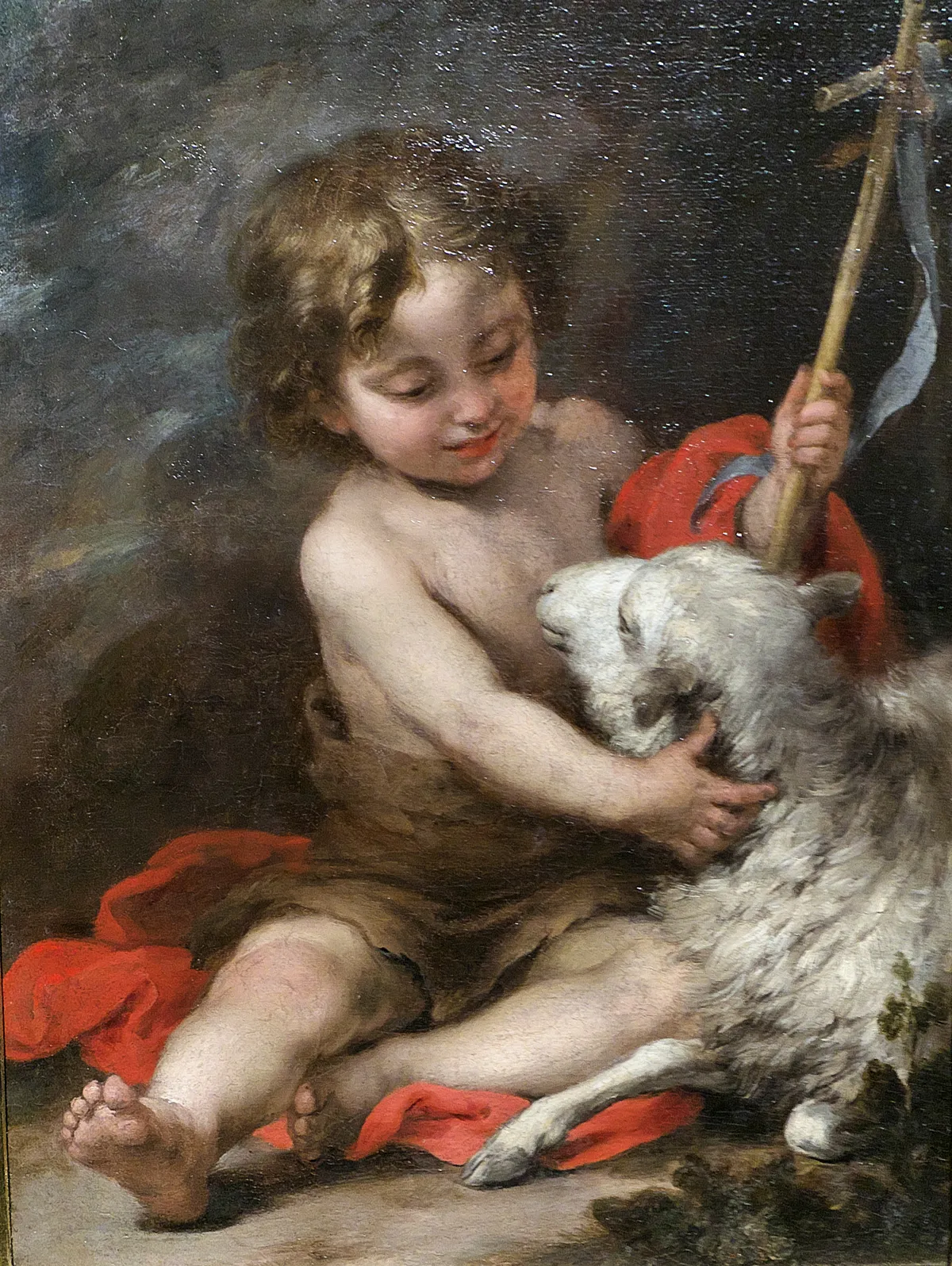
Murillo loved these tender images of holy children, and this one carries a quiet meaning. The child is the future Baptist, the man who will one day point to Christ and cry “Behold the Lamb of God,” and the lamb in his arms is the sign of the friend he does not yet know he must announce. It is the mirror image of Murillo’s own Good Shepherd: there the child Christ tends a lamb, here the child Baptist embraces the Lamb who is Christ. The painting is in the National Gallery of Ireland in Dublin.
7. Agnus Dei by Josefa de Obidos (c. 1670-1684)
A generation after Zurbaran, the Portuguese painter Josefa de Obidos took his austere lamb and wrapped it in flowers. In her Agnus Dei a bound white lamb, this time with a golden halo, lies on a stone slab inside an oval frame, and around it she has heaped a garland of roses, lilies, carnations, grapes, and wheat, with a little cherub looking down from above.
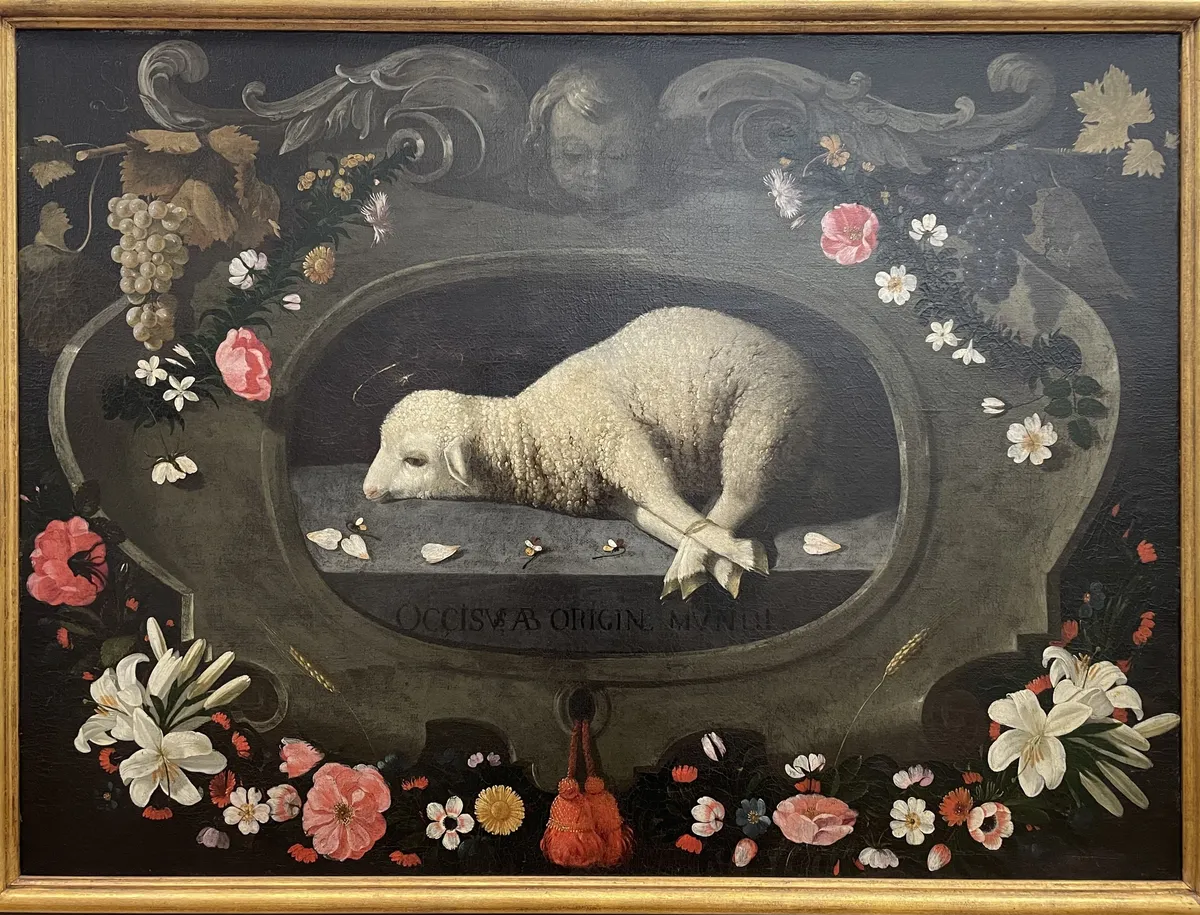
Josefa de Obidos was one of the very few women to run her own painting workshop in the seventeenth century, and she was celebrated for exactly this kind of rich still life. The flowers and fruit are not decoration only: the lilies stand for purity, the grapes and wheat for the bread and wine of the Mass, and the Latin words beneath the lamb, “slain from the foundation of the world,” come straight from the Book of Revelation. The painting is kept in the Museu Nacional Frei Manuel do Cenaculo in Evora, Portugal.
Summary of the Works
| Work | Artist | Date | Medium | Location |
|---|---|---|---|---|
| The Lamb of God | Early Christian mosaic | c. 547 | Mosaic | Basilica of San Vitale, Ravenna |
| The Adoration of the Mystic Lamb | Hubert and Jan van Eyck | 1432 | Oil on panel | Saint Bavo’s Cathedral, Ghent |
| The Adoration of the Lamb | Albrecht Durer | c. 1496-1498 | Woodcut | Apocalypse series |
| The Lamb of God (Isenheim Crucifixion) | Matthias Grunewald | c. 1512-1516 | Oil on panel | Musee Unterlinden, Colmar |
| Agnus Dei | Francisco de Zurbaran | c. 1635-1640 | Oil on canvas | Museo del Prado, Madrid |
| The Infant Saint John with the Lamb | Bartolome Esteban Murillo | c. 1660s | Oil on canvas | National Gallery of Ireland, Dublin |
| Agnus Dei | Josefa de Obidos | c. 1670-1684 | Oil on canvas | Museu Nacional Frei Manuel do Cenaculo, Evora |
Conclusion
From a starry mosaic in Ravenna to a bound lamb on a bare ledge, the Agnus Dei has never lost its strange power. Van Eyck made it a king adored by all heaven, Durer a triumphant vision of the Apocalypse, Grunewald a witness beside the cross, Zurbaran a silent victim, Murillo a child’s playmate, and Josefa de Obidos a jewel set in flowers. Each returns to the same few words of John the Baptist, “Behold the Lamb of God,” and to the same mystery: that the God who made the world chose to enter it as its gentlest creature and to be given up for it. For the shepherd who carries the lamb rather than becoming it, see our gathering of Good Shepherd paintings, and for the wider story that the Lamb completes, our survey of biblical paintings. The lamb is also one of the twelve Christian symbols children can color on our free coloring pages.
Important Facts About the Lamb of God in Art
- The title comes from the Gospel of John, where John the Baptist points to Christ and says, “Behold the Lamb of God, who takes away the sin of the world.”
- The Lamb was one of the earliest images of Christ, common in the Roman catacombs and in early mosaics such as the one at San Vitale in Ravenna, of about 547.
- In the Book of Revelation the Lamb appears “slain yet standing,” worshipped by all heaven, which is the scene Van Eyck and Durer painted.
- The Lamb is often shown bleeding into a chalice, linking the sacrifice of Christ to the wine of the Mass and the Eucharist.
- Francisco de Zurbaran’s Agnus Dei, of about 1635 to 1640 in the Prado, is the most famous single painting of the Lamb of God, remarkable for showing only the bound animal with no halo or inscription.
Questions and Answers
What does the Lamb of God symbolize?
The Lamb of God, or Agnus Dei, symbolizes Christ as the innocent victim who is sacrificed to take away the sin of the world. The image draws on the Passover lamb of the Old Testament and on the words of John the Baptist in the Gospel of John, “Behold the Lamb of God.” In art the Lamb often bleeds into a chalice, a sign of the Mass, and in the Book of Revelation it appears slain yet living and worshipped by all heaven, so the same figure stands for both sacrifice and victory.
Who painted the Lamb of God?
Many of the greatest artists painted the Lamb of God. The most famous versions are the Adoration of the Mystic Lamb by Jan van Eyck in the Ghent Altarpiece of 1432, the Apocalypse woodcut by Albrecht Durer of about 1498, the Lamb at the foot of the cross in Matthias Grunewald’s Isenheim Altarpiece, and above all the Agnus Dei by Francisco de Zurbaran in the Prado. Josefa de Obidos and Bartolome Esteban Murillo also left memorable versions in Spain and Portugal.
What is the most famous Lamb of God painting?
The single most famous painting of the Lamb of God is the Agnus Dei by Francisco de Zurbaran, of about 1635 to 1640, in the Museo del Prado in Madrid, which shows a young lamb with its legs bound lying on a bare ledge. The most famous scene of the Lamb adored is the central panel of the Ghent Altarpiece by Jan van Eyck, known as the Adoration of the Mystic Lamb, which draws crowds to Saint Bavo’s Cathedral in Ghent.
Why is Jesus called the Lamb of God?
Jesus is called the Lamb of God because he is understood as the perfect sacrifice, the innocent victim who takes the place of the sinner, just as a lamb was offered in the temple and at the Passover. John the Baptist gives him the title in the Gospel of John, and the Book of Revelation takes it up again, picturing Christ as a Lamb who was slain and yet lives forever. The name is spoken at every Mass in the prayer Agnus Dei, “Lamb of God, who takes away the sins of the world, have mercy on us.”
What is the Ghent Altarpiece Lamb of God?
The Ghent Altarpiece Lamb of God is the white Lamb at the centre of the great polyptych painted by Hubert and Jan van Eyck in 1432 for Saint Bavo’s Cathedral in Ghent. The Lamb stands on an altar in a green meadow, bleeding into a chalice and adored by saints and angels, in the panel known as the Adoration of the Mystic Lamb. A restoration completed in 2020 uncovered the Lamb’s original, strikingly human face, which had been hidden under later overpaint.
Can you buy Lamb of God paintings as canvas prints?
You can buy Lamb of God paintings at jesuschrist.pictures, in our shop, where classic works of Christian art are offered as high quality canvas prints. A faithful reproduction of Zurbaran’s Agnus Dei or of Van Eyck’s Mystic Lamb makes a quiet, contemplative piece for a home, a chapel, or a place of prayer. Browse our collection of Christian art reproductions on canvas to find an image of the Lamb that speaks to you.