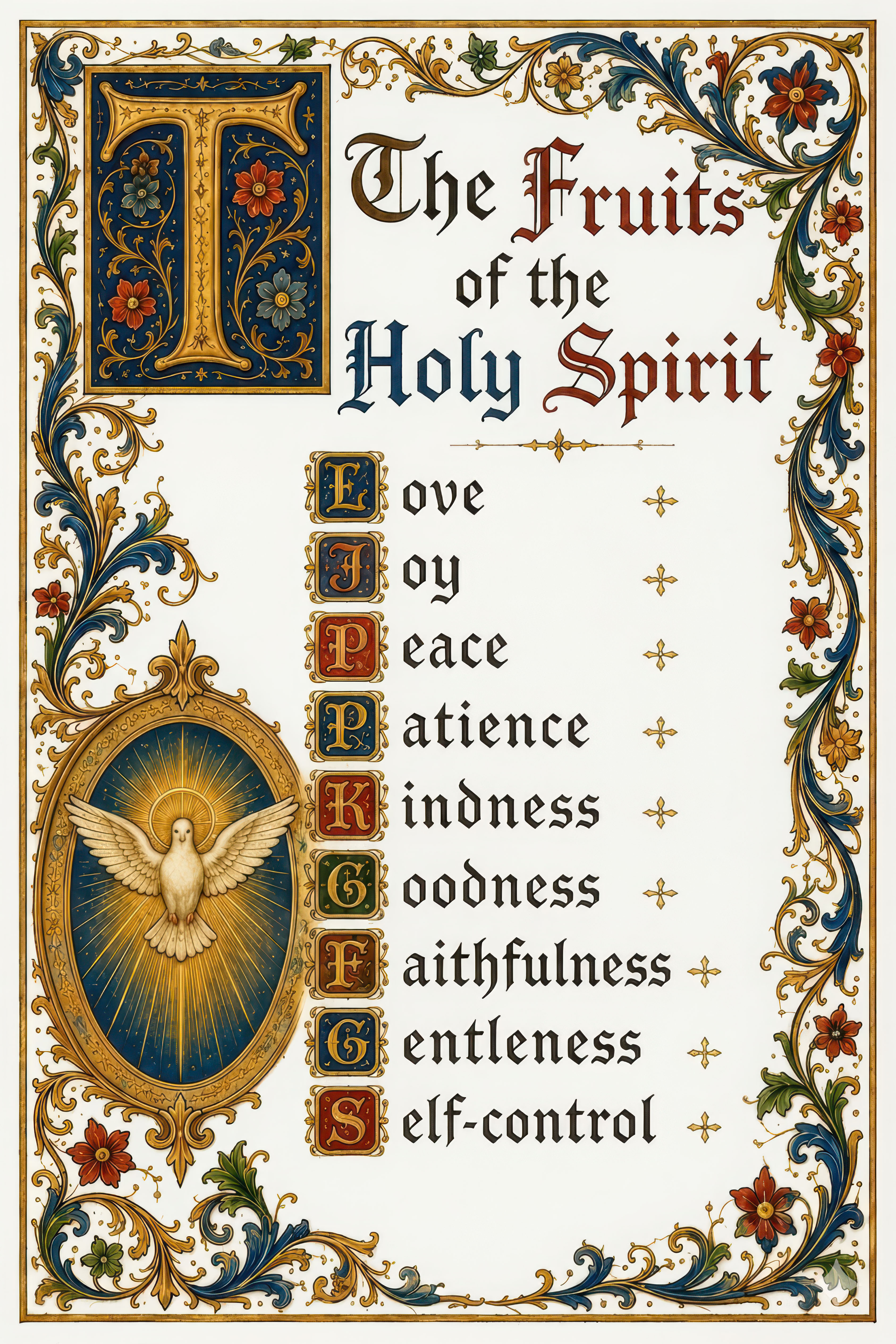
The Fruits of the Holy Spirit: Meaning and Sacred Art
The fruits of the Holy Spirit are the qualities that grow in a person who lives close to God. Saint Paul names them in his letter to the Galatians, and the Church has treasured the list ever since as a simple test of the spiritual life: not what we feel or claim, but what we actually produce. A good tree is known by its fruit, and a soul filled with the Spirit is known by love, joy, peace, and the rest.
This guide explains what the fruits of the Holy Spirit are, gives the full list from Galatians 5:22-23, shows why the Catholic tradition counts twelve fruits instead of nine, and clears up the common confusion between the fruits and the gifts of the Holy Spirit. Along the way we look at how painters have pictured the coming of the Spirit and the virtues it brings to life. For the wider story of Christian painting, see our overview of famous Christian paintings.

What Are the Fruits of the Holy Spirit?
The fruits of the Holy Spirit are the visible virtues and good qualities that appear in the life of a person who follows the lead of the Spirit. They are not skills we achieve by willpower alone. They grow, the way fruit grows on a healthy tree, when a soul stays joined to God through faith, prayer, and the sacraments.
Saint Paul puts it directly in his letter to the Galatians: “But the fruit of the Spirit is love, joy, peace, patience, kindness, goodness, faithfulness, gentleness and self-control. Against such things there is no law” (Galatians 5:22-23). He sets this list against the “works of the flesh” he has just described, things like envy, anger, and division. The contrast is the point. You can tell which power is at work in a life by the fruit it bears.
Teachers often use the image of a garden. The Holy Spirit is like the sun and the rain, and the fruits are the harvest that ripens when we let that grace work in us. The coming of the Spirit at Pentecost, shown in the painting above, is the moment this new life is poured out on the Church.
The Fruits and the Gifts of the Holy Spirit Are Not the Same
A common confusion is to mix up the fruits of the Holy Spirit with the gifts of the Holy Spirit. They are connected but different. The seven gifts, drawn from the prophet Isaiah, are wisdom, understanding, counsel, fortitude, knowledge, piety, and fear of the Lord. They are the inner capacities the Spirit gives us, the tools for living a holy life.

The fruits are the results. If the gifts are the seeds and the sunshine, the fruits are the ripe harvest that anyone can see and taste. Masaccio’s Holy Trinity makes the source of both visible: the dove of the Holy Spirit hovers between God the Father and the crucified Son, the same Spirit poured into the believer. You can read more about this groundbreaking fresco in our article on Masaccio’s Holy Trinity.
The Nine Fruits of the Holy Spirit
In most modern translations of Galatians, Saint Paul lists nine fruits. Here they are with their meaning:
- Love, the unconditional, self-giving goodwill that puts others first.
- Joy, a deep gladness rooted in God that does not depend on circumstances.
- Peace, a calm confidence in God’s care even in the middle of trouble.
- Patience, the strength to endure delays, hardship, and difficult people with grace.
- Kindness, warmth and compassion shown in action.
- Goodness, an uprightness of heart that keeps choosing what is right.
- Faithfulness, loyalty and reliability, keeping our word and our trust in God.
- Gentleness, strength under control, humble and tender rather than harsh.
- Self-control, the mastery of our desires and impulses.
These nine are sometimes remembered in three groups: love, joy, and peace describe our relationship with God; patience, kindness, and goodness shape how we treat others; and faithfulness, gentleness, and self-control order our own hearts.
Why Catholics List Twelve Fruits
The Catholic tradition often speaks of twelve fruits rather than nine. The difference comes from the Latin Vulgate, the translation Saint Jerome made in the fourth century, which included three more terms. Following it, the Catechism of the Catholic Church lists twelve fruits: charity, joy, peace, patience, kindness, goodness, generosity, gentleness, faithfulness, modesty, self-control, and chastity.

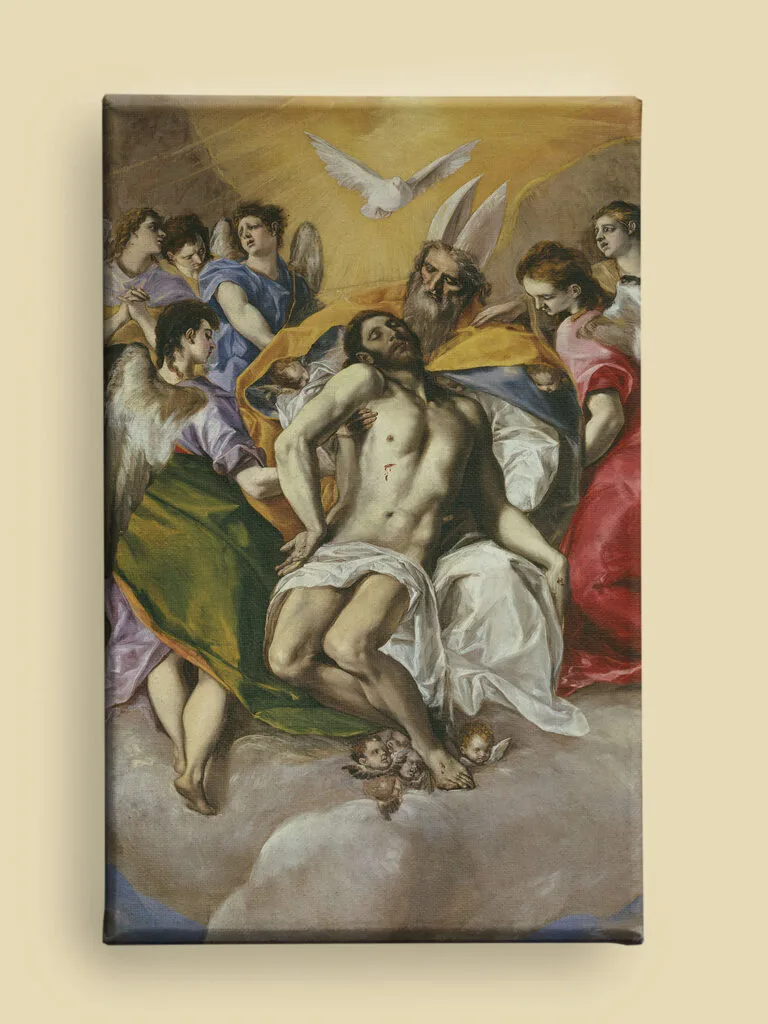
The three that the longer list adds are generosity, modesty, and chastity. They do not contradict Saint Paul; they simply draw out qualities already contained in his words. El Greco’s Holy Trinity shows the Spirit as a radiant dove crowning the Father and the Son, the source from which all these fruits flow. Whether the count is nine or twelve, the meaning is the same: a life shaped by the Spirit looks like this.
The Fruits Made Visible
The fruits of the Holy Spirit are never meant to stay hidden inside. They show in what we do. Charity becomes generosity to the poor; goodness becomes honesty; kindness becomes care for the suffering.
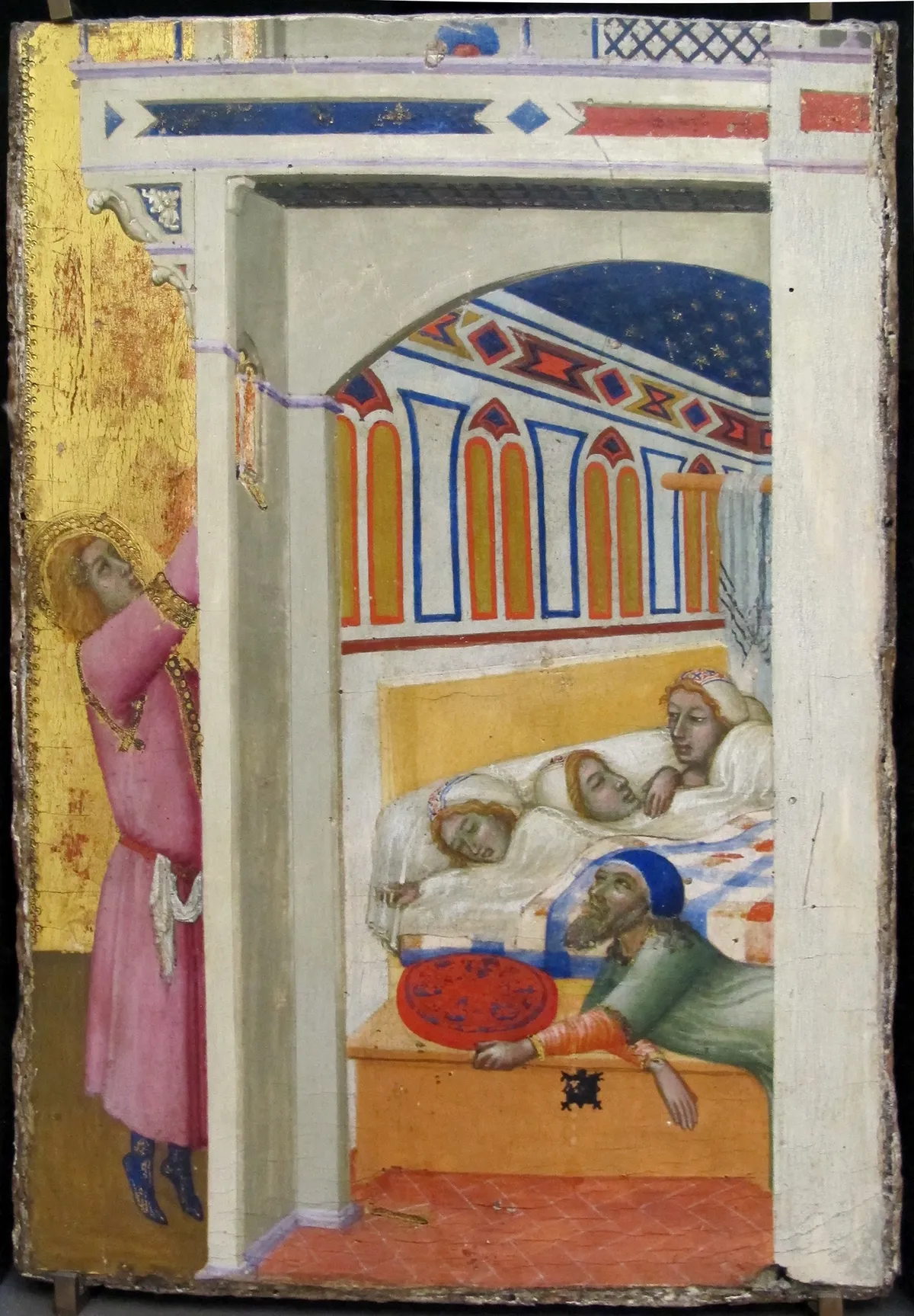
Ambrogio Lorenzetti caught this in his small panel of Saint Nicholas, who throws gold in secret through a window to save three poor sisters from ruin. It is charity, generosity, and goodness all at once, the fruit of the Spirit made into a single quiet act. This is what Saint Paul means: the proof of the Spirit is not in grand words but in a changed life. For more sacred stories told in paint, browse our gallery of famous biblical masterpieces.
A Free Printable Fruits of the Holy Spirit Poster
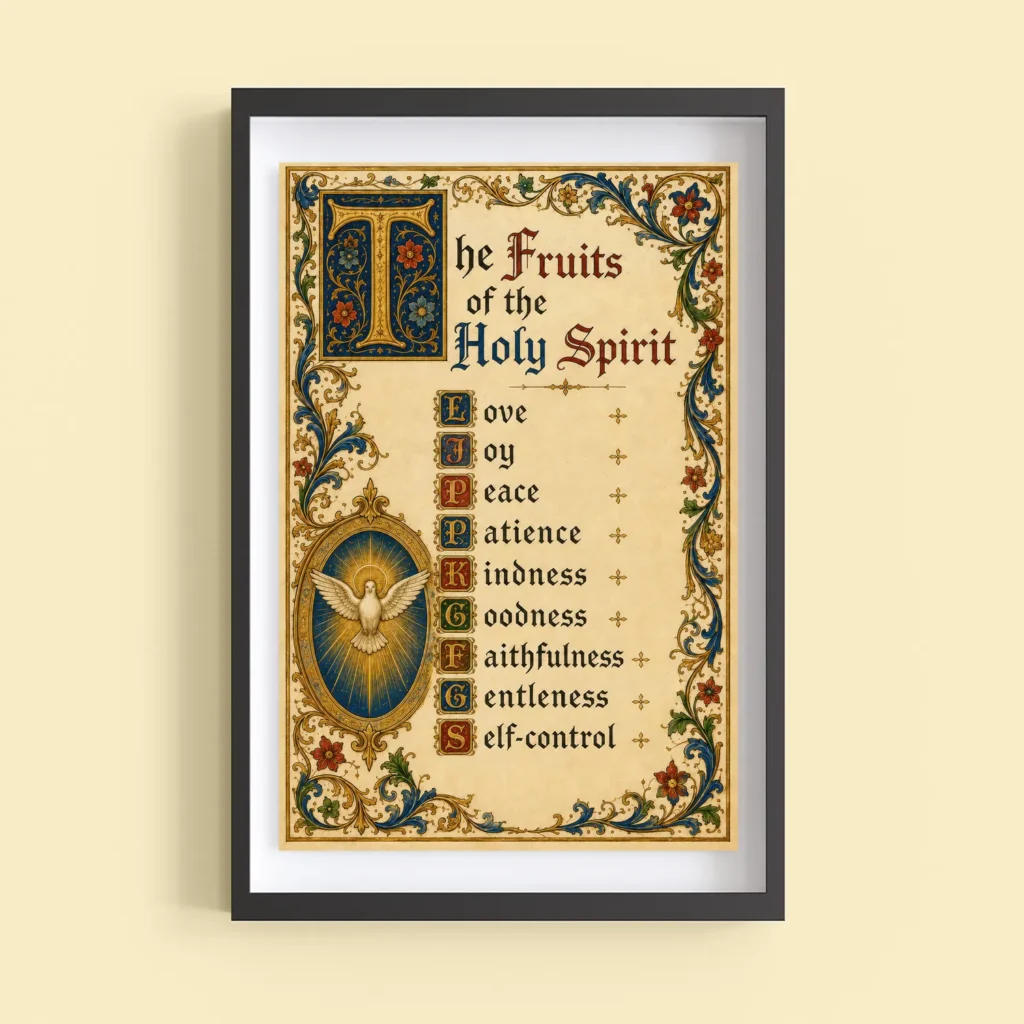
The nine fruits of the Spirit make a beautiful verse to keep in view. This poster sets Galatians 5:22-23 in a clean, illuminated style, ready for a classroom, a nursery, a parish hall, or a quiet corner at home.
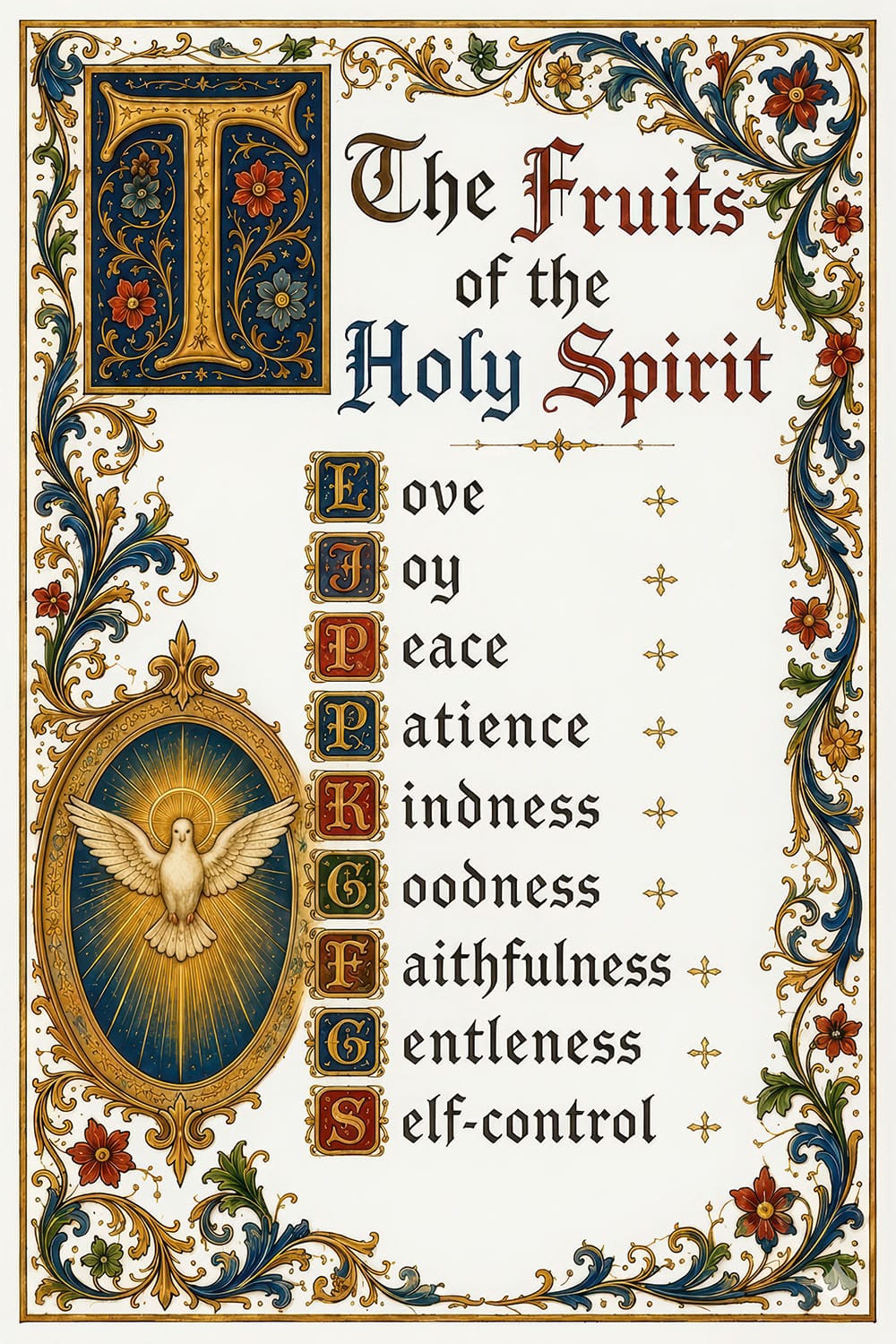
- Poster, PDF, US Letter
- Poster, PDF, A4
- Pocket prayer cards, 4 per sheet, PDF
- High resolution image, JPG
These files are free for personal use, for your parish, or for catechism class.
Paintings Featured in This Article
| Painting | Artist | Date | Museum |
|---|---|---|---|
| The Descent of the Holy Spirit | Hans Multscher | 1437 | Gemaeldegalerie, Berlin |
| The Holy Trinity | Masaccio | c. 1427 | Santa Maria Novella, Florence |
| The Holy Trinity | El Greco | 1577-1579 | Museo del Prado, Madrid |
| The Charity of Saint Nicholas of Bari | Ambrogio Lorenzetti | c. 1332 | Uffizi, Florence |
Conclusion
The fruits of the Holy Spirit give the spiritual life a face you can recognise. They turn faith from an idea into something that can be seen and felt: a patient parent, a generous neighbour, a peaceful heart in a hard week. Whether we count nine fruits with Saint Paul or twelve with the Catholic tradition, the message does not change. The Spirit who came down at Pentecost is still at work, ripening these qualities in anyone who stays close to God.
That is why the fruits are worth learning by heart and keeping in view. They are not a checklist to be earned but a harvest to be welcomed. To follow the Spirit through the great moments of salvation, read our article on the Holy Trinity in art, or explore the wider tradition in our guide to famous Christian paintings.
Key Facts About the Fruits of the Holy Spirit
- They are named by Saint Paul in Galatians 5:22-23 as love, joy, peace, patience, kindness, goodness, faithfulness, gentleness, and self-control.
- Most modern translations count nine fruits, while the Catholic tradition, following the Latin Vulgate, lists twelve.
- The three extra fruits in the longer list are generosity, modesty, and chastity.
- The fruits are different from the seven gifts of the Holy Spirit, which are wisdom, understanding, counsel, fortitude, knowledge, piety, and fear of the Lord.
- They are understood as the result of living by the Spirit, the visible harvest of grace at work in a life.
Frequently Asked Questions
What are the 12 fruits of the Holy Spirit?
The Catholic Church, following the Latin Vulgate, lists twelve fruits of the Holy Spirit: charity, joy, peace, patience, kindness, goodness, generosity, gentleness, faithfulness, modesty, self-control, and chastity. They are listed in the Catechism of the Catholic Church as the first fruits of eternal glory.
What are the 9 fruits of the Holy Spirit and their meanings?
In Galatians 5:22-23 Saint Paul lists nine fruits: love (self-giving goodwill), joy (gladness rooted in God), peace (calm trust in God), patience (endurance with grace), kindness (compassion in action), goodness (an upright heart), faithfulness (loyalty and reliability), gentleness (strength under control), and self-control (mastery of our desires).
What is the difference between the fruits and the gifts of the Holy Spirit?
The seven gifts of the Holy Spirit, drawn from Isaiah, are inner capacities given by God: wisdom, understanding, counsel, fortitude, knowledge, piety, and fear of the Lord. The fruits are the results those gifts produce in a life. If the gifts are the seeds and the sunshine, the fruits are the visible harvest.
Where are the fruits of the Holy Spirit in the Bible?
They are found in the New Testament, in Saint Paul’s letter to the Galatians, chapter 5, verses 22 and 23. Paul sets the fruit of the Spirit against the works of the flesh he describes just before, so the list reads as the mark of a life led by the Spirit.
Can you buy a Fruits of the Holy Spirit poster?
You can buy the Fruits of the Holy Spirit at jesuschrist.pictures, in our shop, where Galatians 5:22-23 is offered as a large poster on high quality matte paper. A free printable version is also available on this page for personal use, for your parish, or for catechism class.
✦ Free Christian & Catholic Printables
Love this one? Find it, along with our complete collection of illuminated prayer cards & Scripture printables, ready to print, free, in one place.
Browse all free printables →