Millais’ Christ in the House of His Parents: The Painting They Hated
Christ in the House of His Parents is one of the most famous and most controversial religious paintings of the Victorian age, made by John Everett Millais between 1849 and 1850. It shows the Holy Family not in glory but at work, in the dust and shavings of Saint Joseph’s carpentry shop. The painting hangs in Tate Britain in London. The museum records its medium as oil on canvas.
The scene looks at first like an ordinary domestic accident. The boy Jesus has cut his hand on a nail, and his mother bends to comfort him while Joseph and the others gather round. Yet almost every object in the room points beyond the moment, toward the cross.
Millais was barely twenty when he painted it, a founding member of the Pre-Raphaelite Brotherhood. The young painters wanted to sweep away academic convention and return to honest, detailed observation of nature, even when the subject was sacred.
When the picture was shown in 1850 it caused an outcry. Readers interested in the movement can also explore our wider look at Pre-Raphaelite Jesus paintings.
The History of Christ in the House of His Parents
Millais painted the work in 1849 to 1850, when he was still a very young man at the start of the Pre-Raphaelite movement. He studied a real carpenter’s shop for the setting, used family and friends as models, and even worked from a sheep’s head from the butcher to paint the animals, all in the name of truth to nature.

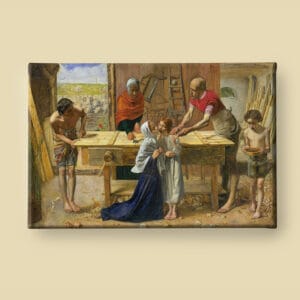
The painting is also known as The Carpenter’s Shop. It entered the national collection and now hangs in Tate Britain, where it is one of the best known of all Pre-Raphaelite works.
The Scandal of 1850
When Christ in the House of His Parents was first exhibited, it shocked the public. Viewers were used to seeing the Holy Family idealized, clean and noble. Here they found a thin, red-haired boy, a careworn mother, and rough working people in a cluttered, dirty room.

The criticism was savage. Charles Dickens attacked the painting in print, calling the young Christ a “hideous, wry-necked, blubbering, red-headed boy” and describing the Virgin as so ugly she would stand out in the lowest company. The realism that Millais valued struck many as something close to blasphemy.
The Wounded Hand
At the heart of the painting is a small wound. The boy Jesus has cut the palm of his hand on a nail sticking out of the workbench, and a drop of blood has fallen onto his bare foot.

This is no accident of storytelling. The wound in the hand and the blood on the foot quietly foretell the marks of the crucifixion. Joseph leans in to examine the cut, his mother kisses the boy, and the whole family is gathered, without knowing it, around a sign of what is to come.
A Room Full of Symbols
Millais fills the workshop with details that point to the Passion and to Christ’s mission. On the right, a boy who is John the Baptist carries a bowl of water toward the wound, a hint of the baptism he will one day perform.

Through the open door at the back, a flock of sheep presses against the fence, standing for the future faithful gathered to the Lamb of God. A ladder, carpenter’s tools, and the door Joseph builds all carry their own echoes of the cross and of Christ as the way of salvation.

Truth to Nature: the Pre-Raphaelite Method
The power of the painting comes from its method. Millais worked with sharp focus across the whole surface, painting every shaving on the floor, every grain of wood, every line on a face with equal care. Nothing is blurred or softened in the academic manner.
This intense realism was the Pre-Raphaelite creed. By refusing to idealize the Holy Family, Millais brought the Gospel into the world of ordinary labor. The same honest attention to a humble scene can be felt in the work of his fellow Pre-Raphaelite William Holman Hunt, as in The Light of the World.
Conclusion
In Christ in the House of His Parents, John Everett Millais turned a quiet moment in a workshop into a deep meditation on the cross. The cut hand, the bowl of water, the waiting sheep, and the careful clutter of the shop all carry the weight of the coming Passion.
The painting that Victorian critics hated is now seen as a landmark. Its honesty, once read as insult, has come to feel like reverence, the Son of God shown sharing fully in the labor and frailty of human life.
Artwork Information
| Artwork | Artist | Date | Medium | Current Location |
|---|---|---|---|---|
| Christ in the House of His Parents | John Everett Millais | 1849 to 1850 | Oil on canvas | Tate Britain, London |
Five Facts About Christ in the House of His Parents
- Christ in the House of His Parents is an oil on canvas by John Everett Millais, kept at Tate Britain in London.
- It was painted in 1849 to 1850, when Millais was a young founder of the Pre-Raphaelite Brotherhood.
- The scene shows the boy Jesus wounding his hand on a nail in Joseph’s carpentry shop, a sign of the crucifixion to come.
- It is also known as The Carpenter’s Shop, and is filled with hidden symbols such as the bowl of water, the flock of sheep, and the ladder.
- When first shown it was fiercely attacked, most famously by Charles Dickens, for its realistic, working-class Holy Family.
FAQ
Why was Christ in the House of His Parents so controversial?
Victorian viewers expected the Holy Family to be shown idealized and noble. Millais instead painted them as ordinary working people in a dirty carpenter’s shop, which many found shocking, even irreverent.
What is the meaning of the painting?
The boy Jesus has cut his hand on a nail, and the blood falling to his foot foreshadows the wounds of the crucifixion. The bowl of water, the sheep, the ladder and the tools all point to Christ’s future Passion and mission.
Who criticized Christ in the House of His Parents?
The writer Charles Dickens was its most famous critic. He mocked the young Christ as a “hideous, wry-necked, blubbering, red-headed boy” and attacked the painting’s realism in print.
Why is it also called The Carpenter’s Shop?
The painting is set in Saint Joseph’s carpentry workshop, full of timber, tools and shavings. Because of this everyday setting, it became widely known as The Carpenter’s Shop.
When did Millais paint Christ in the House of His Parents?
He painted it in 1849 to 1850, early in his career as a Pre-Raphaelite.
Where is Christ in the House of His Parents today?
It is in Tate Britain in London.
Where can I buy a print of Millais’ Christ in the House of His Parents?
You can buy a print of Millais’ Christ in the House of His Parents at jesuschrist.pictures. The canvas reproduction is in our shop, printed on premium canvas and shipped worldwide.