Antonio Ciseri Paintings and His Famous Ecce Homo
If one painter brought the religious imagination of nineteenth century Italy to its highest pitch of theatrical realism, it was Antonio Ciseri. The Antonio Ciseri paintings known to every Catholic schoolchild today, above all the great Ecce Homo of Florence, blend the careful drawing of the Florentine Academy with a photographic sharpness that already belongs to the modern age. His Christ, his Virgin, his Roman governors are real men and women caught at a moment of crisis. Few artists since Caravaggio had made the gospel feel so immediate.
This article gathers six of his most important religious works, the ones that show how a Swiss-born painter trained in Florence became one of the most reproduced sacred image-makers of the Belle Époque.

From Ronco sopra Ascona to the Florentine Academy
Ciseri was born on 25 October 1821 in Ronco sopra Ascona, a small village above Lake Maggiore in the Italian-speaking part of Switzerland. His father was a fresco painter who had worked across Lombardy, and the boy showed his own gift early enough to be sent to Florence in 1833. He studied first with the engraver Ernesto Bonaiuti, then with Niccolò and Pietro Benvenuti at the Accademia di Belle Arti, and finally with Giuseppe Bezzuoli, the great history painter of Tuscany in the Risorgimento years.
By 1849 he had opened his own studio and was teaching a long line of pupils who would carry his manner across the Italian peninsula and to South America. He never went home for long, but he remained legally Swiss all his life, dividing his time between Florence and Locarno where he painted altarpieces for the parish churches of the Canton of Ticino.
Ecce Homo
This is the painting that made Ciseri famous and remains his masterpiece. Commissioned by the Italian government in 1871 and completed only a few months before his death, the Ecce Homo shows the moment in the Gospel of John when Pilate presents the scourged Christ to the Jerusalem crowd. We see the scene almost from behind, with Pilate’s back and his daughter’s silk gown filling the foreground, and Christ silent at the centre, his white linen brilliant in the sun. The crowd, suggested rather than shown, presses up from the courtyard below.

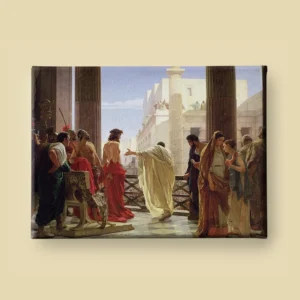
The painting was a sensation when first exhibited and has become one of the most reproduced sacred images of modern Catholicism. The original hangs at the Galleria d’Arte Moderna in the Palazzo Pitti, Florence.
The Entombment
Completed in 1864, The Entombment is one of Ciseri’s most ambitious public canvases. The body of Christ is lowered into the tomb by Joseph of Arimathea and Nicodemus while the Virgin and the holy women weep around him. The composition has the silent gravity of a frieze, and the lighting recalls the night Pietàs of the Bolognese seventeenth century. The figures are individualised to a degree rare in nineteenth century religious painting; each face is studied, each gesture deliberate.

The work is now in the Guildhall Art Gallery in London, where it was acquired in the nineteenth century as one of the most admired Italian religious paintings of its generation.
Madonna Addolorata
This single-figure devotional painting shows the Virgin of Sorrows in three-quarter length, her hands crossed against her breast, a sword piercing her heart. The face is Ciseri’s most concentrated study of grief, painted with the smooth, almost porcelain finish that gave his work its enormous popular appeal. The Virgin is not idealised; she is a woman in her forties whose son has died.

The painting is held by the Museo Civico of Montepulciano, in the heart of Tuscany.
Render unto Caesar
Painted in the 1860s, this version of the famous Gospel scene shows Christ holding the denarius coin and replying to the Pharisees who hoped to trap him. Ciseri places the figures in a Roman portico, with marble pillars, sandalled feet, and the late afternoon Mediterranean light. The composition reads almost like a stage tableau, with Christ at the centre and the disciples and Pharisees framing him in semicircle.

The painting is in a private collection but is frequently reproduced in Italian devotional publications.
The Apparition of the Sacred Heart to Saint Margaret Mary Alacoque
Saint Margaret Mary Alacoque, the seventeenth century Visitandine nun of Paray-le-Monial, received the great series of visions of the Sacred Heart of Jesus between 1673 and 1675. Ciseri painted this altarpiece for the church of the Sacred Heart in Florence, founded after the dogmatic definition of the cult in the nineteenth century. The saint kneels in adoration while Christ appears to her, revealing his open heart in his pierced chest.

The painting hangs at the church of the Sacro Cuore in Florence and is one of the most important nineteenth century treatments of this characteristically Catholic subject.
The Apparition of the Madonna to Bernadette at Lourdes
Painted in 1879, only a generation after the apparitions at the grotto of Massabielle in 1858, this image shows the young Bernadette Soubirous on her knees before the Virgin Mary, who appears in a halo of light above the wild rose bush. The picture combines documentary fidelity, Bernadette’s peasant dress is rendered with photographic care, and visionary clarity, the Virgin floats serene and bright against the grey rocks of the Pyrenees.

The original of this version is no longer publicly located, but the composition spread widely through prints, holy cards, and parish altarpieces across France and Italy.
For wider context, see our article on the broader tradition of Realist Jesus paintings, and on Ciseri’s contemporary William-Adolphe Bouguereau, the great French Academic master who shared his refined Catholic vision. The Italian illustrator Gustave Doré belongs to the same generation of nineteenth century sacred image-makers.
Summary Table of Antonio Ciseri’s Religious Paintings
| Name | Artist | Date | Medium | Museum |
|---|---|---|---|---|
| Ecce Homo | Antonio Ciseri | 1871 to 1891 | Oil on canvas | Galleria d’Arte Moderna, Palazzo Pitti, Florence |
| The Entombment | Antonio Ciseri | 1864 | Oil on canvas | Guildhall Art Gallery, London |
| Madonna Addolorata | Antonio Ciseri | c. 1870 | Oil on canvas | Museo Civico, Montepulciano |
| Render unto Caesar | Antonio Ciseri | c. 1865 | Oil on canvas | Private collection |
| Apparition of the Sacred Heart to Saint Margaret Mary Alacoque | Antonio Ciseri | c. 1875 | Oil on canvas | Church of the Sacro Cuore, Florence |
| Apparition of the Madonna to Bernadette at Lourdes | Antonio Ciseri | 1879 | Oil on canvas | Location unknown |
Conclusion
Ciseri stands at the meeting point of two ages. He kept the patient drawing and the polished finish of the Florentine Academy, and at the same time he absorbed the new visual habits of an age that had just invented photography. His religious paintings have a strange power. They are realistic enough to feel documentary and idealised enough to feel sacred. A century and a half after his death, the great Ecce Homo still stops viewers in the Palazzo Pitti, just as it did the day it was first unveiled.
Important Facts About Antonio Ciseri
- Antonio Ciseri was born on 25 October 1821 in Ronco sopra Ascona, in the Italian-speaking Canton of Ticino in Switzerland, the son of a Lombard fresco painter named Gaspare Ciseri.
- He moved to Florence at the age of twelve to study drawing under Ernesto Bonaiuti, and from 1834 he was a pupil of Niccolò and Pietro Benvenuti at the Accademia di Belle Arti, later working under Giuseppe Bezzuoli, the leading Tuscan history painter of the Risorgimento.
- Ciseri is the central figure of nineteenth century Italian religious painting, fusing the polished classical drawing of the Florentine Academy with the new pictorial sharpness shaped by the rise of photography.
- His most famous religious work is the monumental Ecce Homo, commissioned by the Italian government in 1871 and completed in 1891, now displayed at the Galleria d’Arte Moderna in the Palazzo Pitti, Florence.
- He died on 8 March 1891 in Florence and trained a long line of pupils, including Oreste Costa, Raffaello Sorbi, Niccolò Cannicci, and the Uruguayan painter Juan Manuel Blanes, who carried his style across Europe and the Americas.
Questions and Answers About Antonio Ciseri Paintings
What is Antonio Ciseri’s most famous painting?
Without question, the Ecce Homo at the Palazzo Pitti in Florence. The painting was commissioned by the Italian government in 1871 and was finished only months before Ciseri’s death in 1891. Its dramatic composition, with the viewer placed behind Pilate, made it one of the most reproduced sacred images of the late nineteenth century.
Where can I see Antonio Ciseri paintings today?
The single richest collection is at the Galleria d’Arte Moderna of the Palazzo Pitti in Florence, where the Ecce Homo hangs. The Guildhall Art Gallery in London owns the great Entombment, and the Museo Civico in Montepulciano has the Madonna Addolorata. Many parish churches in the Canton of Ticino still preserve his altarpieces.
What style is Antonio Ciseri associated with?
Ciseri is the leading figure of late Italian Academic painting in the second half of the nineteenth century. His manner combines classical Florentine drawing, polished surface finish, and the new sharpness of detail shaped by the rise of photography. Some critics describe his style as Raphaelesque in composition and almost photographic in effect.
Was Ciseri Swiss or Italian?
Legally he was a Swiss citizen all his life, born in the Canton of Ticino, but culturally and artistically he was entirely Italian. He worked in Florence from the age of twelve, taught generations of Italian painters, and married a Florentine. He returned regularly to Locarno to paint altarpieces for the churches of his native canton, but his studio and his public were in Tuscany.
How did Ciseri compose his Ecce Homo?
Most painters of the subject place the viewer in front of Christ, looking up at him on the balcony. Ciseri placed the viewer behind Pilate, so we see only the Roman governor’s back and the bright white of Christ’s robe across the courtyard. This unusual point of view turns the painting into a kind of stage scene and forces the viewer into the silent crowd that watches the moment of judgement.
Did Ciseri paint subjects other than religious ones?
Yes, he was also one of the most sought-after portrait painters of nineteenth century Tuscany and produced civic and history scenes as well, including a famous version of the Martyrdom of the Maccabees. But religious subjects formed the heart of his output, and it was on the strength of his sacred paintings that the Italian government chose him in 1871 for the great Ecce Homo commission.
Where can I buy Antonio Ciseri paintings reproductions?
You can buy them at jesuschrist.pictures: browse all the Antonio Ciseri canvas prints in our shop, printed on museum-grade canvas and available in several sizes.