“Be still, and know that I am God.” Few lines of scripture are as quietly famous as this one verse from Psalm 46:10, printed on cards, whispered in hospital rooms, and now kept in view as Psalm 46:10 wall art on the walls of homes that need a steady word. It is a command and a comfort in the same breath, an invitation to stop striving and to trust the One who holds the world together. The psalm around it is anything but calm. It speaks of mountains falling into the sea, of nations in uproar and the earth itself melting. Out of that roar comes the voice that says, be still. Christian artists never settled on one fixed image for these words, yet they found their clearest echo in a single Gospel scene, the night Christ stood up in a sinking boat and told the storm to be quiet.
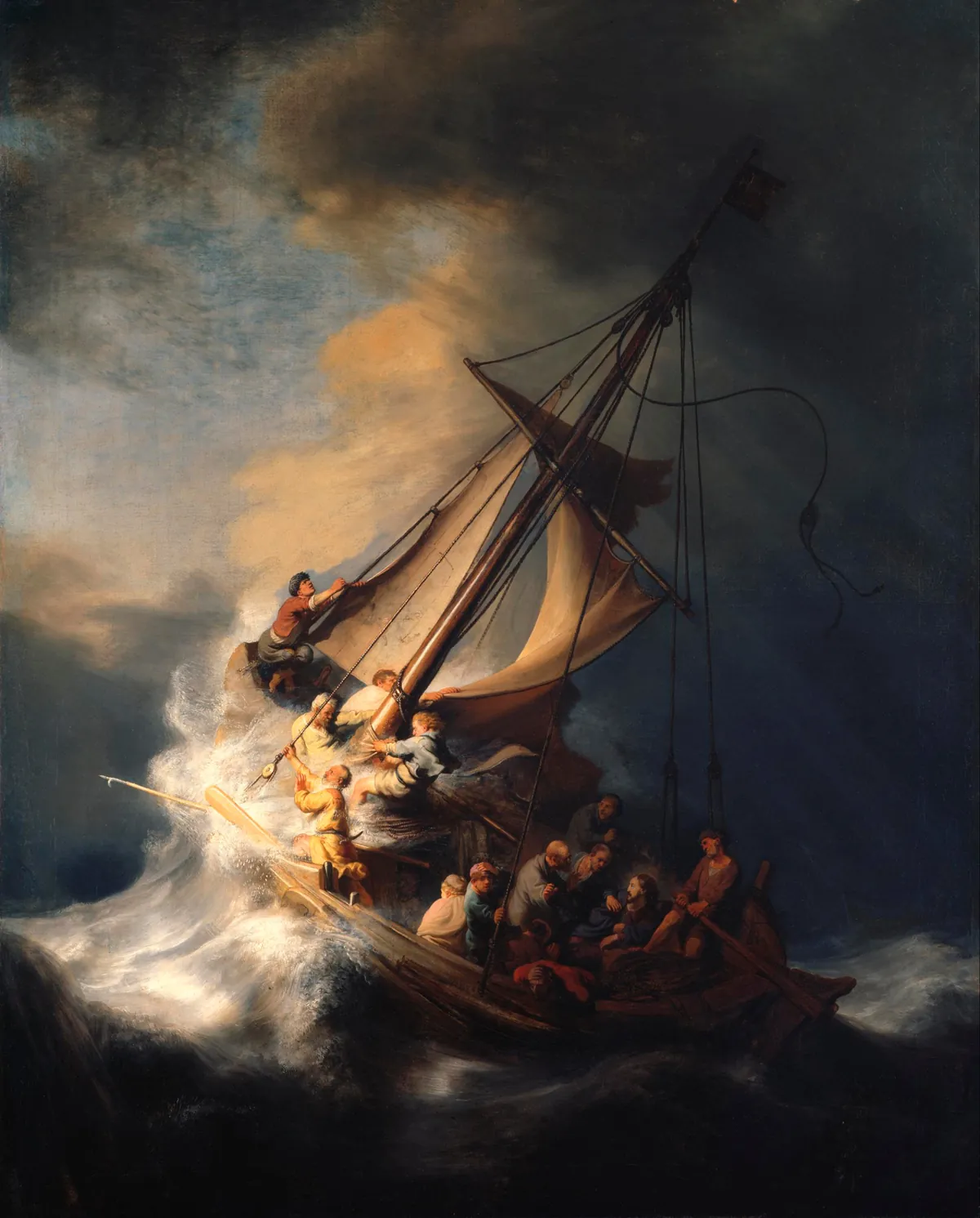
The Storm on the Sea of Galilee, Rembrandt, 1633, Isabella Stewart Gardner Museum, Boston.
The only storm Rembrandt ever painted
Rembrandt painted seas only once. In 1633, still a young man making his name in Amsterdam, he set the disciples’ fishing boat on the crest of a black wave and let the whole drama of Mark’s Gospel break across the canvas. A torn sail snaps in the wind, one terrified man clings to the rigging while another is sick over the side, and the little vessel tilts so steeply that you feel it about to slide out of the frame. Then your eye reaches the stern, and everything changes. There sits Christ, calm in the chaos, while the disciples shake him awake and cry out that they are about to drown. The painting holds the exact instant before the words “Peace, be still” are spoken, the moment when fear and faith are still fighting for the boat.
This is the closest art comes to a portrait of Psalm 46. The earth, or rather the sea, is removed and the waters roar, and into that terror the sovereign voice is about to speak. The work has a sorrowful modern story too. In the early hours of March 18, 1990, thieves dressed as policemen walked into the Isabella Stewart Gardner Museum in Boston and cut this canvas from its frame. It has never been recovered, and an empty frame still hangs on the museum wall in its place. We tell its full story in our study of Rembrandt’s Storm on the Sea of Galilee, part of our wider look at Rembrandt’s religious paintings.
What “be still and know that I am God” really means
The verse is short, but the Hebrew behind it is stronger than the gentle English suggests. The word translated “be still” is harpu, from a root that means to let go, to loosen your grip, to cease striving. It is not the hush asked of a noisy child. It is closer to a command to drop the weapons, to stop the frantic effort to fix everything yourself, and to recognise who is actually in control. Read that way, the line is not only soothing. It carries authority. God is not asking permission. He is declaring that he will be exalted among the nations and exalted in the earth, whether the kingdoms rage or not.
God is our refuge and strength, a very present help in trouble.
Therefore will not we fear, though the earth be removed, and though the mountains be carried into the midst of the sea;
Though the waters thereof roar and be troubled, though the mountains shake with the swelling thereof.
He maketh wars to cease unto the end of the earth; he breaketh the bow, and cutteth the spear in sunder.
Be still, and know that I am God: I will be exalted among the heathen, I will be exalted in the earth.
The Lord of hosts is with us; the God of Jacob is our refuge.
Set in its psalm, the stillness makes sense. The poem opens by calling God a refuge and strength, a very present help in trouble, and it pictures the worst that creation can do, mountains sliding into the sea and the ground giving way underfoot. Against that backdrop the command to be still is an act of trust, not of passivity. To be still is to stop trying to save yourself and to let God be God.
Why artists pictured the verse through the storm
Psalm 46 has no single character and no fixed event, so it never received one settled image the way the shepherd of Psalm 23 or the penitent David of Psalm 51 did. Painters reached instead for the scene that puts the same truth into a story you can see. When Christ rises in the boat and says to the sea, “Peace, be still,” and the wind drops at once, he does in the Gospel exactly what the psalm proclaims, he commands the chaos and it obeys. The disciples ask the question the whole psalm answers, “What manner of man is this, that even the wind and the sea obey him?” For centuries preachers and artists have read the two passages side by side, and the storm on the lake became the visual home of the command to be still.
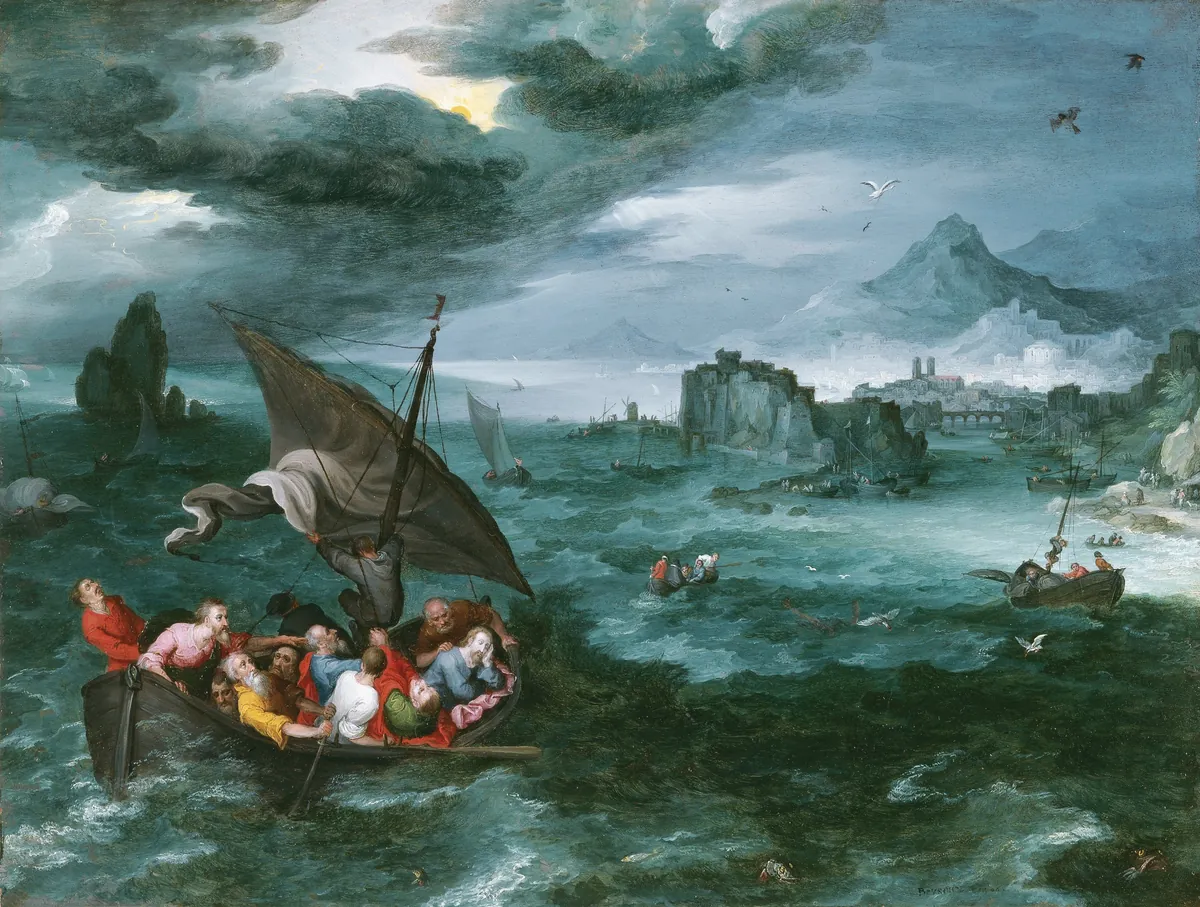
Christ in the Storm on the Sea of Galilee, Jan Brueghel the Elder, 1596, Museo Thyssen-Bornemisza, Madrid.
Jan Brueghel the Elder painted the subject in 1596 as a wide, panoramic landscape. The boat is small against an enormous sky, almost lost between a darkened shore and a sea whipped to white. Brueghel was a master of the tiny, glowing detail, and he uses the scale of the world to make his point. The danger is real and the figures are fragile, yet the same God who made that vast horizon is present in the little boat. It is Psalm 46 read as a seascape, the mountains and waters in full uproar around a faith that refuses to be moved.
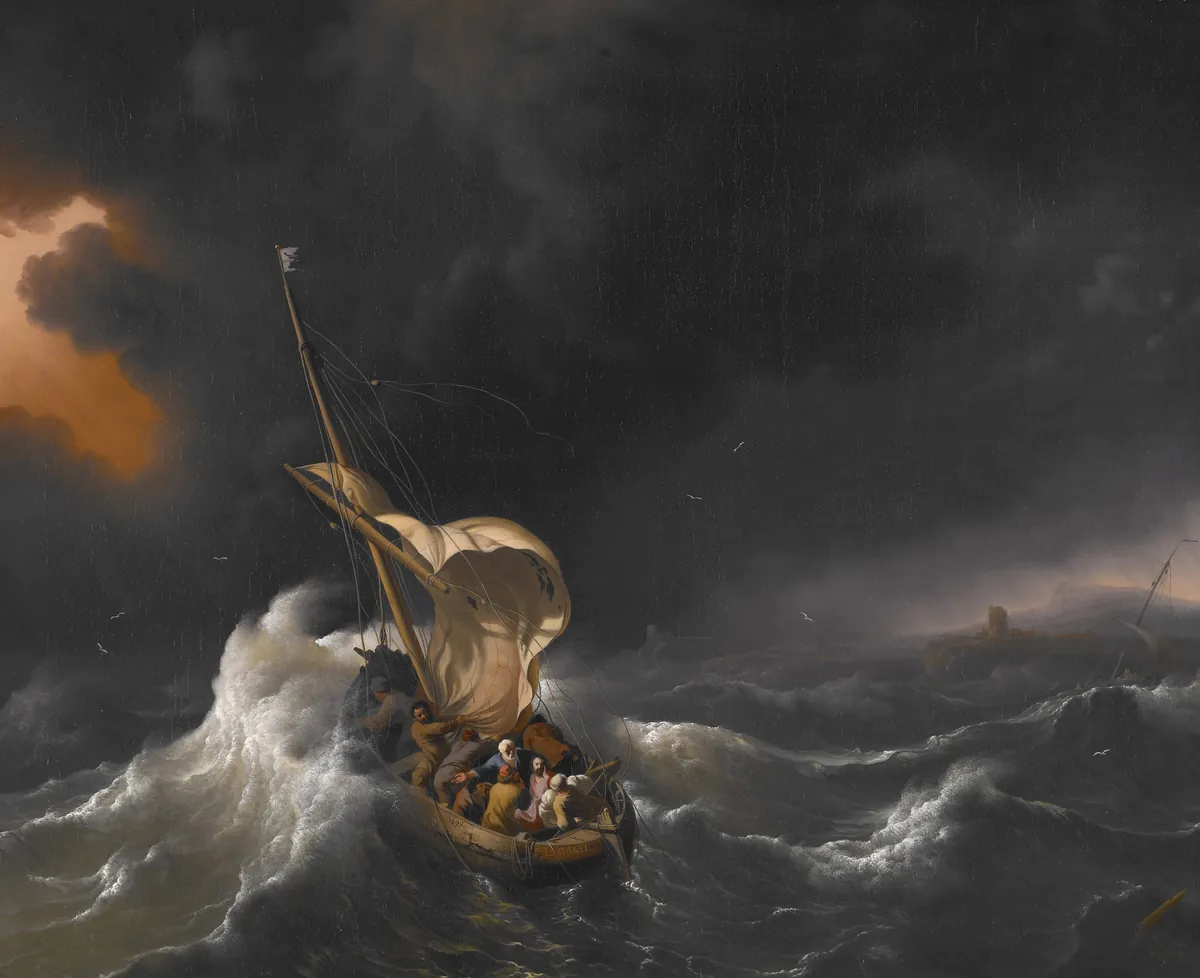
Christ in the Storm on the Sea of Galilee, Ludolf Backhuysen, 1695, Indianapolis Museum of Art.
A century later the Dutch marine painter Ludolf Backhuysen returned to the theme with the eye of a man who knew real ships and real weather. Backhuysen was famous for going out into storms to study them, and it shows. His waves have weight, his clouds break with a cold light low on the horizon, and the spray seems to hiss off the canvas. The boat heels hard to one side, the disciples huddle around the still centre of Christ, and the whole scene becomes a study in trust under pressure. Here the sea is not a symbol. It is the thing itself, the very present trouble of the psalm, painted by someone who had felt it.
Delacroix and the sleeping Christ
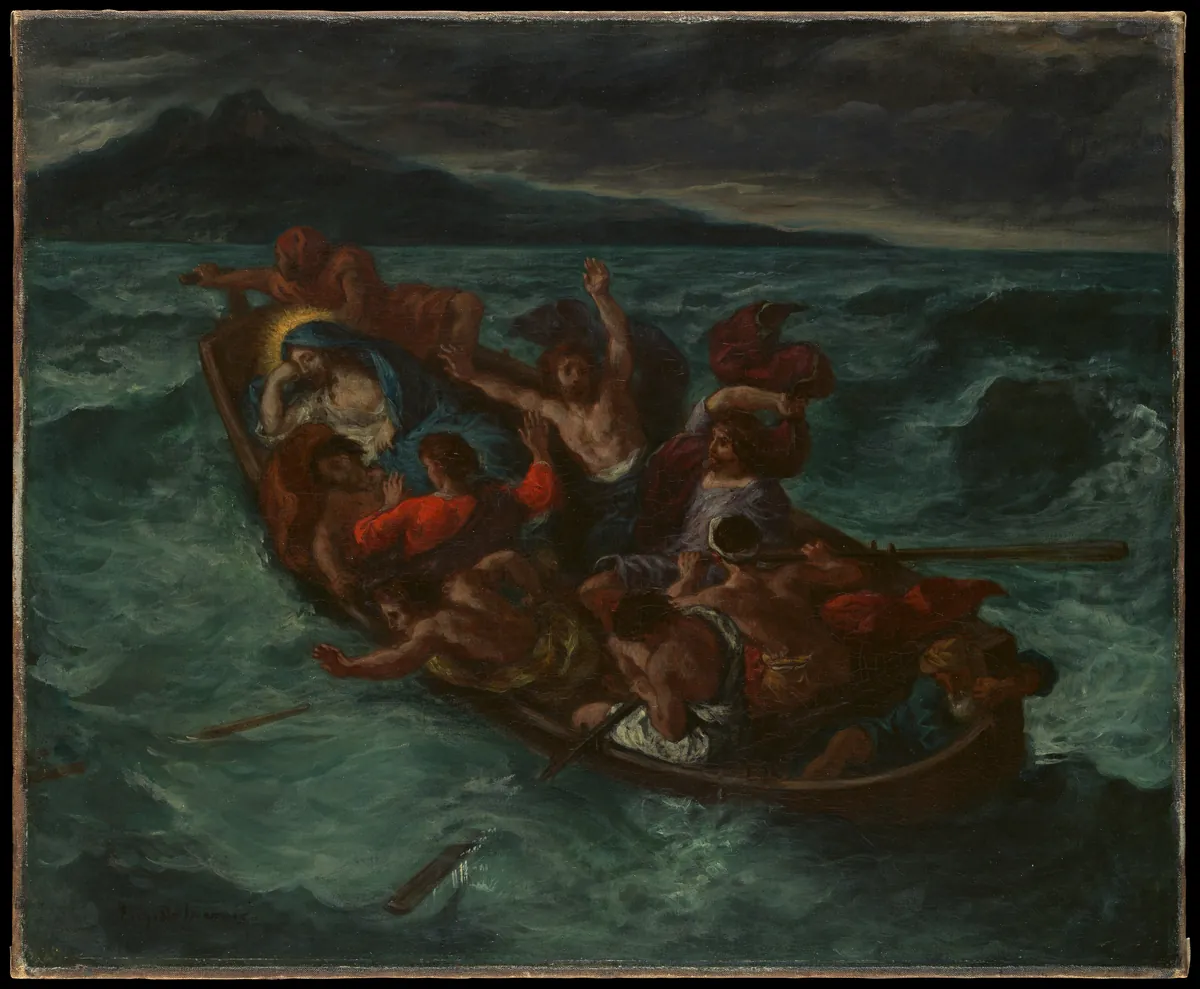
Christ Asleep during the Tempest, Eugene Delacroix, around 1853, Metropolitan Museum of Art, New York.
The great French Romantic Eugene Delacroix was so drawn to this story that he painted it again and again in the last decade of his life. In the version now at the Metropolitan Museum of Art, the colour does the talking. Green and grey waves rise in thick, restless strokes, the sky is a bruise of cloud, and the disciples strain at the oars in real panic. Christ lies asleep in the bow, untouched by it all. Delacroix loved that contradiction, the perfect calm of the divine at the centre of nature’s fury, and he made it the heart of the picture. The sleeping Christ is the stillness of Psalm 46 made flesh, a quiet that the storm cannot reach. You can see how the same instinct runs through the whole tradition of Romantic Jesus paintings, where feeling and faith are painted as one.
James Ensor and the modern storm
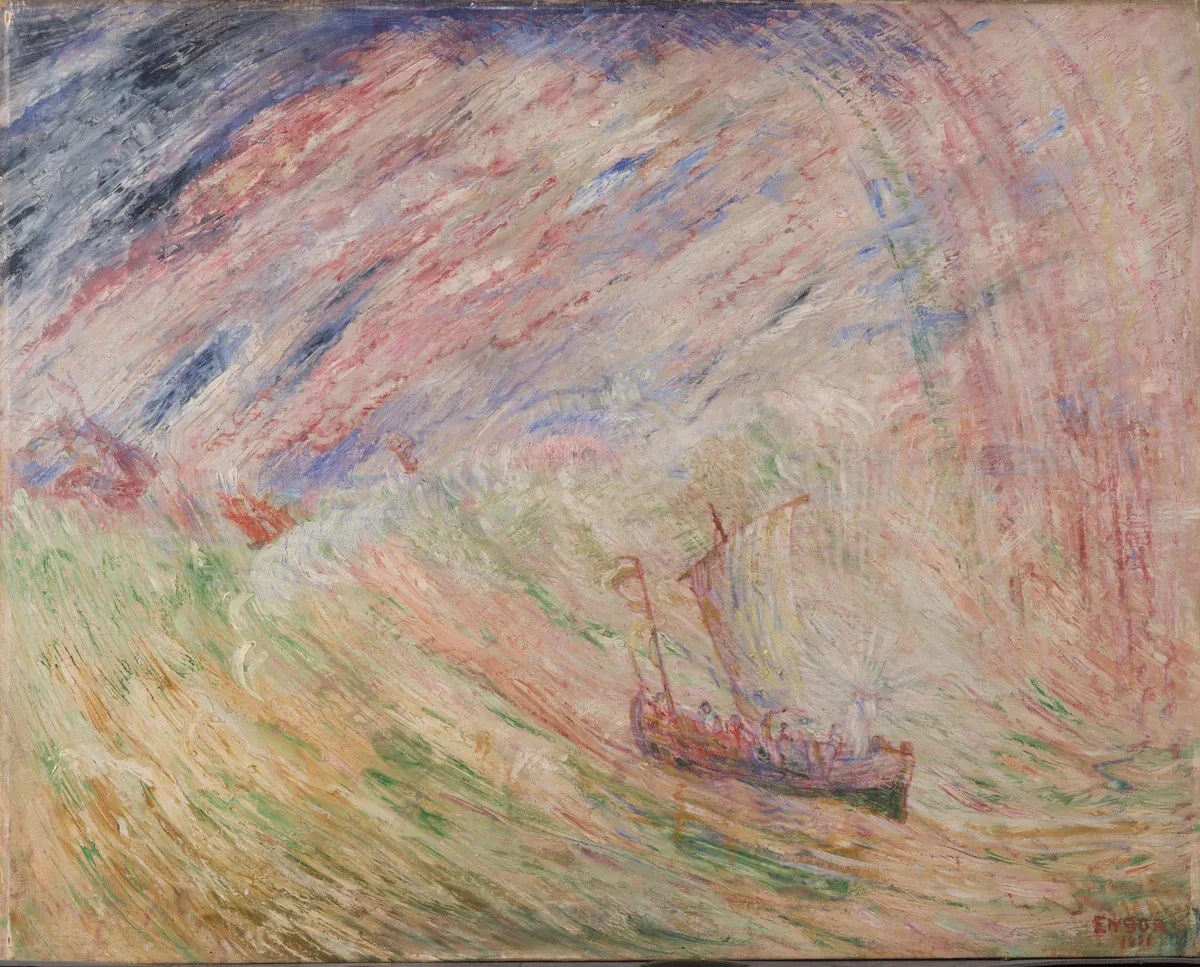
Christ Calming the Storm, James Ensor, 1891, Mu.ZEE, Ostend.
By the end of the nineteenth century the subject had not lost its power, but it had changed its language. The Belgian painter James Ensor, who lived all his life by the North Sea at Ostend, dissolved the scene into light and weather. The boat is barely there, the figures are little more than marks, and the sea and sky take over the canvas in shimmering, broken colour. Ensor was less interested in the historical event than in the feeling of being very small under a very large sky. His storm is almost an abstraction of the psalm, the experience of trouble and the longing for stillness rendered in pure paint. It shows how far the words “be still” could travel and still keep their meaning.
God our refuge: Psalm 46 and a mighty fortress
The storm is only half of Psalm 46. The other half is the image that has comforted readers for three thousand years, God as a refuge and a fortress. “God is our refuge and strength,” the psalm begins, and it returns twice to the same line, “the God of Jacob is our refuge.” It was this picture of an unshakeable stronghold that moved Martin Luther, in the early sixteenth century, to write his great hymn “Ein feste Burg ist unser Gott,” “A mighty fortress is our God,” paraphrasing this very psalm. The verse about being still belongs inside that fortress. We are told to cease our striving precisely because the walls are not ours to hold. The stillness is the rest of someone already safe inside.
That is why the line has become a favourite for quiet spaces, for prayer corners and bedrooms and places of waiting. It pairs the honesty of the psalm, which never pretends the storm is not real, with the assurance that the storm does not have the last word. To read “be still and know that I am God” is to be handed both the trouble and the refuge in a single sentence.
“Be still and know that I am God” as wall art
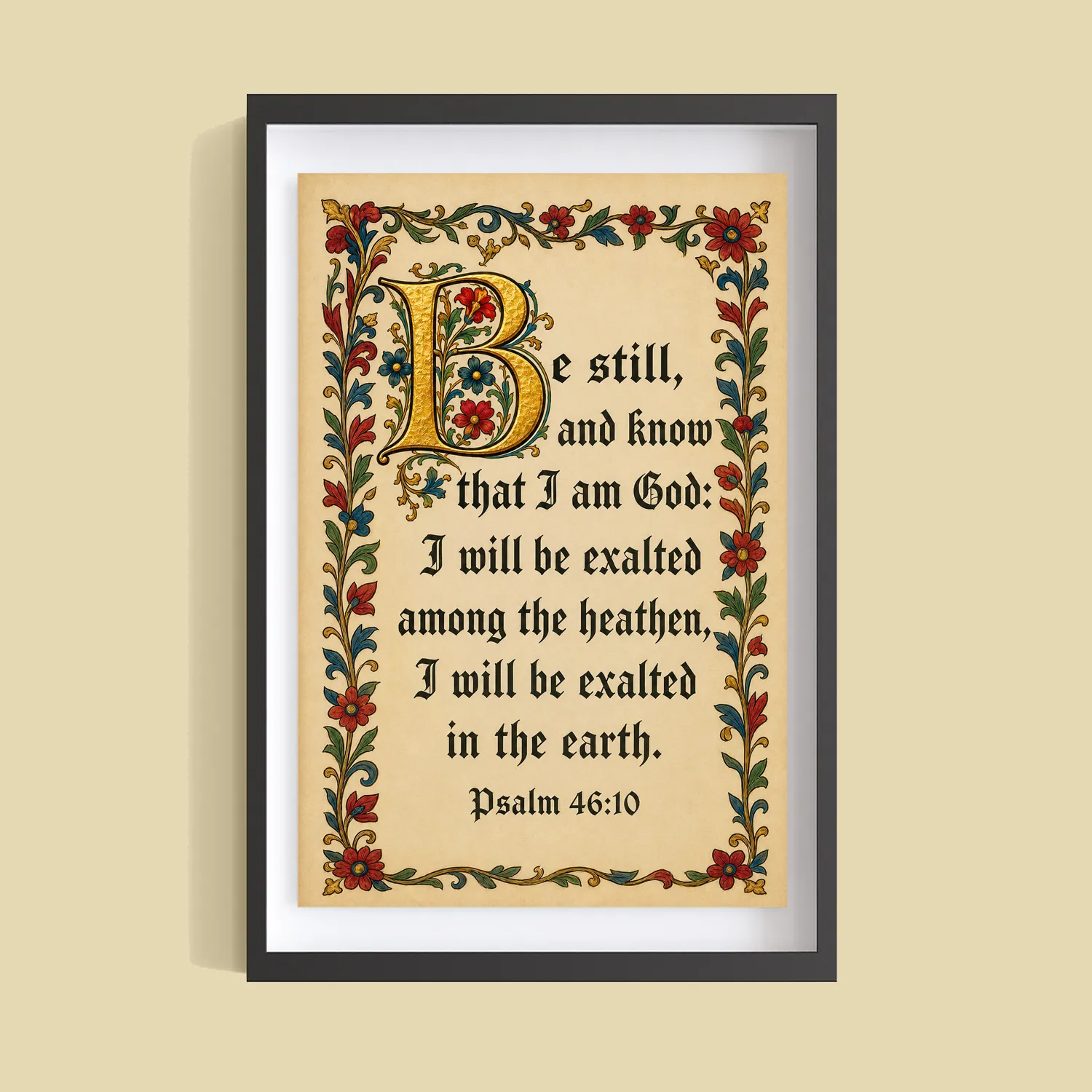
For most of Christian history these words lived in song, in prayer, and in the painted storm. They also belong to the long tradition of scripture set down as a thing of beauty, lettered and framed so the eye can rest on it. That is the spirit behind our own Psalm 46:10 poster. The verse is given room to breathe, designed to be read slowly and kept where the day is busiest, a small still point on the wall that says what the psalm says, that God is God and the weight of the world is not on your shoulders.
Our Be Still and Know That I Am God poster, Psalm 46:10 set as scripture wall art.
Psalm 46:10 has lasted because it tells the truth twice over. It admits that the earth can shake and the sea can roar, and in the same breath it promises a refuge that nothing can move. Artists honoured it not with a calm picture but with a storm, trusting the viewer to find the stillness at its centre, the sleeping or commanding Christ who is the answer to every fear. To keep that promise close you can choose our Be Still and Know That I Am God poster, or follow the verse through the wider cluster on Psalm 23, Psalm 91, and Psalm 121, and the wider collection of Christian wall art.
Important Facts About Psalm 46
Psalm 46:10 reads, in the King James Version, “Be still, and know that I am God: I will be exalted among the heathen, I will be exalted in the earth.”
The Hebrew word translated “be still” is harpu, which means to let go, to relax your grip, or to cease striving, rather than simply to be quiet.
Psalm 46 is one of the psalms of the sons of Korah and is often grouped with the songs that celebrate God as the defender of Zion.
The psalm inspired Martin Luther’s hymn “A mighty fortress is our God,” written around 1527 to 1529 as a paraphrase of its opening lines.
The Hebrew text marks three pauses with the word “Selah,” dividing the psalm into its sections on refuge, the city of God, and the God who ends all wars.
Questions and Answers
What does “be still and know that I am God” really mean?
It is a call to stop striving and to trust that God is in control. The Hebrew word for “be still” means to let go or loosen your grip, so the verse is less about silence and more about surrender. It asks you to put down the effort to fix everything yourself and to recognise God’s authority over the situation. The promise that follows, that he will be exalted in the earth, makes clear that his sovereignty does not depend on our calm.
Where in the Bible is “be still and know that I am God”?
The line is the tenth verse of Psalm 46, written as Psalm 46:10. The psalm belongs to the sons of Korah and describes God as a refuge and strength in the middle of natural and political upheaval. The famous phrase comes near the end, after the psalm has pictured mountains falling into the sea and God making wars cease. It is God himself who speaks the words, not the psalmist.
How does Psalm 46:10 connect to Jesus calming the storm?
The psalm has no single scene, so Christian artists pictured its command to be still through the Gospel story in which Christ stills the storm on the Sea of Galilee. In Mark’s account Jesus says to the sea, “Peace, be still,” and the wind drops at once, doing what the psalm proclaims, commanding chaos so that it obeys. Painters from Rembrandt to Delacroix used that moment to give the verse a face. The sleeping or rising Christ in the boat became the visual home of the words “be still.”
Who said “be still and know that I am God”?
The words are spoken by God within the psalm. After describing the uproar of nations and the shaking of the earth, the psalm shifts to the divine voice, which says, “Be still, and know that I am God.” The line is therefore a direct statement from God to his people rather than a prayer addressed to him. That is part of what gives it such weight when it is read aloud.
Why is Psalm 46:10 so popular as wall art?
The verse offers comfort and command in a single short sentence, which makes it ideal for a place that is often busy or anxious. People hang it in bedrooms, prayer corners, kitchens, and offices as a reminder to pause and trust. Its words are simple enough to take in at a glance yet deep enough to return to for years. That balance of brevity and depth is exactly what makes a verse work as something framed on a wall.
Can you buy Be Still and Know That I Am God wall art?
You can buy Be Still and Know That I Am God wall art at jesuschrist.pictures, in our shop. Our Psalm 46:10 poster sets the full verse as scripture wall art designed to be read slowly and kept in view. The same collection includes companion verses such as Psalm 23, Psalm 91, and Psalm 121, so a quiet corner can hold a small family of related prayers. Each piece is printed for the wall, ready to frame and live with.
✦ Free Christian & Catholic Printables
Looking for free Christian & Catholic printables? Our complete collection of illuminated prayer cards & Scripture verses — the Memorare, Psalm 23, Psalm 91 and more — is ready to print, free, in one place.
Robert Campin paintings stand at the founding moment of European oil painting. Step into the great Mérode Altarpiece and the Tournai workshop of the early Flemish master.