10 David and Goliath Paintings, From Caravaggio to Doré
David and Goliath paintings turn one of the oldest underdog stories in the world into some of the most powerful images in art. In the First Book of Samuel, a young shepherd steps out of the ranks of a terrified army to face Goliath, a Philistine giant in full armour, armed with nothing but a sling and five smooth stones. One stone finds the giant’s forehead, he falls, and David beheads him with his own sword. Painters have been drawn to the story for centuries, because it holds together two things they love, a moment of unbearable tension and a shocking, bloody aftermath. The subject splits naturally into stages. Some artists chose the fight itself, the slight boy against the towering man. Others preferred the terrible calm that follows, David standing quietly with the severed head, or the triumph as he carries it home to a cheering crowd. The severed head became a favourite subject in its own right, and more than one painter, including Caravaggio and Johan Zoffany, gave it their own face. The ten works below, from Renaissance Venice to a nineteenth century engraving, show just how many ways the story can be told. For more of the great scenes of scripture, see our guide to famous biblical masterpieces.
1. David with the Head of Goliath by Caravaggio (1610)
This is the most famous painting of the subject, and one of the most haunting. Caravaggio shows a young David stepping out of deep shadow, sword in hand, holding the severed head of Goliath at arm’s length. There is no triumph in his face, only a strange pity. The most chilling detail is that the giant’s head is a self-portrait: Caravaggio painted his own features, bleeding and defeated.
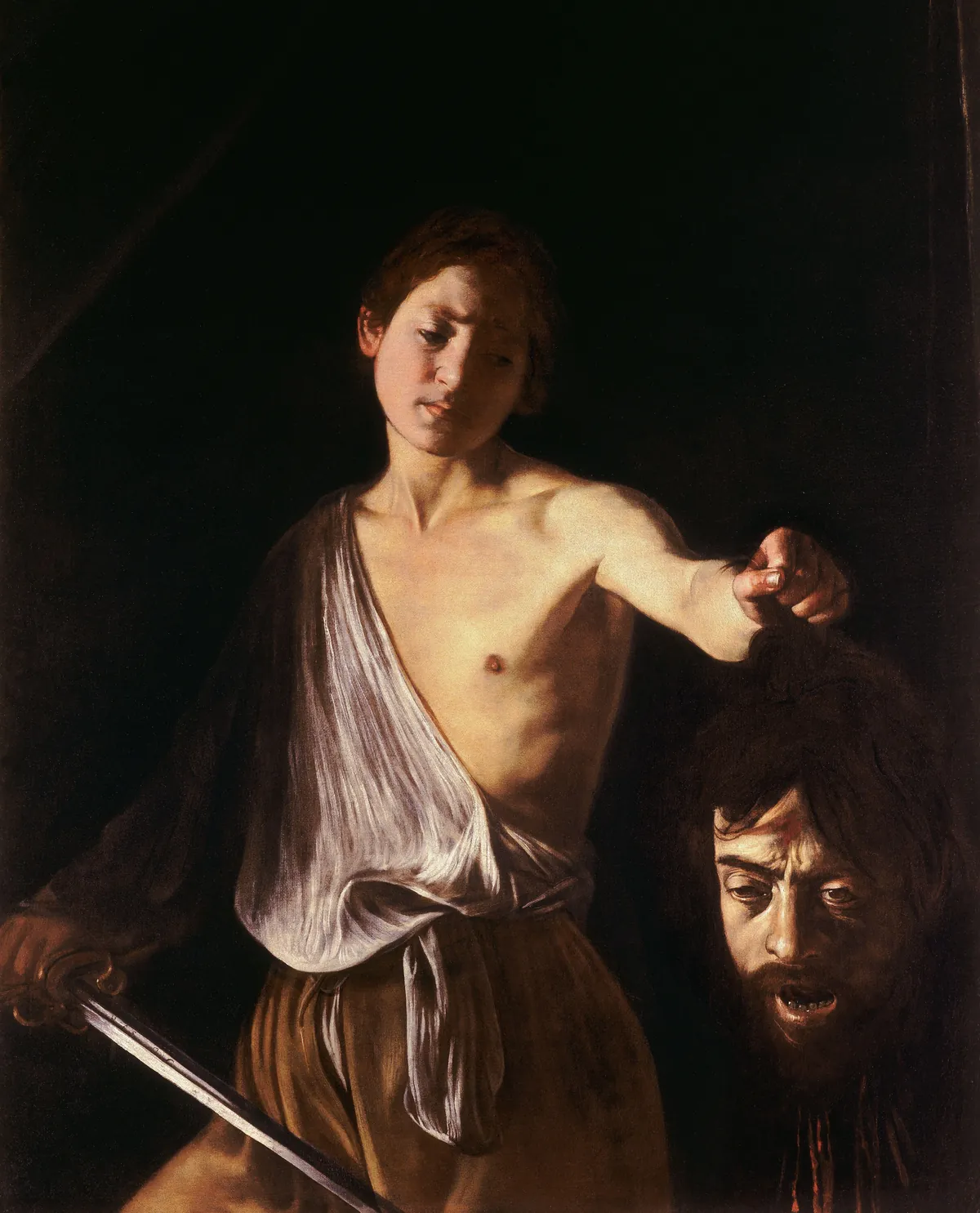
He made the picture near the end of his life, on the run after killing a man in Rome, and sent it to Cardinal Scipione Borghese, who had the power to grant him a pardon. It reads as a confession in paint, the artist offering up his own head. The canvas still hangs in the Galleria Borghese in Rome.
2. David with the Head of Goliath by Guido Reni (c. 1605)
Where Caravaggio gives us guilt and shadow, Guido Reni gives us grace. His David is a beautiful youth in a plumed hat and rich cloak, leaning casually against a stone plinth on which the giant’s head has been set. He gazes at it with cool, almost tender detachment, the sword resting easily in his hand.
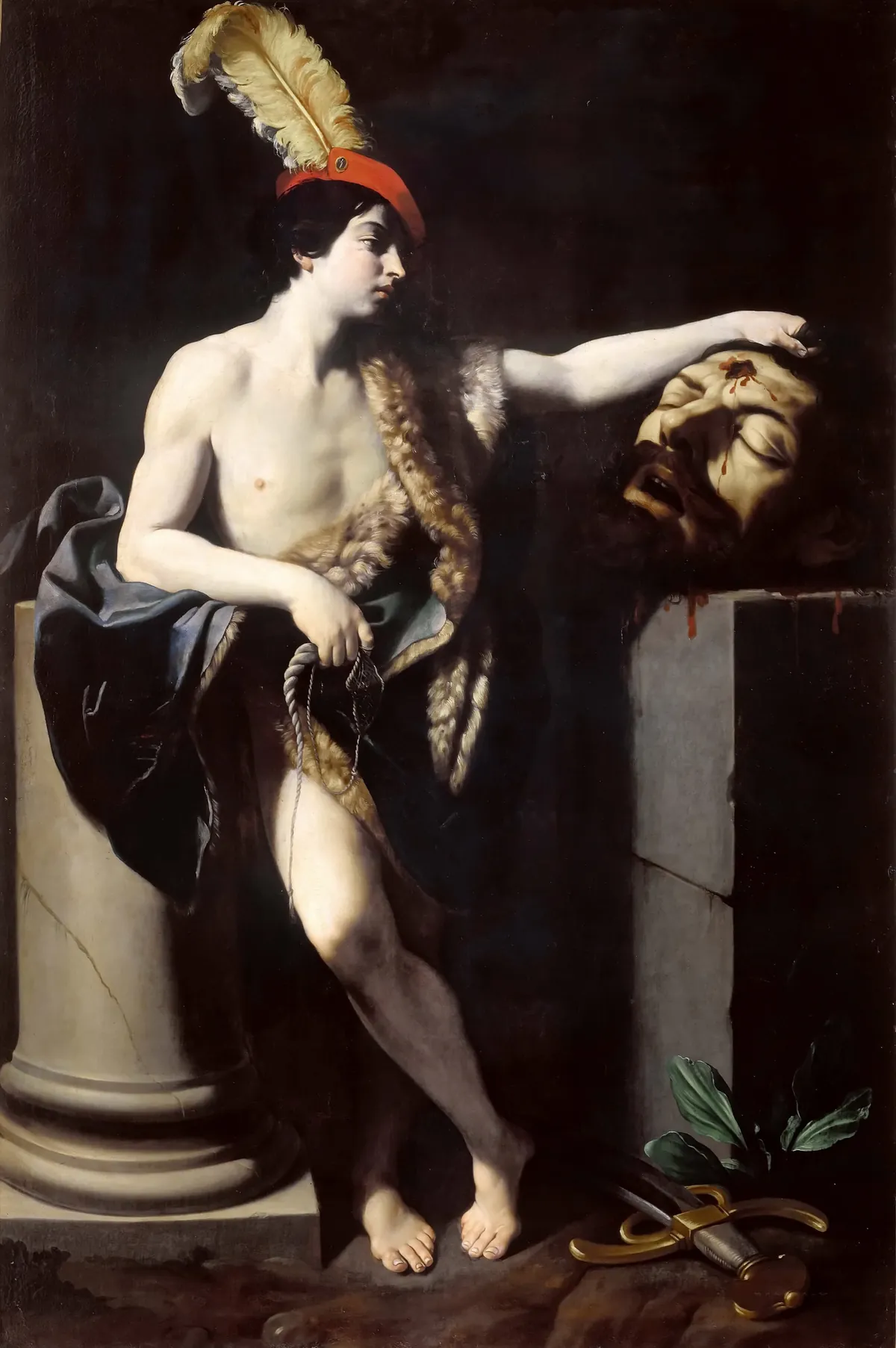
Reni was the great master of Bolognese elegance, and here he turns a scene of slaughter into a study in poise and beauty. The contrast between the lovely living boy and the heavy dead head is the whole point, life and death held in perfect balance. The painting is in the Uffizi Gallery in Florence.
3. David with the Head of Goliath by Guercino (c. 1650)
The Bolognese painter Guercino catches David in a moment of feeling. His hero presses a hand to his chest and looks upward, as if overwhelmed by what he has done, while the giant’s head lies in shadow at his feet beside a discarded helmet. It is a picture less about victory than about the weight of it.
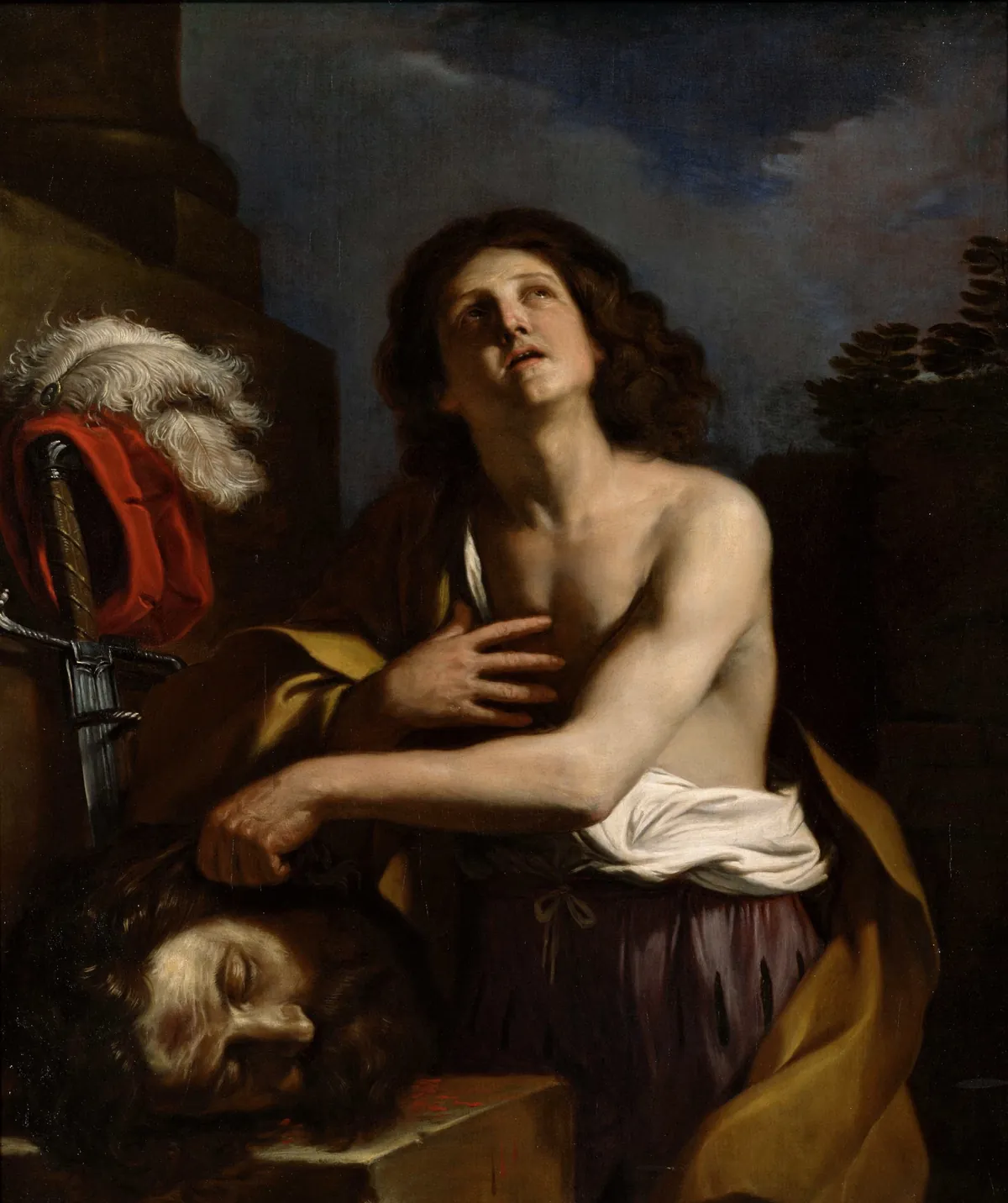
Guercino was a master of warm light and deep, glowing colour, and he uses them here to make David intensely human. The upward gaze turns the moment into a kind of prayer, thanks given for a strength that was not his own. The painting belongs to the National Museum of Western Art in Tokyo.
4. David and Goliath by Orazio Gentileschi (c. 1605 to 1608)
Orazio Gentileschi, an early follower of Caravaggio and the father of the great Artemisia Gentileschi, chose the most violent instant of all. His David straddles the fallen giant and lifts the huge sword high, an instant before the killing blow. Goliath lies helpless in his armour, and the sling and stones lie on the ground where David dropped them.
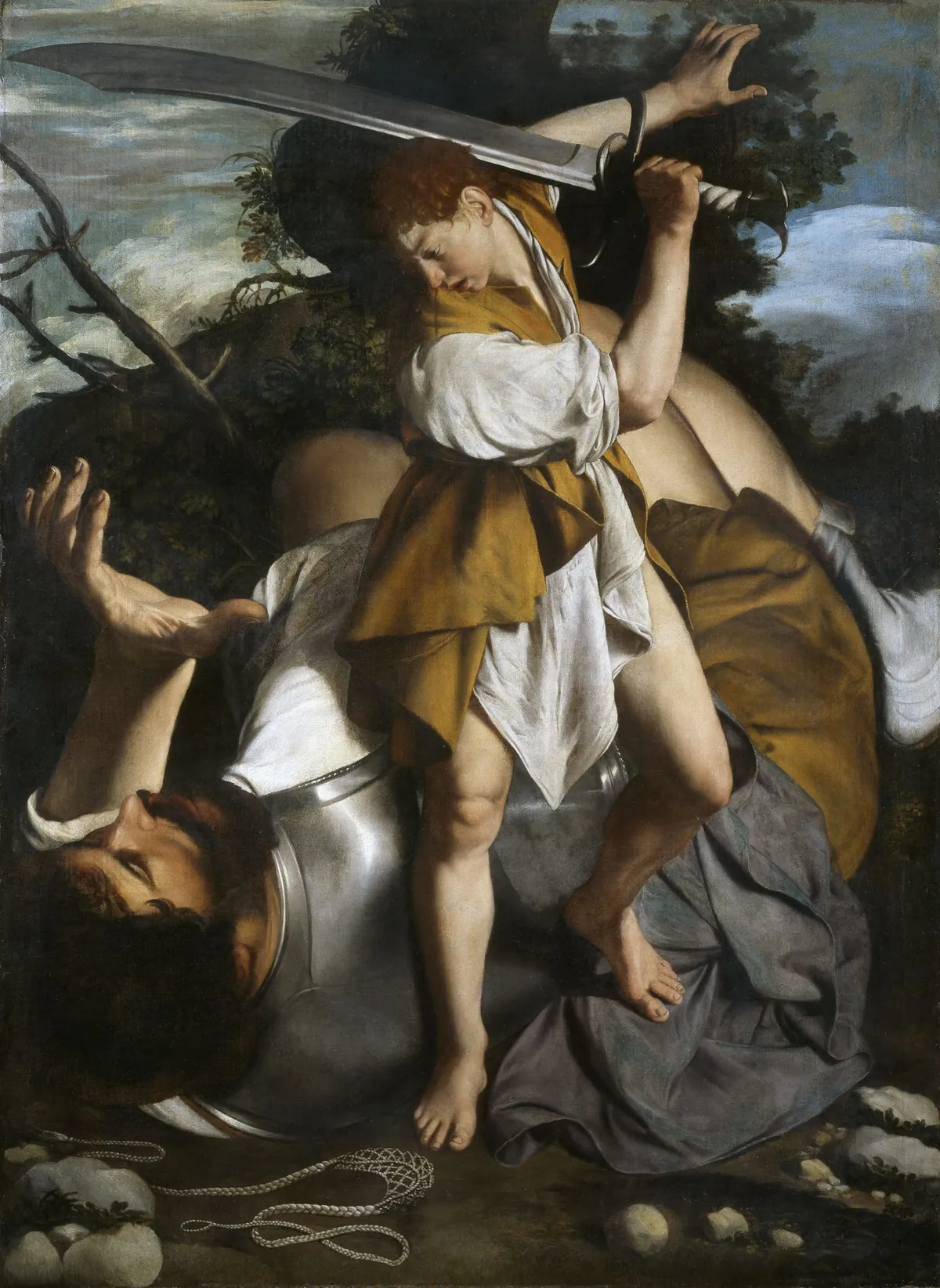
The strong, raking light and the dark sky are pure Caravaggism, learned from the master himself. Gentileschi freezes the story at its most physical, all effort and imminent force. The painting hangs in the National Gallery of Ireland in Dublin.
5. David and Goliath by Titian (1542 to 1544)
The oldest work here is by the greatest of the Venetians, Titian. He painted it for the ceiling of a Venetian church, and so we look up at the scene from below: David kneels over the enormous sprawled body of Goliath, whose foreshortened form seems to tumble out of the sky above us. Storm clouds part to let a shaft of light fall on the victor.
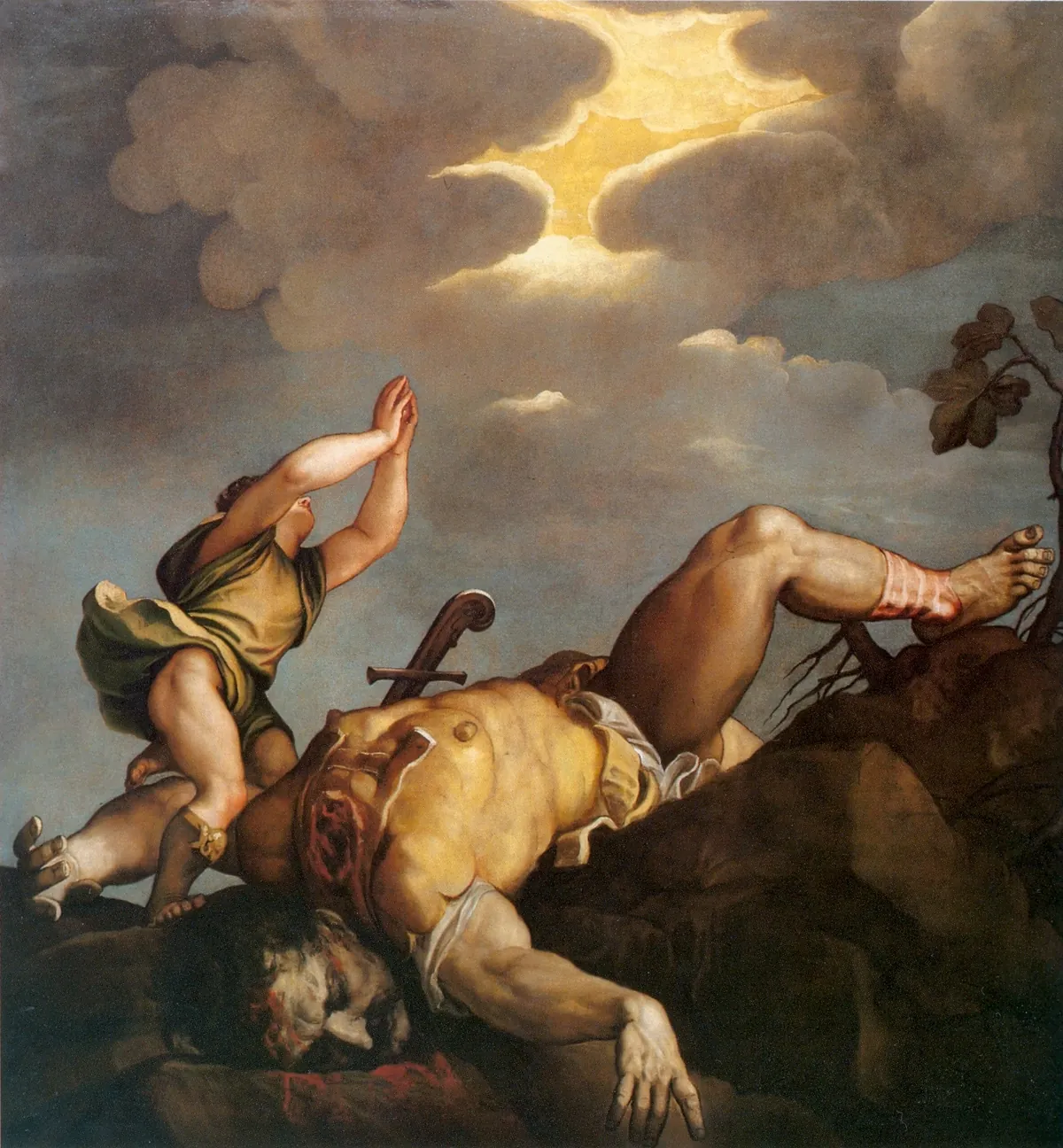
Titian uses the low viewpoint to make the giant overwhelming even in death, a mountain of flesh beneath the small kneeling boy. It is one of three biblical ceiling scenes he made for the church, now installed in the sacristy of Santa Maria della Salute in Venice. Few painters have made the sheer size of Goliath so frighteningly real.
6. Self-portrait as David with the Head of Goliath by Johan Zoffany (c. 1756)
Two centuries after Caravaggio, the German born painter Johan Zoffany took up the same strange idea and made it his own. In this early self-portrait he shows himself as a young David, bare chested and pensive, resting his chin on one hand while the other holds the bearded head of Goliath. A sling and sword complete the disguise.
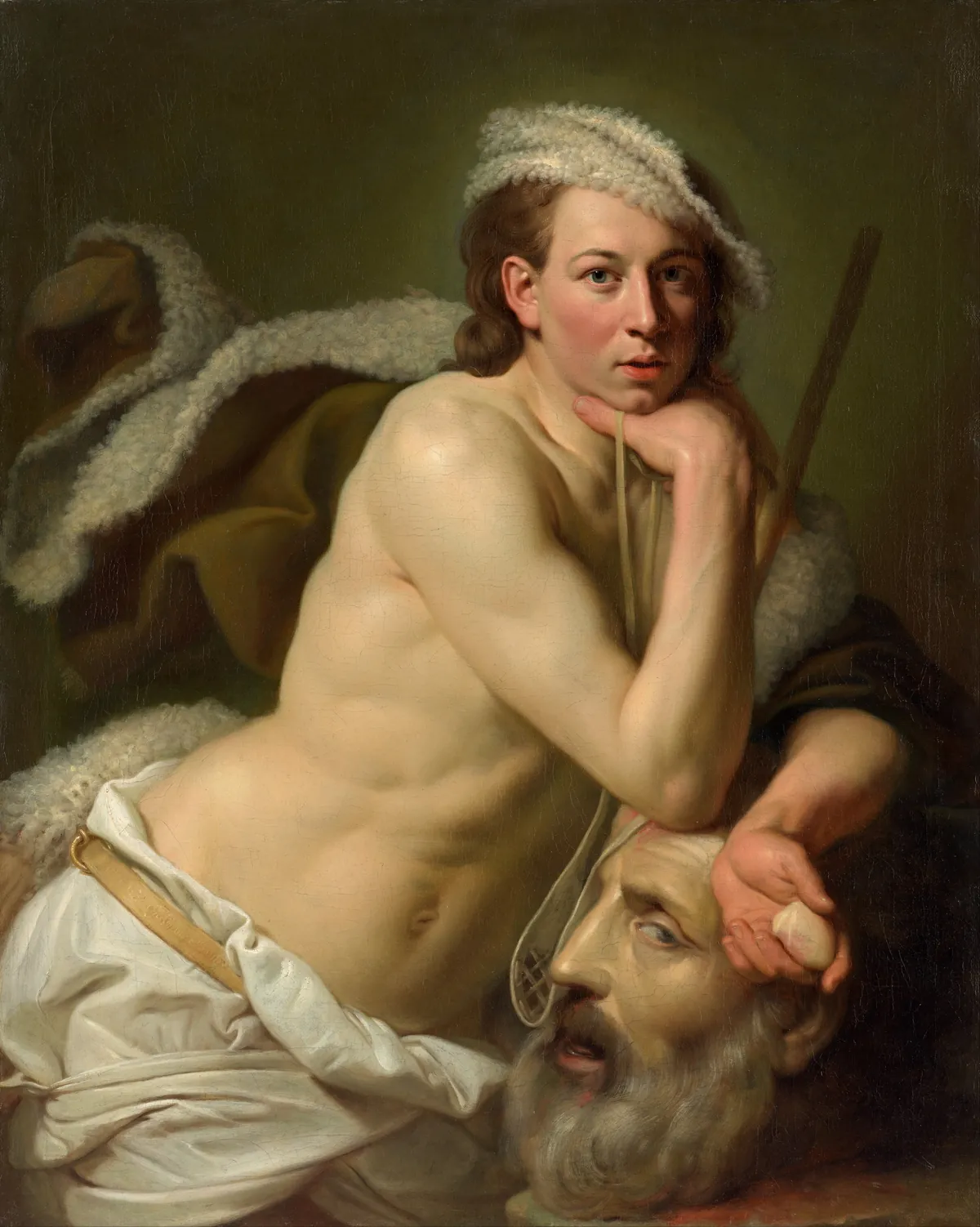
Zoffany, who would later become a favourite portraitist in England, uses the biblical role to present himself as a thoughtful young hero, half in and half out of costume. It is a witty, ambitious picture by an artist announcing his talent. The self-portrait is in the National Gallery of Victoria in Melbourne.
7. David Slaying Goliath by Peter Paul Rubens (c. 1616)
No one painted muscle and motion like Peter Paul Rubens, and his David is all straining power. The young hero kneels on the back of the fallen giant, seizes him by the hair, and hauls back the sword to strike, his whole body twisting with the effort. Behind them the two armies watch from a stormy landscape.
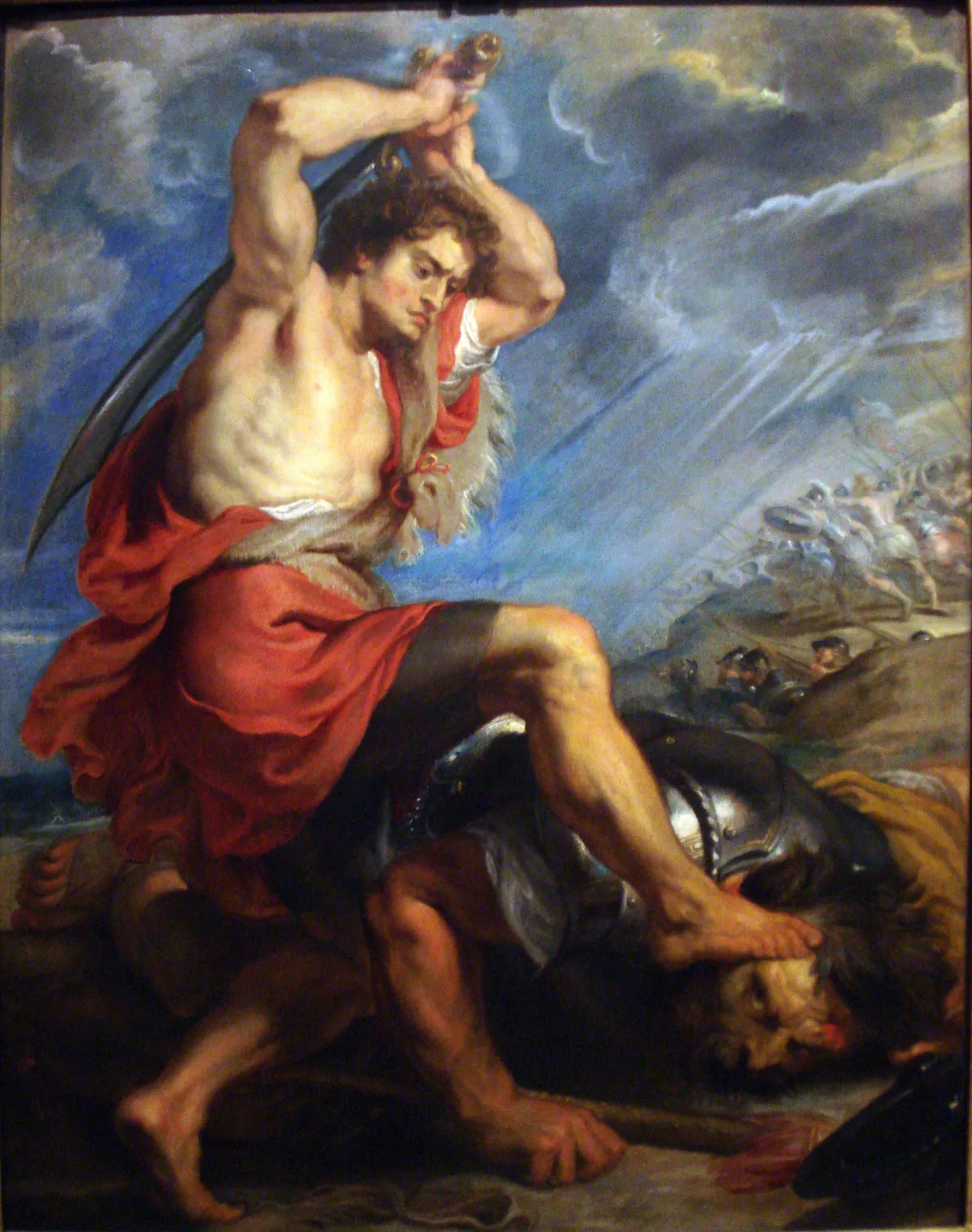
Rubens turns the beheading into a wrestling match of titanic force, closer to Hercules than to a shepherd boy. The energy is overwhelming, every line of the composition driving toward the raised blade. The painting is a highlight of the Norton Simon Museum in Pasadena.
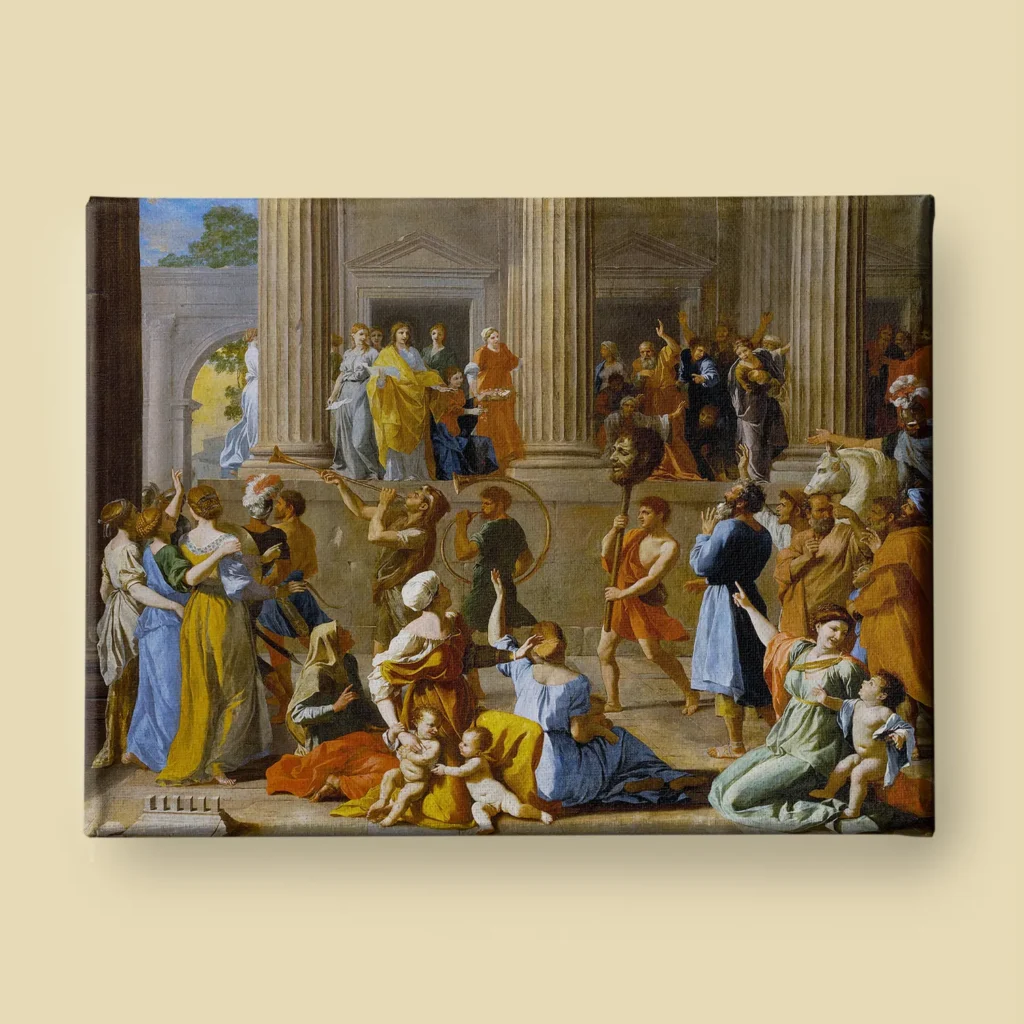
8. The Triumph of David by Nicolas Poussin (c. 1631 to 1633)
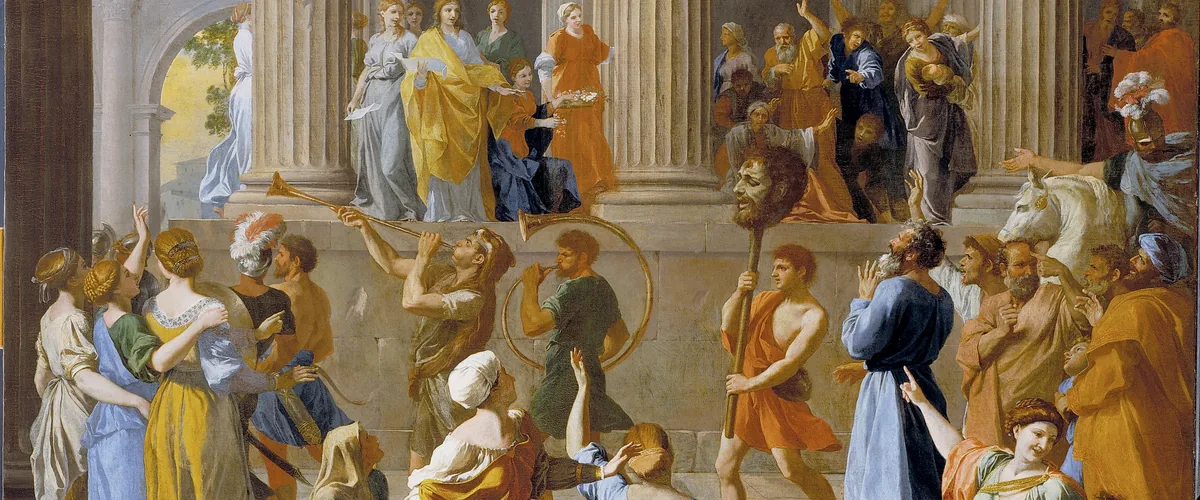
The French master Nicolas Poussin looked past the killing to the celebration that came after. He shows David returning in triumph, carrying Goliath’s head on a pole through a crowd of rejoicing figures, with trumpeters, dancing women, and classical architecture rising behind. The mood is bright, ordered, and joyful.
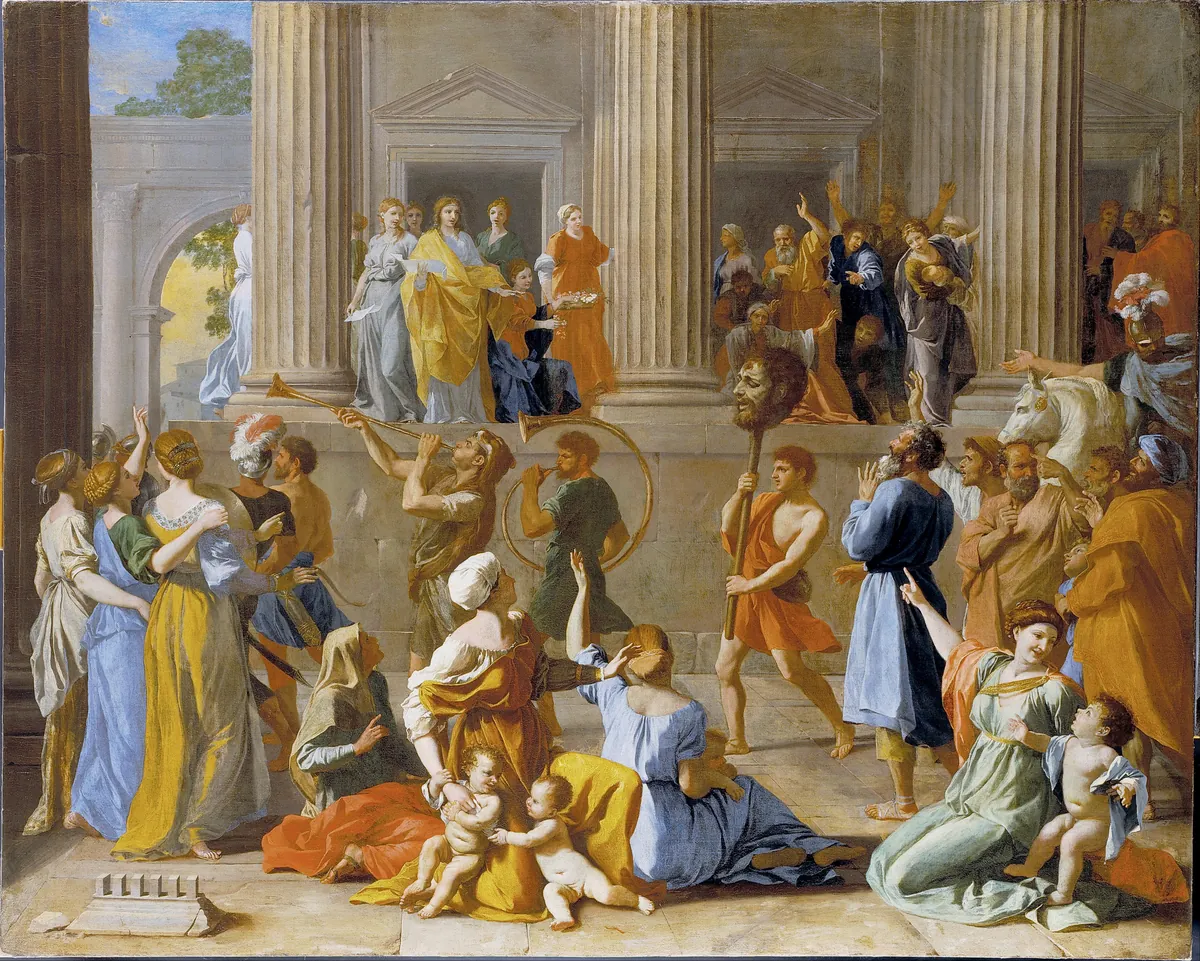
Poussin was the great painter of calm and reason, and he stages the victory like a scene from ancient Rome, all balance and clear design. It is a reminder that the story does not end in blood but in deliverance for a whole people. The painting hangs in the Dulwich Picture Gallery in London. Its procession is also the David ornament of our Jesse Tree, hung on December 14 in the Advent countdown from the Creation to Bethlehem.
9. David Slays Goliath by Gustave Doré (1866)
The most widely seen version of the scene is not a painting at all but an engraving. Gustave Doré made it for his hugely popular illustrated Bible of 1866, and it has shaped how millions picture the story. David stands over the massive body of the fallen giant, sword in hand, while the two armies look on from the hills.
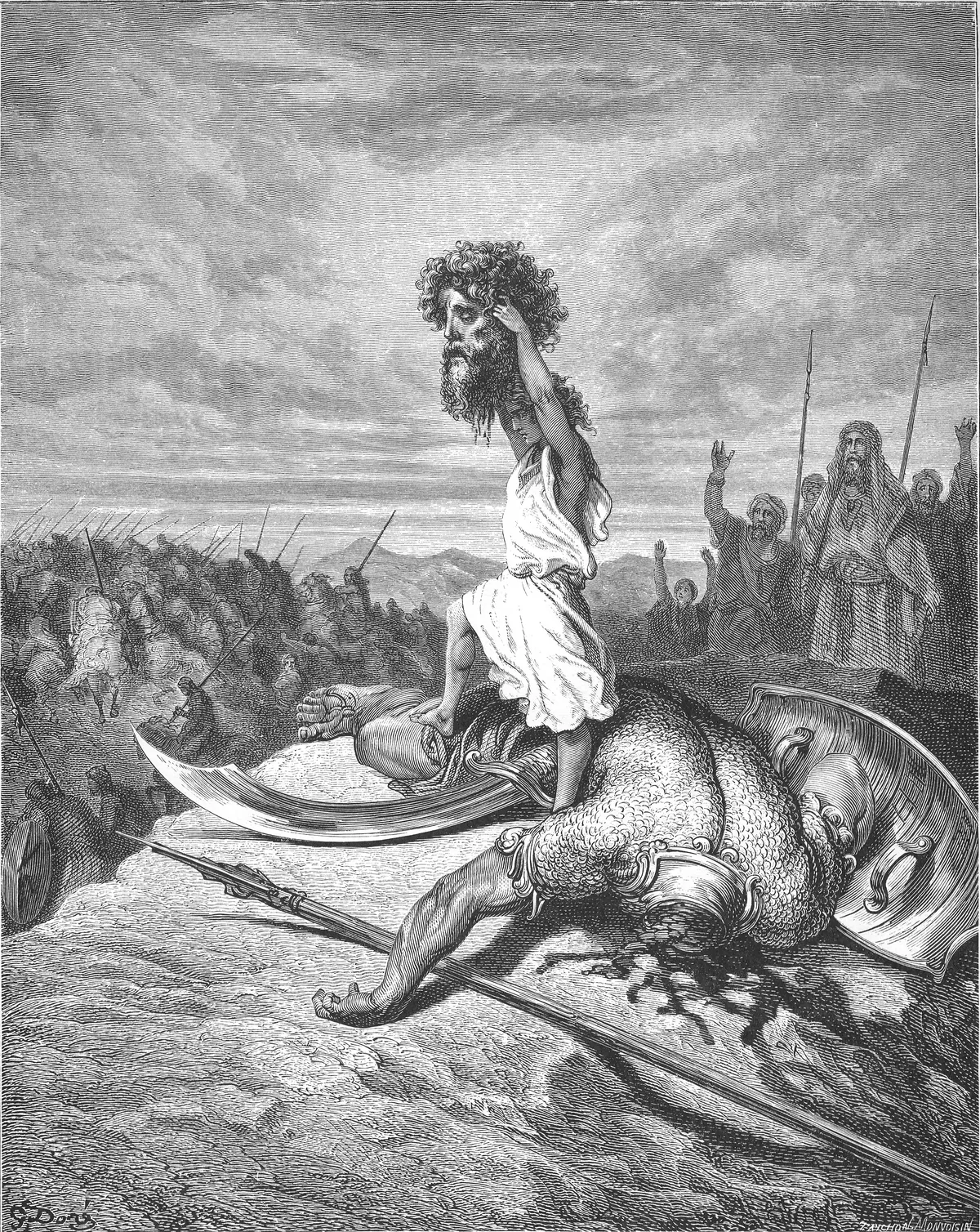
Doré had a genius for scale and drama, and he uses deep contrasts of black and white to make the moment monumental. His giant is truly gigantic, his David truly small, and the sudden reversal truly astonishing. Reproduced in countless Bibles, it became the definitive image of the story for the nineteenth century and beyond.
10. David und Goliath by Osmar Schindler (1888)
The last work is the one many people picture first: a slight, half naked shepherd boy swinging his sling at a towering giant in full armour. The German painter Osmar Schindler made this striking image in 1888, and it has been reproduced in schoolbooks and Bibles ever since as the very emblem of the contest.
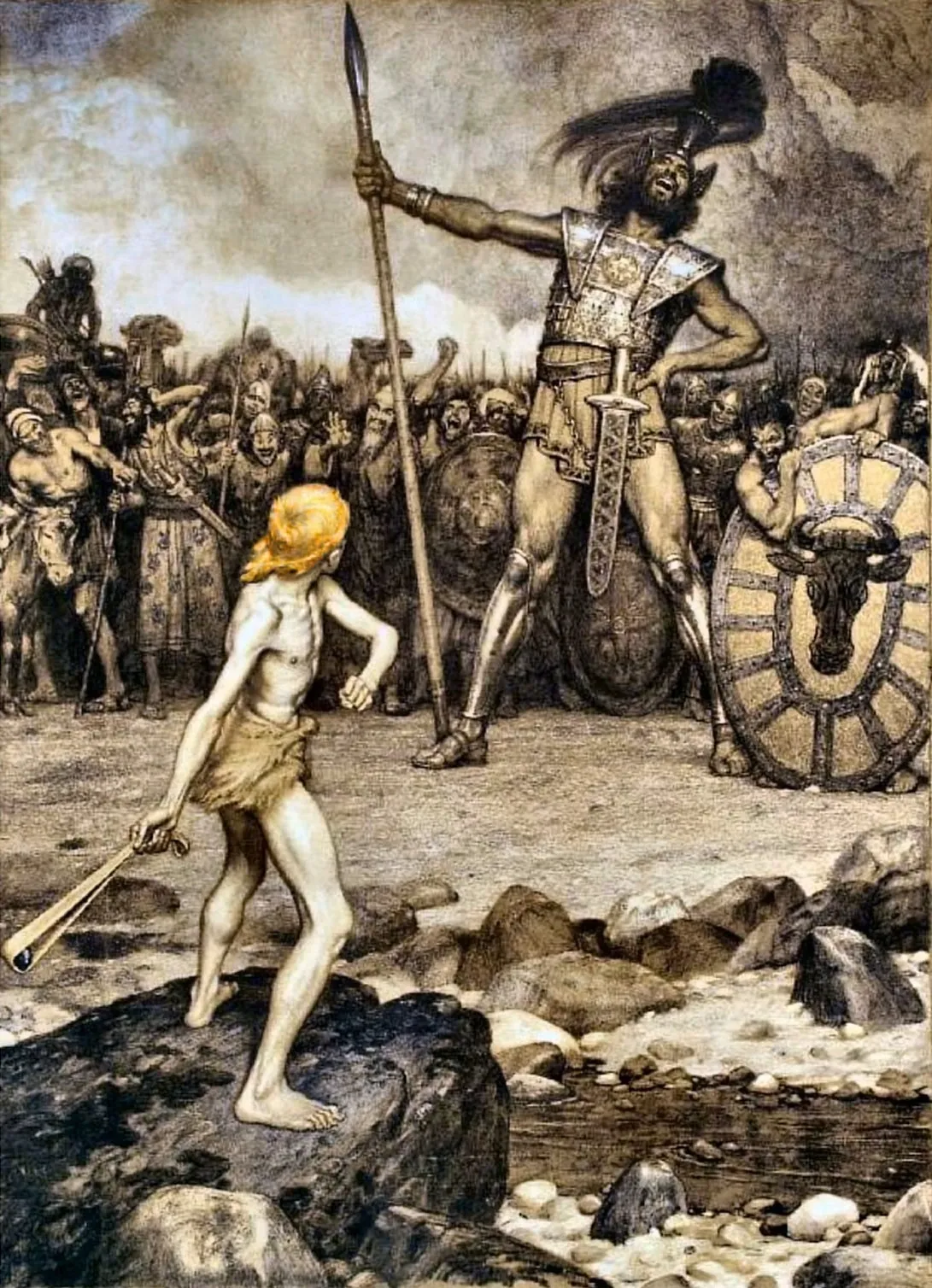
Schindler stages the confrontation at its most unequal, the small pale figure of David against the huge dark bulk of Goliath, with the two armies gathered behind. It captures the heart of the story in a single glance, courage and faith against overwhelming odds. Simple and unforgettable, it remains one of the most familiar images of David and Goliath ever made.
Summary of the Paintings
| Work | Artist | Date | Medium | Location |
|---|---|---|---|---|
| David with the Head of Goliath | Caravaggio | 1610 | Oil on canvas | Galleria Borghese, Rome |
| David with the Head of Goliath | Guido Reni | c. 1605 | Oil on canvas | Uffizi Gallery, Florence |
| David with the Head of Goliath | Guercino | c. 1650 | Oil on canvas | National Museum of Western Art, Tokyo |
| David and Goliath | Orazio Gentileschi | c. 1605 to 1608 | Oil on canvas | National Gallery of Ireland, Dublin |
| David and Goliath | Titian | 1542 to 1544 | Oil on canvas | Santa Maria della Salute, Venice |
| Self-portrait as David with the Head of Goliath | Johan Zoffany | c. 1756 | Oil on canvas | National Gallery of Victoria, Melbourne |
| David Slaying Goliath | Peter Paul Rubens | c. 1616 | Oil on canvas | Norton Simon Museum, Pasadena |
| The Triumph of David | Nicolas Poussin | c. 1631 to 1633 | Oil on canvas | Dulwich Picture Gallery, London |
| David Slays Goliath | Gustave Doré | 1866 | Engraving | La Grande Bible de Tours |
| David und Goliath | Osmar Schindler | 1888 | Illustration | Widely reproduced |
Conclusion
Across three hundred years, painters returned to David and Goliath because it gives them everything at once: a hero and a monster, a fight and its aftermath, faith and horror side by side. Titian made the giant a falling mountain, Rubens a wrestling match, Poussin a joyful procession. Caravaggio and Zoffany turned the story inward and lent the dead giant their own faces, while Doré and Schindler fixed the contest in the popular imagination for good. What holds all these works together is the shock of the reversal, the smallest and least armed figure on the field bringing down the greatest. It is a story about courage over fear and faith over force, and it has never lost its power to move us. For another biblical tale of a lone hero who felled a tyrant with a single blow, see our article on Judith and Holofernes, and for David’s own later story of guilt and grace, our piece on Psalm 51 in art.
Important Facts About David and Goliath in Art
- The story is told in the First Book of Samuel, chapter 17, where the shepherd David kills the Philistine giant Goliath with a single stone from his sling, then beheads him with the giant’s own sword.
- The most famous painting of the subject is Caravaggio’s David with the Head of Goliath of 1610, in which the severed head is a self-portrait of the artist.
- Artists treat the story in three main ways: the fight itself, David standing with the severed head, and the triumphal return with the head carried before a crowd.
- Gustave Doré’s engraving of 1866 and Osmar Schindler’s image of 1888 became the most widely reproduced versions, familiar from Bibles and schoolbooks.
- David and Goliath is one of the classic underdog stories, and the phrase is still used for any contest in which a small challenger defeats a much larger opponent.
Questions and Answers
Who painted the most famous David and Goliath painting?
The best known painting is David with the Head of Goliath by Caravaggio, made in 1610 and now in the Galleria Borghese in Rome. It is famous partly because the severed head of the giant is a self-portrait of Caravaggio himself. Many other great artists painted the subject, including Guido Reni, Guercino, Titian, Peter Paul Rubens, and Nicolas Poussin, and Gustave Doré’s engraving of 1866 is the most widely reproduced version of all.
Where is Caravaggio’s David with the Head of Goliath located?
It hangs in the Galleria Borghese in Rome, the collection begun by Cardinal Scipione Borghese, to whom Caravaggio most likely sent the painting as a plea for pardon. The Borghese holds several major works by Caravaggio, and this is among the most celebrated. Other versions of the David and Goliath theme are spread across museums in Florence, Dublin, Tokyo, Pasadena, London, and Melbourne.
What is the story of David and Goliath?
In the First Book of Samuel, the armies of Israel and the Philistines face each other across a valley. The Philistine champion Goliath, a giant in heavy armour, challenges any Israelite to single combat, and for forty days no one dares. The young shepherd David, visiting his brothers, accepts. Refusing armour, he strikes Goliath in the forehead with a stone from his sling, then kills him with the giant’s own sword. The Philistines flee, and David becomes a hero.
What does David and Goliath symbolise?
It has become the classic image of the underdog, the small and weak overcoming the large and powerful. In its biblical setting the victory belongs to faith and to God, who works through the least likely person rather than through armour and strength. Over time the phrase has spread far beyond religion, and any contest between a small challenger and a dominant opponent is now called a David and Goliath struggle.
Why did artists paint David with the head of Goliath?
The severed head gave painters a powerful way to show both victory and its cost. A calm young David beside the bloody head makes a striking contrast between beauty and death, life and mortality. It also let artists explore complicated feelings, pity, guilt, or thanksgiving, rather than simple triumph. Some, like Caravaggio and Johan Zoffany, went further and gave the head their own features, turning the biblical scene into a meditation on themselves.
Can you buy David and Goliath paintings as canvas prints?
You can buy David and Goliath paintings at jesuschrist.pictures, in our shop, where these classic works are offered as high quality canvas prints. Because the subject has been painted by so many masters, a faithful reproduction lets you bring a work like Caravaggio’s haunting David or Poussin’s joyful triumph into a home, church, or study. Browse our collection of Christian art reproductions on canvas to find a piece for your own walls.