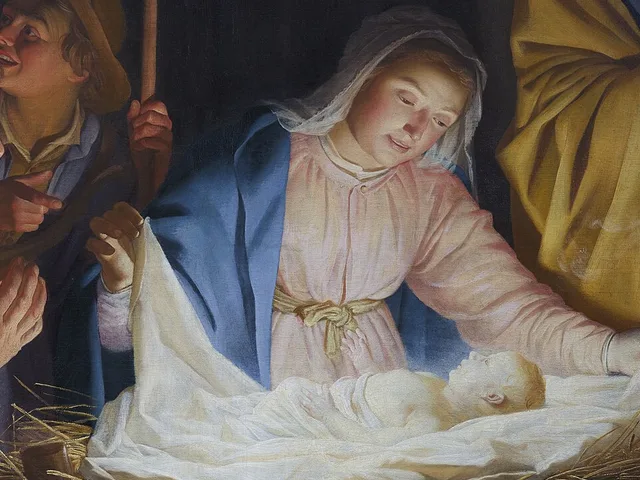
The Memorare Prayer: Meaning, History, and Full Text
The Memorare is one of the most loved prayers in the Catholic Church, a short and confident appeal to the Virgin Mary that has been whispered in chapels, hospitals, and battlefields for centuries. Its name comes from its first Latin word, Memorare, meaning “Remember”, and the whole prayer flows from a single bold claim: that no one who has ever turned to Mary for help has been turned away.
People reach for the Memorare when they have run out of other words. It is the prayer of the desperate hour and the quiet night, trusted because it does not ask timidly but throws itself entirely on the mercy of the Mother of God. This guide gives the full text of the Memorare, explains what each line means, traces its surprising history, and shows how it has been pictured by some of the greatest painters of the Virgin Mary. For another beloved Catholic prayer told the same way, see our article on the Prayer of Saint Francis.

The Full Text of the Memorare
The Memorare is short enough to learn by heart in a single evening. This is the traditional English version:
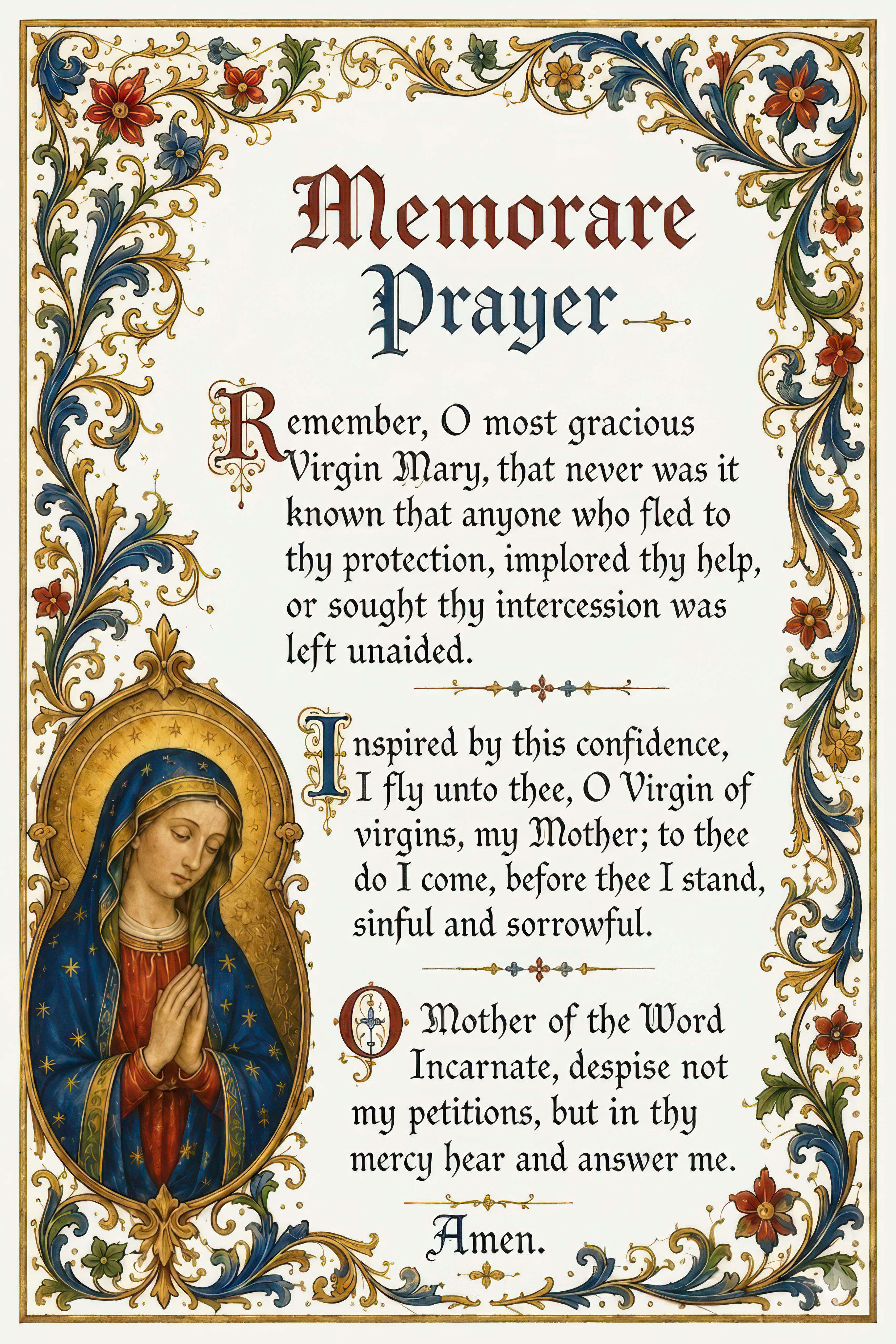
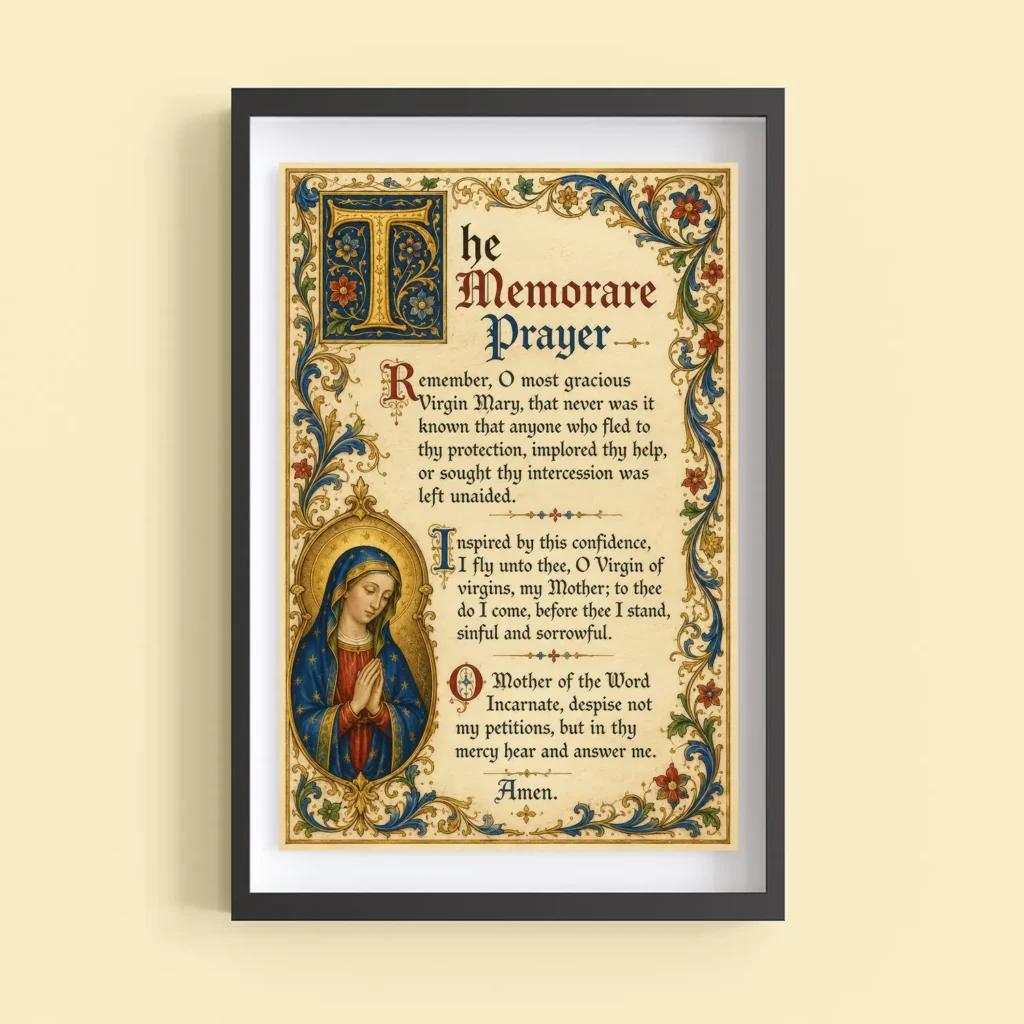
Remember, O most gracious Virgin Mary, that never was it known that anyone who fled to thy protection, implored thy help, or sought thy intercession was left unaided. Inspired by this confidence, I fly unto thee, O Virgin of virgins, my Mother; to thee do I come, before thee I stand, sinful and sorrowful. O Mother of the Word Incarnate, despise not my petitions, but in thy mercy hear and answer me. Amen.
The prayer is often closed with the simple response, “Pray for us, O holy Mother of God, that we may be made worthy of the promises of Christ.” Some say it once, slowly, and some repeat it again and again until the heart grows calm.
A Free Printable Memorare Prayer Card
The Memorare belongs in the visual language of the old prayer books, where holy words were framed in gold and flowers. This prayer card keeps the whole text in that illuminated style, ready to slip into a missal, pin above a desk, or hand to someone who needs it.
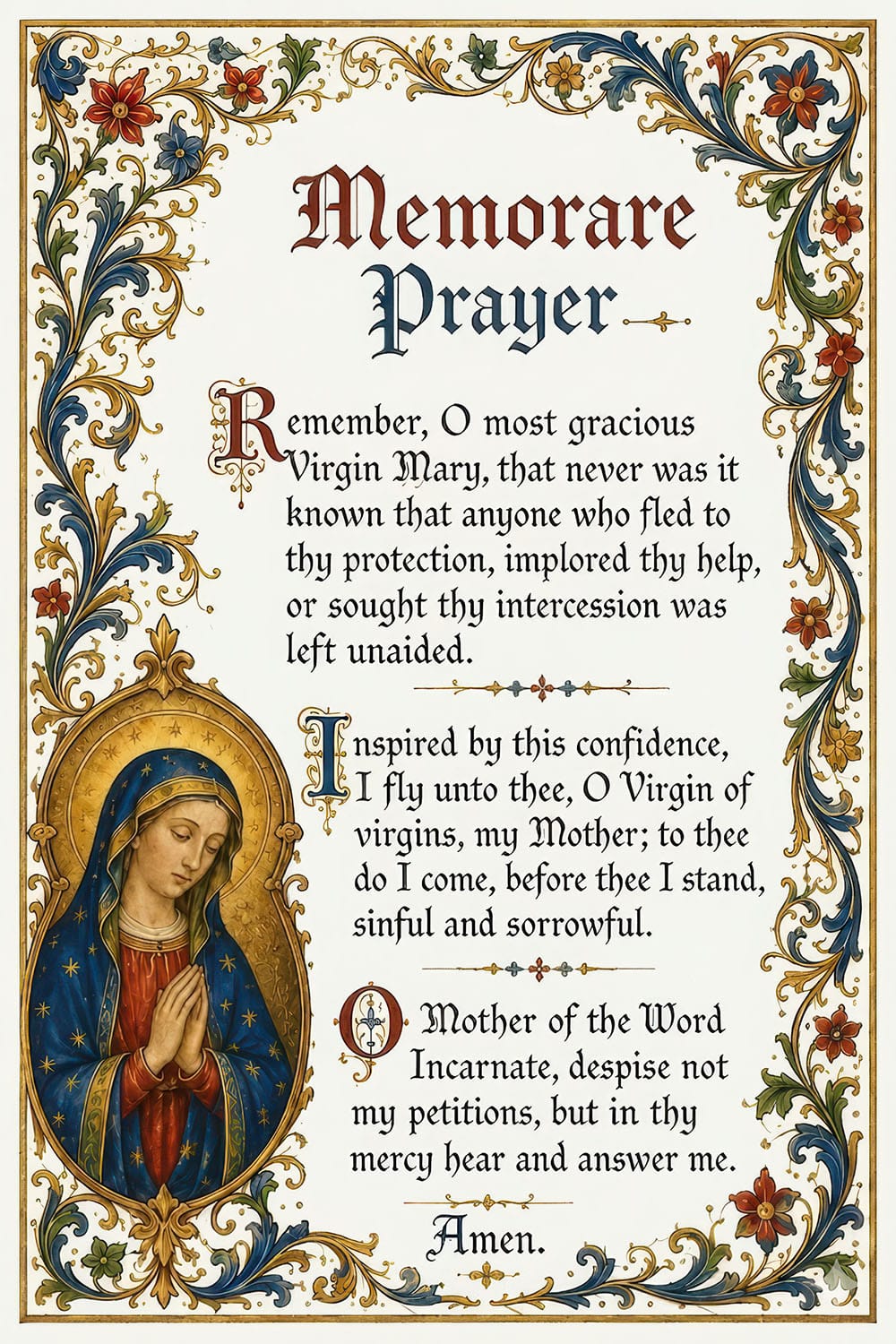
Free printable prayer card:
- Prayer card, PDF, US Letter
- Prayer card, PDF, A4
- Pocket prayer cards, 4 per sheet, PDF
- High resolution image, JPG
These files are free for personal use, for your parish, or for catechism class.
What the Memorare Means
The Memorare is built like a small argument made out of trust. It opens by reminding Mary, and really the one praying, of her unbroken record of mercy: never was it known that anyone who fled to her protection, implored her help, or sought her intercession was left unaided. Those three verbs matter. To flee to her protection is to run to her as a child runs to its mother in danger. To implore her help is to ask plainly for what we need. To seek her intercession is to ask her to carry that need to her Son.
From that confidence comes the leap of the second part. “Inspired by this confidence, I fly unto thee.” The one praying does not approach slowly or argue for a hearing. Standing “sinful and sorrowful”, aware of every failure, the soul still rushes to Mary as “Virgin of virgins, my Mother”. The prayer ends by naming who she is, the “Mother of the Word Incarnate”, the mother of God made man, and asking her not to despise the small petitions brought to her but to hear and answer them in mercy.
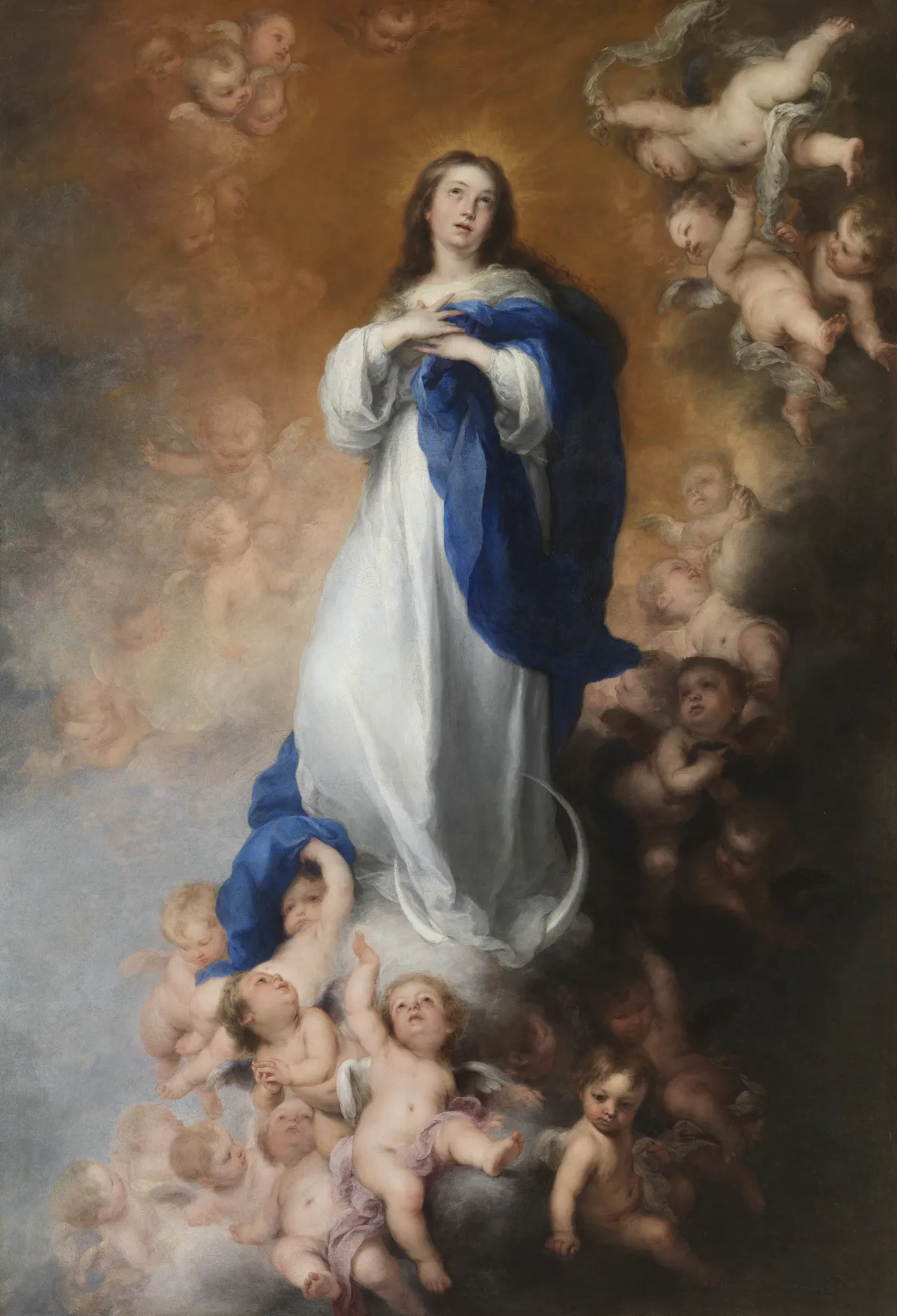
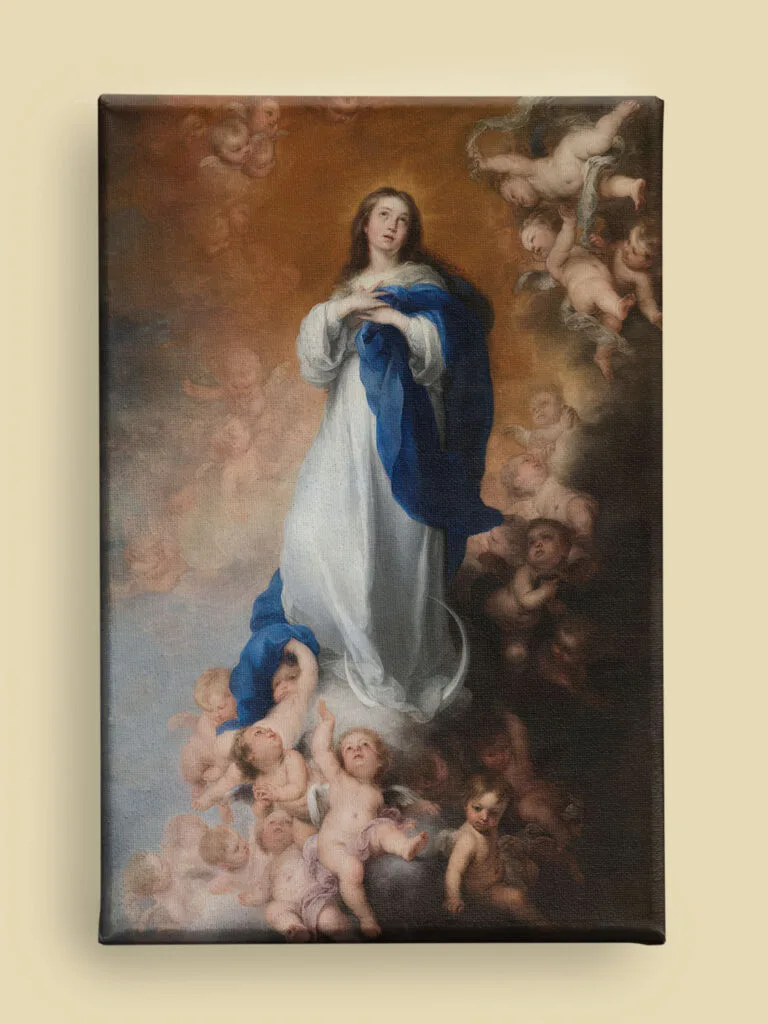
Painters captured this same trust in images of Mary lifted up in glory. Murillo’s Immaculate Conception shows her clothed with light and carried by angels, the pure Mother whose intercession the Memorare counts on. You can see this subject across the centuries in our gallery of famous Virgin Mary paintings.
Who Wrote the Memorare?
For a long time the Memorare was attributed to Saint Bernard of Clairvaux, the great twelfth century monk and Doctor of the Church famous for his burning devotion to the Virgin. The link felt natural, because Saint Bernard wrote and preached about Mary with a tenderness that matches the prayer’s tone.

Murillo painted the legend that ties the two together, the Virgin appearing to Saint Bernard as he writes. Modern scholars, however, doubt that Bernard composed the words we use today. The Memorare in its current form seems to have appeared in the late fifteenth century, drawn from a longer Latin prayer that began “Ad sanctitatis tuae pedes, dulcissima Virgo Maria”. What is certain is who made it famous. In the seventeenth century a French priest named Claude Bernard, known as “the poor priest”, printed and gave away tens of thousands of copies and used it in his work with prisoners and the sick. Because the two men shared a surname, the prayer’s authorship grew only more tangled, but its popularity was secured.
Mary, Refuge of Sinners
The heart of the Memorare is the image of Mary as a refuge, the one to whom the frightened and the guilty can run. No painting expresses this better than the Madonna of Mercy by Piero della Francesca, where the Virgin opens her great cloak to shelter a crowd of kneeling men and women beneath it.
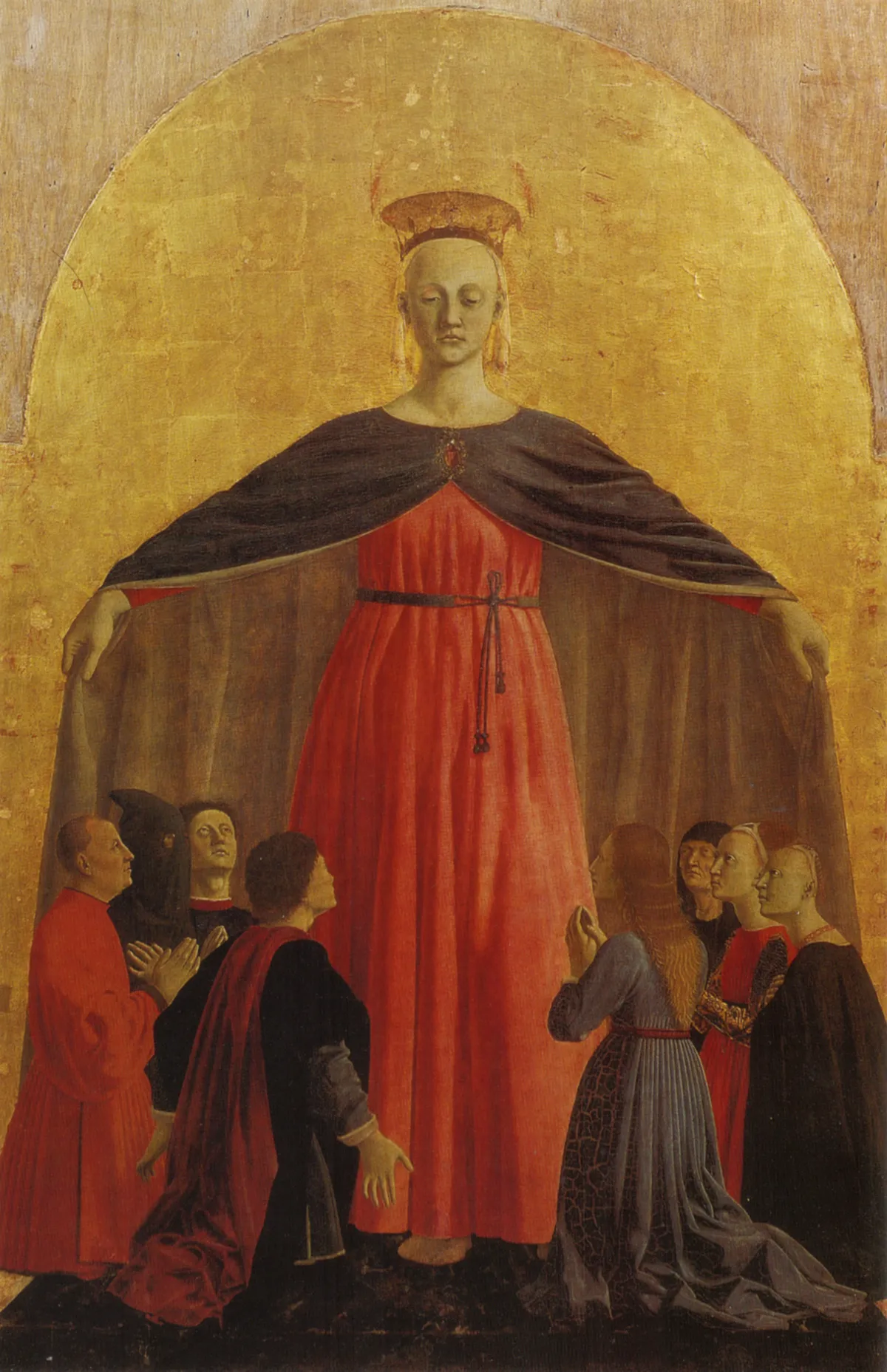
This was a favourite medieval and Renaissance image, the Madonna della Misericordia, the Madonna of Mercy. The faithful gather under her mantle as under the walls of a fortress, exactly as the Memorare describes those who “fled to thy protection”. The prayer does not claim that Mary saves by her own power. It trusts that she brings our needs to Christ, and that a mother’s plea is never ignored by her Son.
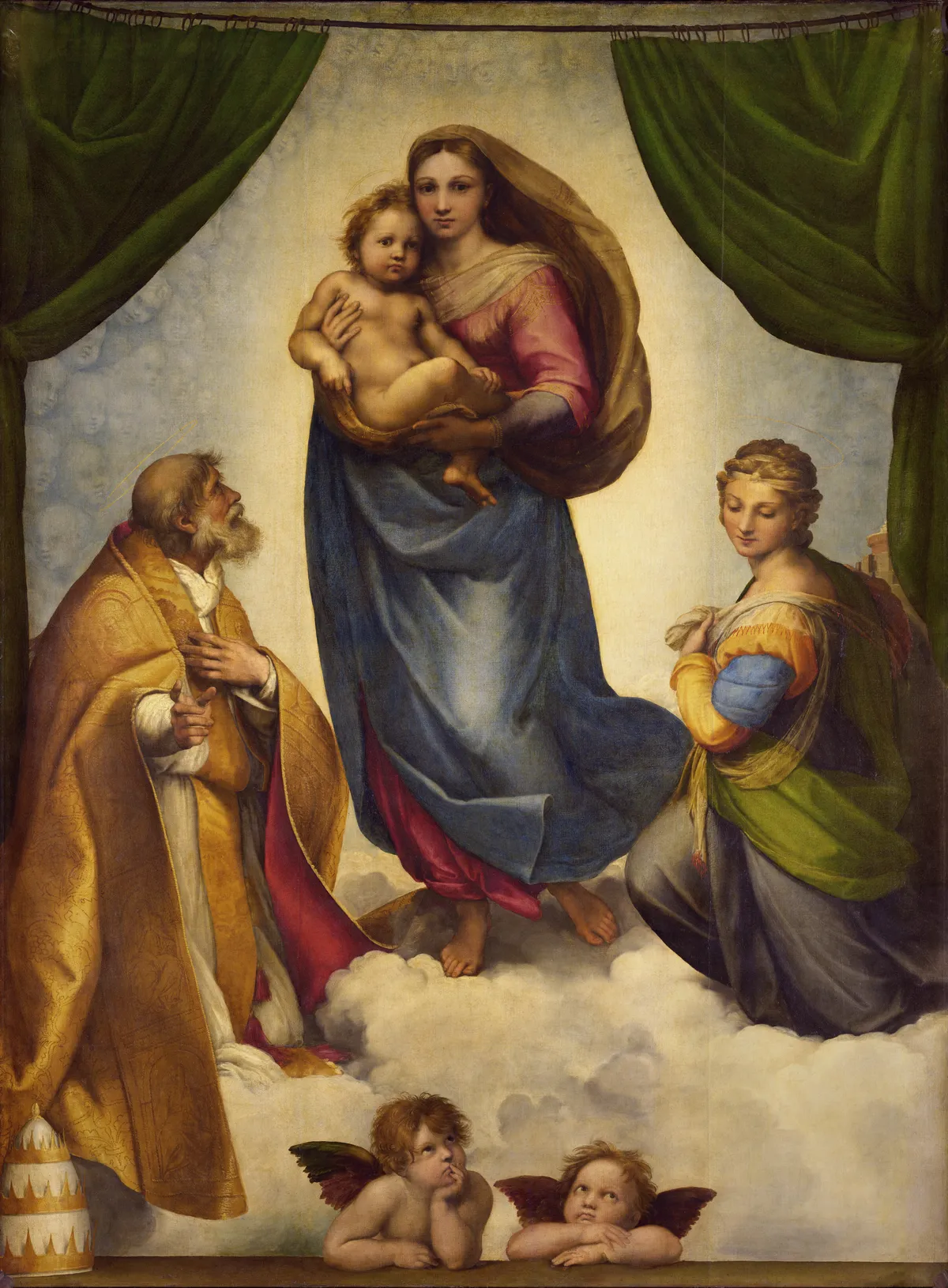
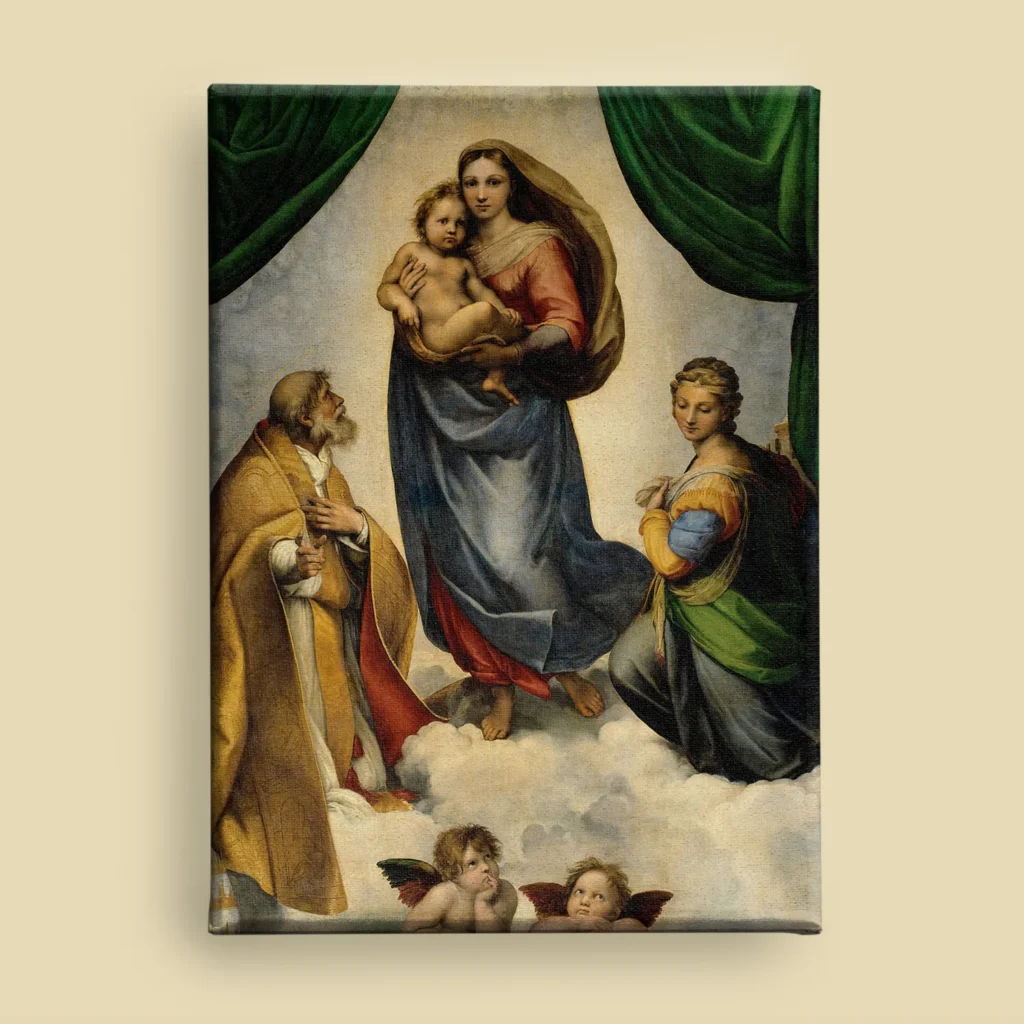
Raphael’s Sistine Madonna shows the other half of that movement. Here Mary steps forward through parted curtains and carries the Christ Child toward the viewer, as if bringing him to meet our need. To follow this subject in the work of the greatest painter of the Madonna, read our article on the Sistine Madonna and our selection of Raphael Madonna paintings.
When and How to Pray the Memorare
The Memorare can be prayed at any time, but it has always belonged especially to moments of urgent need: before surgery, during a hard decision, in grief, or simply at the end of a long day. Because it is short and so easy to remember, it is the prayer many Catholics turn to when there is no time for anything longer.
One popular way of praying it is the “flying novena”. Instead of spreading a novena over nine days, the person prays the Memorare nine times in a row, in a single sitting, when help is needed at once. This practice was a favourite of Saint Teresa of Calcutta, who prayed nine Memorares whenever she faced an impossible situation, which is why some people call it the prayer that “never fails”. The promise is not magic. It is the simple confidence the prayer itself teaches, that a mother who has never failed before will not begin now.
Marian Paintings Featured in This Article
| Painting | Artist | Date | Museum |
|---|---|---|---|
| Madonna della Seggiola | Raphael | c. 1513-1514 | Palazzo Pitti, Florence |
| The Apparition of the Virgin to Saint Bernard | Bartolome Esteban Murillo | c. 1655 | Museo del Prado, Madrid |
| Madonna of Mercy | Piero della Francesca | c. 1445-1462 | Museo Civico, Sansepolcro |
| The Sistine Madonna | Raphael | 1513-1514 | Gemaeldegalerie, Dresden |
| The Immaculate Conception of Los Venerables | Bartolome Esteban Murillo | c. 1678 | Museo del Prado, Madrid |
Conclusion
The Memorare has lasted because it says, in a few lines, what the heart most needs to believe: that there is a mother who never turns anyone away. It does not pretend that the one praying is worthy. It admits the opposite, that we come “sinful and sorrowful”, and then trusts anyway. That mix of honesty and confidence is why the prayer fits every situation, from the smallest worry to the gravest hour.
Whether prayed once before sleep or nine times in a moment of crisis, the Memorare keeps pointing past itself to the Virgin Mary and, through her, to Christ. The painters knew this. They showed her sheltering the faithful under her cloak and carrying her Son toward the world, the living picture of a prayer that has never been known to fail. To explore more sacred images of the Mother of God, see our gallery of famous Virgin Mary paintings.
Key Facts About the Memorare
- The Memorare is a Catholic prayer to the Virgin Mary that takes its name from its first Latin word, meaning “Remember”.
- It was long attributed to Saint Bernard of Clairvaux, but most scholars now date its present form to the late fifteenth century.
- It was popularised in the seventeenth century by the French priest Claude Bernard, who printed and distributed it widely.
- The “flying novena” prays the Memorare nine times in a row and was a favourite practice of Saint Teresa of Calcutta.
- Its central image, Mary as a refuge who shelters those who flee to her, is pictured in the medieval Madonna of Mercy.
Frequently Asked Questions
What is the full Memorare prayer?
The Memorare reads: “Remember, O most gracious Virgin Mary, that never was it known that anyone who fled to thy protection, implored thy help, or sought thy intercession was left unaided. Inspired by this confidence, I fly unto thee, O Virgin of virgins, my Mother; to thee do I come, before thee I stand, sinful and sorrowful. O Mother of the Word Incarnate, despise not my petitions, but in thy mercy hear and answer me. Amen.”
Who wrote the Memorare prayer?
It was traditionally attributed to Saint Bernard of Clairvaux in the twelfth century, but scholars now believe the prayer in its current form dates from the late fifteenth century. It was made widely known in the seventeenth century by a French priest, Claude Bernard, whose shared surname only deepened the confusion over its author.
When should you pray the Memorare?
The Memorare can be prayed at any time, but it is especially loved in moments of urgent need, such as before surgery, in grief, or during a difficult decision. Because it is short and easy to memorise, many Catholics reach for it when there is no time for a longer prayer.
How do you pray the Memorare as a flying novena?
In the “flying novena” the Memorare is prayed nine times in a row, in a single sitting, rather than once a day for nine days. This practice was favoured by Saint Teresa of Calcutta, who used it whenever she faced an impossible situation, which is why the prayer is sometimes called the one that never fails.
Can you buy the Memorare as a prayer card or print?
You can buy the Memorare at jesuschrist.pictures, in our shop, where the prayer is offered as a printable prayer card and as a large poster on high quality matte paper. A free printable version is also available on this page for personal use, for your parish, or for catechism class.
✦ Free Christian & Catholic Printables
Love this one? Find it, along with our complete collection of illuminated prayer cards & Scripture printables, ready to print, free, in one place.
Browse all free printables →