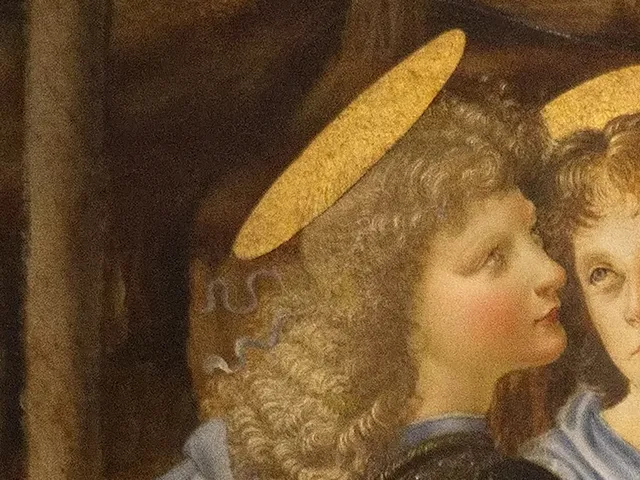
Gentile da Fabriano Paintings and the International Gothic
Gentile da Fabriano paintings are among the most sumptuous objects produced in fifteenth-century Italy. Born Gentile di Niccolo around 1370 in Fabriano, a small town in the Marche, he became the foremost master of the International Gothic style in the Italian peninsula. His art is a world of gleaming gold, jeweled surfaces, languid aristocratic figures, and a decorative richness that makes the naturalistic revolution of the Florentine Renaissance seem, by contrast, almost austere. He worked across northern and central Italy, from Venice to Florence, Siena, and Rome, leaving a trail of masterpieces that astonished patrons and artists alike.

The International Gothic in Italy
The International Gothic was the dominant style of European court painting around 1380 to 1430, and Gentile da Fabriano was its greatest Italian practitioner. The style was characterized by sinuous line, sumptuous surface decoration, a love of precious materials (gold leaf, lapis lazuli, costly pigments), and an elegance of figure and gesture that owed more to the courtly ideal than to the observation of nature. It had little interest in the spatial geometry that Masaccio was developing in Florence at exactly the same time, and it did not want any. Its ambition was not to reproduce the world but to transfigure it.
Gentile was trained in the late Gothic tradition of central Italy, absorbing influences from Siena and from the Venetian painting he encountered early in his career. By the first decade of the fifteenth century he was already the most celebrated Italian painter of his style, attracting commissions from the most powerful patrons of the day. His closest contemporary within the Sienese Gothic world was Sassetta, though Gentile operated on a grander, more courtly scale. Lorenzo Monaco in Florence represented a parallel flowering of the same late Gothic sensibility.
The Adoration of the Magi
The Adoration of the Magi (1423) is Gentile da Fabriano’s greatest achievement and one of the supreme masterpieces of the entire fifteenth century. Painted for Palla Strozzi, the wealthiest man in Florence, for the family chapel in Santa Trinita, it is a work of overwhelming decorative splendor. The three Magi arrive with their vast retinues of horses, falconers, leopards, and servants, a procession that fills the upper registers of the picture with movement and color. The predella below shows three scenes from the life of Christ in a very different, quieter mood. The gold ground is tooled, punched, and embossed with extraordinary skill, creating a surface that seems to generate its own light.

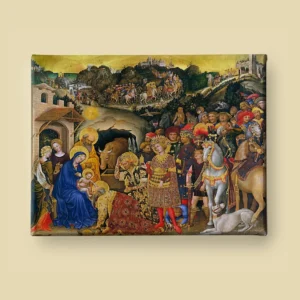
The painting was commissioned as a statement of Strozzi’s wealth, piety, and cultural ambition, and it fulfilled all three. It arrived in the Uffizi in 1919, where it still hangs near Fra Angelico’s Linaiuoli Tabernacle, a juxtaposition that says everything about the crossroads at which Florentine painting stood in the 1420s. Gentile’s version of the Adoration is the single most spectacular painting in the genre that fourteenth and fifteenth century Italian art produced. Lorenzo Monaco’s Adoration nearby offers a compelling comparison.
The Adoration of the Child and the Coronations
The Adoration of the Child, now in the J. Paul Getty Museum in Los Angeles, is a smaller and more intimate work, painted around 1420 to 1422. The Virgin kneels before the Christ child who lies on the ground, while Joseph and a ring of angels gather around them. The gold ground glows behind the scene with the warmth that is Gentile’s hallmark, and the figures are rendered with the same delicacy that marks all his finest works. It is a devotional image of great tenderness, very different in character from the public magnificence of the Strozzi Adoration.

The Coronation of the Virgin, also at the Getty, is a complex multi-figure composition showing Christ crowning the Virgin in heaven as saints and angels look on. It gives a sense of Gentile at his most formally elaborate, organizing a large number of figures across a hierarchical space with characteristic Gothic elegance. The Valle Romita Polyptych in the Pinacoteca di Brera in Milan is an earlier and in some ways more revealing work, painted around 1400 to 1410. The central panel shows the Coronation of the Virgin with saints in the lateral panels. The style here is somewhat more archaic, the gold grounds more dominant, the figures more frontally arranged, but the quality of the painting is already extraordinary, particularly in the heads of the flanking saints.


Madonnas and a Stigmatization
The Madonna and Child with Angels in the Metropolitan Museum of Art in New York is one of the finest of Gentile’s smaller-scale devotional works. The Virgin holds the Christ child against a gold ground as a group of angels frames the composition on either side. The painting demonstrates the mastery of surface and color that made Gentile the first choice of wealthy patrons throughout Italy. The gold is tooled with particular care, and the drapery of the Virgin falls in the languid Gothic curves that are among Gentile’s most recognizable characteristics.

The Madonna and Child with Saints Nicolas, Catherine and Donor in the Gemaldegalerie in Berlin is a work of intimate scale and great refinement. The donor, shown much smaller than the sacred figures according to medieval convention, kneels in the lower corner in an attitude of prayer. Saint Nicolas holds his attribute of three golden balls, and Catherine her palm. The picture belongs to the tradition of votive images commissioned by wealthy individuals as expressions of personal piety and devotion.

The Madonna of Humility in the Museu Nacional d’Art de Catalunya in Barcelona shows the Virgin seated on the ground, the “Madonna of Humility” iconographic type, emphasizing Mary’s submission and her identity as servant of God. The image is more economical than many of Gentile’s works, concentrating attention on the central group with a directness that is quietly powerful.

The Saint Francis Receives the Stigmata, now in the Fondazione Magnani-Rocca in Parma, is one of the most original of Gentile’s narrative works. Saint Francis kneels in a rocky landscape as the seraph appears to him, sending rays of light toward the saint’s hands and feet. The setting is genuinely observed from nature, rocks, plants, and the distant town are all rendered with an attentiveness to the visible world that sits in interesting tension with the supernatural event depicted. It is a reminder that even within the Gothic tradition, painters were beginning to look at the natural world with new curiosity.

Paintings by Gentile da Fabriano
| Name | Date | Medium | Location |
|---|---|---|---|
| Adoration of the Child | c. 1420-1422 | Tempera on panel | J. Paul Getty Museum, Los Angeles |
| Adoration of the Magi (Strozzi Altarpiece) | 1423 | Tempera and gold on panel | Uffizi Gallery, Florence |
| Coronation of the Virgin | c. 1420 | Tempera on panel | J. Paul Getty Museum, Los Angeles |
| Coronation of the Virgin with Saints (Valle Romita Polyptych) | c. 1400-1410 | Tempera on panel | Pinacoteca di Brera, Milan |
| Madonna and Child with Angels | c. 1420 | Tempera on panel | Metropolitan Museum of Art, New York |
| Madonna and Child with Saints Nicolas, Catherine and Donor | c. 1395-1400 | Tempera on panel | Gemaldegalerie, Berlin |
| Madonna of Humility | c. 1420 | Tempera on panel | Museu Nacional d’Art de Catalunya, Barcelona |
| Saint Francis Receives the Stigmata | c. 1415-1420 | Tempera on panel | Fondazione Magnani-Rocca, Parma |
Important Facts About Gentile da Fabriano
- Gentile da Fabriano was born Gentile di Niccolo di Giovanni Massi around 1370 in Fabriano, a town in the Marche region of central Italy.
- He trained in the late Gothic tradition of central Italy, working in Venice in the 1410s before moving to Florence, where he painted the Strozzi Altarpiece in 1423.
- Gentile da Fabriano is the supreme master of the International Gothic style in Italian painting, celebrated for his sumptuous decorative surfaces, brilliant color, and figures of aristocratic elegance set against richly tooled gold grounds.
- His greatest work is the Strozzi Altarpiece, or Adoration of the Magi, completed in 1423 for Palla Strozzi and now in the Uffizi Gallery in Florence.
- He died in Rome in 1427 while working on a fresco cycle in San Giovanni in Laterano, a commission that was later completed by Pisanello, his most devoted follower.
Questions & Answers
What is Gentile da Fabriano’s most famous painting?
The Adoration of the Magi (1423), known as the Strozzi Altarpiece and now in the Uffizi Gallery in Florence, is his undisputed masterpiece. It was commissioned by Palla Strozzi, the wealthiest man in Florence, and represents the International Gothic style at its most opulent and confident. The procession of the Magi with their retinues of horses, falconers, and exotic animals fills the upper panel with extraordinary decorative complexity, while the gold ground is worked and tooled with a virtuosity unmatched in Italian panel painting. It is one of the most spectacular objects produced anywhere in Europe during the fifteenth century.
Where can I see Gentile da Fabriano’s paintings today?
His works are spread across several major collections. The Uffizi Gallery in Florence has the Adoration of the Magi. The J. Paul Getty Museum in Los Angeles holds both the Adoration of the Child and the Coronation of the Virgin. The Pinacoteca di Brera in Milan has the Valle Romita Polyptych. The Metropolitan Museum in New York holds the Madonna and Child with Angels. The Gemaldegalerie in Berlin has the Madonna with Saints Nicolas and Catherine. The Museu Nacional d’Art de Catalunya in Barcelona has the Madonna of Humility.
What is the International Gothic style?
The International Gothic was a courtly style of painting and manuscript illumination that flourished across Europe from roughly 1380 to 1430. It emphasized sinuous, elegant line, rich decorative surfaces, brilliant color, and a graceful idealization of the human figure derived from aristocratic court culture. It was practiced by artists across France, Burgundy, Bohemia, and Italy, and it shared enough visual characteristics across borders to be considered a genuinely international phenomenon. In Italy, Gentile da Fabriano and Pisanello were its greatest representatives; in France, the Limbourg Brothers; in Burgundy, Melchior Broederlam.
What happened to Gentile da Fabriano’s frescoes?
Gentile da Fabriano is known to have painted several important fresco cycles that have since been lost. His frescoes in the Hall of the Great Council in the Doge’s Palace in Venice, painted in the 1410s, were destroyed by fire in 1577. His frescoes in the Broletto in Brescia are also lost. Most significantly, his fresco cycle in San Giovanni in Laterano in Rome, begun in 1427 and left unfinished at his death, was later completed by Pisanello but was ultimately destroyed during later renovations. We know his frescoes mainly through the testimony of Ghiberti, who described them with great admiration.
How does Gentile da Fabriano compare to his contemporaries?
The most instructive comparison is with Masaccio, who was painting in Florence at exactly the same moment. Where Masaccio stripped painting down to its structural essentials, building monumental figures in convincing three-dimensional space, Gentile covered every surface with decorative richness and kept his figures in the flat, gilded plane of the Gothic tradition. The two painters represent opposite poles of the possibilities open to Italian painting in the 1420s. Neither “won”: Masaccio’s revolution defined the future, but Gentile’s tradition of decorative splendor never entirely disappeared, and it was revived with great success by painters of later generations.
Who were Gentile da Fabriano’s most important patrons?
His most celebrated patron was Palla Strozzi of Florence, who commissioned the Strozzi Altarpiece in 1423. Before his Florentine period, he worked for the Malatesta family in Brescia and for the Venetian Republic in the Doge’s Palace. In Rome, he received the commission for San Giovanni in Laterano from Pope Martin V. His clientele was consistently drawn from the highest levels of Italian political and ecclesiastical society, which is itself a testament to the prestige that the International Gothic carried in early fifteenth-century Italy.
Where can I buy Gentile da Fabriano paintings reproductions?
You can buy them at jesuschrist.pictures: browse all the Gentile da Fabriano canvas prints in our shop, printed on museum-grade canvas and available in several sizes.