Rembrandt’s Head of Christ: A Human Face of God
Head of Christ is a small, deeply human image of Jesus, painted by Rembrandt around 1648. It is not a grand altarpiece but a quiet study, a single face emerging from shadow, made on a panel barely larger than a sheet of paper. The painting is now in the Gemaldegalerie in Berlin. The museum records its medium as oil on oak panel.
What makes the work remarkable is how ordinary, and how tender, this Christ appears. He does not stare out in majesty. His head is slightly bowed, his eyes lowered, his expression gentle and a little sad. He looks like a real person caught in a moment of thought.
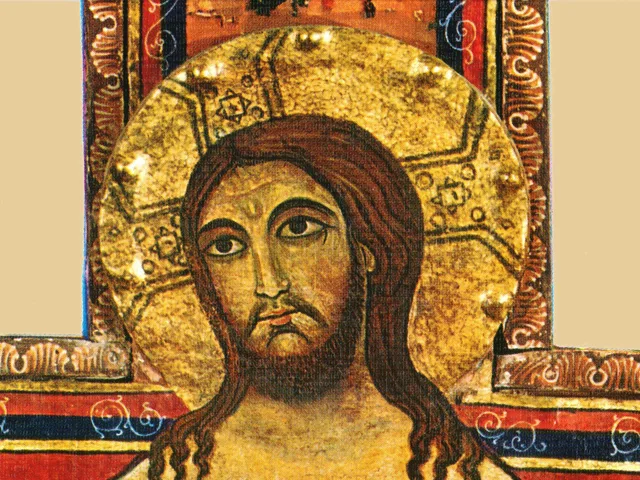
This was a radical step. Rather than repeat the timeless, idealized face handed down from Byzantine and medieval tradition, Rembrandt painted Jesus from a living model, a young Jewish man from the Sephardic community of his own Amsterdam.
Rembrandt returned to the life of Christ again and again. Readers can also see his dramatic side in our article on The Storm on the Sea of Galilee.
The History of the Head of Christ
The Head of Christ belongs to a group of small studies of Jesus that Rembrandt and his workshop made in Amsterdam around 1648 to 1656. Several closely related versions survive, in Berlin, Philadelphia, Detroit and elsewhere, and scholars still debate which are by the master’s own hand.


These were not commissioned showpieces but working studies, kept in the studio and used as models for larger New Testament scenes. The Berlin panel is among the finest, a quiet experiment in how to paint the face of God as a living man. More of the artist can be seen in our overview of Rembrandt’s paintings.
A Face Painted From Life
For centuries, artists had shown Christ with a fixed, idealized face, symmetrical, golden-haired, almost more sign than man. Rembrandt broke with that tradition. He set a real model before him, most likely a young Jewish man from his Amsterdam neighborhood, and painted what he saw.

The result is a Jesus with dark hair and beard, olive skin, and a thoughtful, unidealized face, closer to how a man from first-century Judea might actually have looked. By painting Christ from a Jewish model, Rembrandt brought a new honesty and humanity to sacred portraiture.
The Downcast Eyes
The heart of the painting is the gaze. Christ does not look at the viewer. His eyes are lowered, turned inward, soft with what seems like patience or quiet sorrow.

Rembrandt builds the face out of gentle light and warm shadow, letting it glow against the dark, empty background. There is no halo, no gold, no display. The holiness is carried entirely by the expression, an inwardness that invites the viewer to prayer rather than awe. The small size shows it was made for private devotion, to be held and contemplated up close.
Light Out of Darkness
The power of the Head of Christ lies in its restraint. With a limited range of browns and golds, and a few touches of light on the forehead and cheek, Rembrandt gives the face a living presence. The figure seems to emerge from the shadow as if from deep thought.
This is the same gift for inward, human emotion that fills his great religious works. Here it is concentrated into a single face, an image of Christ that feels less like a doctrine and more like a person one might meet.
Conclusion
In the Head of Christ, Rembrandt set aside the splendor usually given to the Son of God and painted instead a gentle, thoughtful man drawn from life. By using a Jewish model and refusing every idealizing convention, he created one of the most humane images of Jesus in Western art.
Small enough to hold in two hands, the Berlin panel still speaks quietly to anyone who stands before it, offering not a distant icon but a near and human face of God.
Artwork Information
| Artwork | Artist | Date | Medium | Current Location |
|---|---|---|---|---|
| Head of Christ | Rembrandt | c. 1648 | Oil on oak panel | Gemaldegalerie, Berlin |
Five Facts About Rembrandt’s Head of Christ
- Head of Christ is a small oil on oak panel by Rembrandt, kept in the Gemaldegalerie in Berlin.
- It was painted around 1648, part of a group of small studies of Jesus made in Rembrandt’s Amsterdam workshop.
- Rembrandt painted Christ from a living model, most likely a young Jewish man from Amsterdam’s Sephardic community.
- The image breaks with the idealized, Byzantine face of Jesus and shows him as a real, thoughtful man.
- Its small size and intimate mood indicate it was made as an aid to private devotion.
FAQ
What is Rembrandt’s Head of Christ?
It is a small oil study of the face of Jesus, painted by Rembrandt around 1648. Instead of an idealized icon, it shows Christ as a gentle, thoughtful young man emerging from shadow.
Who was the model for the Head of Christ?
Rembrandt is believed to have used a living model, a young Jewish man from the Sephardic community in his own Amsterdam neighborhood, rather than copying a traditional type.
Why is the Head of Christ significant?
It was one of the first times an artist painted Jesus from a real Jewish model, giving the face a new realism and humanity and breaking with centuries of idealized convention.
Are there several versions of the Head of Christ?
Yes. Rembrandt and his workshop made a group of closely related small studies, now in Berlin, Philadelphia, Detroit and other collections. Scholars still discuss which are by Rembrandt himself.
When did Rembrandt paint the Head of Christ?
The Berlin panel was painted around 1648, with related versions made over the following years.
Where is Rembrandt’s Head of Christ today?
It is in the Gemaldegalerie in Berlin.
Can you buy a reproduction of Rembrandt’s Head of Christ?
You can buy a reproduction of Rembrandt’s Head of Christ at jesuschrist.pictures: see the canvas reproduction in our shop, printed on museum-grade canvas and available in several sizes.