Dali’s Corpus Hypercubus: A Crucifixion in Four Dimensions
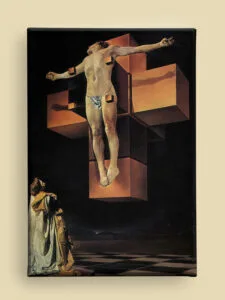
Crucifixion (Corpus Hypercubus) is one of the most original religious paintings of the twentieth century, made by Salvador Dali in 1954. It reimagines the crucifixion through the language of mathematics, showing Christ floating before a cross built from a four-dimensional cube. The painting is in the Metropolitan Museum of Art in New York. Its medium is oil on canvas.
Instead of a wooden cross, Dali paints an unfolded hypercube, or tesseract, a shape from geometry made of eight cubes that opens out into the form of a cross. Christ does not hang from it but levitates in front of it, his body whole and healthy, free of nails, blood, and the crown of thorns.
The effect is at once modern and devout. Dali called himself the first painter of the atomic age, and here he joins faith, science, and geometry into a single image of a Christ who has passed beyond the limits of the ordinary world. Readers who want to see more can also read our article on Dali’s religious paintings.
The History of Corpus Hypercubus
Dali painted Corpus Hypercubus in 1954, during the deeply religious phase of his career he called nuclear mysticism. In these years he became fascinated by modern physics and mathematics, and tried to unite the new science of the atom with the Catholic faith of his Spanish heritage.

The Metropolitan Museum of Art acquired the painting in 1955, and it has remained one of its most popular works. It is often hung near older Spanish masters such as Velazquez and Zurbaran, whose sober realism Dali admired and quietly echoes in the chessboard floor and the careful modeling of the body.
Christ and the Hypercube
The heart of the painting is the strange cross. A tesseract is a cube in four dimensions, and when it is unfolded into our three-dimensional world it forms a group of eight cubes shaped like a cross. Dali uses this shape to suggest a reality beyond the one we can see, fitting for a Christ who has conquered death.

Christ floats before it without a single nail. Small cubes hover near his hands and feet where the nails would be, and his body is calm, athletic, and unmarked. There is no agony here. Dali shows not the suffering of the cross but the triumph beyond it, a Christ already glorified.
Gala as Witness
At the lower left kneels a single witnessing figure, dressed in classical golden drapery and gazing up at Christ. She takes the place of the Virgin Mary, but her features are those of Gala, Dali’s wife and lifelong muse, whom he painted into many of his sacred works.

Her calm, monumental presence grounds the floating vision above her. While Christ hovers in a dark, weightless space, she stands solidly on the earth, the human witness to a mystery that reaches beyond human sight.
The Chessboard and the Bay
Beneath the figures stretches a floor of black and white squares, like a great chessboard, receding toward a low horizon. In the distance lies a quiet stretch of water, the bay of Port Lligat in Catalonia, where Dali lived and worked.

The chessboard recalls the tiled floors of old Spanish and Flemish paintings, tying this most modern of crucifixions to the long tradition behind it. The familiar bay anchors the cosmic event, once again, in Dali’s own beloved corner of the world.
Faith in the Atomic Age
Corpus Hypercubus is Dali’s attempt to paint the crucifixion for a scientific century. By replacing the wooden cross with a figure from higher geometry, he suggests that the truths of faith and the truths of science point toward the same hidden reality.
Whether or not one follows his mysticism, the painting is unforgettable. It takes the oldest image in Christian art and rebuilds it from pure mathematics, creating a Christ who seems to belong to no single time or dimension.
Conclusion
In Crucifixion (Corpus Hypercubus) Dali joined the cross to the fourth dimension and turned the death of Christ into a vision of geometry and light. The floating body, the unfolded cube, and the watching Gala make an image like no other crucifixion before it.
It remains one of the boldest religious paintings of the modern age, a meeting of ancient faith and new science, and one of the treasures of the Metropolitan Museum of Art.
Artwork Information
| Artwork | Artist | Date | Medium | Current Location |
|---|---|---|---|---|
| Crucifixion (Corpus Hypercubus) | Salvador Dali | 1954 | Oil on canvas | Metropolitan Museum of Art, New York |
Five Facts About Corpus Hypercubus
- Crucifixion (Corpus Hypercubus) is a 1954 oil painting by Salvador Dali.
- It shows Christ crucified on the unfolded net of a tesseract, a four-dimensional cube.
- Christ floats without nails, blood, or a crown of thorns, his body whole and idealized.
- The witnessing figure below is Gala, Dali’s wife, shown in classical drapery.
- It belongs to Dali’s nuclear mysticism period and hangs in the Metropolitan Museum of Art.
FAQ
What does Corpus Hypercubus mean?
The Latin title means roughly the body of the hypercube. It refers to the way Dali sets the body of Christ against an unfolded hypercube, or tesseract, instead of a wooden cross.
What is the hypercube in the painting?
A hypercube, or tesseract, is a cube in four dimensions. When it is unfolded into our three-dimensional world it forms a group of eight cubes shaped like a cross, which Dali uses as the cross of Christ.
Why is there no blood, nails, or crown of thorns?
Dali shows the triumph beyond the cross rather than the suffering on it. Christ floats free, his body whole, while small cubes hover where the nails would be. It is a glorified, not a tortured, Christ.
Who is the woman in the painting?
She stands in for the Virgin Mary, but her features are those of Gala, Dali’s wife and muse, whom he included in many of his religious paintings.
What is the meaning of Corpus Hypercubus?
It unites faith, science, and mathematics. By building the cross from higher geometry, Dali suggests that religious truth and scientific truth point toward the same reality beyond ordinary sight.
Where is Corpus Hypercubus?
It is in the Metropolitan Museum of Art in New York, which acquired it in 1955.
When did Dali paint Corpus Hypercubus?
He painted it in 1954, during the religious, so called nuclear mysticism phase of his career.
Can you buy a reproduction of Dali’s Corpus Hypercubus?
You can buy a reproduction of Dali’s Corpus Hypercubus at jesuschrist.pictures. The canvas reproduction is in our shop, printed on premium canvas and shipped worldwide.


