I Can Do All Things Through Christ: Philippians 4:13 in Art
“I can do all things through Christ which strengtheneth me.” Philippians 4:13 may be the most quoted verse in the New Testament, stitched onto sportswear, written under signatures, and kept close as I Can Do All Things Through Christ wall art in homes and workplaces everywhere. It sounds like a verse of triumph, and it is, but not in the way the gym posters suggest. The man who wrote it was sitting in a prison cell, uncertain whether he would live or die, and what he had learned there was not how to win but how to endure. Christian artists understood this. When they pictured Paul, they did not paint a victor on a podium. They painted a prisoner with a sword and a book, an old man bent over a letter, a saint whose strength was clearly borrowed from somewhere beyond himself.
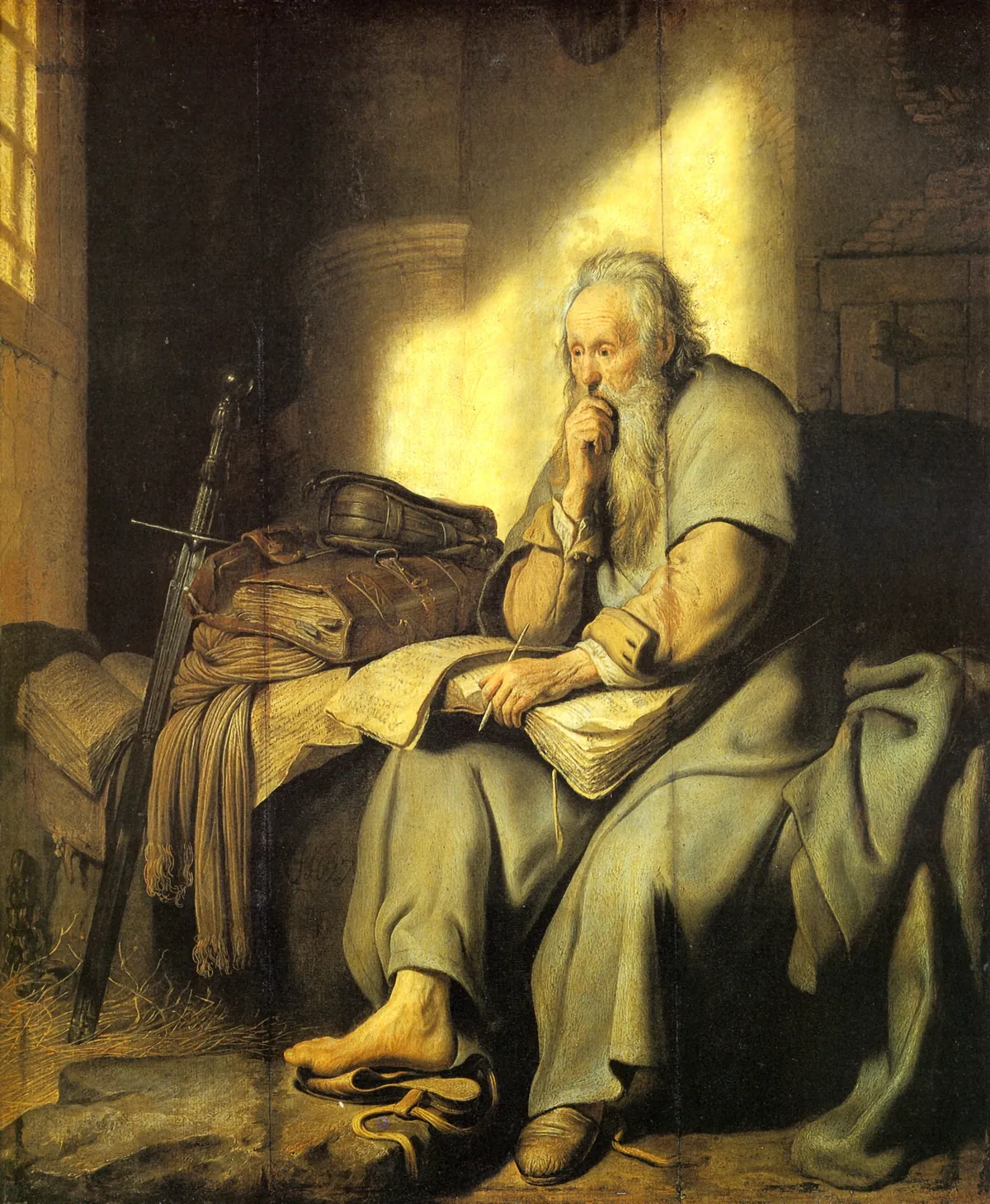
A promise written in chains
Rembrandt was only about twenty-one when he painted this Saint Paul, and already he understood the heart of the subject. The apostle sits on a low bed in a bare cell, a great sword leaning beside him, a manuscript open on his knee. He has stopped writing. One hand rests against his mouth, his eyes turned inward, caught in the long pause of a man searching for the right word. Light falls from a small barred window and gathers around his head. This is not a defeated prisoner. It is a man at work, composing in confinement the very letters that would outlast every empire that jailed him.
That setting is the key to Philippians 4:13. Paul wrote the letter to the church at Philippi from prison, in chains, with his future entirely out of his hands. The famous verse is not a boast about achievement. It is the conclusion of a man who has discovered that he can face anything, because his strength does not come from his circumstances. Read in Rembrandt’s cell, the words change tone. They become quiet and hard-won, the testimony of someone who has been to the bottom and found Christ holding him there.
Not that I speak in respect of want: for I have learned, in whatsoever state I am, therewith to be content.
I know both how to be abased, and I know how to abound: every where and in all things I am instructed both to be full and to be hungry, both to abound and to suffer need.
I can do all things through Christ which strengtheneth me.
What Philippians 4:13 really means
Set back into its paragraph, the verse says something deeper than the slogan. The two lines before it are about contentment, not conquest. Paul has learned to live with plenty and to live with nothing, to be full and to be hungry, and to stay steady through both. “I can do all things” is really “I can get through all things,” I can be content in every state, because Christ supplies the strength I lack. It is a promise of endurance, not a guarantee that every plan will succeed. That is why it has comforted prisoners, the sick, and the grieving far more than it has ever helped anyone win a game.
There is a small but telling point in the words themselves. In the oldest Greek manuscripts the sentence does not name Christ directly. It reads, more literally, “I can do all things through him who strengthens me,” which is why translations like the NIV and the ESV say “through him who gives me strength” while the King James and New King James supply the name “Christ.” The meaning is the same, but the older phrasing makes the dependence even plainer. The whole sentence leans on someone else. Paul is strong only because he is held.
From persecutor to apostle: where the strength began
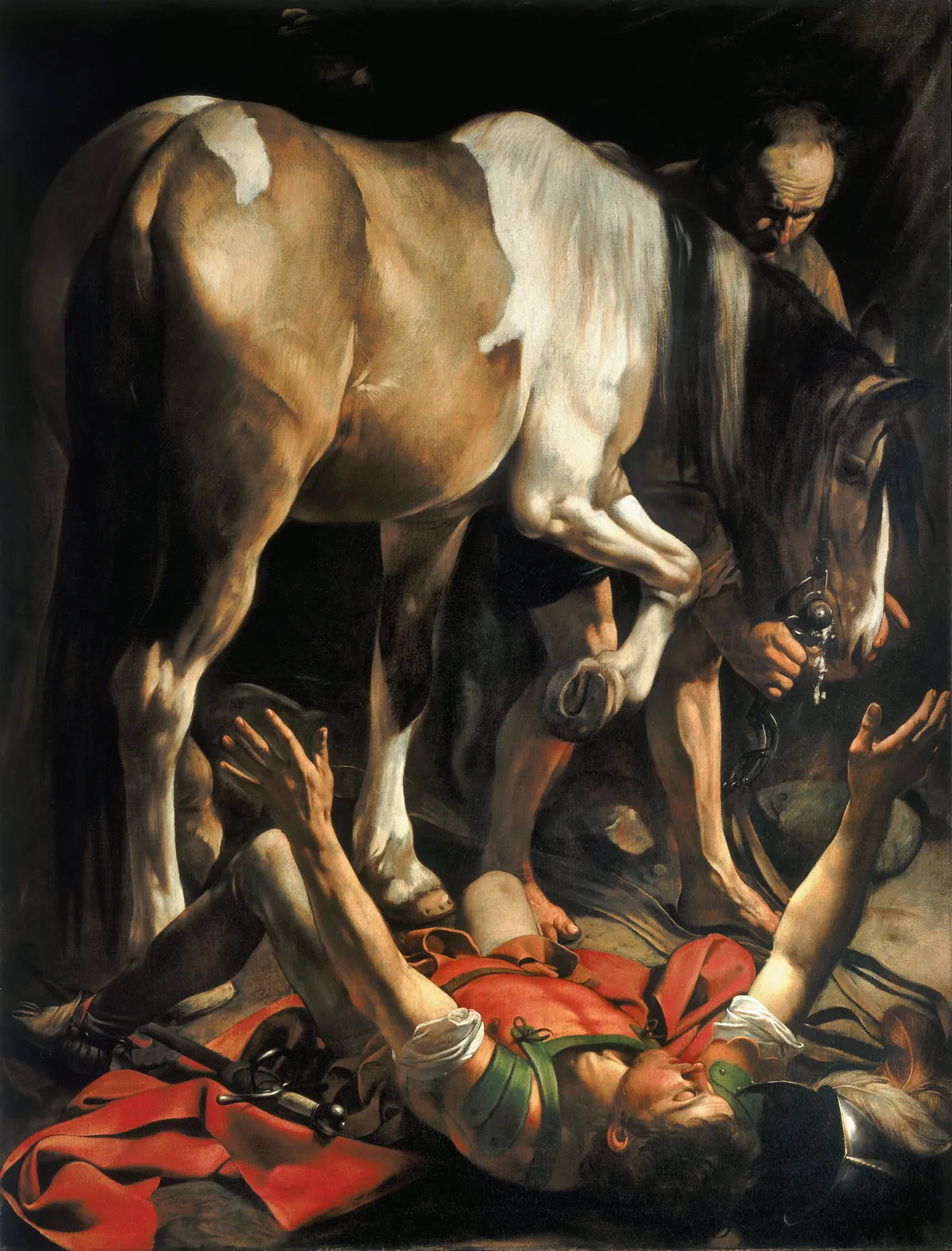
To understand the strength Paul speaks of, you have to go back to the road to Damascus. Caravaggio painted that moment for the Cerasi Chapel in Rome in 1601, and he stripped it of all grandeur. There is no army of angels, only a huge horse, a startled groom, and Saul thrown flat on his back on the ground, arms flung up toward a light that has knocked him from his mount and blinded him. The man who set out to arrest Christians has been seized himself. Everything Paul later became, including the contentment of the prison letters, begins in this violent surrender on the dirt. We tell the fuller story in our study of Caravaggio’s Conversion of Saint Paul, one of the boldest of all Caravaggio’s paintings. The strength that lets him say “I can do all things” is not his own. It arrived on that road and never left.
Saint Paul, the writer of the letters
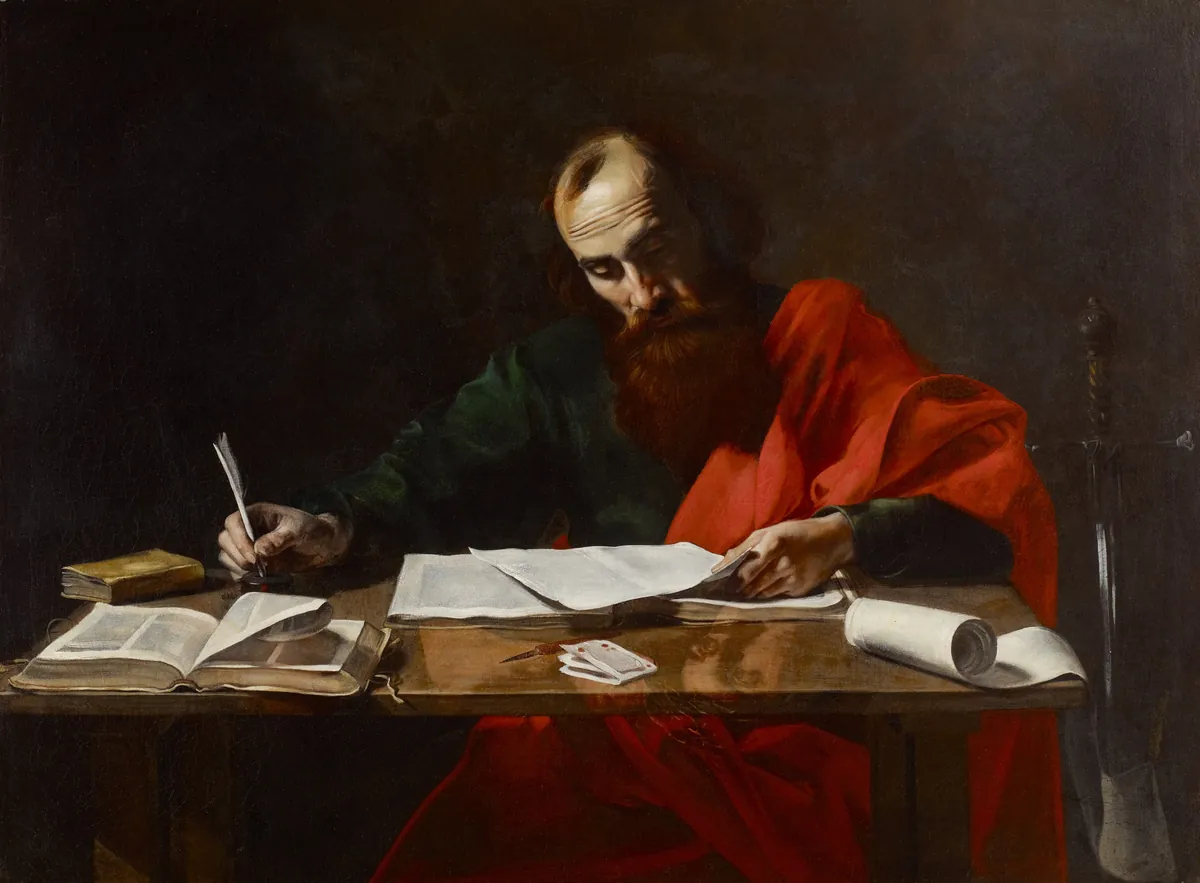
If Philippians 4:13 is a line from a letter, then the truest image of it is Paul at his desk, pen in hand. The French painter Valentin de Boulogne, who worked in Rome in the shadow of Caravaggio, gave us one of the finest. His Saint Paul leans into the lamplight in a deep red cloak, brow furrowed, quill poised over the page, an open book and a scattered manuscript before him. A sword rests against the table at the right, the traditional emblem of the apostle. Valentin makes you feel the labour of writing, the weight of choosing words that will be read for two thousand years. This is the hand that wrote the sentence, and the face is that of a man who means every word of it.
El Greco’s burning Saint Paul
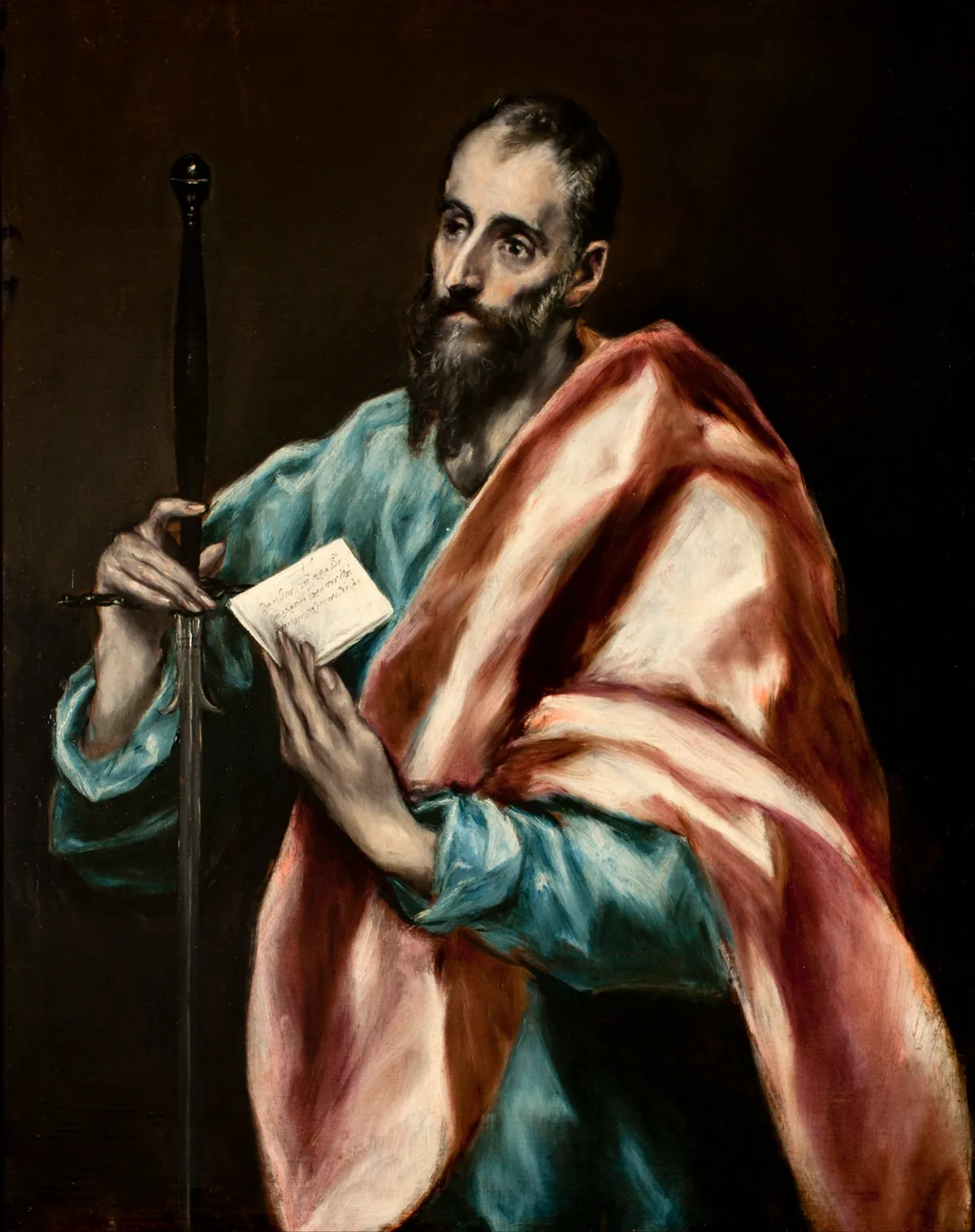
El Greco painted Paul many times, and his version belongs to a different world from the calm desks of the Caravaggesque painters. Here the apostle is all flame and spirit. The figure is stretched tall, the colours cold and electric, the face long and intense beneath a high brow. Paul holds a letter inscribed with his name and rests a hand near the hilt of his sword. There is nothing comfortable about this saint. He looks like a man consumed from within by the message he carries, which is exactly how Paul described himself. El Greco’s elongated, otherworldly style, seen across his many El Greco paintings, turns the apostle into a kind of living torch, strong with a strength that is plainly not of this earth.
“I can do all things through Christ” as wall art
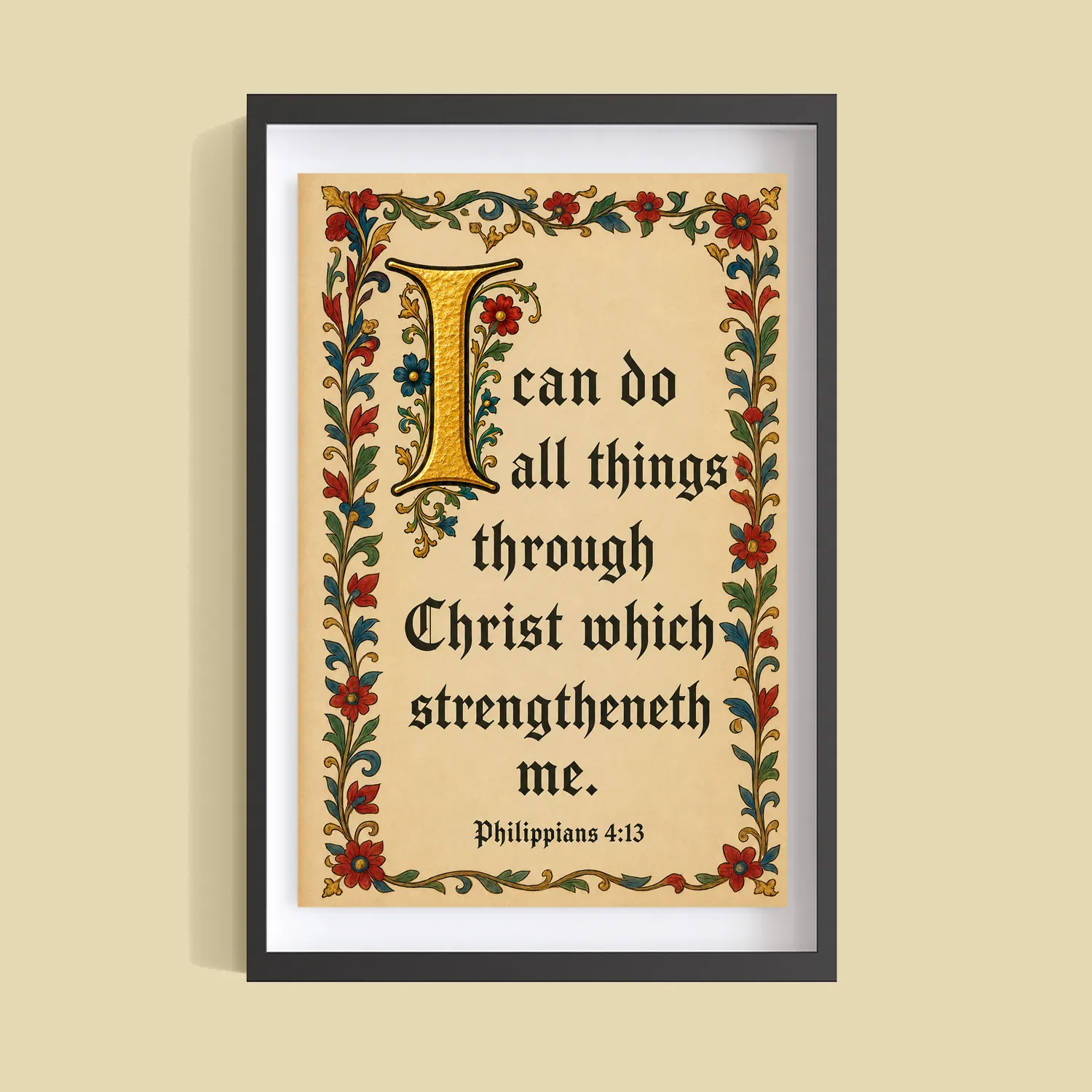
For most of Christian history this verse lived in letters, sermons, and painted portraits of the saint who wrote it. It also belongs to the older habit of setting scripture down as something to keep before your eyes, lettered with care and hung where it can do its quiet work. That is the idea behind our own Philippians 4:13 poster. The verse is given room and dignity, designed to be read as Paul meant it, a daily reminder that the strength to face whatever comes is on loan from Christ, and that this is enough.
Summary table of the works
| Work | Artist | Date | Medium | Location |
|---|---|---|---|---|
| The Conversion of Saint Paul | Caravaggio | 1601 | Oil on canvas | Santa Maria del Popolo, Rome |
| Saint Paul Writing His Epistles | Valentin de Boulogne | around 1618 to 1620 | Oil on canvas | Museum of Fine Arts, Houston |
| Saint Paul in Prison | Rembrandt | 1627 | Oil on panel | Staatsgalerie Stuttgart |
| Saint Paul | El Greco | around 1610 to 1614 | Oil on canvas | Museo del Greco, Toledo |
Conclusion
Philippians 4:13 has lasted because it tells the truth about strength. It does not promise that you will always win, only that you will never be left to carry the weight alone. The painters knew this. They gave us Paul on the road, Paul at his desk, and Paul in his cell, and in every case the strength is borrowed, poured into a fragile man from above. To keep that promise in view you can choose our I Can Do All Things Through Christ poster, or follow the verse through the wider cluster on Psalm 23, Psalm 46, and Psalm 121, and the wider collection of Christian wall art.
Important Facts About Philippians 4:13
- Philippians 4:13 is the thirteenth verse of the fourth chapter of Paul’s Letter to the Philippians in the New Testament.
- In the King James Version it reads, “I can do all things through Christ which strengtheneth me.”
- Paul wrote the Letter to the Philippians from prison, most likely during his imprisonment in Rome around AD 61 to 62.
- The immediate context, in verses 11 and 12, is about learning to be content whether in plenty or in want, which frames the verse as a promise of endurance.
- In the earliest Greek manuscripts the sentence reads “through him who strengthens me,” and the name Christ is supplied by later translations such as the King James and New King James versions.
Questions and Answers
What does Philippians 4:13 really mean?
It means that a believer can endure any circumstance through the strength Christ supplies. The verse comes right after Paul says he has learned to be content whether he has plenty or nothing, so “I can do all things” is closer to “I can get through all things.” It is a promise of endurance and contentment rather than a guarantee that every ambition will succeed. The strength in the verse is borrowed from Christ, not produced by willpower.
Did Paul really write Philippians 4:13 from prison?
Yes. Paul wrote the Letter to the Philippians while he was in prison, most likely in Rome around AD 61 to 62, though some scholars suggest an earlier imprisonment. Throughout the letter he speaks openly about his chains and his uncertain future. That setting is what gives the verse its weight, because the man claiming he can do all things had almost no control over his own life. Rembrandt’s painting of Paul in his cell captures exactly that situation.
Does Philippians 4:13 mean I can do anything I want?
No, and this is the most common misreading. The verse is often used to suggest that faith guarantees success in sports, business, or personal goals, but that is not Paul’s point. In context he is talking about being content and steady in hardship as well as in abundance. The “all things” he has in mind are the trials of life, which he can face because Christ strengthens him. It is about spiritual endurance, not unlimited achievement.
Is it “through Christ” or “through him who gives me strength”?
Both are correct, and the difference comes from the manuscripts. The oldest Greek copies read “through him who strengthens me,” without naming Christ, which is why modern translations like the NIV and ESV phrase it that way. The King James and New King James versions supply the name “Christ” for clarity, giving the familiar “through Christ which strengtheneth me.” The meaning is identical, since the “him” in the sentence is plainly Christ.
Why is Philippians 4:13 so important to Christians?
It compresses a central truth of the faith into a single line, that the strength to live well comes from Christ rather than from ourselves. Because Paul wrote it from a place of real weakness, it speaks directly to anyone facing illness, fear, loss, or pressure. It offers both comfort and courage without pretending that life will be easy. That balance of honesty and hope is why it is one of the most loved and most displayed verses in the Bible.
Can you buy I Can Do All Things Through Christ wall art?
You can buy I Can Do All Things Through Christ wall art at jesuschrist.pictures, in our shop. Our Philippians 4:13 poster sets the verse as scripture wall art made to be read slowly and kept in view where strength is needed most. The same collection includes companion verses such as Psalm 23, Psalm 46, and Psalm 121, so a quiet corner can hold a small family of related prayers. Each piece is printed for the wall, ready to frame and live with.
✦ Free Christian & Catholic Printables
Looking for free Christian & Catholic printables? Our complete collection of illuminated prayer cards & Scripture verses — the Memorare, Psalm 23, Psalm 91 and more — is ready to print, free, in one place.
Browse all free printables →