10 Religious Paintings by Pieter Bruegel the Elder
Pieter Bruegel the Elder is remembered first as the great painter of peasants, of hunters in the snow and dancing villagers. Yet a large part of his work is deeply religious, and it is unlike anyone else’s. Bruegel rarely lets a holy figure dominate a panel. Instead he hides the sacred inside the ordinary, setting the Bible in a Flemish winter, among carts and frozen ponds and crowds who barely notice the miracle in their midst. The ten Pieter Bruegel paintings gathered here show how original, and how serious, his Christian art really is.
To find Christ in a Bruegel you often have to search for him, exactly as you would in real life. That is the heart of his religious vision: God enters a world too busy to look up. This article gathers his finest sacred works, from the crowded road to Calvary to the skeleton armies of the Triumph of Death. For more sacred stories told in paint, see our guide to famous biblical masterpieces.
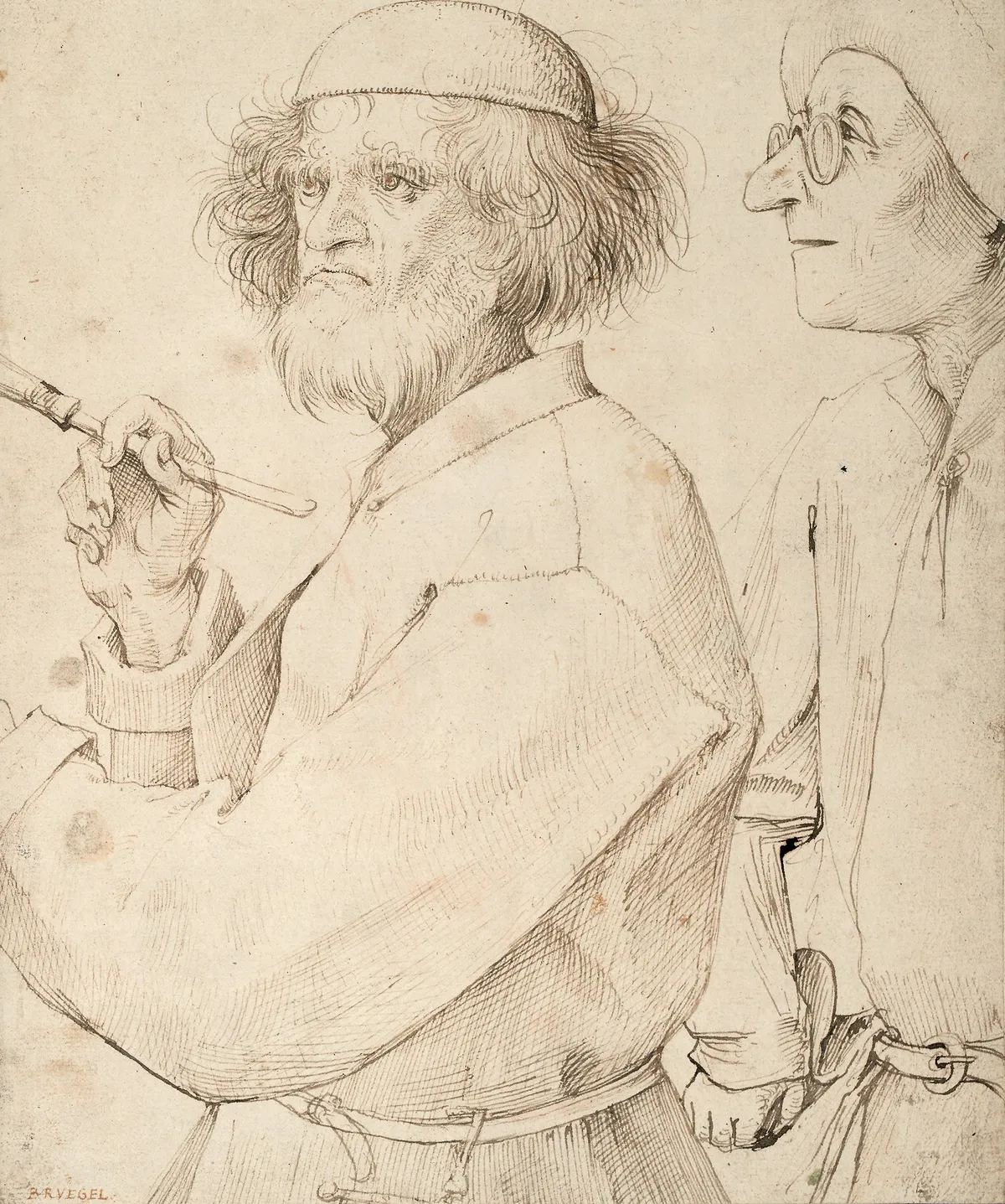
Who Was Pieter Bruegel the Elder?
Born around 1525 in the Low Countries and active in Antwerp and then Brussels, Bruegel was the leading painter of the Netherlands in the generation after Hieronymus Bosch, whose nightmarish invention he openly admired and revived. He died in 1569, still young, leaving only about forty five paintings. He also founded a dynasty, and his name is a frequent source of confusion: he dropped the h to sign Bruegel, while his sons Pieter Brueghel the Younger and Jan Brueghel the Elder kept it. To see the demons and monsters Bruegel learned from, read our article on Hieronymus Bosch’s paintings.
1. The Procession to Calvary (1564)
This is Bruegel’s largest painting and the clearest example of his method. More than five hundred figures swarm across a wide Flemish landscape, riding, gossiping, and trailing toward the gallows hill on the right. Somewhere near the centre, almost lost in the crowd, Christ has fallen under the weight of the cross. Few of the people around him even turn to look.
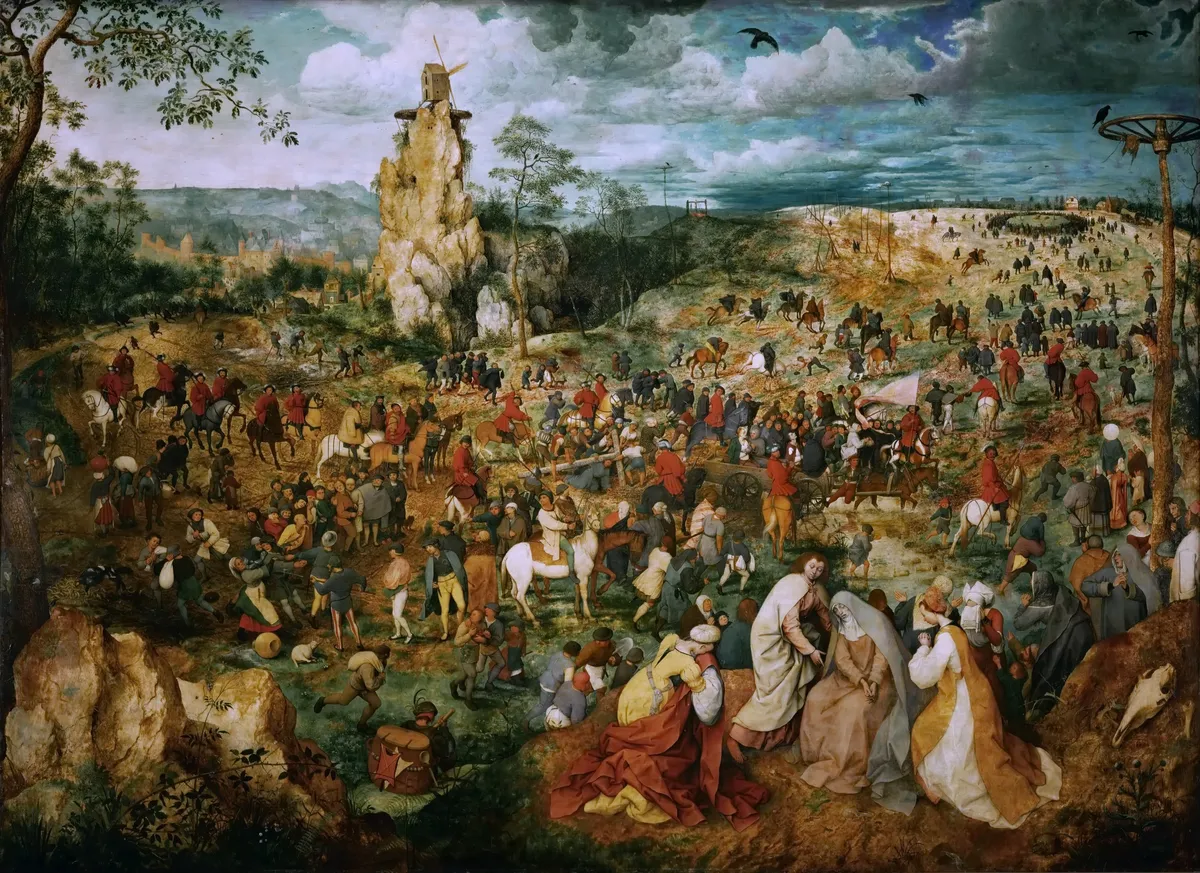
Only in the foreground, set apart in older costume, do the Virgin and the holy women mourn, as if they belong to a different and more sacred world. Bruegel’s point is sharp and modern: the most important event in history is happening, and almost no one is paying attention. The panel hangs in the Kunsthistorisches Museum in Vienna.
2. The Census at Bethlehem (1566)
Bruegel sets the Nativity story in a snowbound Flemish village at dusk. Peasants gather at an inn to be taxed, pigs are slaughtered, and children skate on the frozen pond. Down in the foreground, a woman in blue rides a donkey led by a man with a saw over his shoulder, Mary and Joseph, arriving unrecognised among the everyday bustle.
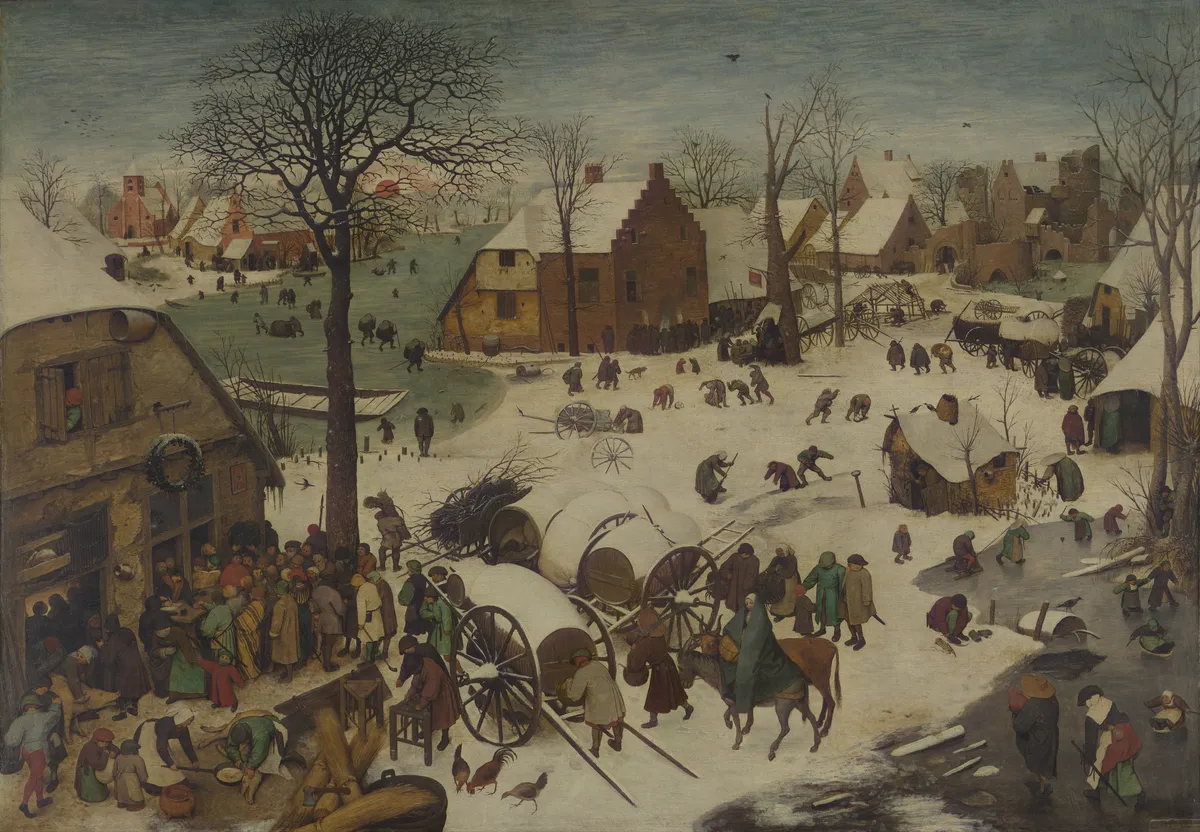
Nothing marks them as holy. There are no halos, no angels, only the cold and the crowd. By burying the Holy Family in ordinary life, Bruegel makes the viewer do the work of finding them, and turns the Christmas story into something startlingly close to home. The painting is in the Royal Museums of Fine Arts of Belgium in Brussels.
3. The Adoration of the Kings (1564)
For once Bruegel brings the holy figures up close. In this upright panel the three kings press in around the Virgin and Child, offering their gifts, while a jostling crowd of soldiers and townsfolk cranes to see. The faces are blunt and unidealised, almost ugly, far from the elegance of Italian altarpieces.
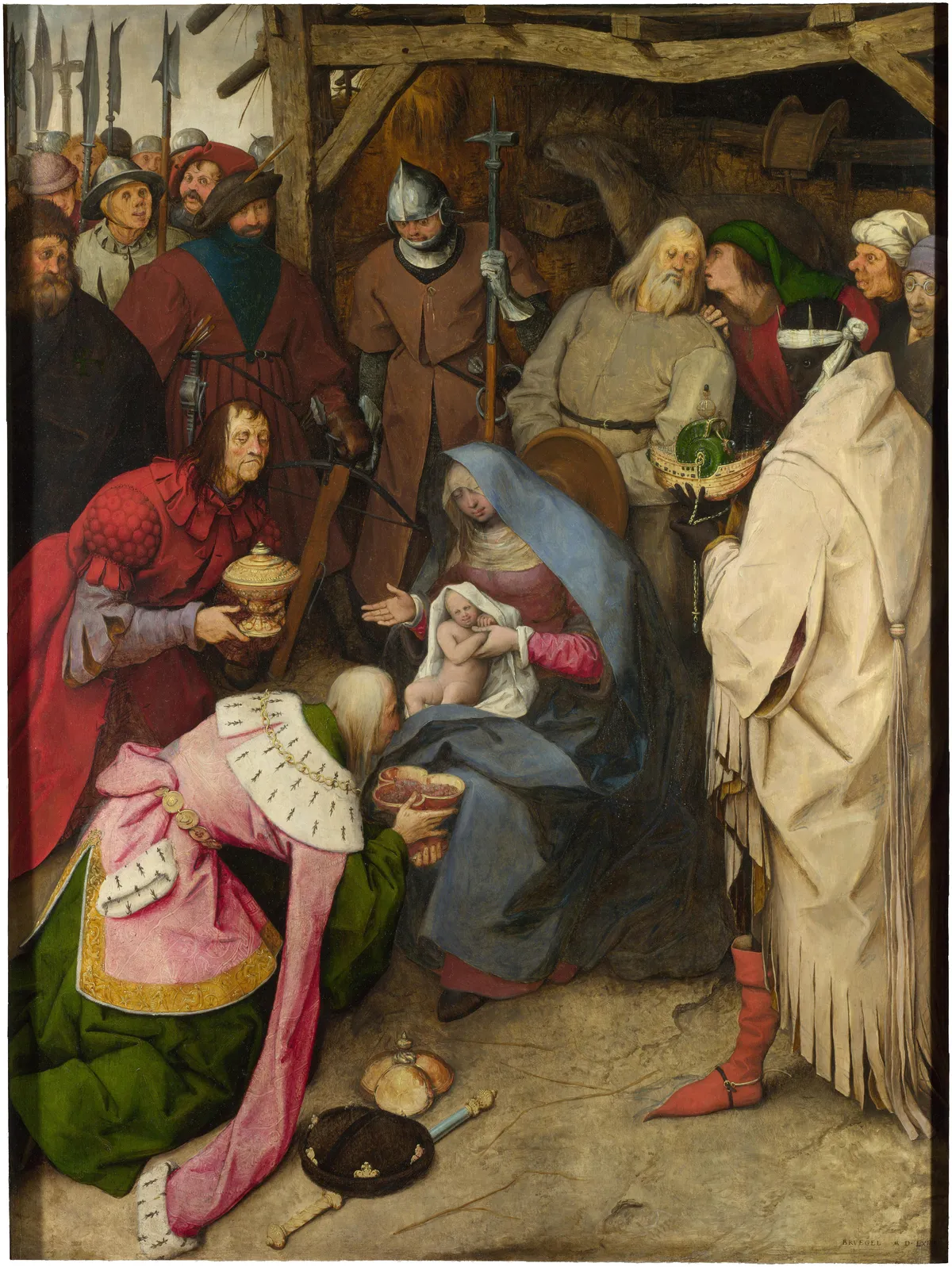
The Child shrinks back from the strange gold vessel held out to him, a small, human touch. Whispering onlookers and glinting armour fill the background, turning a sacred moment into something crowded and real. It is one of the few formal religious commissions Bruegel painted, and it belongs to the National Gallery in London.
4. The Massacre of the Innocents (c. 1567)
Bruegel turns Herod’s slaughter of the children of Bethlehem into a raid on a Flemish village under snow. A block of armoured cavalry seals off the street while soldiers break into houses and tear infants from their parents. The white ground and the quiet winter light make the violence all the more chilling.
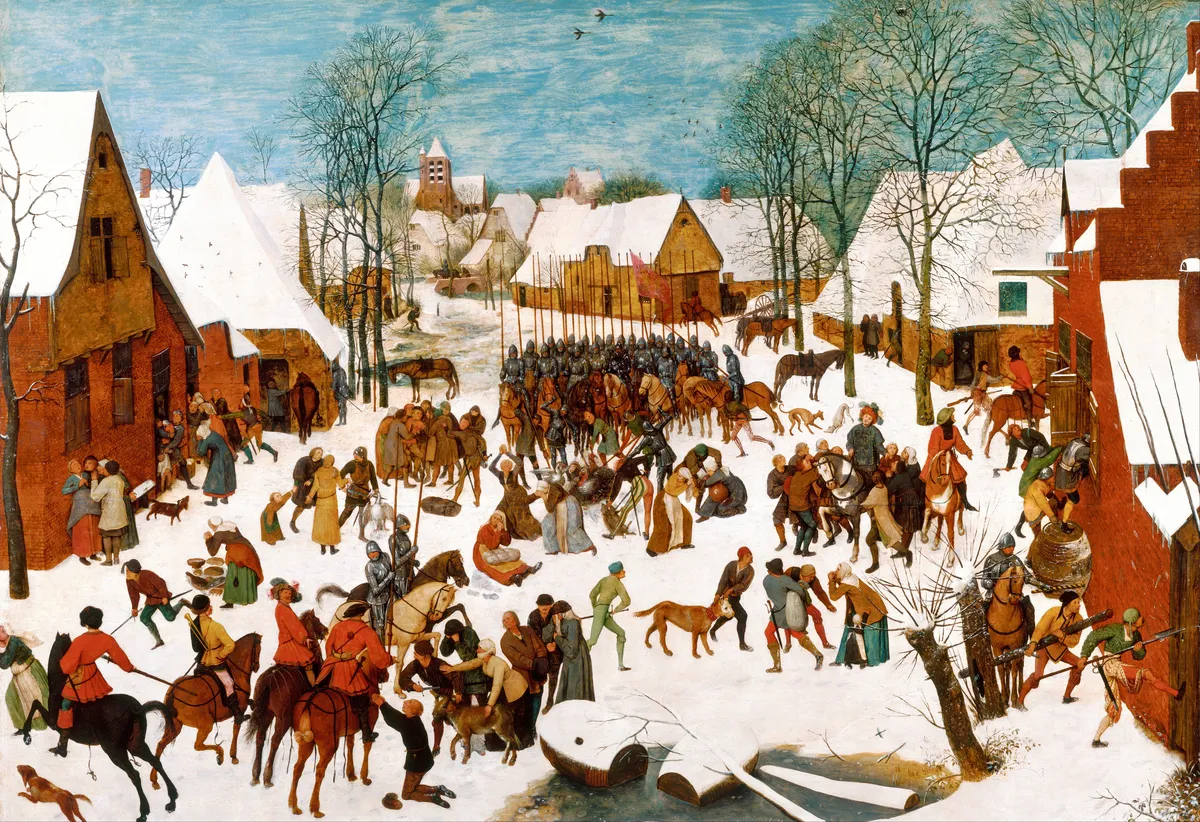
Many read the painting as a veiled comment on the Spanish troops then terrorising the Netherlands. So disturbing was it that a later owner had the murdered babies painted over with bundles and animals. For another harrowing treatment of the subject, see our article on Guido Reni’s Massacre of the Innocents. This version is in the Royal Collection at Windsor.
5. The Conversion of Saul (1567)
The moment when Saul is struck blind on the road to Damascus becomes, in Bruegel’s hands, a vast Alpine panorama. A whole army of soldiers, horses, and cannon winds up through a mountain pass, and only if you look carefully do you find Saul himself, fallen from his horse in a small clearing of light far below the towering peaks.
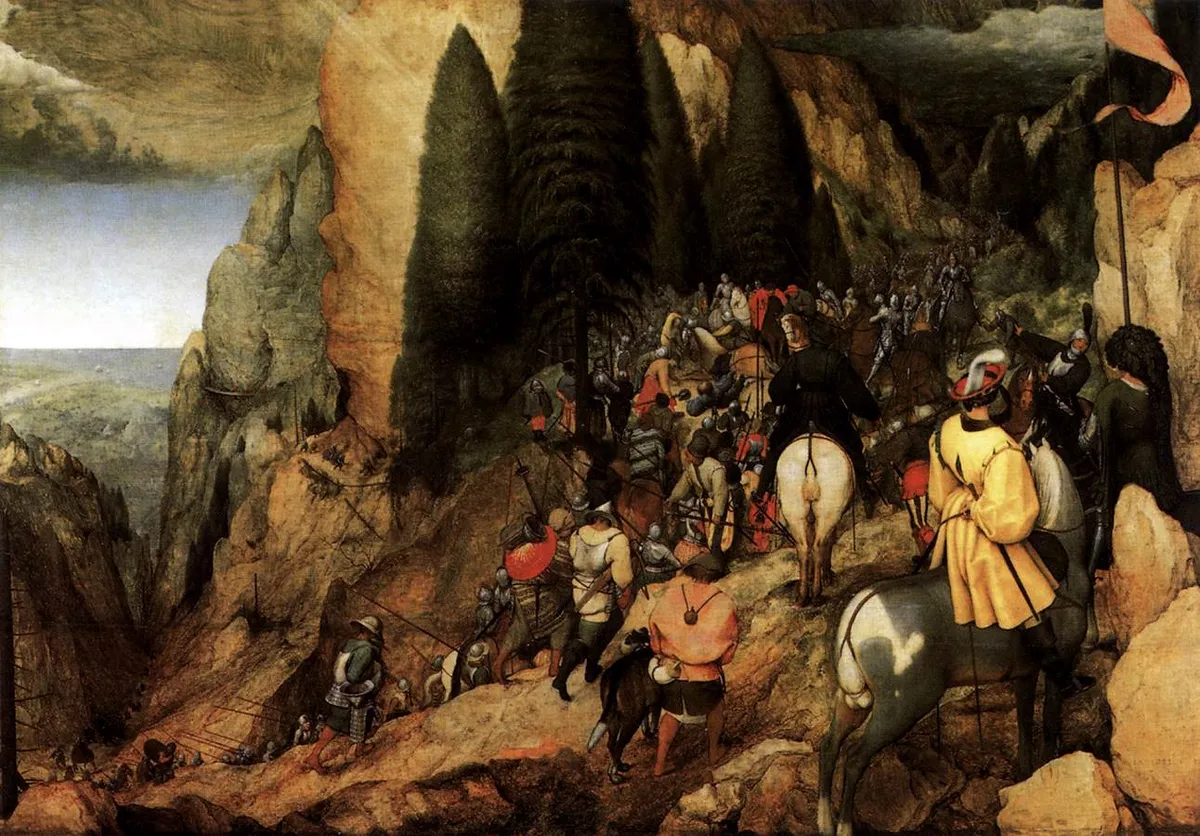
The grandeur of the mountains dwarfs the miracle, yet that is the point: grace strikes quietly, in the middle of an army that marches on regardless. For a fierce close up of the same scene, read our article on Caravaggio’s Conversion of Saint Paul. Bruegel’s panel hangs in the Kunsthistorisches Museum in Vienna.
6. The Sermon of Saint John the Baptist (1566)
A dense crowd presses into a clearing in a wood to hear John the Baptist preach. He stands to one side, pointing toward a quiet figure who is Christ, while the listeners include peasants, pilgrims, and even a fortune teller reading a hand at the edge of the throng.
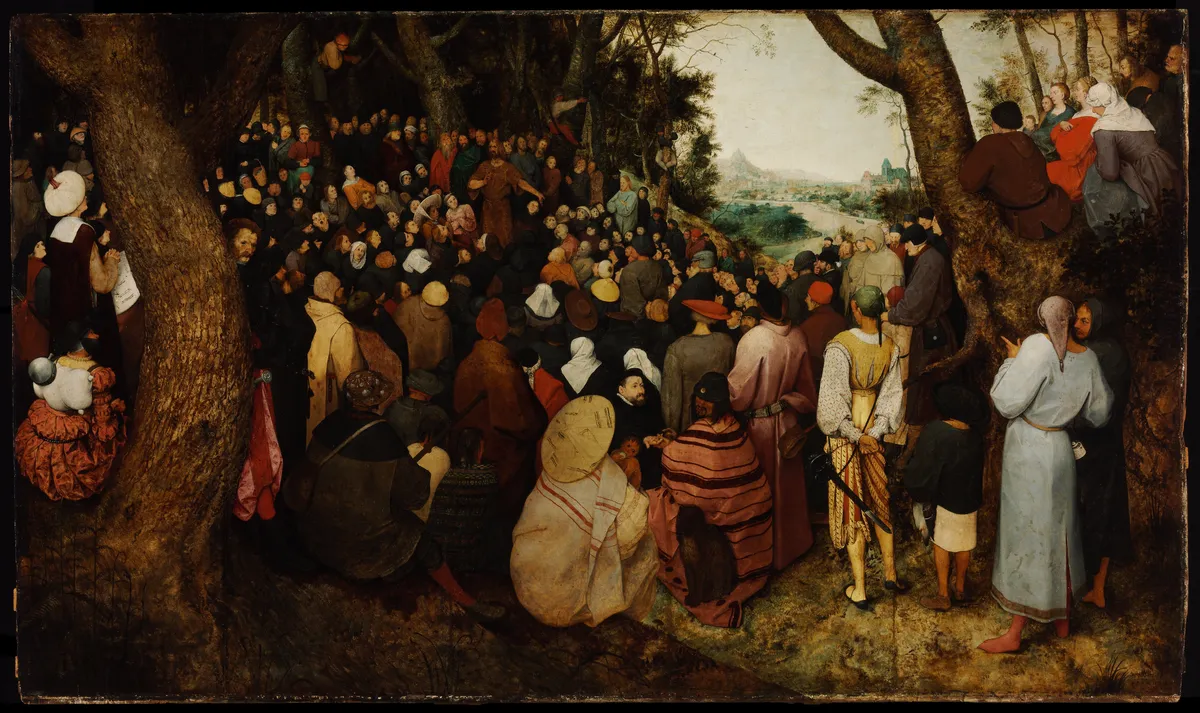
Painted while reformers were holding open air sermons across the Netherlands, the picture would have felt pointedly contemporary to its first viewers. Again Bruegel makes the holy figures hard to pick out, rewarding the patient eye. For more images of the forerunner, see our article on Saint John the Baptist paintings. The work is in the Museum of Fine Arts in Budapest.
7. The Fall of the Rebel Angels (1562)
Here Bruegel lets his Bosch like imagination run wild. The Archangel Michael, in golden armour, leads the loyal angels in driving the rebel host out of heaven, and as they fall the rebels mutate into a swarm of fish, insects, and gaping monsters tumbling down the panel.
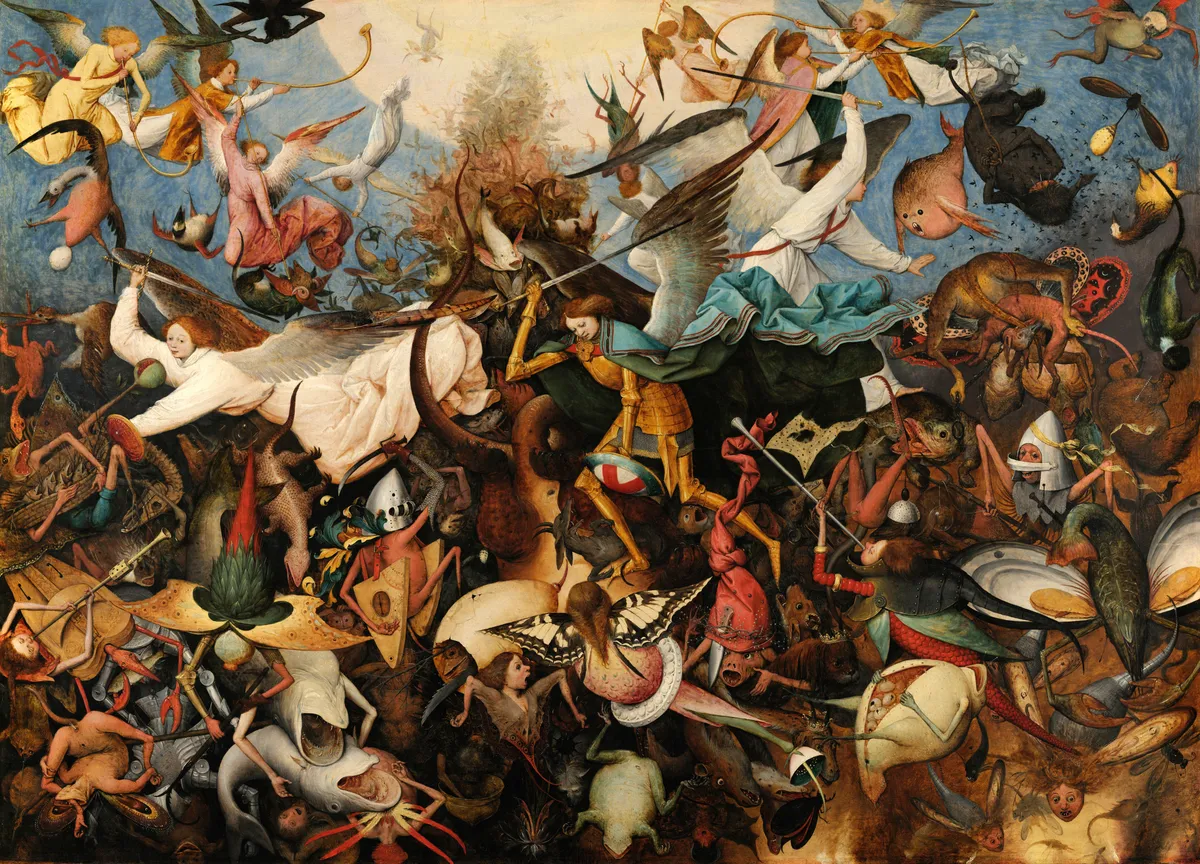
It is a riot of strange anatomy and brilliant colour, a vision of pride cast down into chaos. The subject comes from the Book of Revelation, and Bruegel fills it with the same inventive horror that made Bosch famous a generation earlier. The painting belongs to the Royal Museums of Fine Arts of Belgium in Brussels.
8. The Parable of the Blind (1568)
One of Bruegel’s last and most moving works illustrates Christ’s warning that if the blind lead the blind, both will fall into a pit. Six blind men cross the panel in a diagonal line, each with a hand on the man in front, and as the leader topples into a ditch the others stumble helplessly after him.
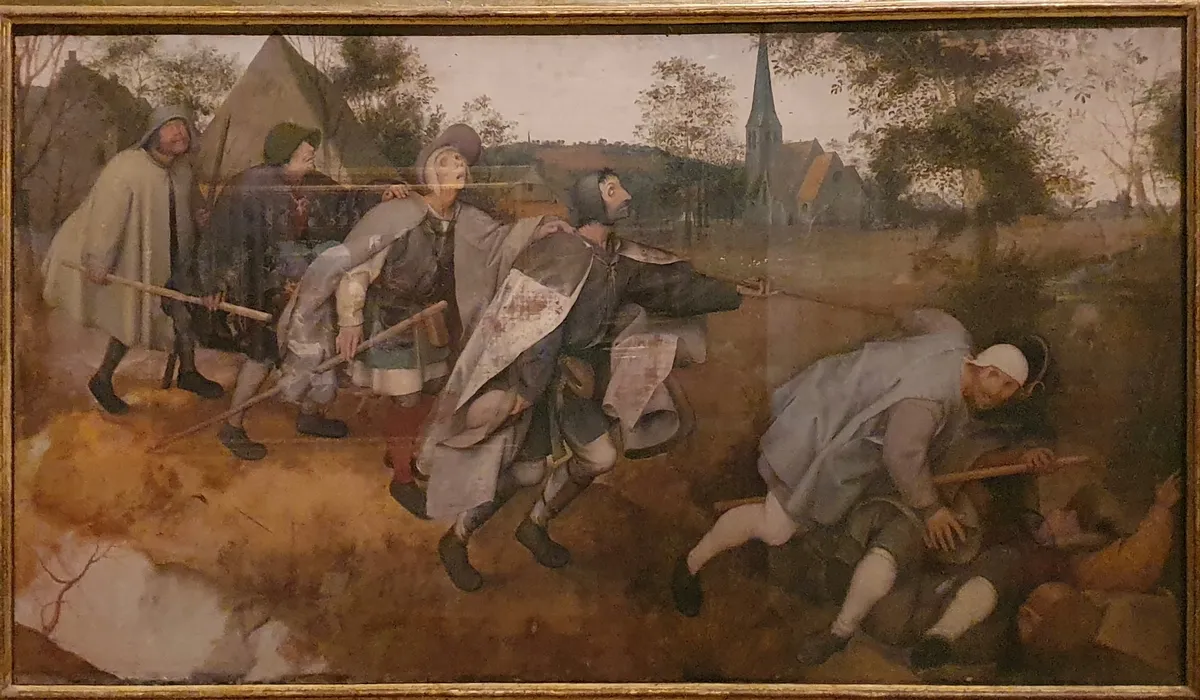
Bruegel renders their afflicted faces with unsettling accuracy, and the falling chain of bodies turns a short Gospel saying into an image of human folly that no one forgets. A church spire rises calmly in the background, the truth they cannot see. The painting is in the Museo di Capodimonte in Naples.
9. Christ and the Woman Taken in Adultery (1565)
Painted almost entirely in shades of grey, this small grisaille shows the moment when Christ, asked whether an adulteress should be stoned, kneels and writes on the ground. In the Gospel he answers that whoever is without sin should cast the first stone, and one by one the accusers slip away.
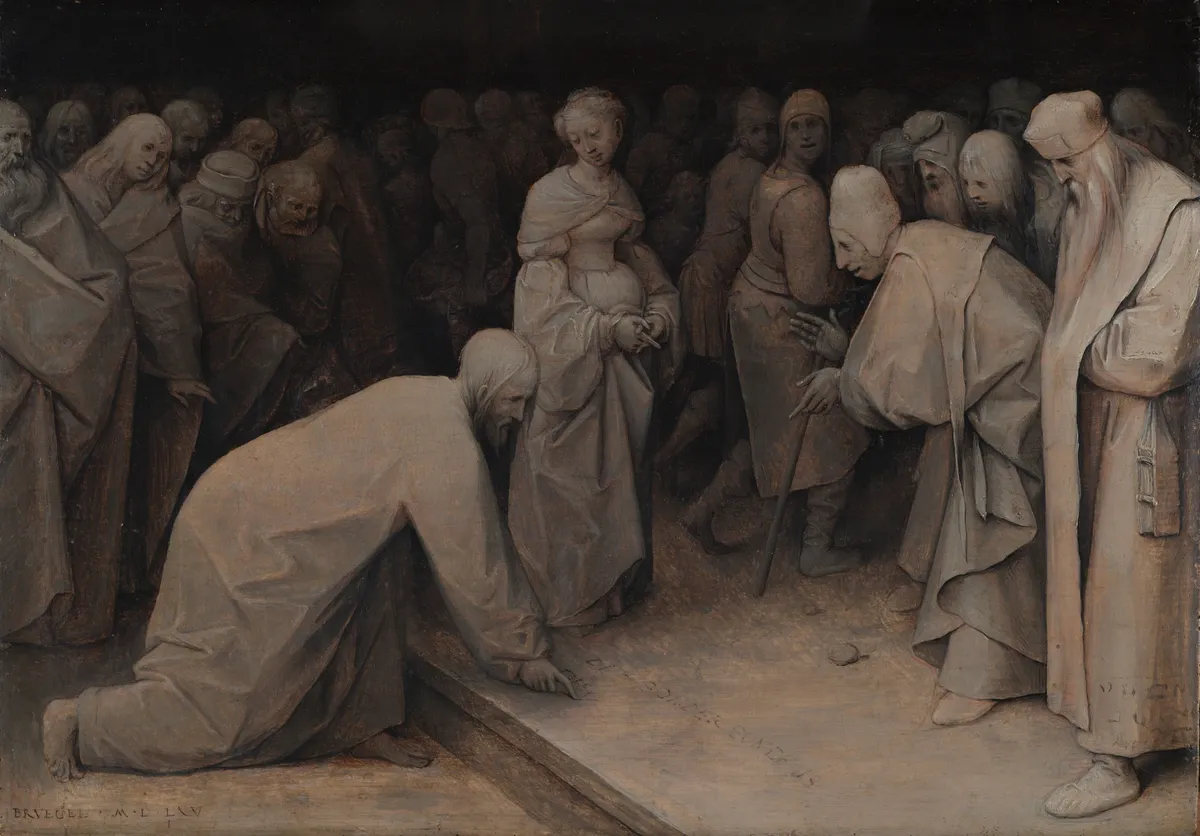
Bruegel even paints the Flemish words of Christ’s reply in the dust. The restrained grey tones and the hushed, attentive crowd make it one of his most intimate religious works. Bruegel kept it for himself, and it passed down in his family before reaching the Courtauld Gallery in London.
10. The Triumph of Death (c. 1562)
Bruegel’s most terrifying panel is a panorama of the end of all things. An army of skeletons sweeps across a scorched land, herding kings and peasants alike toward a giant coffin lid, while fires burn on the horizon and the sea is full of wrecks. No prayer and no rank offers any escape.
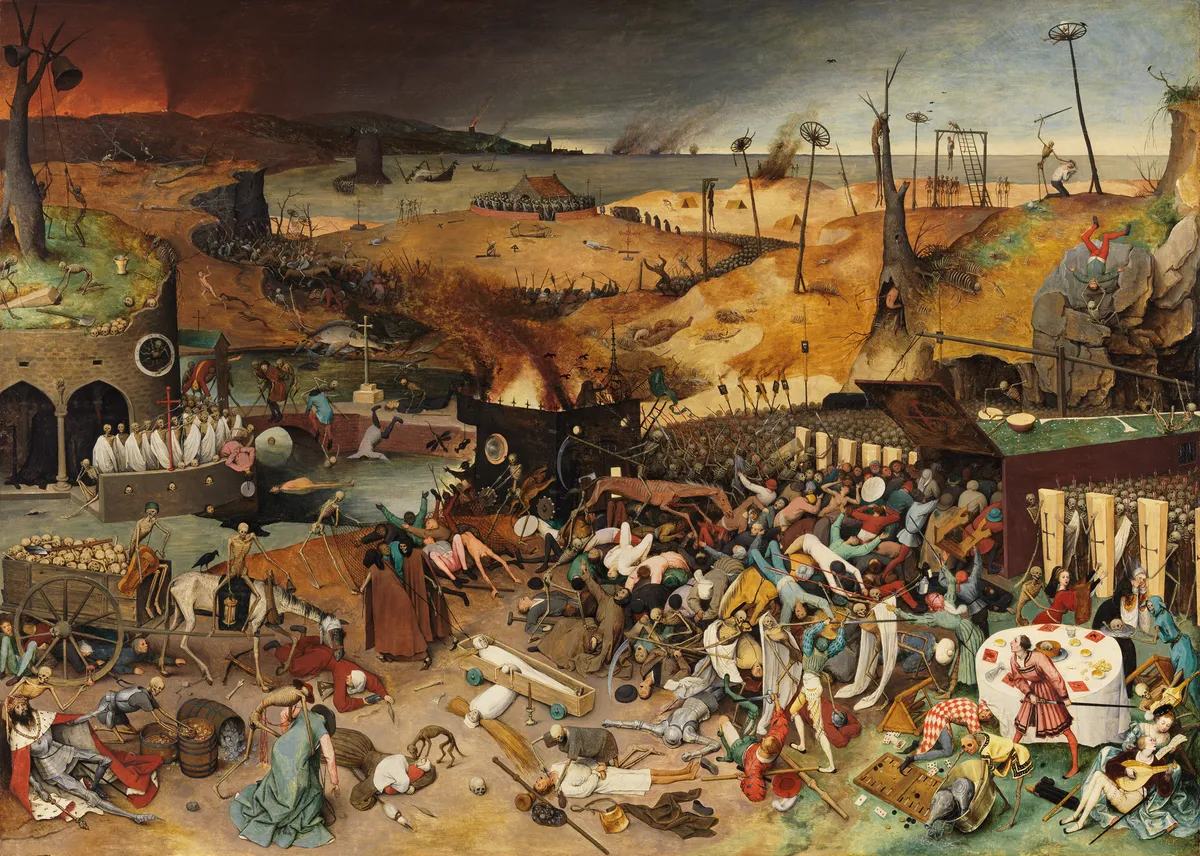
For all its horror it is a deeply Christian image, a memento mori warning that death comes for everyone and that judgment follows. It distils the medieval Dance of Death into one overwhelming vision. The painting is one of the treasures of the Museo del Prado in Madrid.
Pieter Bruegel the Elder’s Religious Paintings
| Painting | Date | Medium | Museum |
|---|---|---|---|
| The Procession to Calvary | 1564 | Oil on panel | Kunsthistorisches Museum, Vienna |
| The Census at Bethlehem | 1566 | Oil on panel | Royal Museums of Fine Arts of Belgium, Brussels |
| The Adoration of the Kings | 1564 | Oil on panel | National Gallery, London |
| The Massacre of the Innocents | c. 1567 | Oil on panel | Royal Collection, Windsor |
| The Conversion of Saul | 1567 | Oil on panel | Kunsthistorisches Museum, Vienna |
| The Sermon of Saint John the Baptist | 1566 | Oil on panel | Museum of Fine Arts, Budapest |
| The Fall of the Rebel Angels | 1562 | Oil on panel | Royal Museums of Fine Arts of Belgium, Brussels |
| The Parable of the Blind | 1568 | Tempera on canvas | Museo di Capodimonte, Naples |
| Christ and the Woman Taken in Adultery | 1565 | Oil on panel (grisaille) | Courtauld Gallery, London |
| The Triumph of Death | c. 1562 | Oil on panel | Museo del Prado, Madrid |
Conclusion
Taken together, these ten works overturn the idea that Bruegel was merely a painter of peasants. He was one of the most original religious artists of the sixteenth century, who refused the grand altarpiece in favour of something stranger and more searching. He set the Bible in his own frozen, crowded country and asked his viewers to find the holy for themselves.
That is what still makes his sacred paintings feel modern. The Christ who falls unnoticed on the road to Calvary, the Holy Family lost in a winter census, the blind stumbling toward a pit they cannot see, all speak to a world distracted from the things that matter most. For another northern master of quiet devotion, read our article on the landscapes of Joachim Patinir.
Important Facts About Pieter Bruegel the Elder
- Pieter Bruegel the Elder was born around 1525 and died in Brussels in 1569, leaving only about forty five surviving paintings.
- He signed his name Bruegel without an h, while his sons Pieter Brueghel the Younger and Jan Brueghel the Elder used the older spelling Brueghel.
- He was the most important Netherlandish painter of his generation and the leading heir to the fantastical imagination of Hieronymus Bosch.
- Bruegel often hid the religious subject inside an everyday Flemish scene, so that figures like Christ or the Virgin must be searched for in the crowd.
- Several of his religious works, such as the Massacre of the Innocents, are read as veiled comments on the Spanish occupation of the Netherlands.
Questions and Answers About Pieter Bruegel Paintings
What is Pieter Bruegel the Elder best known for?
Bruegel is best known for his scenes of peasant life and his sweeping landscapes, such as The Hunters in the Snow and The Harvesters. But he was also a major religious painter, and works like The Procession to Calvary and The Tower of Babel are among his most celebrated. His genius was to combine the two, setting biblical stories inside the everyday Flemish world he observed so closely.
Did Pieter Bruegel paint religious subjects?
Yes, and they make up a large part of his output. Bruegel painted the Nativity, the road to Calvary, the conversion of Saint Paul, the fall of the rebel angels, and many other sacred subjects. His approach was unusual: rather than placing holy figures front and centre, he often tucked them into a crowd, so the viewer has to search for Christ or the Virgin among ordinary people busy with daily life.
What are the most famous paintings by Pieter Bruegel?
His single most famous work is probably The Hunters in the Snow of 1565. Among his religious paintings, the best known are The Procession to Calvary, The Tower of Babel, The Census at Bethlehem, and The Triumph of Death. Many of the finest are held in Vienna and Brussels, and a major share of all his surviving panels can be seen in the Kunsthistorisches Museum in Vienna.
What is the difference between Bruegel and Brueghel?
It is mostly a matter of spelling and generation. Pieter Bruegel the Elder dropped the h from his name around 1559. His two sons kept it: Pieter Brueghel the Younger, who copied many of his father’s compositions, and Jan Brueghel the Elder, famous for flowers and paradise landscapes. When people say simply Bruegel, they almost always mean the father, the founder of the dynasty.
Can you buy Pieter Bruegel paintings as canvas prints?
You can buy Pieter Bruegel paintings at jesuschrist.pictures, in our shop, where his religious masterpieces are offered as high quality canvas prints. Because his panels are so rich in detail, a faithful reproduction lets you bring a work like The Procession to Calvary or The Census at Bethlehem into a home, study, or church hall. Browse our collection of Christian art reproductions on canvas to find a piece for your home or parish.