The Samson and Delilah Story: Hero, Love, and Hair
The Samson and Delilah story is one of the most dramatic tales in the whole Bible: a hero with the strength of a lion, brought down not by an army but by the woman he loved. Found in the Book of Judges, chapters 13 to 16, it is a story of power and weakness, of love and betrayal, and of a secret hidden in a head of uncut hair. For centuries it has gripped preachers and painters alike, and the greatest artists in Europe, from Rubens and Rembrandt to Gustave Dore, returned to it again and again.
At its heart the story asks a hard question: how can the strongest man alive be so easily ruined? The answer lies not in Samson’s muscles but in his choices. This article retells the whole story, scene by scene, and illustrates it with the masterpieces it inspired. For more sacred narratives told in paint, see our guide to famous biblical masterpieces.
A Strongman Set Apart
Samson’s life is marked as special before he is even born. An angel appears to his mother, a barren woman of the tribe of Dan, and tells her she will have a son who must be a Nazirite, dedicated to God from the womb. He is never to drink wine or cut his hair, the outward sign of his vow. In return God gives him strength no man can match.
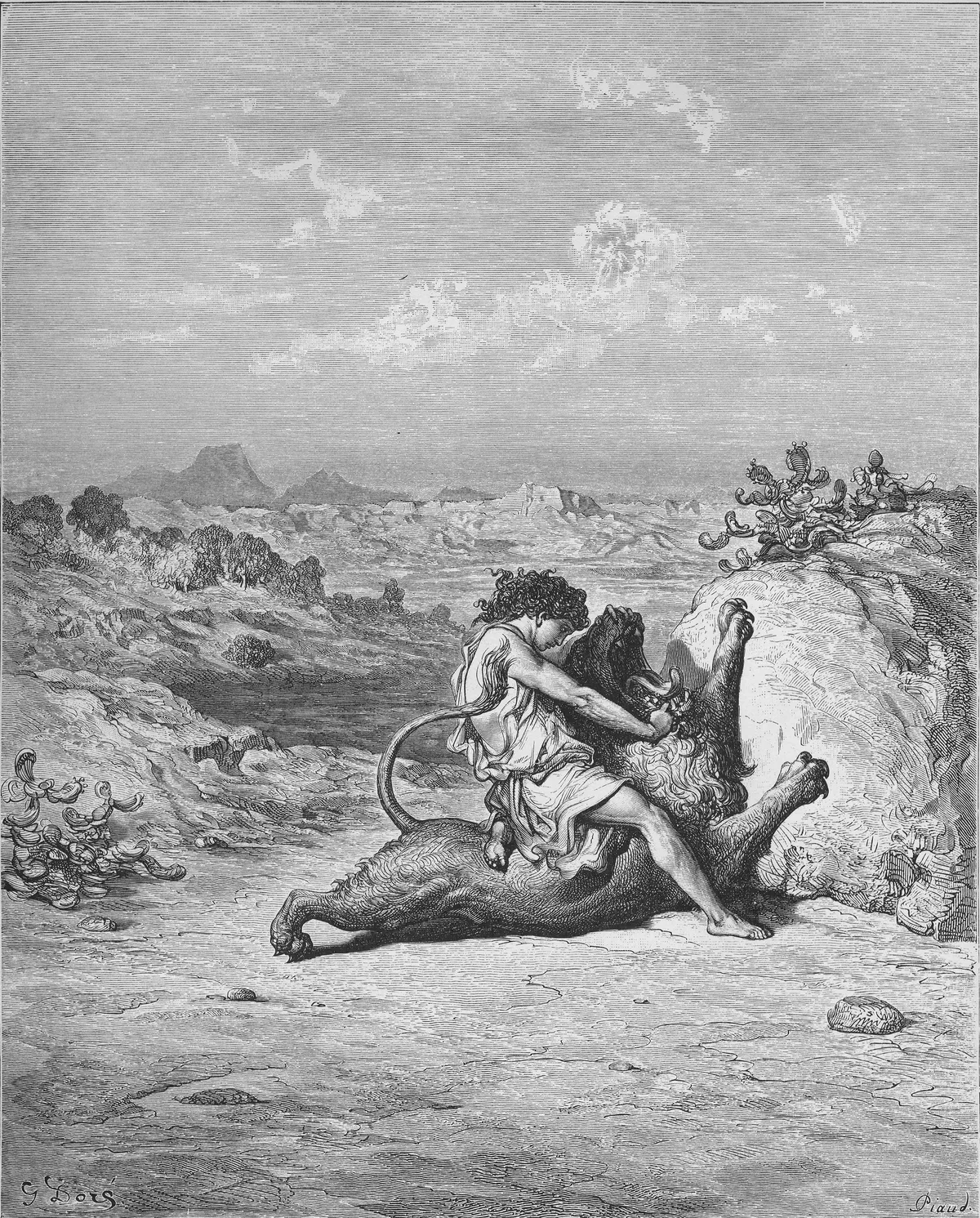
The young Samson tears a lion apart with his bare hands, as Gustave Dore shows in his powerful Bible engraving. Later he strikes down a thousand Philistines with nothing but the jawbone of a donkey, and carries off the gates of the city of Gaza on his shoulders. For twenty years he leads Israel against the Philistines, a one man army whose secret no enemy can guess.
Samson and Delilah
Delilah was not the first Philistine woman to lead Samson astray. Earlier he had married a woman from Timnah and set a riddle at his wedding feast, only to lose the wager when she wept until he told her the answer and she passed it to her people. The pattern was already set: a beautiful woman, a secret, and a hero who cannot keep his own counsel. He had every reason to see the danger coming.
Then Samson falls in love with a woman named Delilah, who lives in the Valley of Sorek. The Philistine rulers see their chance. They come to Delilah and offer her an enormous bribe, eleven hundred pieces of silver from each of them, if she can discover the secret of his strength and deliver him into their hands.
Delilah begins to ask. The first time, Samson says that seven fresh bowstrings would hold him; the second, new ropes never used; the third, that his hair must be woven into the fabric on her loom. Each time she binds him as he sleeps and cries that the Philistines have come, and each time he springs up and snaps free as if the bonds were thread. The men lie in wait in the next room for nothing. It is a deadly game, and Samson keeps playing it even as the danger grows clearer with every round.
The Secret and the Scissors
At last Delilah wears him down. She weeps and accuses him of not loving her, nagging him day after day until, the Bible says, he was sick to death of it. Finally he tells her the truth: his strength comes from his uncut hair, the sign of his vow to God. While he sleeps on her lap, she calls in a man to shave off his seven braids, and his power drains away.
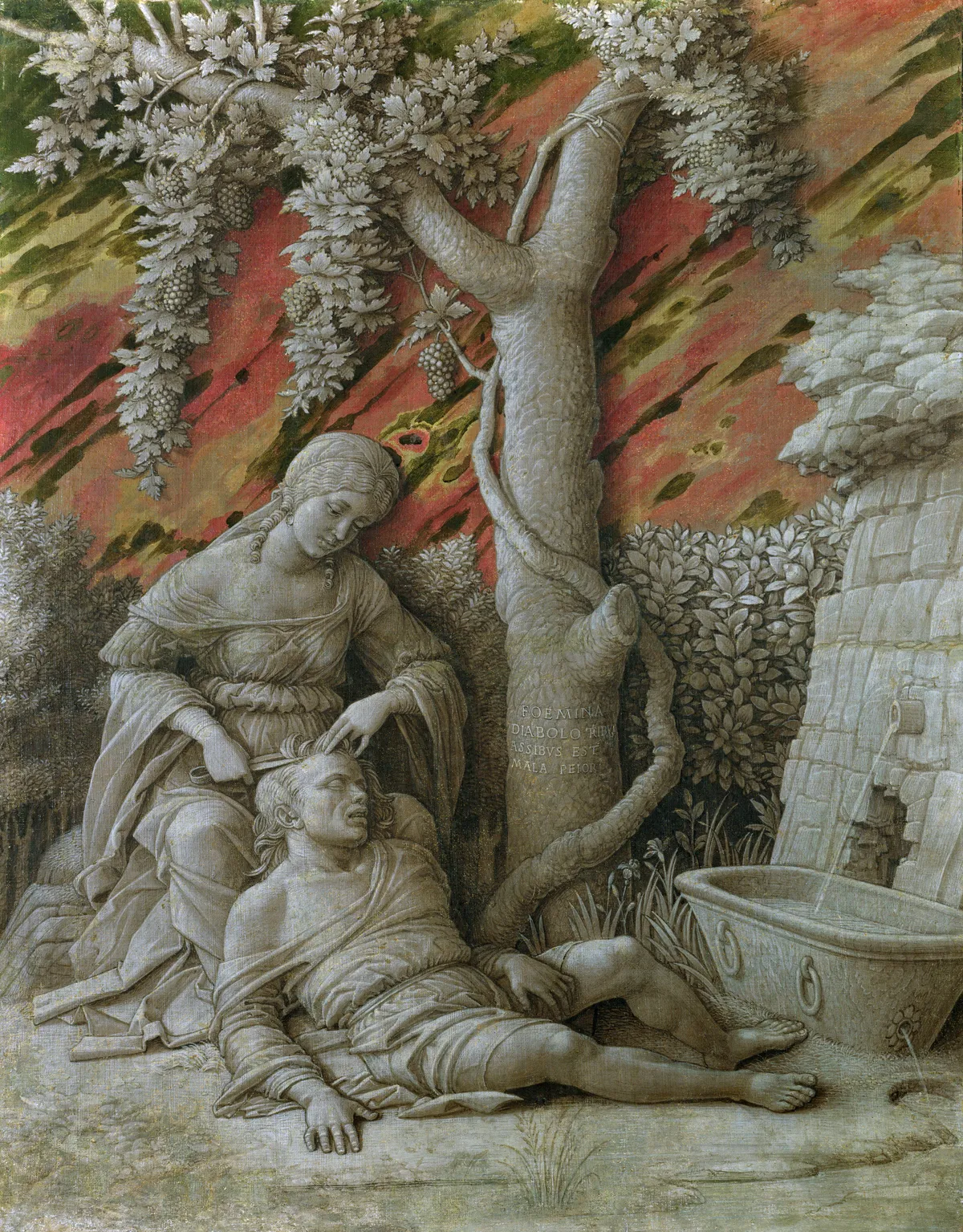
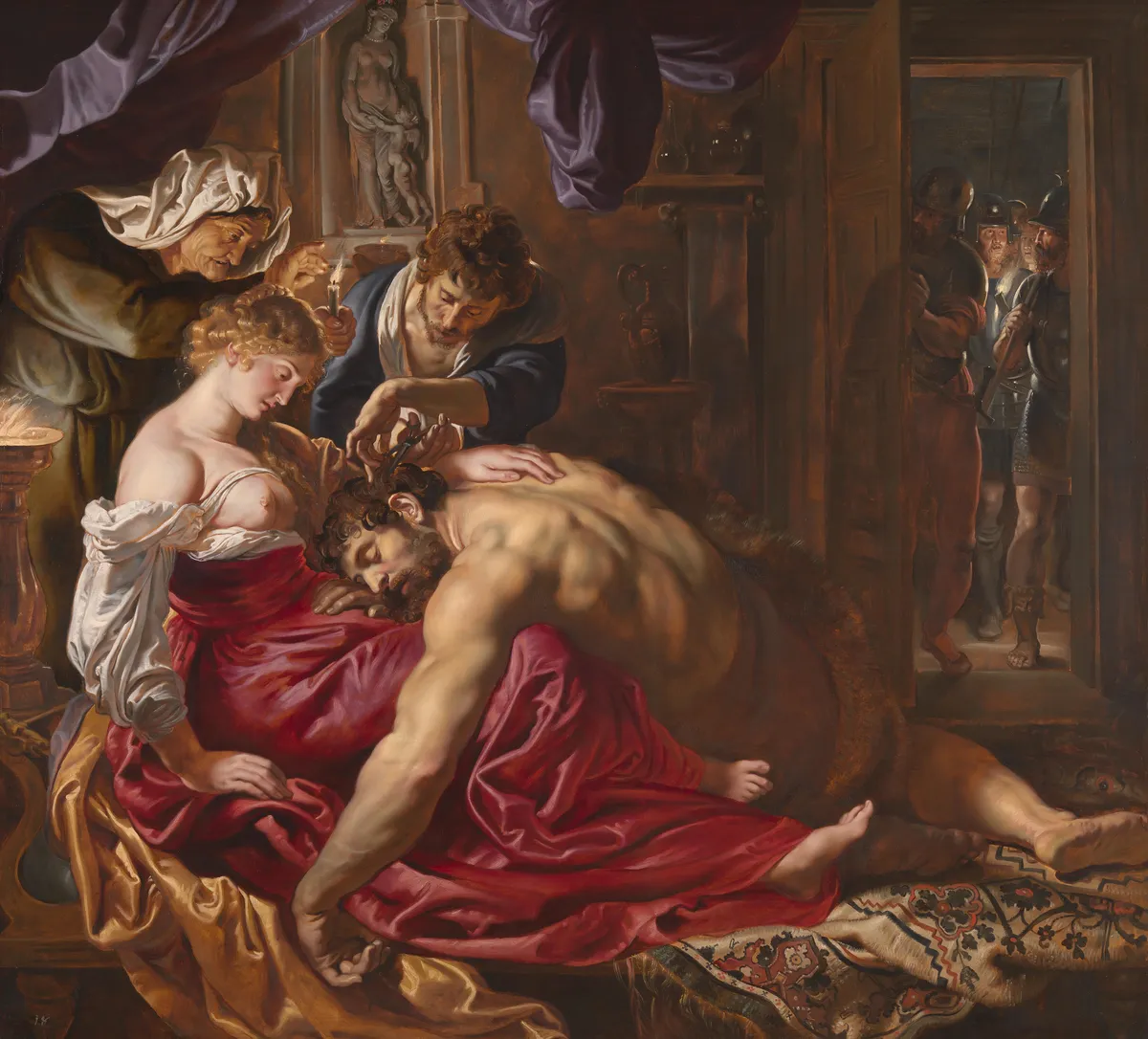
Andrea Mantegna painted this betrayal as a cool grey relief, Delilah cutting the hair of the sleeping hero beneath a vine, with a Latin warning carved into the tree: a bad woman is three times worse than the devil. To explore this sculptural master of the early Renaissance, read our article on Andrea Mantegna’s paintings. The great image at the top of this article, by Peter Paul Rubens, shows the same moment with Baroque richness, the candlelight, the red drapery, and the soldiers already crowding the doorway. To follow the Flemish master, read our article on Peter Paul Rubens’s paintings.
Captured and Blinded
When Delilah cries out that the Philistines are upon him, Samson wakes and tries to fight as before, not knowing that the Lord has left him. This time the ropes hold. The men he has terrorised for years finally seize him.
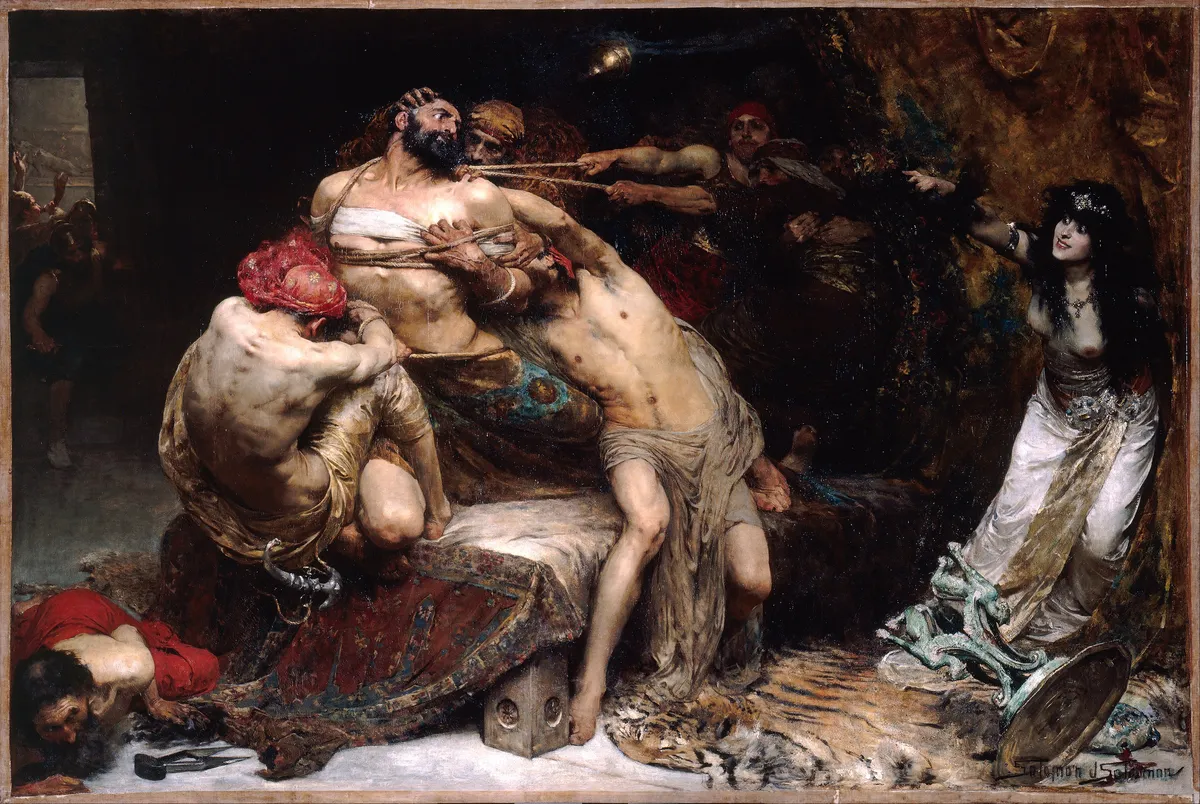
The Victorian painter Solomon J. Solomon caught the raw struggle of that capture, the shorn giant straining against a pile of soldiers while Delilah stands apart, holding up his cut hair in triumph. What the Philistines do next is brutal: they gouge out his eyes, bind him in bronze chains, and set him to grind grain like an animal in the prison of Gaza.
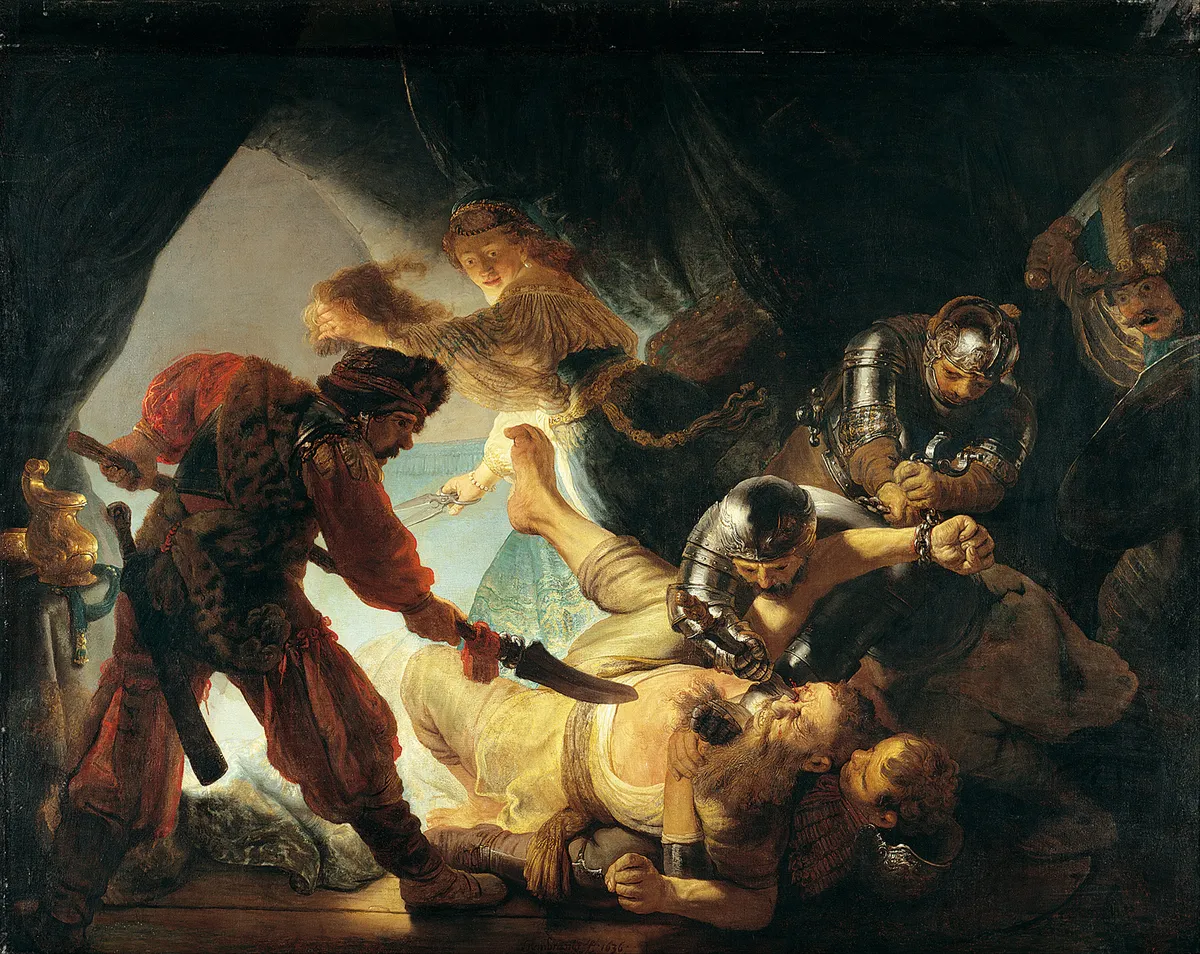
Rembrandt’s Blinding of Samson is one of the most violent paintings of the Baroque, a soldier driving a blade into the hero’s eye while light pours through the tent and Delilah flees with the shears and the hair. To discover more of the Dutch master’s biblical world, read our article on Rembrandt’s paintings.
Delilah’s Triumph
For Delilah the story ends in reward. She has her silver, and her people have their enemy in chains. Painters have long been fascinated by her cold, knowing calm in the face of the ruin she has caused.

Alexandre Cabanel gives her the glamour of a femme fatale, turning away in cool satisfaction as the broken hero is led off. The contrast between her beauty and her treachery is the moral centre of the whole tale. To see more of this polished French master, read our article on Alexandre Cabanel’s paintings.
The Temple of Dagon
But the story is not over, because in prison Samson’s hair slowly begins to grow back. The Philistines gather for a great feast in the temple of their god Dagon, and in their pride they bring out the blind Samson to mock him before the crowd. He asks the boy leading him to place his hands on the two central pillars of the temple.
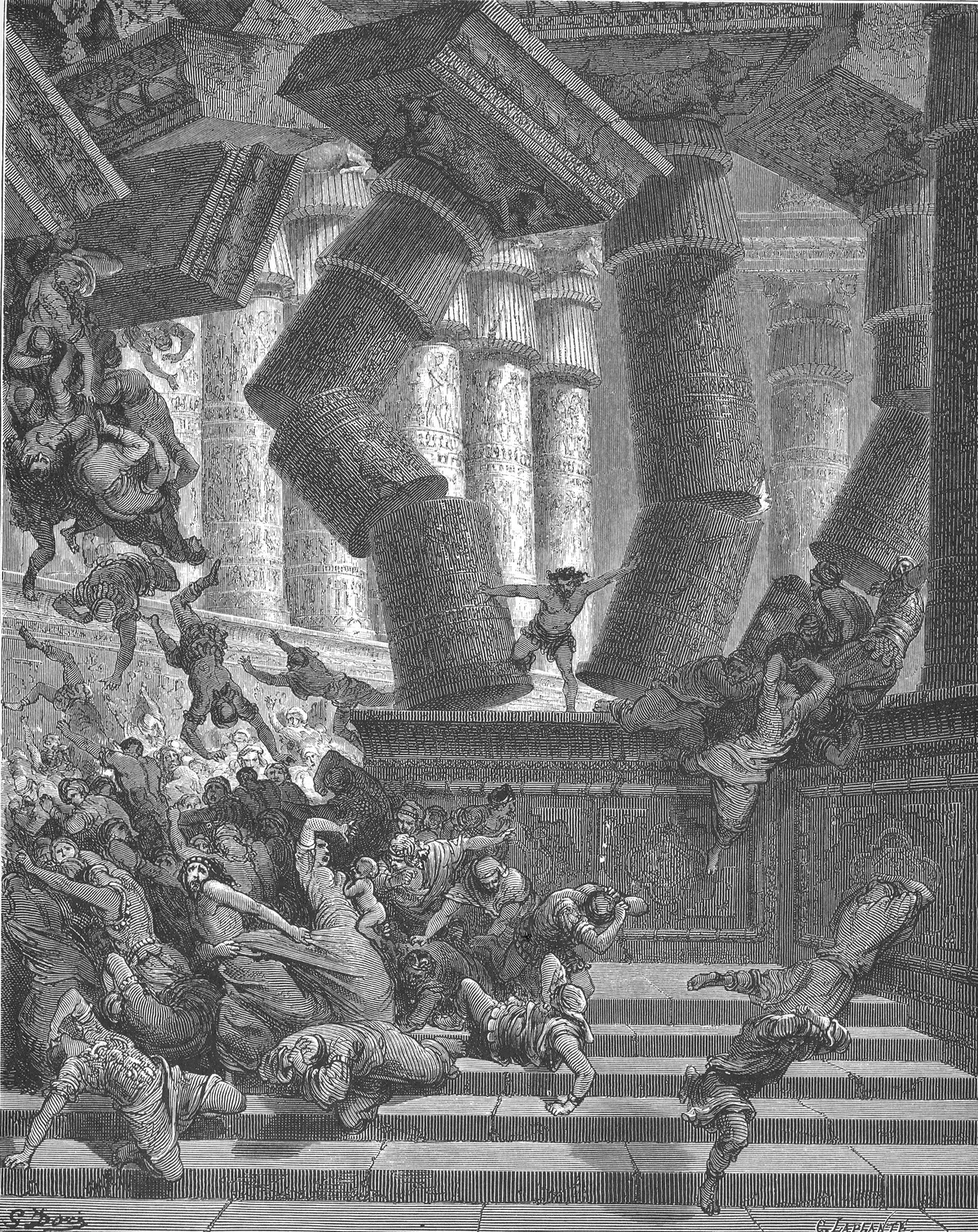
Praying to God for strength one last time, Samson pushes with all his returning might, and the whole temple crashes down, killing himself and thousands of Philistines with him. As Gustave Dore shows in his thunderous engraving, Samson kills more of his enemies in his death than he ever did in his life. It is a tragic, terrible victory, and a redemption snatched from total defeat. To explore this great illustrator, read our article on Gustave Dore’s paintings.
Samson and Delilah Paintings Featured in This Article
| Painting | Artist | Date | Museum |
|---|---|---|---|
| Samson and Delilah | Peter Paul Rubens | c. 1609 | National Gallery, London |
| Samson Slaying the Lion | Gustave Dore | 1866 | From the Dore Bible |
| Samson and Delilah | Andrea Mantegna | c. 1500 | National Gallery, London |
| Samson | Solomon J. Solomon | 1887 | Walker Art Gallery, Liverpool |
| The Blinding of Samson | Rembrandt | 1636 | Stadel Museum, Frankfurt |
| Samson and Delilah | Alexandre Cabanel | 19th century | Private collection |
| The Death of Samson | Gustave Dore | 1866 | From the Dore Bible |
Conclusion
The Samson and Delilah story has lasted three thousand years because it is about more than a haircut. Samson is the man who has every advantage, strength, calling, and the favour of God, and throws it away one weak choice at a time. His hair is only the outward sign of a vow he has already been breaking for years. Delilah simply finishes what his own appetites began.
That is why painters never tired of it. The story let them show beauty and danger in the same woman, power and helplessness in the same man, and a flash of grace in the darkest possible ending. From Rubens’s warm candlelight to Rembrandt’s scream of violence and Dore’s collapsing temple, each artist found in Samson a mirror of how easily the mighty can fall, and how even then, mercy is not entirely out of reach. For a heroine who turned beauty and cunning to the opposite end, read about Judith and Holofernes.
Important Facts About the Samson and Delilah Story
- The story of Samson and Delilah is told in the Old Testament Book of Judges, chapters 13 to 16, with the Delilah episode falling in chapter 16.
- Samson was a Nazirite, bound by a vow never to cut his hair, drink wine, or touch a dead body, and his uncut hair was the visible sign of that dedication to God.
- Delilah was promised eleven hundred pieces of silver by each of the Philistine rulers in exchange for the secret of Samson’s strength.
- Rubens, Rembrandt, Mantegna, Van Dyck, and Gustave Dore are among the many great artists who painted or engraved the story.
- Samson killed more Philistines in his final act, pulling down the temple of Dagon, than in all the rest of his life put together.
Questions and Answers
What is the story of Samson and Delilah?
Samson is an Israelite hero given superhuman strength by God, on the condition that he never cut his hair. He falls in love with Delilah, a woman from the Valley of Sorek, and the Philistine rulers bribe her to discover the source of his power. After three false answers, Samson finally admits that his strength lies in his hair. Delilah has it cut while he sleeps, the Philistines capture and blind him, and in a final act he pulls down their temple, dying with his enemies.
Why did Delilah betray Samson?
Delilah betrayed Samson for money. The rulers of the Philistines, who feared Samson and wanted him destroyed, each offered her eleven hundred pieces of silver if she could find out the secret of his strength and hand him over. The Bible never says she loved him in return, only that she pressed him day after day until he told her the truth. Her betrayal is presented as a calculated act of greed rather than a crime of passion.
Why was Samson’s strength in his hair?
His strength was not really in the hair itself but in his vow. Samson was a Nazirite, set apart for God from birth, and leaving his hair uncut was the outward sign of that promise. As long as he kept the vow, God’s power was with him. When Delilah had his head shaved, she broke the last part of a vow he had already been neglecting, and the Bible says simply that the Lord had left him. The hair was the symbol; the obedience was the substance.
How did Samson die?
After he was blinded and imprisoned, Samson’s hair slowly grew back. The Philistines brought him into the temple of their god Dagon to mock him during a festival. Samson asked to lean against the two central pillars, prayed to God for strength one last time, and pushed them apart. The temple collapsed, killing Samson along with thousands of Philistines, so that he destroyed more of his enemies in his death than he had in his entire life.
Can you buy Samson and Delilah paintings as canvas prints?
You can buy Samson and Delilah paintings at jesuschrist.pictures, in our shop, where the great versions are offered as high quality canvas prints. Because the story is so dramatic, a faithful reproduction lets you bring a work like Rubens’s Samson and Delilah or Rembrandt’s Blinding of Samson into a home, study, or church hall. Browse our collection of Christian art reproductions on canvas to find a piece for your home or parish.