The Burial of the Count of Orgaz: El Greco’s Hidden Signature
The Burial of the Count of Orgaz is the most famous painting by El Greco, the Cretan-born master who made his career in Toledo. Painted in oil on canvas between 1586 and 1588, it still hangs where it was made to hang, in a side chapel of the parish church of Santo Tomé in Toledo, above the tomb of the man it shows being buried. Nearly five metres high, it is one of the largest and most ambitious pictures of its century. And on a white handkerchief in the corner, El Greco left a signature that most visitors walk past without seeing.
That small detail is a good way into the whole painting. It shows a painter who knew exactly what he had made, who put his family and his own face into it, and who meant the picture to be read slowly, figure by figure, like a page of history.
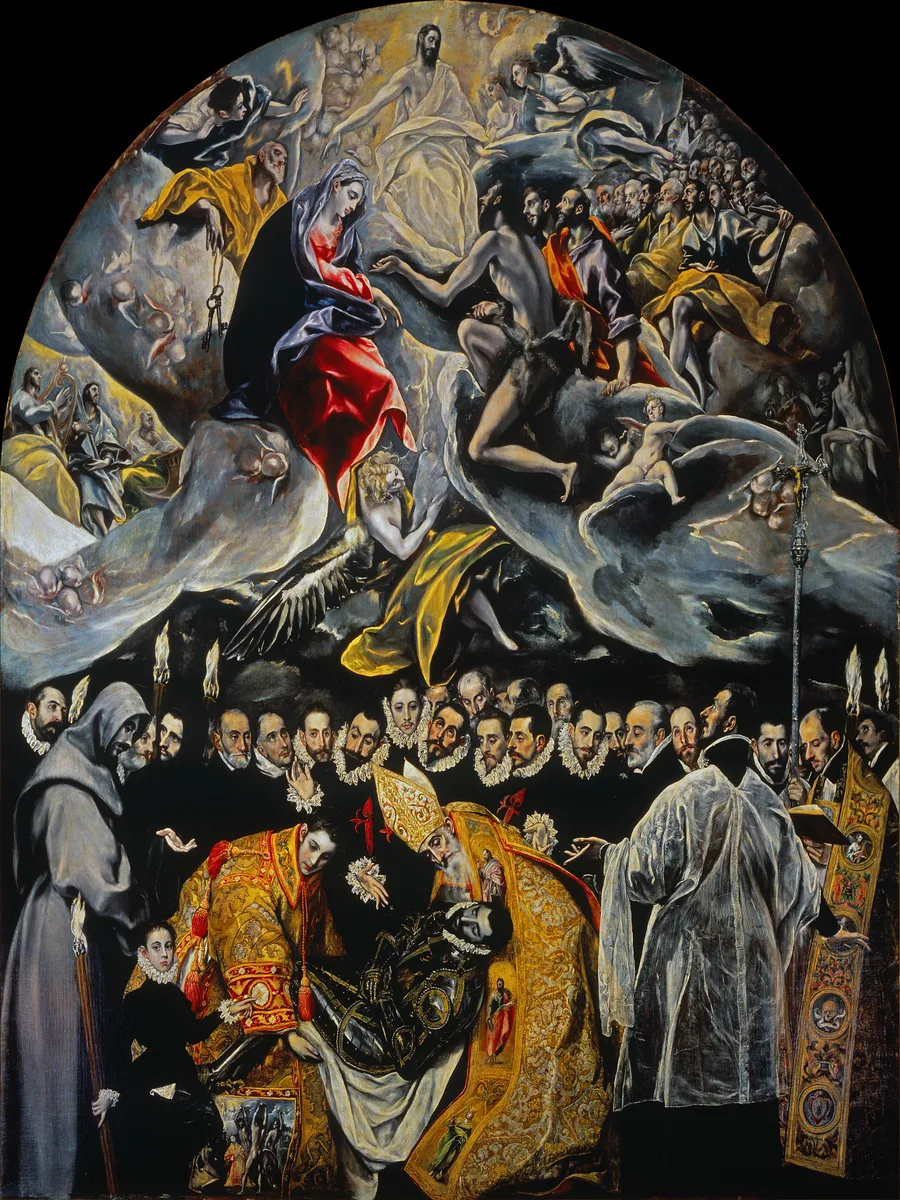
The canvas is divided into two worlds. Below, a funeral takes place in sixteenth century Toledo, with mourners in black, torches, a processional cross and a priest reading the office. Above, the clouds open onto heaven, where Christ sits in glory among the saints. Between the two, an angel carries a tiny soul upward. Few paintings bring earth and heaven so close together, and few reward a close look so generously.
The Signature on a Child’s Handkerchief
In the lower left corner stands a boy of about eight, dressed in black with a white ruff, looking straight out at us and pointing at the miracle. He is Jorge Manuel, El Greco’s only son. From his pocket hangs a handkerchief, and on it the painter wrote his name in Greek letters, Doménikos Theotokópoulos, together with a date: 1578. It is not the date of the painting, which was begun eight years later. It is the year Jorge Manuel was born.
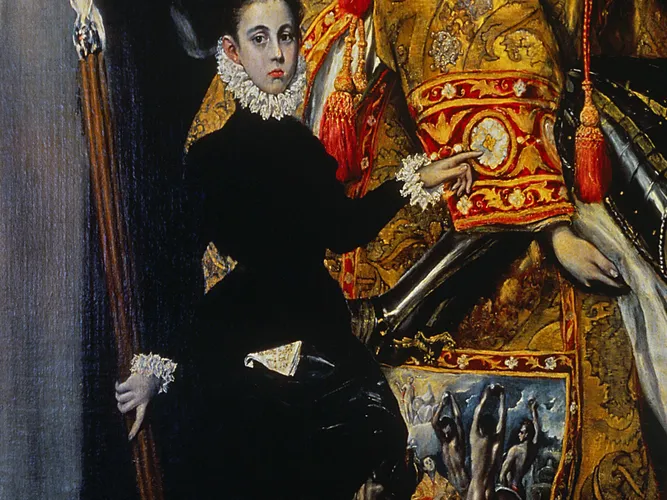
So the signature does two things at once. It claims the work for the painter, in the Greek he never stopped using, and it ties the picture to the most personal date in his life. The boy’s gesture matters as well. He is placed closer to us than anyone else in the scene, and his finger directs our eye toward the two saints and the body of the count. He is our guide, and through him El Greco quietly invites us into the event.
Jorge Manuel grew up to become his father’s assistant and, later, an architect and painter in his own right. In the Burial he is a child, but already part of the workshop’s story, the heir standing at the threshold of the most important picture his father would ever paint.
The Legend of 1323
The painting tells a story that every parishioner of Santo Tomé knew. Don Gonzalo Ruiz de Toledo, lord of the town of Orgaz, died in 1323. He was a pious and generous man who had paid for the rebuilding of Santo Tomé and wished to be buried there. His family later received the title of count, which is why he is remembered as the Count of Orgaz, although he never held it himself.
According to the legend, when his body was lowered into the tomb, two saints came down from heaven to bury him with their own hands: Saint Stephen, the first Christian martyr, and Saint Augustine, the great bishop and theologian. A voice was heard saying that such is the reward of those who serve God and his saints. The miracle is recorded in a Latin inscription set into the wall below the painting, so that the picture and its text still read together.
The legend also had a practical side. In his will the lord of Orgaz left the parish an annual gift, paid by the people of his town. More than two centuries later the payments had stopped, and the energetic parish priest, Andrés Núñez, took the town to court and won. Refurbishing the count’s burial chapel, and commissioning a great painting of the miracle, was his way of celebrating the parish’s rights and the count’s piety at the same time.
A Contract, a Deadline and a Quarrel over the Price
Núñez signed the contract with El Greco on 18 March 1586. It was remarkably precise. It described the miracle, the two saints, the crowd of noblemen and the open heaven above, required the painter to pay for his own materials, and set a deadline of Christmas 1587. El Greco worked at a ferocious pace and finished the canvas between the end of 1587 and the spring of 1588.
Then came the dispute. The contract left the price to be fixed by expert valuation. The first appraisal set it at 13,200 reales. A second, higher valuation followed, the priests protested, and the two sides argued for months. In the end El Greco gave way and accepted the first figure. It was not his only quarrel with a client in Toledo: his first great commission in the city, The Disrobing of Christ for the cathedral, had also ended in a dispute over money and over details of the composition.
The parish had got a bargain. Almost as soon as the canvas was installed, people began coming to Santo Tomé to see it, and they have never stopped.
A Gallery of the Living Men of Toledo
What drew the first crowds was not only the miracle. It was the faces. El Greco filled the funeral with a line of Toledan gentlemen, dressed in the black of mourning with crisp white ruffs, and they were real people, the lawyers, scholars, clergy and noblemen of the city. Writing in 1612, the Toledo historian Francisco de Pisa noted that the townspeople never tired of the picture, because they found in it lifelike portraits of so many notable men of their own day.
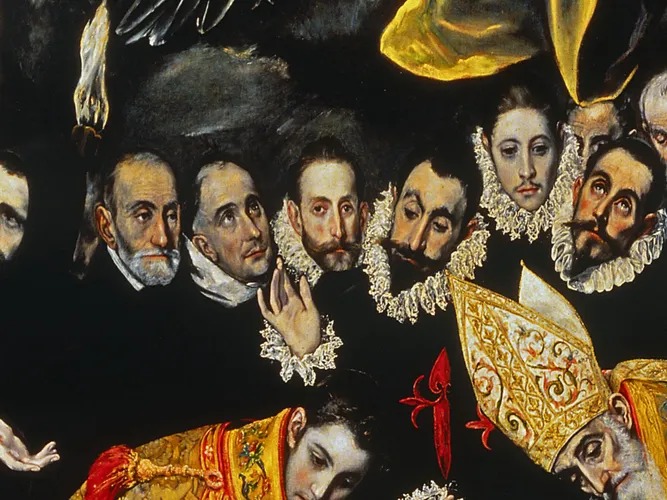
Several of these faces have been identified over the centuries, though not all identifications are certain. The priest reading from the book on the right is Núñez himself, the man who commissioned the work. And above the raised hand of a knight wearing the red cross of the Order of Santiago, one face looks out at us directly. It is traditionally identified as El Greco’s self-portrait. If the identification is right, the painter put himself into the crowd as a witness, a few steps above his son, so that father and child both look out of the picture toward the viewer.
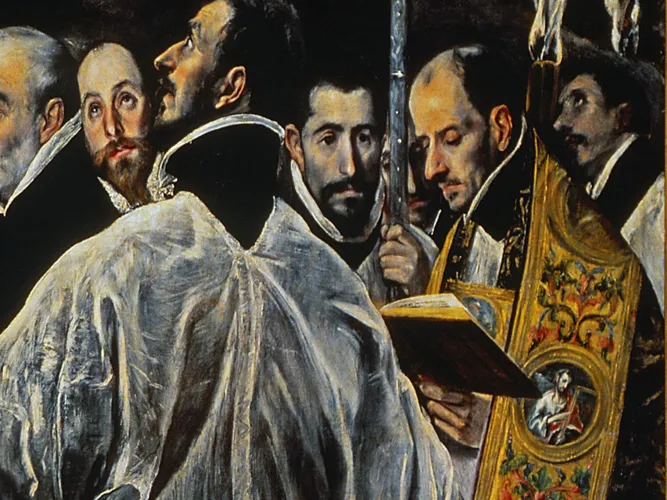
The effect is striking even today. These men do not gasp or fall to their knees. They watch with grave composure, some looking down at the body, a few glancing up toward heaven, as if a miracle were something a well-born Toledan should receive with dignity. The calm has been read as a lesson of the Counter-Reformation, and also as an echo of the stillness of the Byzantine icons El Greco painted as a young man in Crete.
Two Saints in Gold
At the centre of the funeral, the two saints bend over the count. Saint Stephen, young and beardless, takes the legs, and Saint Augustine, old and bearded under his mitre, holds the shoulders. Both wear sumptuous liturgical vestments of gold brocade, the dress of the Spanish church in El Greco’s own day rather than that of the fourteenth century. Saint Augustine is often said to bear the features of the Archbishop of Toledo, Gaspar de Quiroga.
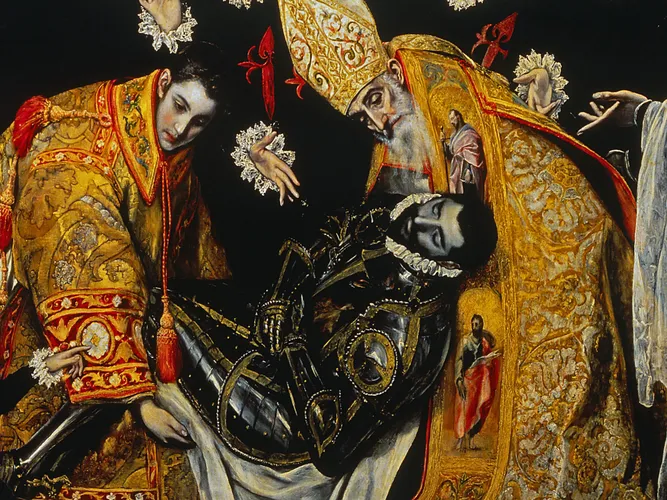
The count himself wears full armour, polished and dark, of a type made in El Greco’s lifetime rather than in 1323. Its reflections pick up the gold and red of the saints’ robes. The design recalls the ceremonial armour in the portraits of Titian, whose work El Greco had studied closely in Venice, along with the bold compositions of Tintoretto.
Look at the hem of Saint Stephen’s dalmatic and you will find a small painted scene: the stoning of Stephen himself, the martyrdom that made him a saint. El Greco loved these pictures within the picture. They reward the slow viewer, and they remind us that the men bending over the body are not courtiers but saints who have already passed through death.
Heaven Opens
The upper half of the painting belongs to another world. The scale changes, the figures grow longer and paler, and the clouds turn into icy, almost abstract shapes. At the summit sits Christ in glory, dressed in white and dissolving into light. Below him, on either side, the Virgin Mary and Saint John the Baptist lean in to plead for the soul that is arriving.
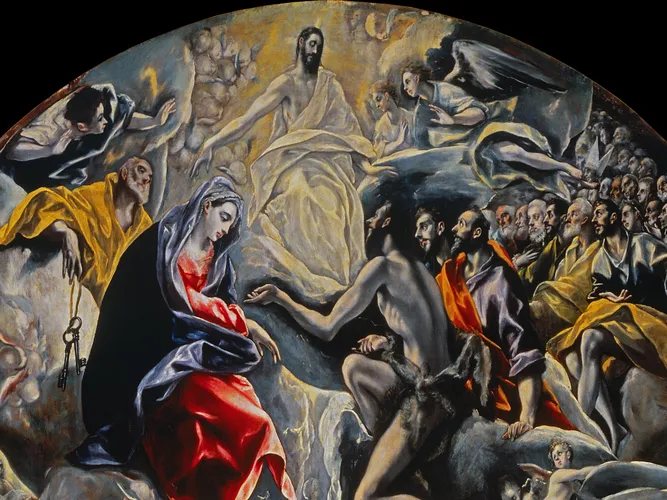
This group of three, Christ between his Mother and the Baptist, is the Deesis, one of the oldest compositions of Byzantine art, and El Greco would have painted it many times as an icon painter in Crete. Here he sets it at the top of a Western altarpiece, a quiet signature of his origins as eloquent as the one on the handkerchief. For the long history of that tradition, see our article on Byzantine paintings of Jesus, and for the Baptist’s place in sacred art, our selection of Saint John the Baptist paintings.
Around them crowd apostles, martyrs and figures of the Old Testament. Saint Peter, in yellow, holds the keys of the kingdom. Among the blessed, scholars have also recognised King Philip II of Spain, who was still alive when the picture was painted. Placing the living king in heaven was a bold compliment, and it fits the painting’s message: the good and the faithful, the count of 1323 as much as the men of 1586, belong to the same communion of saints.
The Passage of the Soul
The hinge between the two worlds is a small and easily missed figure. Just above the funeral, an angel with great spread wings carries the count’s soul upward. El Greco paints the soul as a pale, almost transparent child, pressed through a narrow opening in the clouds, like a birth into heaven.
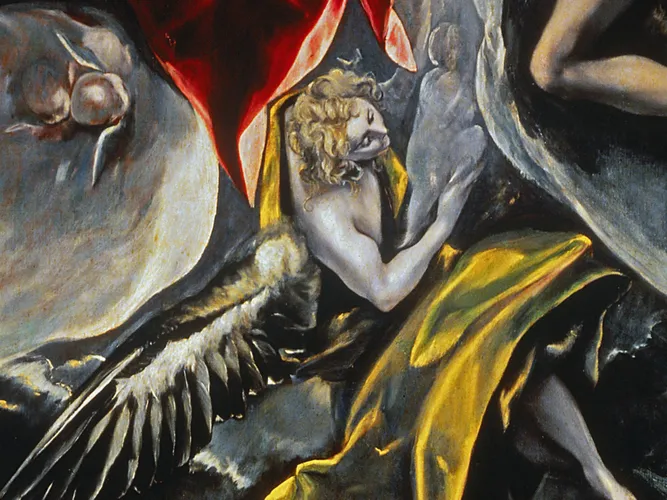
Some scholars have related this motif to Byzantine images of the Dormition of the Virgin, in which Christ holds his Mother’s soul as a small swaddled child above her body. In 1983 an early Dormition icon by El Greco himself was discovered on the Greek island of Syros, and its composition, a body laid out below and a heavenly vision above, has often been compared with the Burial. Whether or not the link is direct, the soul in Orgaz shows how deeply the painter’s Greek training stayed with him, years after he had settled in Spain.
What the Burial of the Count of Orgaz Teaches
At its heart the painting is a sermon in paint. It says that good works and the honour paid to the saints are rewarded, and that heaven is not far from the life of a city but bends down toward it. That message was central to Catholic teaching after the Council of Trent, and the people of Santo Tomé could see it every time they came to Mass.
Yet El Greco gives the lesson a warmth no treatise could. The real men of Toledo stand at a real funeral, the saints wear the vestments of the local church, and the painter’s own child points the way. The miracle is not set in a distant past. It is happening in their parish, among their neighbours, under their eyes. That is why the painting has long been seen as a summit of Spanish Renaissance religious painting and as the fullest statement of El Greco’s style, where the realism of the portraits and the visionary freedom of heaven meet on one canvas.
Conclusion
The Burial of the Count of Orgaz has hung in the same chapel since 1588, above the tomb of the man it shows, and it has never needed to travel to be famous. It is a portrait gallery, a legend, a theological argument and a family record all at once. The more closely you look, the more it gives back: the stoning of Stephen on a hem, a soul squeezed through the clouds, a living king among the blessed, and a boy with a handkerchief carrying his father’s name and his own birthday.
To see how this masterpiece fits into the rest of the painter’s work, from his early panels to the visionary canvases of his last years, explore our selection of El Greco paintings, or look at his devotional Christ Carrying the Cross.
Artwork Information
| Artwork | Artist | Date | Medium | Current Location |
|---|---|---|---|---|
| The Burial of the Count of Orgaz | El Greco (Doménikos Theotokópoulos) | 1586 to 1588 | Oil on canvas, about 480 x 360 cm | Church of Santo Tomé, Toledo |
Five Facts About the Burial of the Count of Orgaz
- El Greco signed the painting in Greek on the handkerchief of his son Jorge Manuel, with the date 1578, the year the boy was born.
- The contract was signed on 18 March 1586, and the painter had to supply his own materials and finish by Christmas 1587.
- After a long dispute over the valuation, El Greco accepted the first appraisal, 13,200 reales.
- The mourners are portraits of real men of Toledo, including the parish priest Andrés Núñez, who commissioned the work.
- The painting has never left the church of Santo Tomé, where it hangs above the count’s tomb.
FAQ
What does the Burial of the Count of Orgaz depict?
It depicts a miracle said to have happened in Toledo in 1323, at the funeral of Don Gonzalo Ruiz, lord of Orgaz: Saint Stephen and Saint Augustine came down from heaven and laid him in his tomb with their own hands. The lower half shows the funeral, watched by the noblemen of Toledo, and the upper half shows heaven opening to receive the count’s soul, with Christ in glory, the Virgin and Saint John the Baptist.
What is El Greco’s most famous painting?
The Burial of the Count of Orgaz is generally considered El Greco’s most famous painting and his masterpiece. Among his other celebrated works are The Disrobing of Christ in Toledo Cathedral, the View of Toledo, the Opening of the Fifth Seal and the portrait known as The Nobleman with his Hand on his Chest.
What style did El Greco use in the Burial of the Count of Orgaz?
The painting belongs to late Mannerism. The lower zone is painted with sober realism, in the life-size portraits of the mourners, while the heavenly zone uses the elongated figures, unreal space and cold, shimmering colour typical of El Greco’s mature style. Its combination of Venetian colour, Roman draughtsmanship and Byzantine composition makes it unlike any other painting of its time.
Where is the Burial of the Count of Orgaz?
The original hangs in the church of Santo Tomé in Toledo, Spain, in the chapel built over the count’s tomb, where it has been since 1588. The Museo del Prado in Madrid owns a copy of the lower part, which is sometimes mistaken for the original.
How big is the Burial of the Count of Orgaz?
It is a very large canvas, about 4.8 metres high and 3.6 metres wide, with an arched top. The figures in the funeral are close to life size, which is part of what makes the scene so present when you stand in front of it.
Where can I buy a Burial of the Count of Orgaz print?
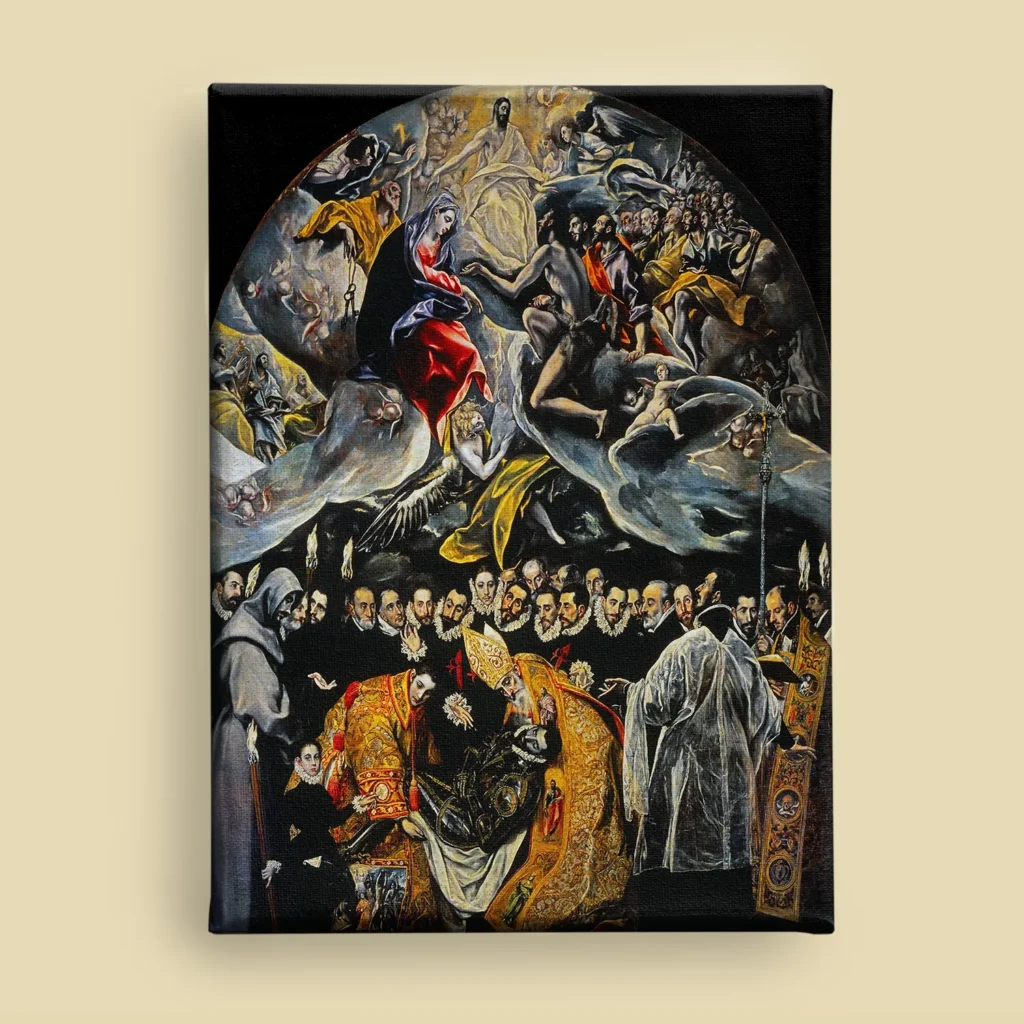
You can buy a Burial of the Count of Orgaz canvas print at jesuschrist.pictures: our Burial of the Count of Orgaz canvas reproduction keeps the arched top of the original on a deep black ground and comes in two sizes, 30 x 40 cm and 60 x 80 cm, ready to hang. More of the painter’s religious masterpieces are in our El Greco canvas collection.