The Stations of the Cross: 14 Paintings, the Prayers and a Free PDF
The Stations of the Cross are fourteen moments of the last day of Jesus, from his condemnation by Pilate to his burial, prayed one after the other in memory of his road to Calvary. Catholics pray them on the Fridays of Lent and on Good Friday, in church before the fourteen crosses on the walls, or at home.
This page gives the 14 Stations of the Cross with their traditional prayers, those of Saint Alphonsus Liguori, and one painting for each station: the Way of the Cross that Giandomenico Tiepolo painted for a church in Venice between 1747 and 1749, when he was twenty. The same stations, pictures and prayers are also a free printable booklet.
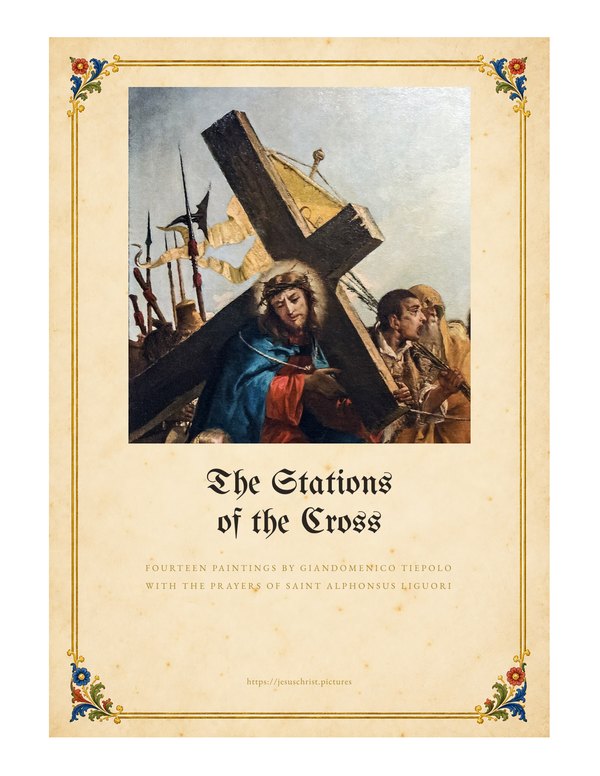
✦ The Stations of the Cross as a Free Printable Booklet
The fourteen stations below are also a booklet you can print at home and carry to church: seventeen illuminated pages, one station per page with Tiepolo’s painting large enough to pray with, and the prayers of Saint Alphonsus Liguori. It is free, and there is nothing to fill in.
Download for US LetterDownload for A4
PDF, seventeen pages, ready to print.
What Are the Stations of the Cross?
In Jerusalem, pilgrims retraced the road Jesus walked from Pilate’s court to Calvary, the street later called the Via Dolorosa, and stopped to pray where each event of the Passion took place. Those who could never make the journey began to make it at home: from the fifteenth century, churches in Europe set up a series of small shrines along a path or along their walls. The Franciscans, guardians of the holy places since 1342, spread the devotion everywhere, and in 1731 Pope Clement XII fixed the number of stations at fourteen. Today almost every Catholic church has them, each marked by a small cross, usually with a painting or a carved relief.
Most of the fourteen stations come straight from the Gospels. Five come from tradition: the three falls of Jesus, his meeting with his mother, and Veronica wiping his face. In 1991 Pope John Paul II introduced a Scriptural Way of the Cross for Good Friday at the Colosseum, in which every station comes from the Gospels; its fourteen stations are listed at the end of this page.
The 14 Stations of the Cross
There are fourteen traditional stations:
- Jesus Is Condemned to Death
- Jesus Takes Up His Cross
- Jesus Falls the First Time
- Jesus Meets His Mother
- Simon of Cyrene Helps Jesus Carry the Cross
- Veronica Wipes the Face of Jesus
- Jesus Falls the Second Time
- Jesus Meets the Women of Jerusalem
- Jesus Falls the Third Time
- Jesus Is Stripped of His Garments
- Jesus Is Nailed to the Cross
- Jesus Dies on the Cross
- Jesus Is Taken Down from the Cross
- Jesus Is Laid in the Tomb
Some parishes add a fifteenth station, the Resurrection, so that the Way of the Cross ends at the empty tomb.
How to Pray the Stations of the Cross
In church, walk from one station to the next; at home, follow the pictures on this page or in the booklet. At every station:
- say the versicle, We adore Thee, O Christ, and we bless Thee, and its response, Because by Thy holy Cross Thou hast redeemed the world (it is the custom to genuflect);
- read the short meditation that begins “Consider”;
- say the prayer of the station;
- end with an Our Father, a Hail Mary and a Glory Be.
The whole Way takes about half an hour. It can be prayed alone, or together, one voice reading and the others answering. Begin with the prayer of Saint Alphonsus below.
Opening Prayer
Make an act of contrition, then say:
My Lord Jesus Christ, Thou hast made this journey to die for me with love unutterable, and I have so many times unworthily abandoned Thee; but now I love Thee with my whole heart, and because I love Thee I repent sincerely for having ever offended Thee. Pardon me, my God, and permit me to accompany Thee on this journey. Thou goest to die for love of me; I wish also, my beloved Redeemer, to die for love of Thee. My Jesus, I will live and die always united to Thee.
The prayers on this page are those of Saint Alphonsus Liguori (1696-1787), bishop, founder of the Redemptorists and Doctor of the Church, whose method is still the one most parishes use. The English text is that of A Manual of Prayers for the Use of the Catholic Laity (1889), prepared by order of the Third Plenary Council of Baltimore; we have only corrected a few printing errors, modernized the punctuation and, in the fifth station, written “the soldiers”, as in the Gospels (Matthew 27:32).
The Stations of the Cross with Pictures and Prayers
Each station below has Tiepolo’s painting, a few words on what he shows, and the meditation and prayer of Saint Alphonsus.
First Station: Jesus Is Condemned to Death
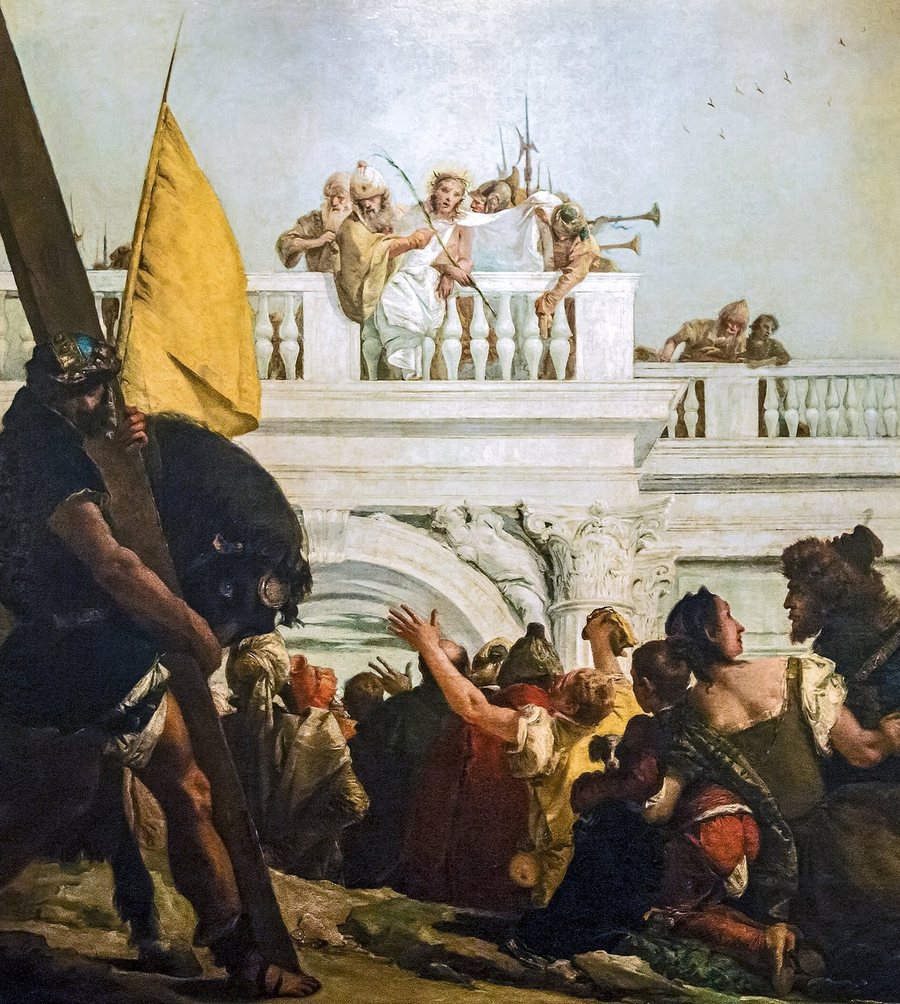
Tiepolo sets the sentence far away. Jesus, in a white robe and crowned with thorns, stands at the balustrade of Pilate’s palace among his judges, while trumpets sound the verdict. In the foreground a soldier, seen from behind, is already shouldering the cross, and the crowd below raises its arms toward the balcony.
V. We adore Thee, O Christ, and we bless Thee.
R. Because by Thy holy Cross Thou hast redeemed the world.Consider how Jesus, after having been scourged and crowned with thorns, was unjustly condemned by Pilate to die on the Cross.
My adorable Jesus, it was not Pilate; no, it was my sins that condemned Thee to die. I beseech Thee, by the merits of this sorrowful journey, to assist my soul in her journey towards eternity. I love Thee, my beloved Jesus; I love Thee more than myself; I repent with my whole heart of having offended Thee. Never permit me to separate myself from Thee again. Grant that I may love Thee always; and then do with me what Thou wilt.
Our Father, Hail Mary, Glory Be.
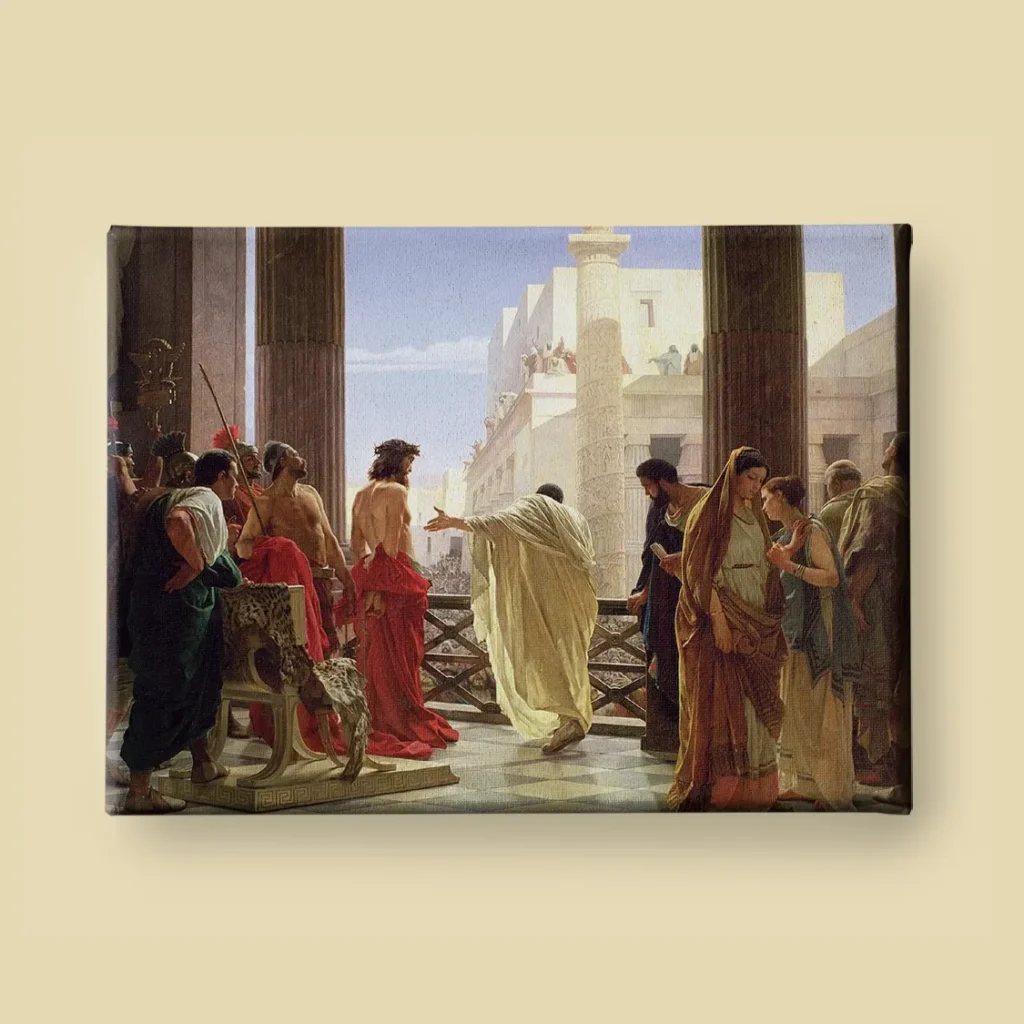
Antonio Ciseri painted the moment just before this station, when Pilate shows Jesus to the crowd: Ecce Homo, Behold the man. More of his work is in our article on Antonio Ciseri’s paintings.
Second Station: Jesus Takes Up His Cross
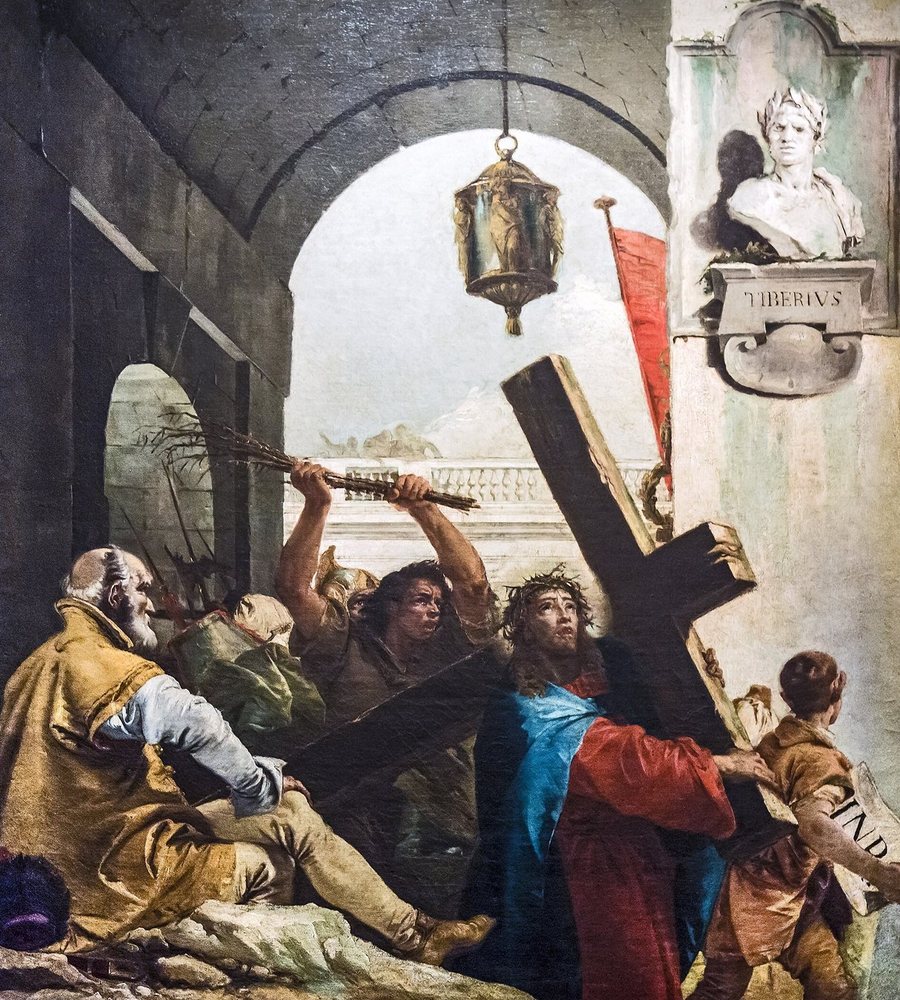
Under an archway hung with a lantern, Jesus takes the cross into his arms and lifts his eyes to heaven, while a man behind him raises a bundle of rods to strike. From a niche above, a marble bust of the emperor Tiberius looks down: the Passion happened under a Roman emperor, at a precise moment of history.
V. We adore Thee, O Christ, and we bless Thee.
R. Because by Thy holy Cross Thou hast redeemed the world.Consider how Jesus, in making this journey with the Cross on His shoulders, thought of us, and for us offered to His Father the death He was about to undergo.
My most beloved Jesus, I embrace all the tribulations Thou hast destined for me until death. I beseech Thee, by the merits of the pain Thou didst suffer in carrying Thy Cross, to give me the necessary help to carry mine with perfect patience and resignation. I love Thee, Jesus my love; I repent of having offended Thee. Never permit me to separate myself from Thee again. Grant that I may love Thee always and then do with me what Thou wilt.
Our Father, Hail Mary, Glory Be.
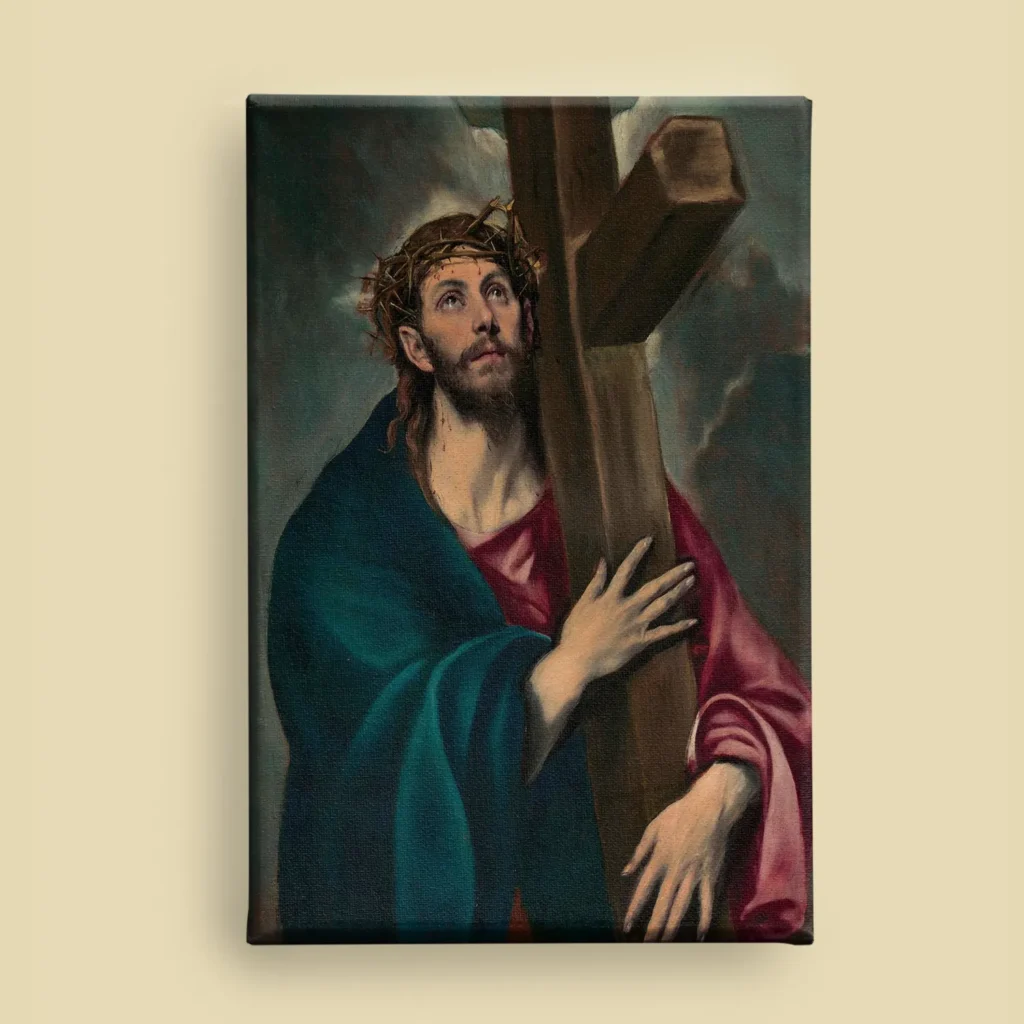
El Greco painted the same moment as a single face turned to heaven: read the story of El Greco’s Christ Carrying the Cross.
Third Station: Jesus Falls the First Time
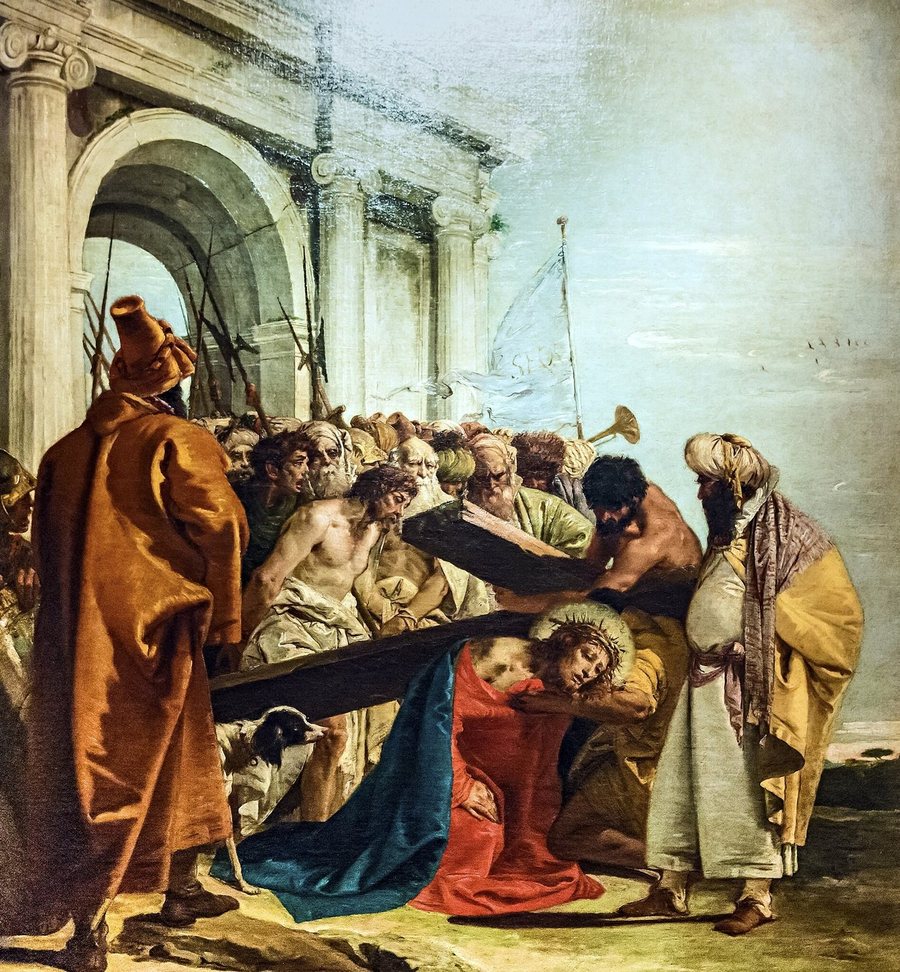
Jesus has gone down under the beam, his haloed head almost touching the ground, and a man hauls the cross up behind him. The crowd presses round in turbans and long robes, the way Venetian painters imagined the East, and at the left a small dog has wandered in, as dogs do in every street.
V. We adore Thee, O Christ, and we bless Thee.
R. Because by Thy holy Cross Thou hast redeemed the world.Consider this first fall of Jesus under His Cross. His flesh was torn by the scourges, His head crowned with thorns, and He had lost a great quantity of blood. He was so weakened that He could scarcely walk, and yet He had to carry this great load upon His shoulders. The soldiers struck Him rudely, and thus He fell several times in His journey.
My Jesus, it is not the weight of the Cross, but of my sins, which has made Thee suffer so much pain. Ah! by the merits of this first fall, deliver me from the misfortune of falling into mortal sin. I love Thee, O my Jesus, with my whole heart; I repent of having offended Thee. Never permit me to offend Thee again. Grant that I may love Thee always, and then do with me what Thou wilt.
Our Father, Hail Mary, Glory Be.
Fourth Station: Jesus Meets His Mother
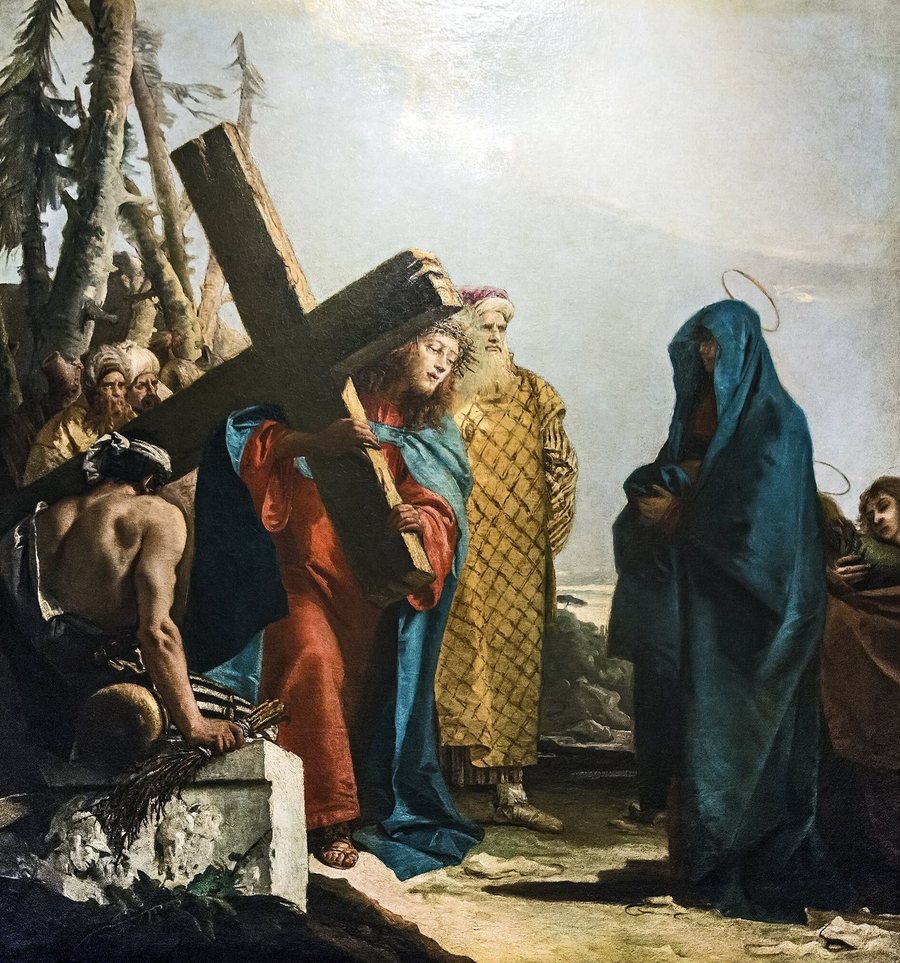
Jesus, still carrying the cross, turns his head toward his mother. Mary stands apart at the right, wrapped in a deep blue mantle drawn over her head, her hands folded. Tiepolo gives her no gesture at all, only stillness, and the empty space between the two figures says the rest.
V. We adore Thee, O Christ, and we bless Thee.
R. Because by Thy holy Cross Thou hast redeemed the world.Consider the meeting of the Son and the Mother, which took place on this journey. Jesus and Mary looked at each other, and their looks became as so many arrows to wound those hearts which loved each other so tenderly.
My most loving Jesus, by the sorrow that Thou didst experience in this meeting, grant me the grace of a truly devoted love for Thy most holy Mother. And thou, my Queen, who wast overwhelmed with sorrow, obtain for me, by thy intercession, a continual and tender remembrance of the Passion of thy Son. I love Thee, Jesus my love; I repent of having offended Thee. Never permit me to offend Thee again. Grant that I may love Thee, and then do with me what Thou wilt.
Our Father, Hail Mary, Glory Be.
Fifth Station: Simon of Cyrene Helps Jesus Carry the Cross
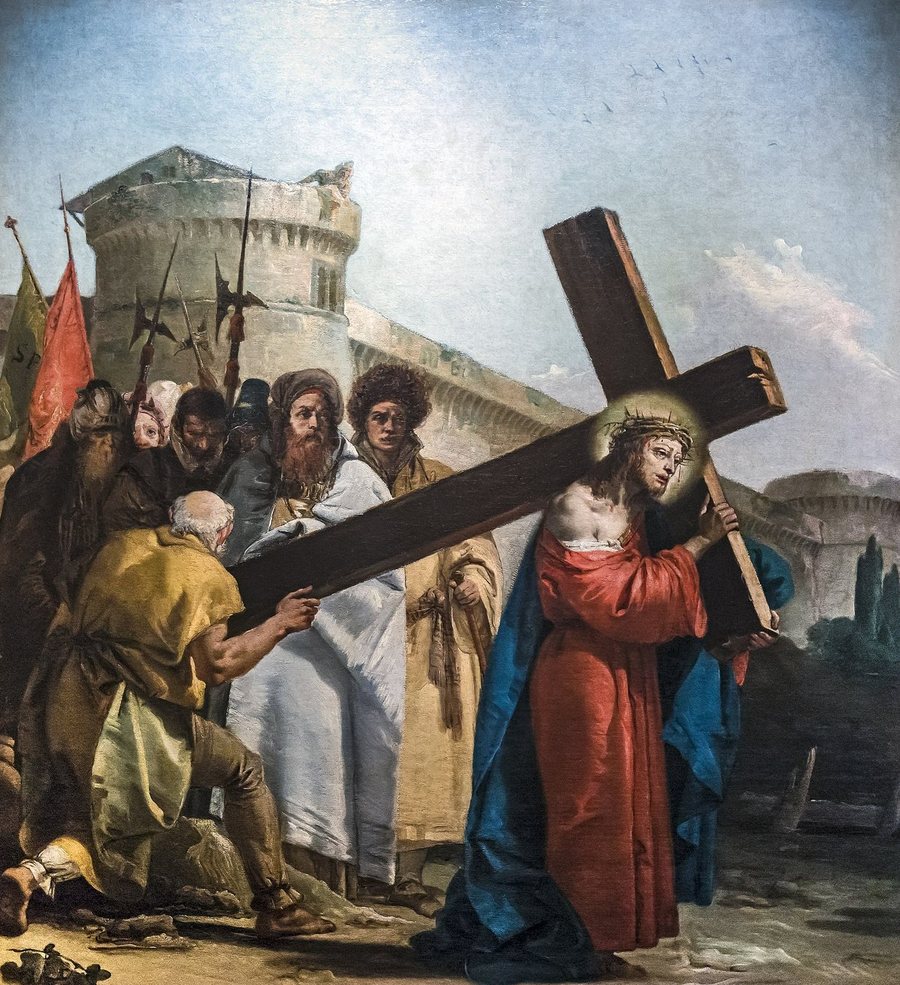
An old, bald man in a coarse yellow coat kneels and takes the end of the cross on his shoulder, while Jesus, crowned and haloed, looks back toward him. The procession has reached the walls of the city: behind them rise a round tower, red banners and the points of the halberds.
V. We adore Thee, O Christ, and we bless Thee.
R. Because by Thy holy Cross Thou hast redeemed the world.Consider how the soldiers, seeing that at each step Jesus from weakness was on the point of expiring, and fearing that He would die on the way, when they wished Him to die the ignominious death of the Cross, constrained Simon the Cyrenian to carry the Cross behind our Lord.
My most beloved Jesus, I will not refuse the Cross as the Cyrenian did; I accept it, I embrace it. I accept in particular the death Thou hast destined for me, with all the pains which may accompany it; I unite it to Thy death, I offer it to Thee. Thou hast died for love of me; I will die for love of Thee, and to please Thee. Help me by Thy grace. I love Thee, Jesus my love; I repent of having offended Thee. Never permit me to offend Thee again. Grant that I may love Thee; and then do with me what Thou wilt.
Our Father, Hail Mary, Glory Be.
Sixth Station: Veronica Wipes the Face of Jesus
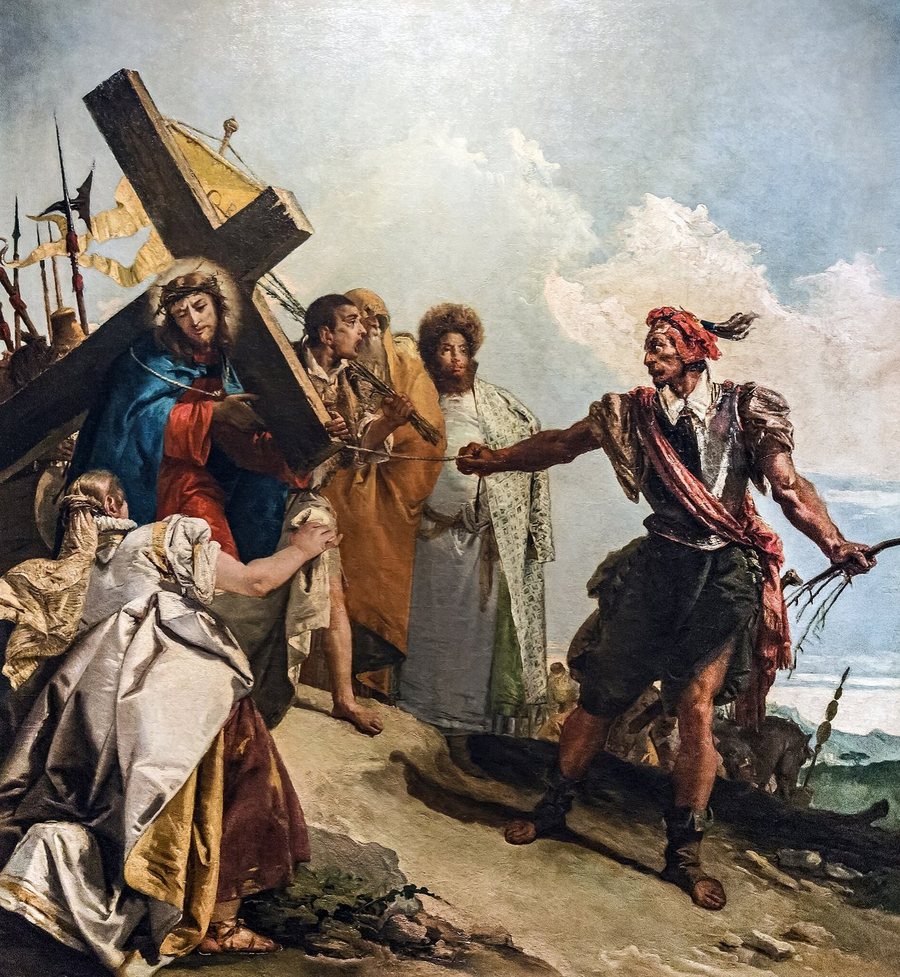
Veronica kneels with her back to us, her silvery dress spread over the ground, and holds up her cloth toward the face of Jesus. A soldier in a red turban and sash drags him forward by a rope, a whip in his other hand.
V. We adore Thee, O Christ, and we bless Thee.
R. Because by Thy holy Cross Thou hast redeemed the world.Consider how the holy woman named Veronica, seeing Jesus so afflicted, and His face bathed in sweat and blood, presented Him with a towel, with which He wiped His adorable face, leaving on it the impression of His holy countenance.
My most beloved Jesus, Thy face was beautiful before, but in this journey it has lost all its beauty, and wounds and blood have disfigured it. Alas! my soul also was once beautiful, when it received Thy grace in Baptism; but I have disfigured it since by my sins. Thou alone, my Redeemer, canst restore it to its former beauty. Do this by Thy passion, and then do with me what Thou wilt.
Our Father, Hail Mary, Glory Be.
Seventh Station: Jesus Falls the Second Time
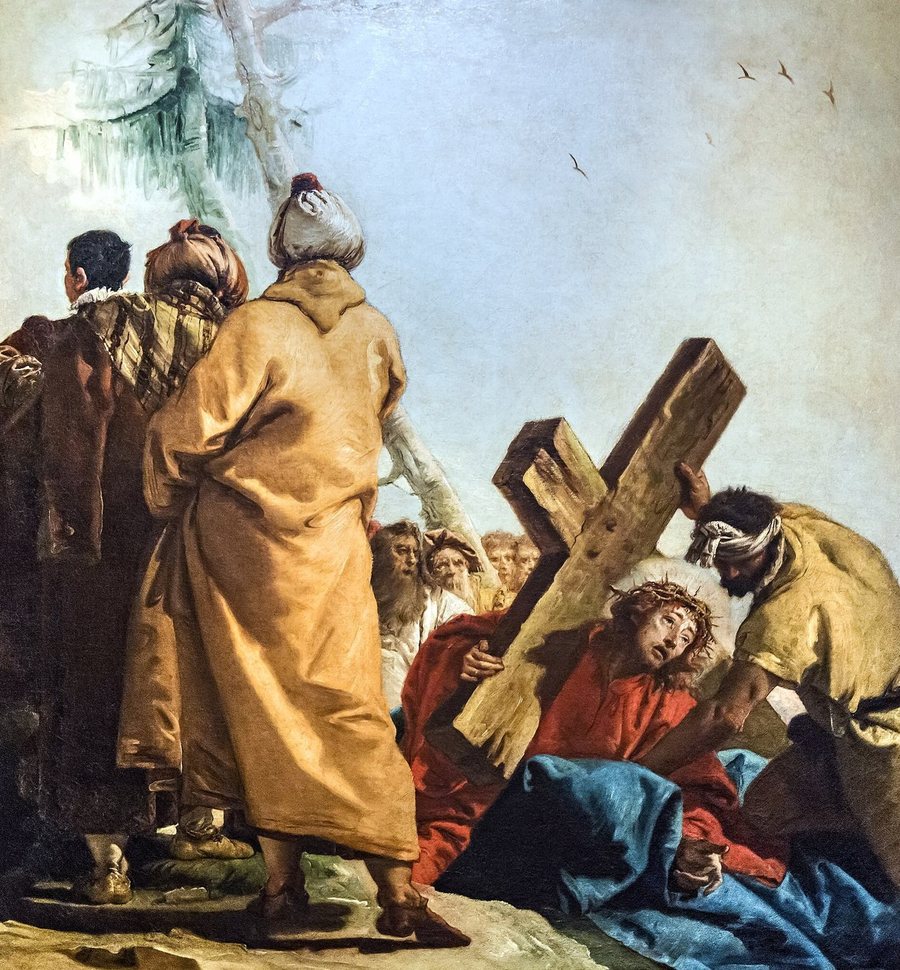
Most of the picture is taken up by a man in a great saffron robe and white turban, seen from behind, who blocks our view the way a stranger blocks it in a crowd. Only past him do we find Jesus, down on the ground for the second time, his face lifted, while an executioner wrestles the cross back onto his shoulder.
V. We adore Thee, O Christ, and we bless Thee.
R. Because by Thy holy Cross Thou hast redeemed the world.Consider the second fall of Jesus under the Cross, a fall which renews the pain of all the wounds of the head and members of our afflicted Lord.
My most gentle Jesus, how many times Thou hast pardoned me, and how many times have I fallen again, and begun again to offend Thee! Oh! by the merits of this new fall, give me the necessary helps to persevere in Thy grace until death. Grant that in all temptations which assail me I may always commend myself to Thee. I love Thee, Jesus my love, with my whole heart; I repent of having offended Thee. Never permit me to offend Thee again. Grant that I may love Thee always; and then do with me what Thou wilt.
Our Father, Hail Mary, Glory Be.
Eighth Station: Jesus Meets the Women of Jerusalem
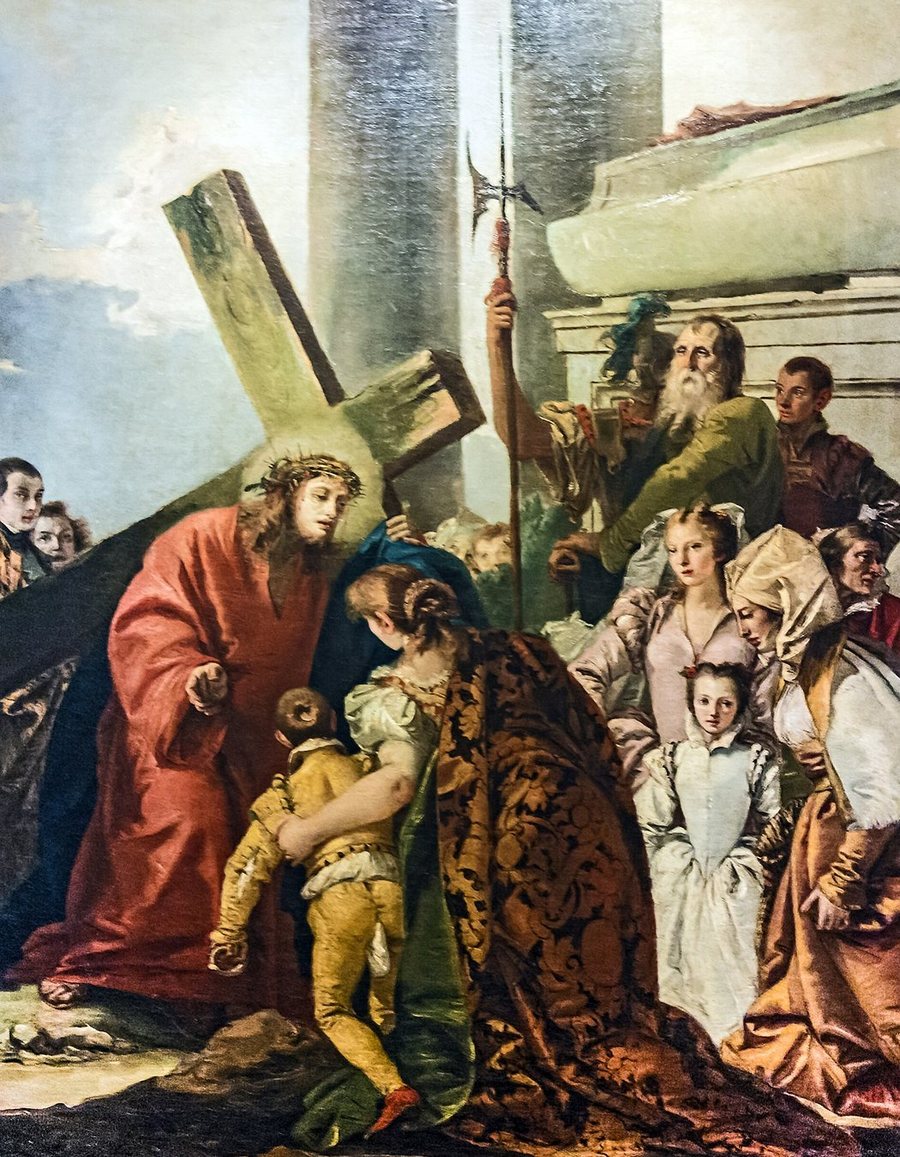
Jesus turns to the women of Jerusalem and holds out his hand to them. Tiepolo has painted them as the ladies of his own city, in brocade and silk, one kneeling with a small boy in yellow beside her, and a little girl in white: Daughters of Jerusalem, weep not for me, but weep for yourselves, and for your children (Luke 23:28).
V. We adore Thee, O Christ, and we bless Thee.
R. Because by Thy holy Cross Thou hast redeemed the world.Consider how those women wept with compassion at seeing Jesus in such a pitiable state, streaming with blood, as He walked along. But Jesus said to them: Weep not for Me, but for your children.
My Jesus, laden with sorrows, I weep for the offences I have committed against Thee, because of the pains they have deserved, and still more because of the displeasure they have caused Thee, who hast loved me so much. It is Thy love, more than the fear of hell, which causes me to weep for my sins. My Jesus, I love Thee more than myself; I repent of having offended Thee. Never permit me to offend Thee again. Grant that I may love Thee always; and then do with me what Thou wilt.
Our Father, Hail Mary, Glory Be.
Ninth Station: Jesus Falls the Third Time
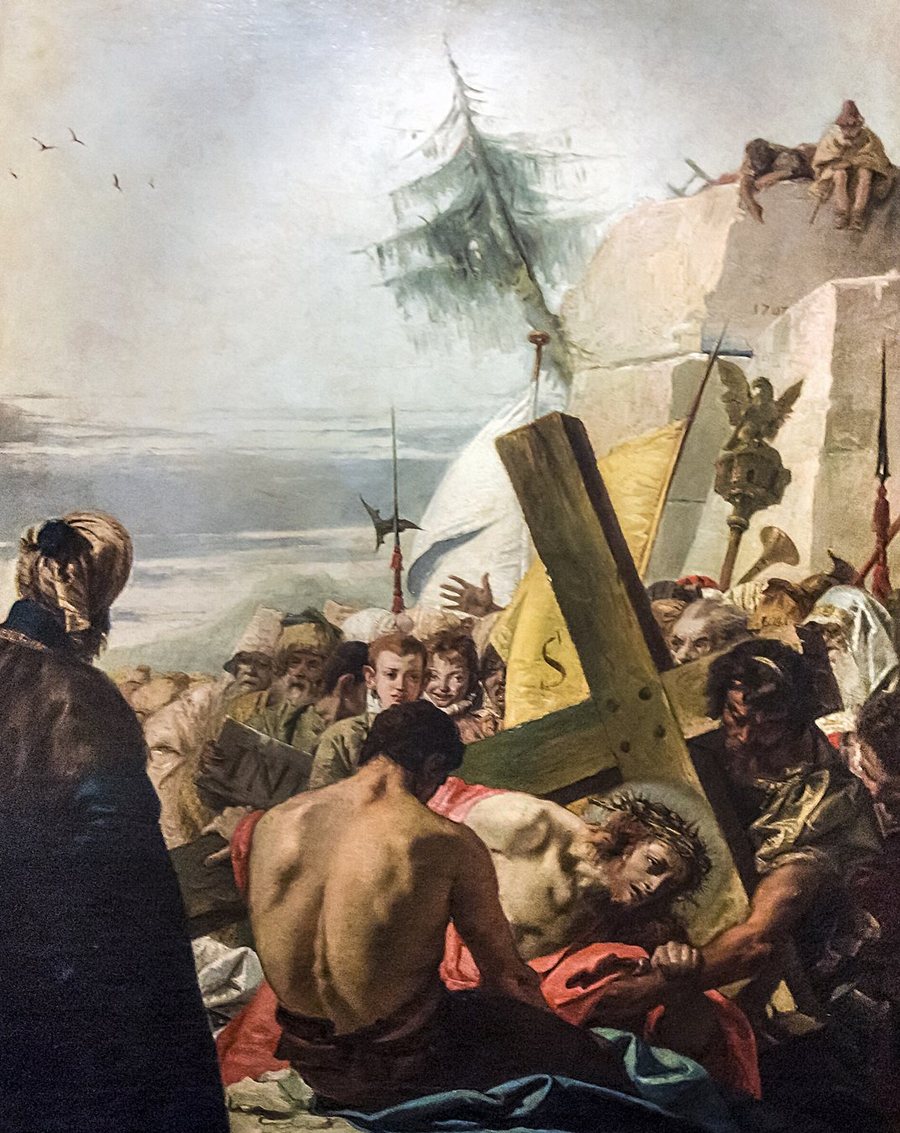
The third fall is the lowest: Jesus lies almost flat beneath the cross, his crowned head on the ground. In the crowd behind him two boys grin at the sight, a man holds up the board with the charge against him, and on top of the rock of Calvary a few onlookers sit and watch.
V. We adore Thee, O Christ, and we bless Thee.
R. Because by Thy holy Cross Thou hast redeemed the world.Consider the third fall of Jesus Christ. His weakness was extreme, and the cruelty of His executioners excessive, who tried to hasten His steps when He had scarcely strength to move.
Ah, my outraged Jesus, by the merits of the weakness Thou didst suffer in going to Calvary, give me strength sufficient to conquer all human respect, and all my wicked passions, which have led me to despise Thy friendship. I love Thee, Jesus my love, with my whole heart; I repent of having offended Thee. Never permit me to offend Thee again. Grant that I may love Thee always; and then do with me what Thou wilt.
Our Father, Hail Mary, Glory Be.
Tenth Station: Jesus Is Stripped of His Garments
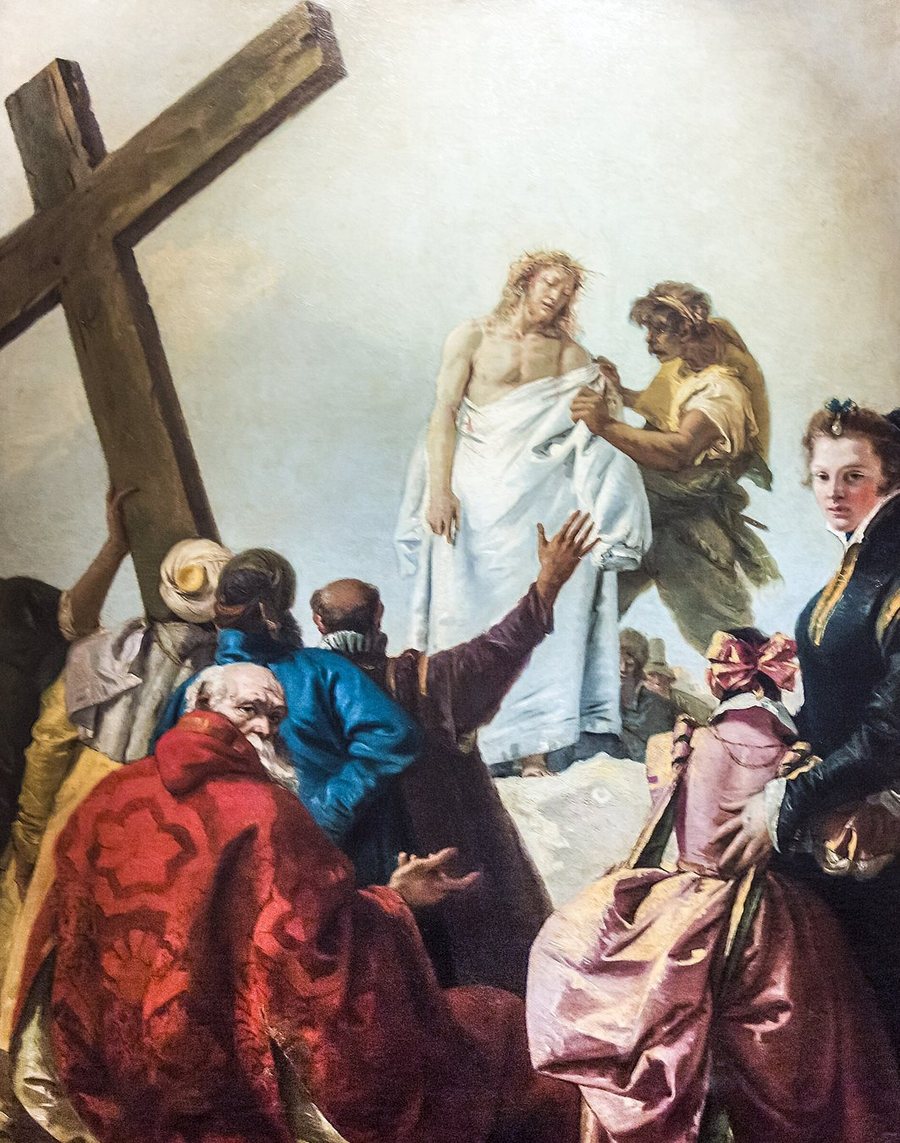
On the summit of Calvary an executioner pulls the garment from Jesus, who stands pale and silent in white. At the foot of the hill Tiepolo has gathered Venetians of his own day: an old man in red damask, a girl in pink silk with a ribbon in her hair, and a lady in a dark gown who turns round to look straight at us.
V. We adore Thee, O Christ, and we bless Thee.
R. Because by Thy holy Cross Thou hast redeemed the world.Consider the violence with which the executioners stripped Jesus. His inner garments adhered to His torn flesh, and they dragged them off so roughly that the skin came with them. Compassionate your Saviour thus cruelly treated, and say to Him:
My innocent Jesus, by the merits of the torment Thou hast felt, help me to strip myself of all affection to things of earth, in order that I may place all my love in Thee, who art so worthy of my love. I love Thee, O Jesus, with my whole heart; I repent of having offended Thee. Never permit me to offend Thee again. Grant that I may love Thee always; and then do with me what Thou wilt.
Our Father, Hail Mary, Glory Be.
Eleventh Station: Jesus Is Nailed to the Cross
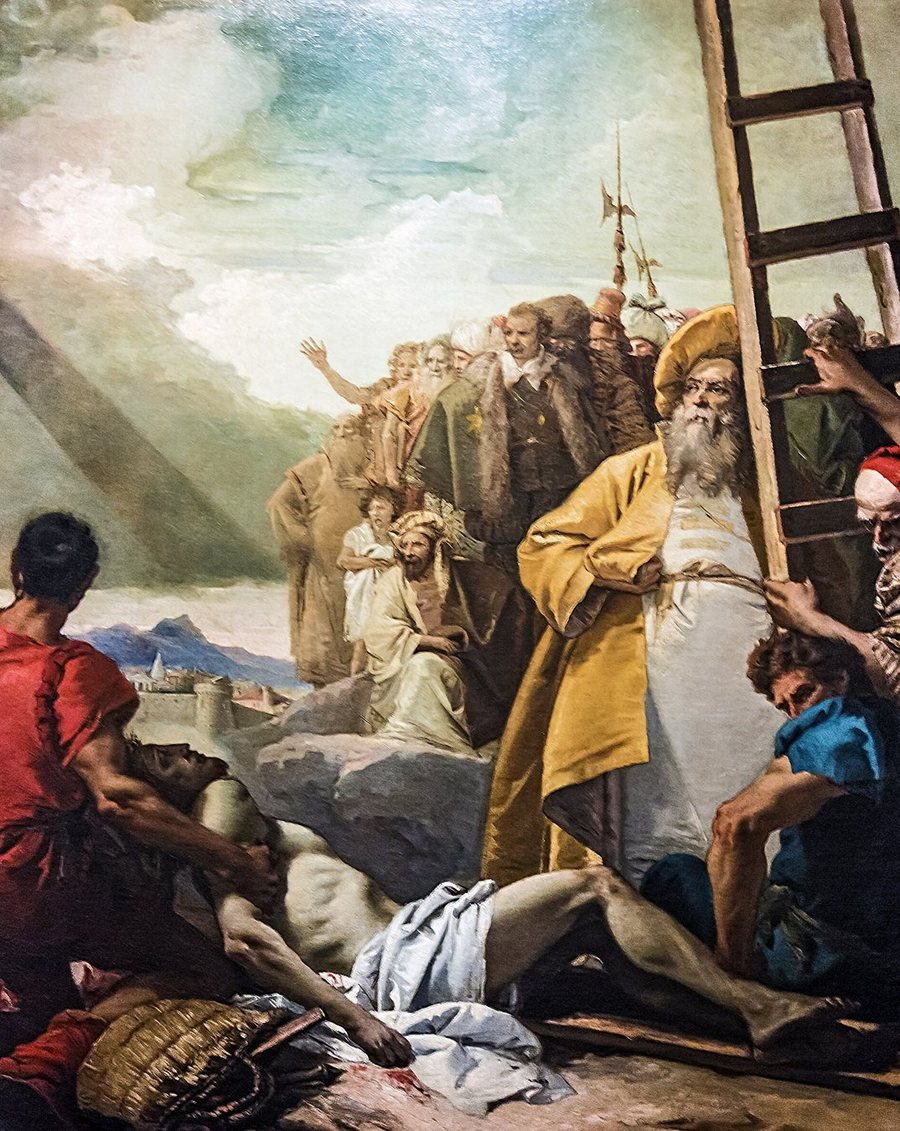
Jesus lies stretched on the cross on the ground while the executioners drive in the nails. An old man in a golden robe leans against the ladder and holds the rope that will raise the cross, the crowd climbs the hill behind him, and a basket of tools waits in the foreground.
V. We adore Thee, O Christ, and we bless Thee.
R. Because by Thy holy Cross Thou hast redeemed the world.Consider how Jesus, after being thrown on the Cross, extended His hands, and offered to His Eternal Father the sacrifice of His life for our salvation. These barbarians fastened Him with nails, and then, raising the Cross, allowed Him to die with anguish on this infamous gibbet.
My Jesus! loaded with contempt, nail my heart to Thy feet, that it may ever remain there, to love Thee, and never quit Thee again. I love Thee more than myself; I repent of having offended Thee. Never permit me to offend Thee again. Grant that I may love Thee always; and then do with me what Thou wilt.
Our Father, Hail Mary, Glory Be.
Twelfth Station: Jesus Dies on the Cross
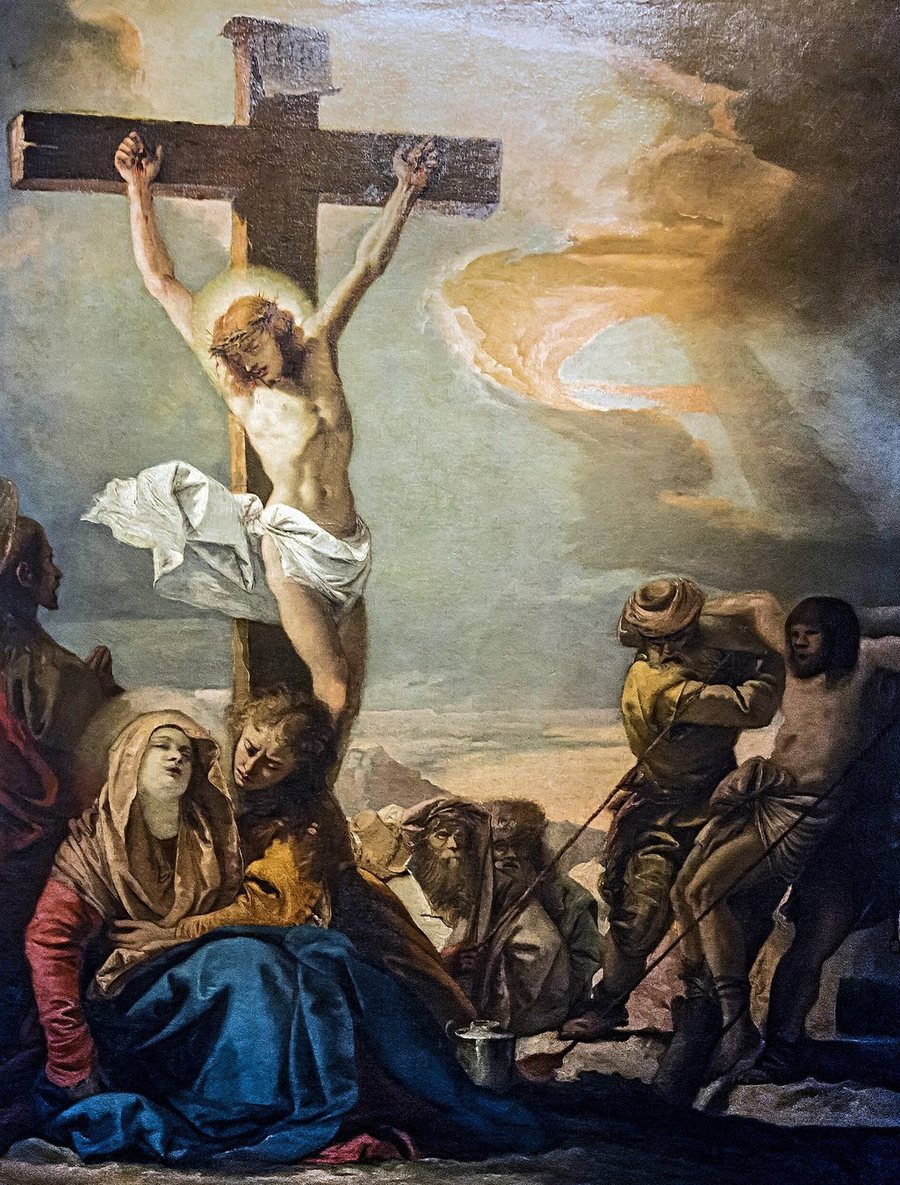
The sky has darkened and a strange orange light breaks through the clouds as Jesus dies, his loincloth lifted by the wind. At the foot of the cross Mary sinks back, her eyes raised to her son, held up by those beside her, while at the right two men are still hauling on their ropes.
V. We adore Thee, O Christ, and we bless Thee.
R. Because by Thy holy Cross Thou hast redeemed the world.Consider how thy Jesus, after three hours’ Agony on the Cross, consumed at length with anguish, abandons Himself to the weight of His body, bows His head and dies.
O my dying Jesus, I kiss devoutly the Cross on which Thou didst die for love of me. I have merited by my sins to die a miserable death, but Thy death is my hope. Ah, by the merits of Thy death, give me grace to die, embracing Thy feet, and burning with love to Thee. I commit my soul into Thy hands. I love Thee with my whole heart; I repent of ever having offended Thee. Never permit me to offend Thee again. Grant that I may love Thee always; and then do with me what Thou wilt.
Our Father, Hail Mary, Glory Be.
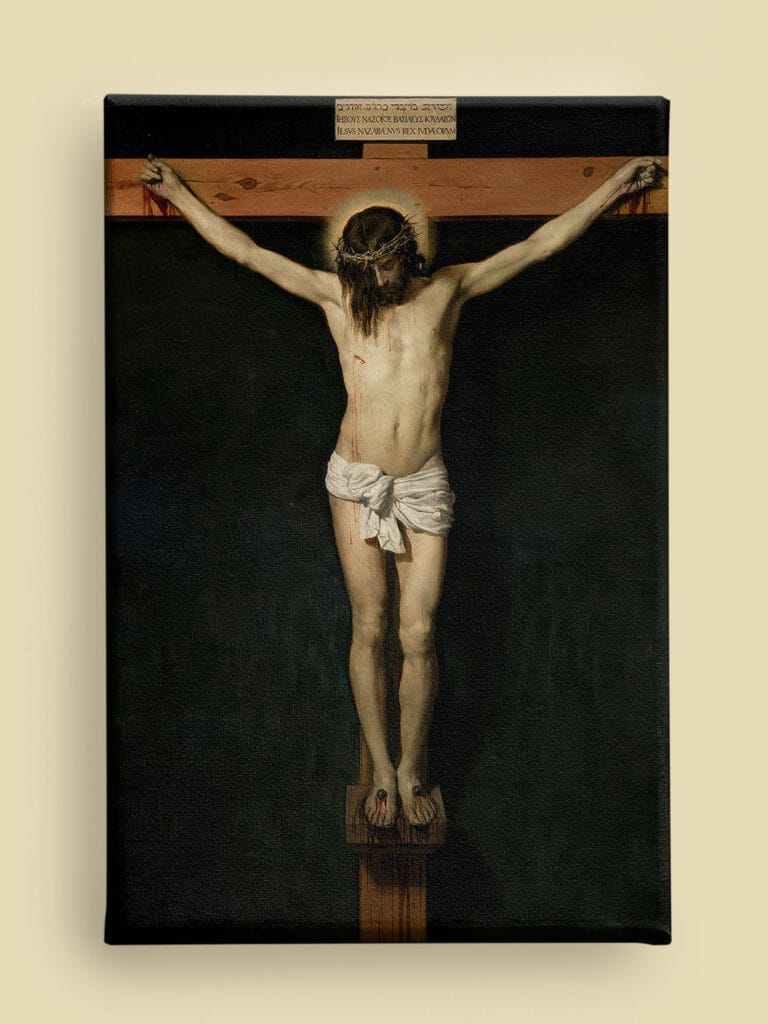
For more paintings of this station, from Giotto to Dalí, see our 13 famous Crucifixion paintings.
Thirteenth Station: Jesus Is Taken Down from the Cross
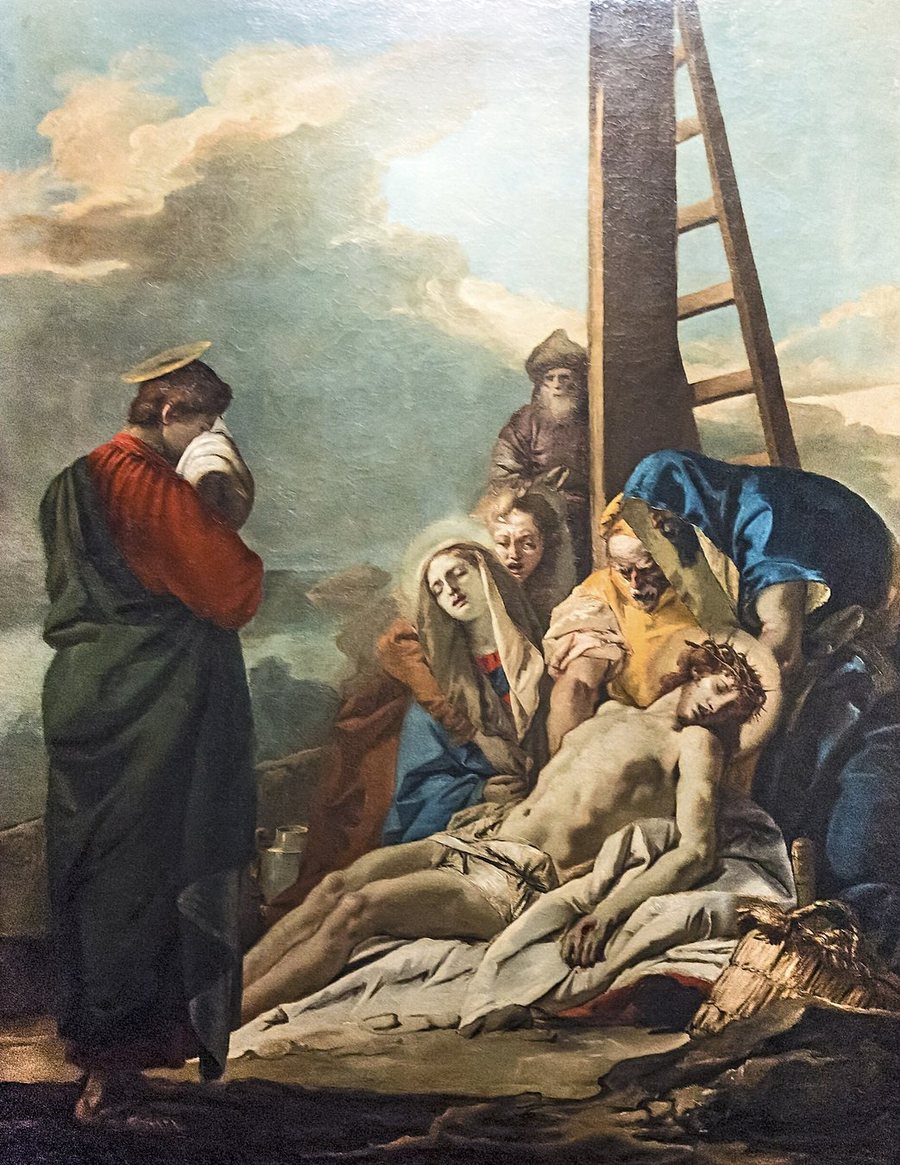
The body of Jesus has been laid across his mother’s lap, and two old men, Joseph of Arimathea and Nicodemus, bend over him. Mary’s eyes are half closed. At the left Saint John stands alone, his halo glowing, pressing a white cloth to his face, and the ladder still leans against the empty cross.
V. We adore Thee, O Christ, and we bless Thee.
R. Because by Thy holy Cross Thou hast redeemed the world.Consider how, after the death of our Lord, two of His disciples, Joseph and Nicodemus, took Him down from the Cross, and placed Him in the arms of His afflicted Mother, who received Him with unutterable tenderness, and pressed Him to her bosom.
O Mother of sorrow, for the love of this Son, accept me for thy servant, and pray to Him for me. And Thou, my Redeemer, since Thou hast died for me, permit me to love Thee; for I wish but Thee, and nothing more. I love Thee, my Jesus, and I repent of ever having offended Thee. Never permit me to offend Thee again. Grant that I may love Thee always; and then do with me what Thou wilt.
Our Father, Hail Mary, Glory Be.
The descent from the cross inspired one of the masterpieces of Flemish painting: Rogier van der Weyden’s Descent from the Cross.
Fourteenth Station: Jesus Is Laid in the Tomb
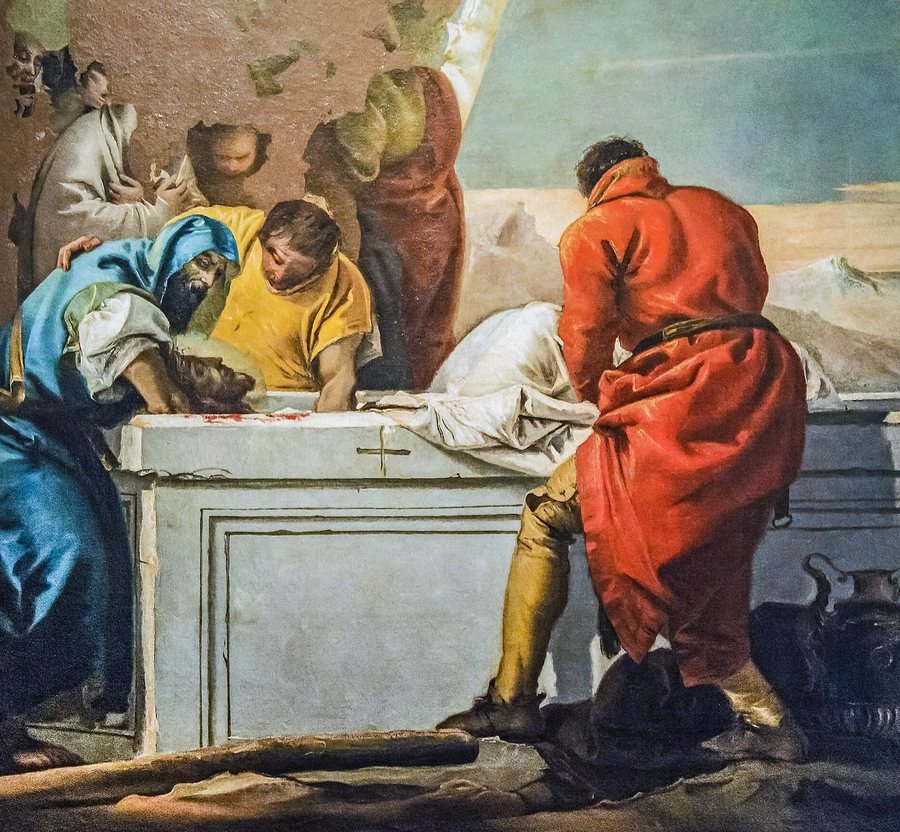
The last station is a plain stone tomb marked with a cross. A bearded man in a blue hood and a young man in yellow lower the head of Jesus over its edge, and a man in a red coat, seen from behind, bends to the shroud at the other end. Our photograph leaves out the top of the canvas, where the paint of the rock vault has flaked away.
V. We adore Thee, O Christ, and we bless Thee.
R. Because by Thy holy Cross Thou hast redeemed the world.Consider how the disciples carried the body of Jesus to bury it, accompanied by His holy Mother, who arranged it in the sepulchre with her own hands. They then closed the tomb, and all withdrew.
Ah, my buried Jesus, I kiss the stone that encloses Thee. But Thou didst rise again the third day. I beseech Thee by Thy Resurrection, make me rise glorious with Thee at the last day, to be always united with Thee in heaven, to praise Thee and love Thee for ever. I love Thee, and I repent of ever having offended Thee. Never permit me to offend Thee again. Grant that I may love Thee; and then do with me what Thou wilt.
Our Father, Hail Mary, Glory Be.
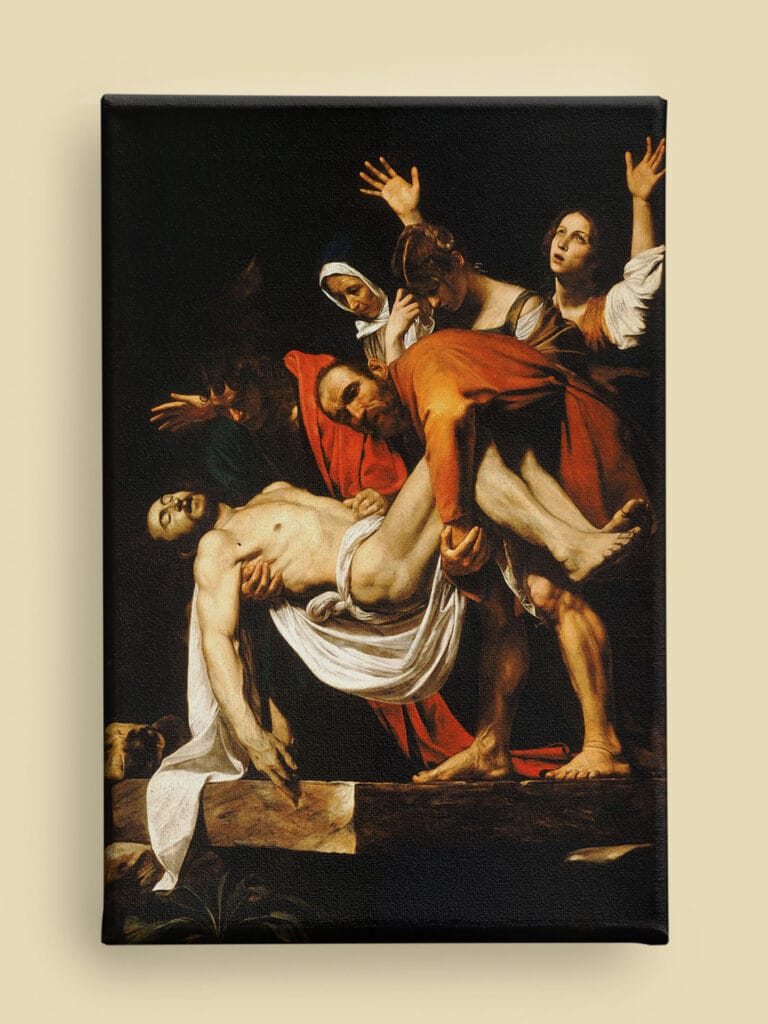
Caravaggio painted the same moment with the whole weight of the body: see Caravaggio’s Entombment of Christ.
After the Fourteenth Station
After the fourteenth station, say the Our Father, the Hail Mary and the Glory Be five times in honor of the Passion of Jesus Christ.
✦ Free Christian & Catholic Printables
Love this one? Find it, and our complete collection of illuminated prayer cards, novenas and Scripture printables, ready to print, free, in one place.
Tiepolo’s Way of the Cross in San Polo, Venice
Giandomenico Tiepolo (1727-1804) was the eldest son and assistant of the great Venetian painter Giambattista Tiepolo. The fourteen stations of the Oratory of the Crucifix, in the church of San Polo, were his first large work of his own, painted between 1747 and 1749, and they still hang there today.
He did not paint a solemn procession but a crowded street. Roman soldiers with halberds and banners, men in turbans and long Oriental robes, grinning boys, dogs, and in the tenth station a group of Venetians in the silks of 1749, watching Christ stripped of his garments as if they had just stepped off the campo outside. In the middle of all this noise, Jesus is always the quietest figure in the picture.
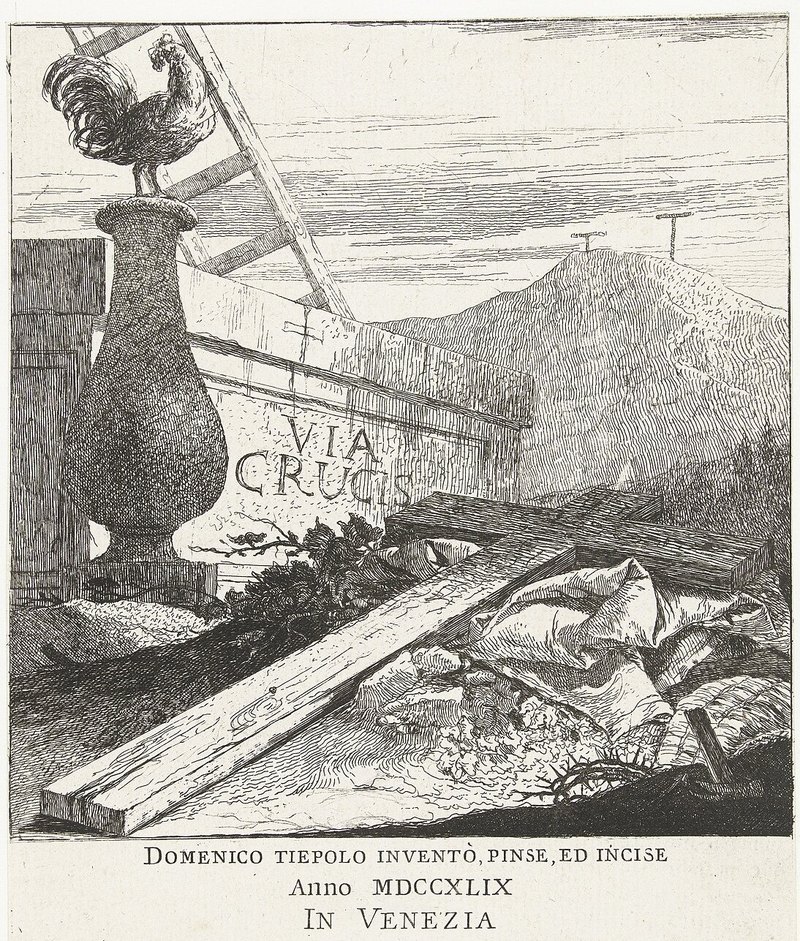
In 1749 he also etched the whole series in a set of prints titled Via Crucis, which carried his stations far beyond Venice. The title plate above, Domenico Tiepolo inventò, pinse, ed incise (Domenico Tiepolo designed, painted and engraved), belongs to the Rijksmuseum, Amsterdam.
The photographs of the fourteen paintings on this page and in the booklet are by Didier Descouens, published on Wikimedia Commons under the CC BY-SA 4.0 license. The top of the fourteenth has been cropped, where the paint has flaked away.
The Scriptural Way of the Cross
Pope John Paul II prayed this version on Good Friday 1991 at the Colosseum in Rome. It keeps the same road, but every station is taken from the Gospels, beginning in the garden of Gethsemane:
- Jesus in the Garden of Gethsemane
- Jesus, betrayed by Judas, is arrested
- Jesus is condemned by the Sanhedrin
- Jesus is denied by Peter
- Jesus is judged by Pilate
- Jesus is scourged and crowned with thorns
- Jesus takes up his cross
- Jesus is helped by Simon of Cyrene to carry his cross
- Jesus meets the women of Jerusalem
- Jesus is crucified
- Jesus promises his kingdom to the good thief
- Jesus speaks to his mother and the disciple
- Jesus dies on the cross
- Jesus is placed in the tomb
Both forms are approved, and both may be prayed in Lent. To keep the whole season with a painting each day, see our Lenten calendar of forty paintings.
Conclusion
The Way of the Cross asks for little: half an hour, fourteen halts, a few words at each. Tiepolo understood what it is for. He filled every station with the noise of a city, soldiers and merchants, children and dogs, and kept Jesus quiet at the centre of it all, so that whoever prays before these paintings learns to find him in a crowd.
Print the booklet and take it to church on a Friday of Lent, or pray it at home on Good Friday: the road is the same, and so are the prayers Catholics have said along it for nearly three centuries. And on Good Friday, after the last station, you can begin the Divine Mercy Novena.
Where These Paintings Hang
| Painting | Artist | Date | Medium | Location |
|---|---|---|---|---|
| Station I: Jesus Is Condemned to Death | Giandomenico Tiepolo | 1747 to 1749 | Oil on canvas | Oratory of the Crucifix, church of San Polo, Venice |
| Station II: Jesus Takes Up His Cross | Giandomenico Tiepolo | 1747 to 1749 | Oil on canvas | Oratory of the Crucifix, church of San Polo, Venice |
| Station III: Jesus Falls the First Time | Giandomenico Tiepolo | 1747 to 1749 | Oil on canvas | Oratory of the Crucifix, church of San Polo, Venice |
| Station IV: Jesus Meets His Mother | Giandomenico Tiepolo | 1747 to 1749 | Oil on canvas | Oratory of the Crucifix, church of San Polo, Venice |
| Station V: Simon of Cyrene Helps Jesus Carry the Cross | Giandomenico Tiepolo | 1747 to 1749 | Oil on canvas | Oratory of the Crucifix, church of San Polo, Venice |
| Station VI: Veronica Wipes the Face of Jesus | Giandomenico Tiepolo | 1747 to 1749 | Oil on canvas | Oratory of the Crucifix, church of San Polo, Venice |
| Station VII: Jesus Falls the Second Time | Giandomenico Tiepolo | 1747 to 1749 | Oil on canvas | Oratory of the Crucifix, church of San Polo, Venice |
| Station VIII: Jesus Meets the Women of Jerusalem | Giandomenico Tiepolo | 1747 to 1749 | Oil on canvas | Oratory of the Crucifix, church of San Polo, Venice |
| Station IX: Jesus Falls the Third Time | Giandomenico Tiepolo | 1747 to 1749 | Oil on canvas | Oratory of the Crucifix, church of San Polo, Venice |
| Station X: Jesus Is Stripped of His Garments | Giandomenico Tiepolo | 1747 to 1749 | Oil on canvas | Oratory of the Crucifix, church of San Polo, Venice |
| Station XI: Jesus Is Nailed to the Cross | Giandomenico Tiepolo | 1747 to 1749 | Oil on canvas | Oratory of the Crucifix, church of San Polo, Venice |
| Station XII: Jesus Dies on the Cross | Giandomenico Tiepolo | 1747 to 1749 | Oil on canvas | Oratory of the Crucifix, church of San Polo, Venice |
| Station XIII: Jesus Is Taken Down from the Cross | Giandomenico Tiepolo | 1747 to 1749 | Oil on canvas | Oratory of the Crucifix, church of San Polo, Venice |
| Station XIV: Jesus Is Laid in the Tomb | Giandomenico Tiepolo | 1747 to 1749 | Oil on canvas | Oratory of the Crucifix, church of San Polo, Venice |
| Ecce Homo | Antonio Ciseri | 1871 to 1891 | Oil on canvas | Gallery of Modern Art, Palazzo Pitti, Florence |
| Christ Carrying the Cross | El Greco | About 1577 to 1587 | Oil on canvas | Metropolitan Museum of Art, New York |
| Christ Crucified | Diego Velázquez | About 1632 | Oil on canvas | Museo del Prado, Madrid |
| The Entombment of Christ | Caravaggio | 1603 to 1604 | Oil on canvas | Vatican Pinacoteca, Vatican City |
| Via Crucis, title plate | Giandomenico Tiepolo | 1749 | Etching | Rijksmuseum, Amsterdam |
Frequently Asked Questions
What are the Stations of the Cross?
The Stations of the Cross are a Catholic devotion that follows Jesus on the day of his death, from his condemnation by Pilate to his burial, in fourteen stages called stations. At each one the faithful stop, meditate on that moment of the Passion and pray. In churches the stations are marked by fourteen crosses along the walls, usually with a picture of each scene.
How many Stations of the Cross are there?
There are fourteen traditional Stations of the Cross, fixed by Pope Clement XII in 1731. Some parishes add a fifteenth station, the Resurrection. The Scriptural Way of the Cross introduced by Pope John Paul II in 1991 also has fourteen stations, all taken from the Gospels.
When do Catholics pray the Stations of the Cross?
Most parishes pray the Stations of the Cross on every Friday of Lent and on Good Friday. In 2027 that means from Friday, February 12, to Good Friday, March 26. The devotion may be prayed on any day of the year, in church or at home.
Which Stations of the Cross are not in the Bible?
Five of the fourteen traditional stations come from tradition rather than the Gospels: the three falls of Jesus (the third, seventh and ninth stations), his meeting with his mother (the fourth) and Veronica wiping his face (the sixth). The other nine are described in the Gospels.
Who wrote the Stations of the Cross prayers?
The most widely used prayers are those of Saint Alphonsus Liguori, an eighteenth-century Italian bishop and Doctor of the Church. Each station has a short meditation that begins with the word Consider and a prayer that ends with the words then do with me what Thou wilt. They are given in full on this page.
Is there a printable Stations of the Cross PDF?
Yes. The fourteen stations on this page are also a free booklet of seventeen pages, in US Letter and A4, with one station per page: Tiepolo’s painting, the versicle and response, and the meditation and prayer of Saint Alphonsus Liguori. The download links are at the top of this page.