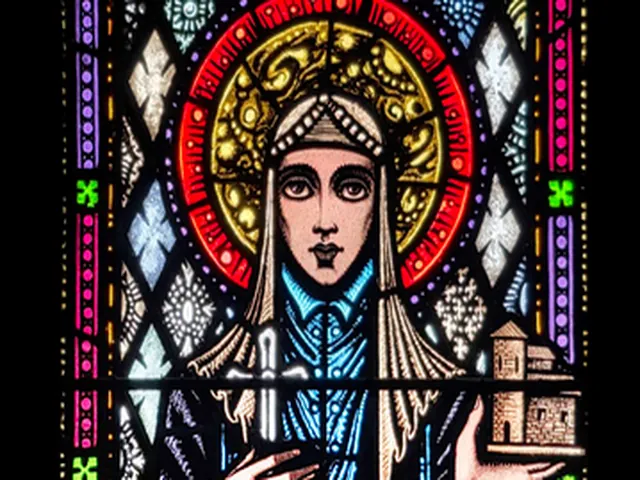
Ignatius of Loyola: The Cannonball That Made a Saint
On 20 May 1521 a cannonball came through the wall of the citadel at Pamplona, passed between Inigo de Loyola’s legs, shattered the right one and tore the left. He was thirty, a courtier in armour who had talked the garrison out of surrendering, and the garrison surrendered anyway within hours of his going down. That is the famous part, and it is the least interesting part. Cannonballs hit a great many people in the sixteenth century and produced no saints at all. What happened to Ignatius of Loyola happened afterwards, in a bed in a Basque farmhouse, and it was an act of noticing so ordinary that he almost missed it.
Loyola, 1491: Not a Pious Household
Inigo Lopez de Loyola was born in 1491 at the family tower house at Azpeitia in Gipuzkoa, the youngest of thirteen children of a Basque family of the minor nobility. He was raised for a court career, went into the household of the treasurer of Castile, and later served the Duke of Najera, viceroy of Navarre. The surviving records are not those of a devout young man. He carried a sword and used it. A judicial document from 1515 accuses him and his brother, a cleric, of nocturnal offences described as premeditated and serious, and he tried to claim clerical privilege to avoid the civil court. He was vain about his appearance and, by his own later account, addicted to gambling, duelling and the reading of chivalric romances.
Pamplona, and the Leg
In 1521 France invaded Navarre. The Spanish defenders of Pamplona were outnumbered and wanted terms. Ignatius argued them out of it, and the bombardment followed. The French, who admired the resistance, treated his wounds and carried him home on a litter across the mountains. At Loyola the bone had been set badly and had to be broken again and reset, without anaesthetic. It knitted with a piece of bone protruding below the knee, which would have ruined the line of the tight hose a courtier wore. He asked the surgeons to saw it off. They did. He then had the leg stretched with weights for weeks to lengthen it. None of it worked, and he limped for the remaining thirty-five years of his life. That detail is worth keeping, because it tells you who was in the bed: not a man on the edge of conversion but a man who would have his leg sawn for the sake of a boot.
The Wrong Books
Convalescing, he asked for romances of chivalry. The house did not have any. What it had was Ludolph of Saxony’s Life of Christ and a Spanish Flos sanctorum, a collection of saints’ lives. He read them because there was nothing else. Then he noticed something. When he daydreamed about knightly exploits and a particular noble lady, the daydreams were delightful while they lasted, and afterwards he felt dry and discontented. When he daydreamed about doing what Francis and Dominic had done, walking to Jerusalem, living on alms, the daydreams were also delightful, and afterwards he felt content and strong. Same pleasure during. Different residue after. That observation is the seed of everything he ever wrote. It became the rules for the discernment of spirits in the Spiritual Exercises, and through the Exercises it became the working method of the largest religious order in the Catholic Church. It is a psychological observation before it is a theological one, and its originality lies in the suggestion that you can test a desire by its aftertaste rather than by its intensity. The cannonball gets the credit. The credit belongs to a bored convalescent paying attention to his own boredom.
Montserrat, Manresa, and the Year That Nearly Broke Him
In March 1522 he made a night vigil before the Black Madonna at Montserrat, gave his fine clothes to a beggar and left his sword and dagger hanging at the shrine. Then he went down to Manresa intending to stay a few days and stayed almost a year. Manresa was not serene. He let his hair and nails grow, begged, fasted to the point of damaging his health, and fell into a scrupulosity so severe that he could not stop confessing the same sins and came close to throwing himself from a window. He came out of it by deciding, deliberately, to stop confessing the past. Later, sitting by the river Cardoner, he had an experience of understanding he never managed to describe, and said afterwards that he learned more in that hour than in all the rest of his life together. He began writing down the exercises that had worked on him, which is why the Spiritual Exercises reads like a manual: it is one.
Interrogated Four Times
He walked to Jerusalem in 1523 and was expelled by the Franciscan custodian, who was tired of pilgrims getting themselves killed. Back in Spain he concluded that if he wanted to help people spiritually he would have to study, so at thirty-three he sat down with schoolboys in Barcelona to learn Latin grammar. At Alcala and then Salamanca he attracted followers and the attention of the authorities. He was investigated repeatedly, held in custody twice, and eventually forbidden to speak publicly about the distinction between mortal and venial sin until he had completed four more years of theology. A layman with no degree, giving spiritual direction to women, in the Spain that was hunting the alumbrados, was exactly the profile the Inquisition was built to examine. He never complained about it in his account. He moved to Paris.
Paris, Montmartre, La Storta
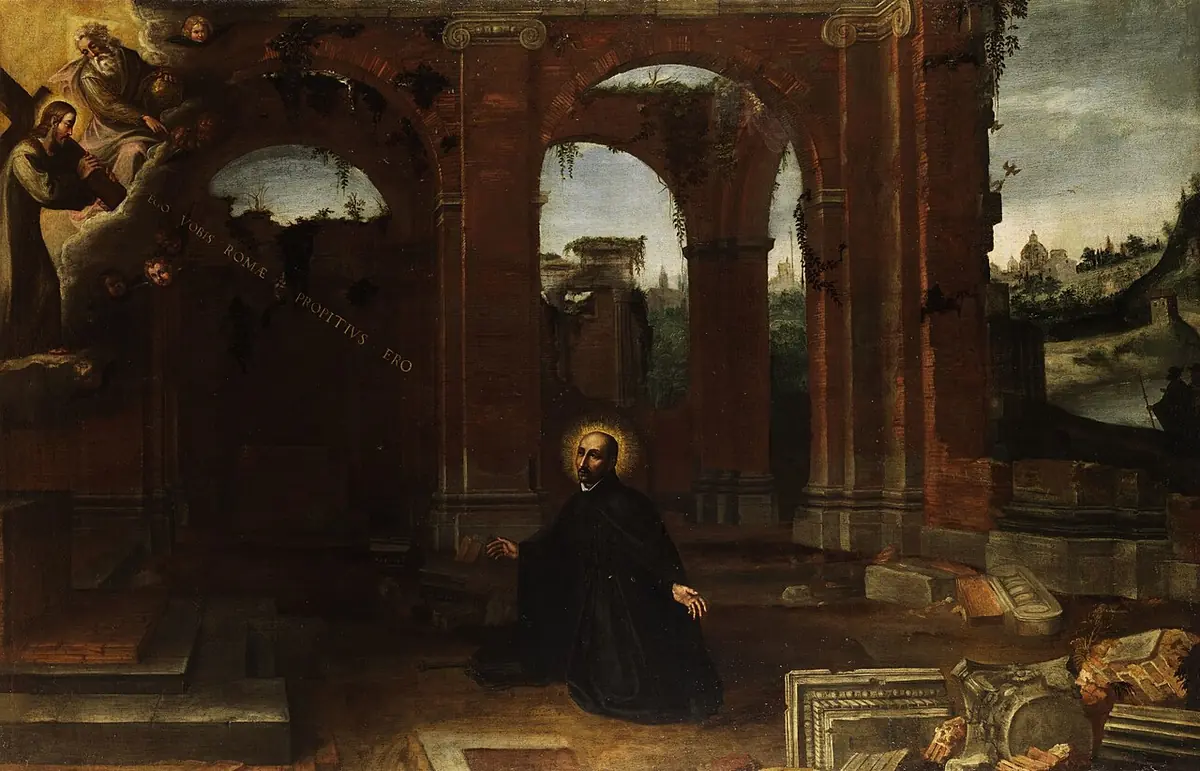
He arrived in Paris in 1528, spent seven years there, and took his Master of Arts in his mid forties. He shared rooms with a Savoyard named Pierre Favre and a Navarrese nobleman named Francisco de Jasso, who resisted him for years and became Francis Xavier. On 15 August 1534, seven of them went up to a chapel on Montmartre and took vows of poverty, chastity and a pilgrimage to Jerusalem, with a clause that if the pilgrimage proved impossible they would go to Rome and place themselves at the pope’s disposal. War closed the Mediterranean, so the clause took effect, and it is that clause rather than the vow that produced the Society of Jesus. Near Rome, at a chapel at La Storta in 1537, Ignatius had a vision in which the Father placed him with the Son, who was carrying his cross, and he understood that the company would be called the Company of Jesus. Paul III approved it on 27 September 1540, with a cap of sixty members, which was removed within four years.
The Desk
Ignatius was elected the first superior general in 1541 after refusing and being made to accept. He then did almost nothing that looks like the life he had imagined at Manresa. He spent the last fifteen years of his life at a desk in Rome. He wrote the Constitutions of the order, revising them continually. He wrote or dictated close to seven thousand letters that survive, more than any other figure of the sixteenth century, on subjects including the price of grain, the health of individual novices and whether a particular Jesuit should be moved out of Portugal. He founded the Roman College, which became the Gregorian University, and the German College. He founded a house in Rome for women leaving prostitution, and when someone objected that they would relapse, he said that if he could prevent a single offence against God for a single night it would be worth every effort.
The Thing He Refused
One decision deserves attention because it cut against everything around him. Spain in his lifetime was building limpieza de sangre statutes, blood purity rules that excluded anyone of Jewish or Moorish descent from offices, guilds and religious orders. Ignatius refused to apply any such rule to the Society, admitted men of converso descent, and appointed several to senior positions, including Diego Lainez, who succeeded him as general and whose Jewish ancestry was well known. Asked about it at table, he said he would take it as a grace from God to be of Jewish blood, because it would make him a kinsman of Christ and of the Virgin. His successors did not hold the line. In 1593 the Society adopted a purity of blood statute of its own, which stayed on the books until the twentieth century. It is worth saying both halves.
The Ceiling That Answered Him
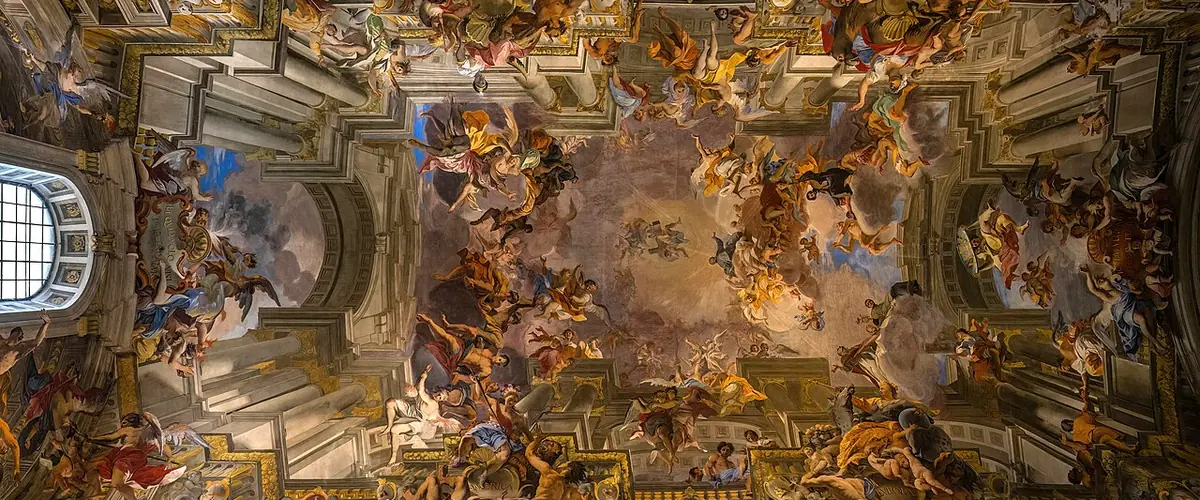
Ignatius died in Rome on 31 July 1556, aged about sixty-five. Nobody expected it that night, so no one arranged the last rites, and the founder of the Society of Jesus died without them, which the Jesuits have never tried to hide. A hundred and forty years later, Andrea Pozzo painted the vault of the church of Sant’Ignazio in Rome. On a flat ceiling he painted architecture that continues the real architecture of the nave, so convincingly that from the marble disc set in the floor the building appears to open and keep rising. Light comes from Christ to Ignatius and from Ignatius out to four groups representing Europe, Asia, Africa and America.
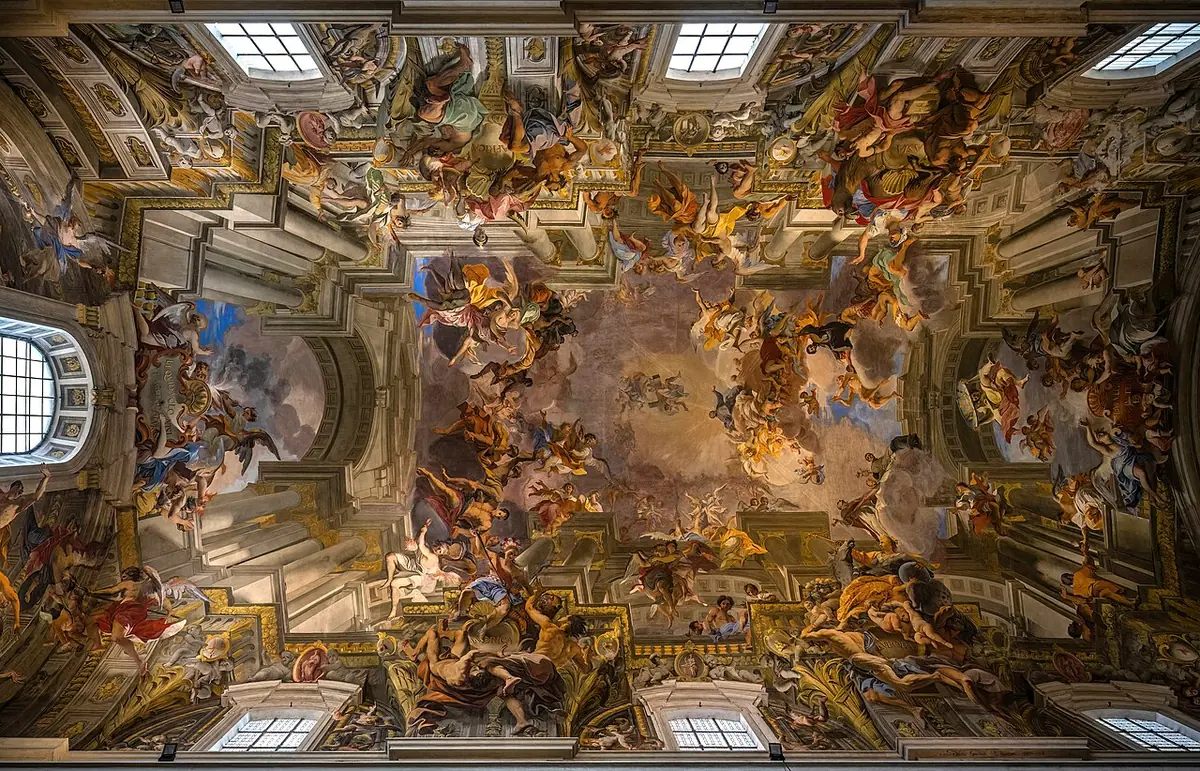
It is the most extravagant argument in paint that the Counter-Reformation ever made, and it is about a man who limped, worked at a desk and thought his own daydreams were worth examining. The Baroque did this to all of them. It did it to Teresa of Avila through Bernini and to Xavier through Rubens. The gap between the documents and the ceilings is the most interesting thing about the whole period.
Ignatius of Loyola Paintings Featured in This Article
| Painting | Artist | Date | Museum |
|---|---|---|---|
| The Triumph of Saint Ignatius | Andrea Pozzo | 1691-1694 | Church of Sant’Ignazio, Rome |
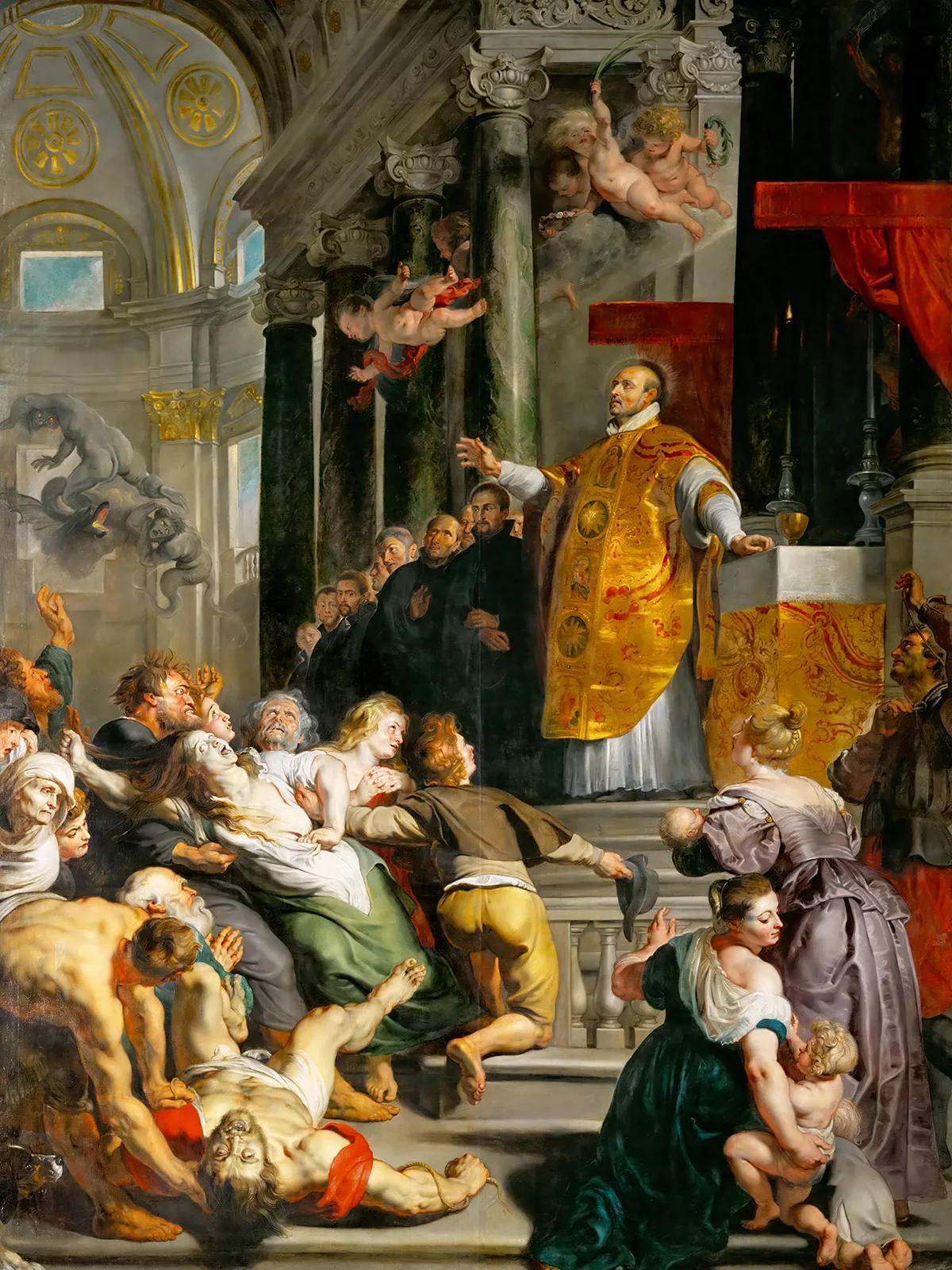
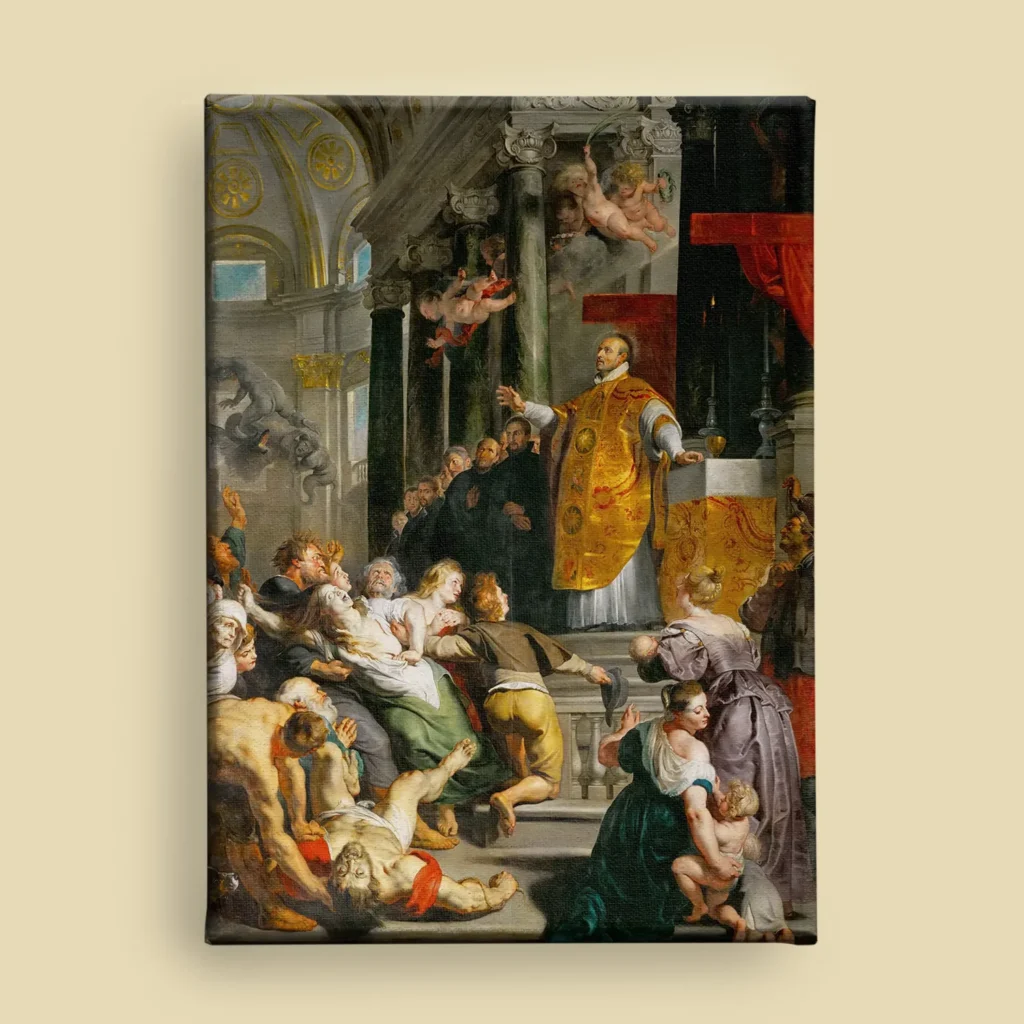
| The Miracle of Saint Ignatius of Loyola | Peter Paul Rubens | 1617-1618 | Kunsthistorisches Museum, Vienna |
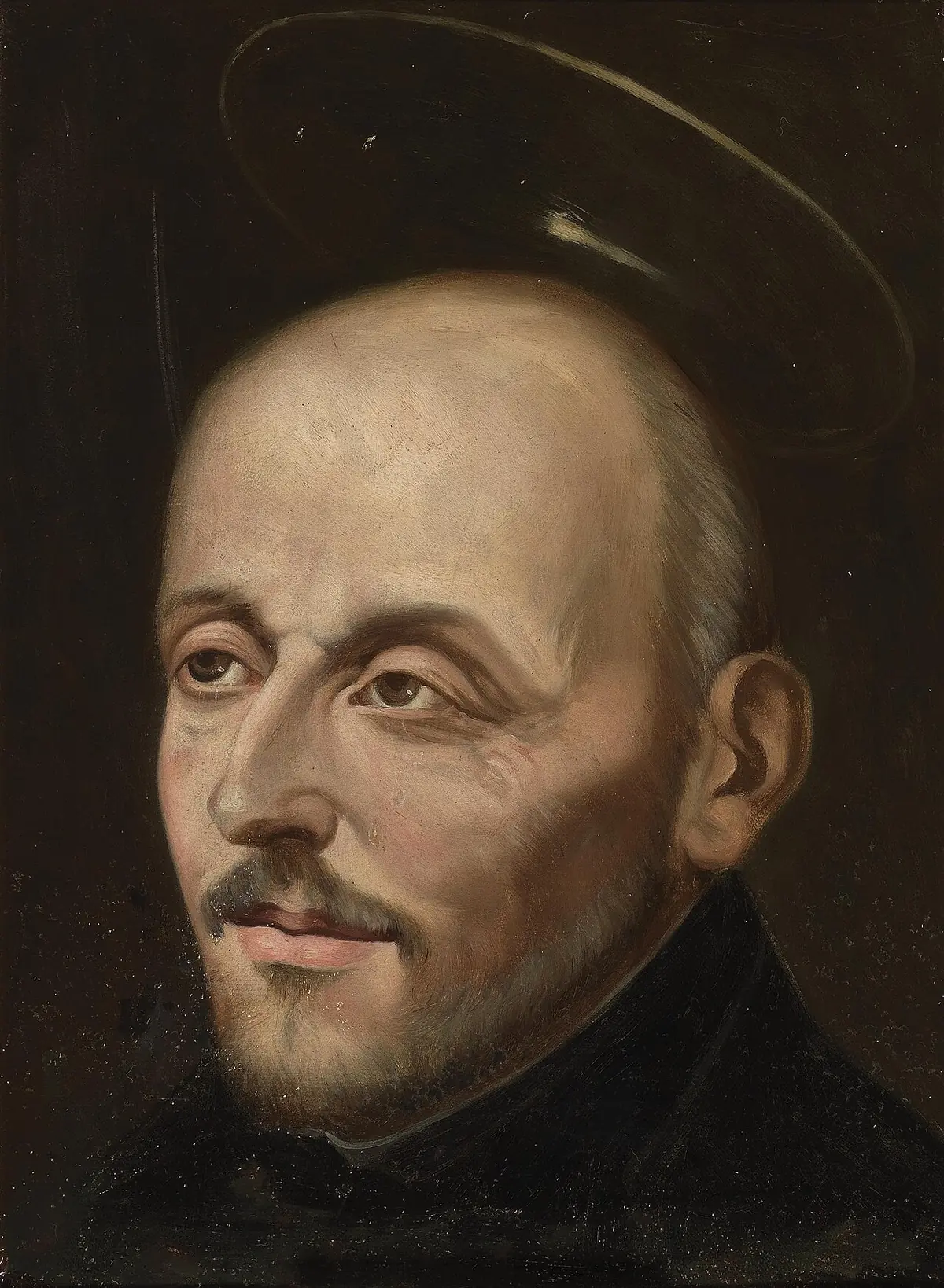
| San Ignacio de Loyola | Anonymous | 19th century | Museo del Prado, Madrid |
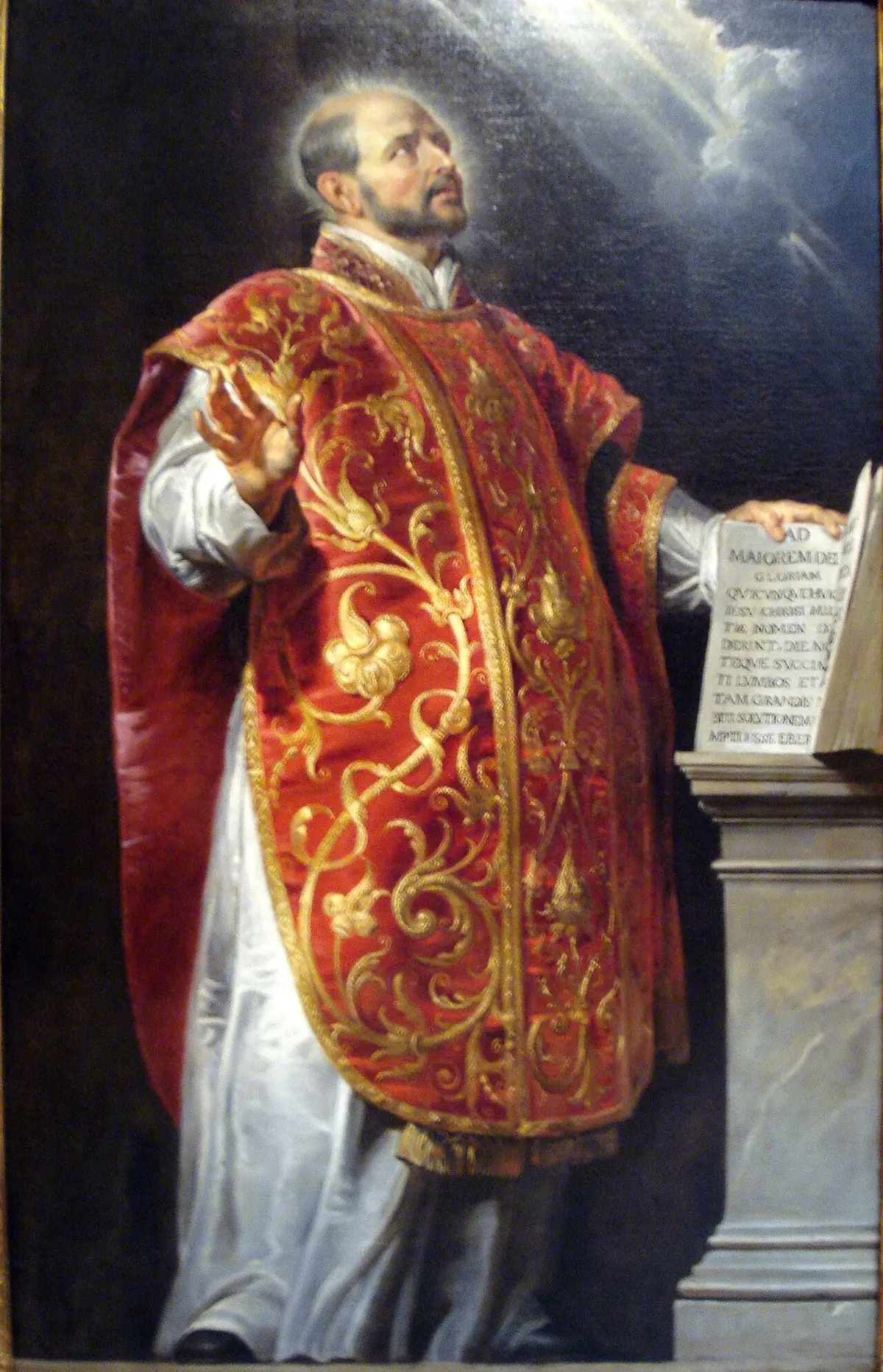
| Saint Ignatius of Loyola | Peter Paul Rubens | 17th century | Location not recorded |
| The Vision of Ignatius of Loyola | Unidentified painter | about 1622 | Location not recorded |
A Method, Not a Miracle
Of the four Spanish saints in this cluster, Ignatius is the one whose legacy is least visible in art and most visible in institutions. Teresa left poems and convents, John of the Cross left a few dozen pages of verse, Xavier left a body in Goa. Ignatius left a procedure. The Spiritual Exercises is not a book you read. It is a set of instructions for a director to give to one person over thirty days, with timings, postures, subjects for each hour and rules for interpreting what happens. The prayer it leans on most is not even his: the Anima Christi, Soul of Christ, sanctify me, which he recommends again and again and which later editions printed on their opening pages. It assumes the person doing it will have experiences the director cannot predict, and it tells the director to get out of the way. That is an unusual thing for a sixteenth century Spaniard to write, and it explains why the Society spread the way it did: what Ignatius exported was not a doctrine but a way of paying attention, which turns out to travel.
Important Facts About Ignatius of Loyola
- Born: 1491, at the tower house of Loyola, Azpeitia, Gipuzkoa, in the Basque Country, as Inigo Lopez de Loyola. Youngest of thirteen.
- Wounded: 20 May 1521 at the siege of Pamplona. He was left with a permanent limp after having a protruding bone sawn off out of vanity.
- Converted: while convalescing, by noticing that daydreams of glory left him empty afterwards and daydreams of holiness left him content.
- Wrote: the Spiritual Exercises, begun at Manresa in 1522, and the Constitutions of the Society. Nearly 7,000 of his letters survive.
- Investigated: repeatedly by church authorities at Alcala and Salamanca, and held in custody twice, before he had any theological qualification.
- Founded: the Society of Jesus, vows taken at Montmartre on 15 August 1534, approved by Paul III on 27 September 1540.
- Died: 31 July 1556 in Rome, aged about 65, unexpectedly and without the last rites. He is buried in the Church of the Gesu.
- Canonised: 12 March 1622, with Francis Xavier and Teresa of Avila.
- Patron of: the Society of Jesus, soldiers, spiritual retreats, the Basque Country and Gipuzkoa.
Frequently Asked Questions
What was Ignatius of Loyola famous for?
For founding the Society of Jesus, the Jesuits, in 1540, and for writing the Spiritual Exercises, a thirty day programme of guided prayer that is still given today. He was its first superior general and ran the order from Rome for fifteen years, founding colleges including the Roman College, which became the Gregorian University. He was a Basque soldier until a cannonball ended that career at thirty.
What happened to Ignatius at Pamplona?
On 20 May 1521, during the French invasion of Navarre, a cannonball struck him in the citadel of Pamplona, shattering his right leg and wounding his left. He had persuaded the garrison not to surrender, and it surrendered anyway once he fell. The French carried him home to Loyola. The leg was set badly, broken and reset without anaesthetic, and he had a protruding piece of bone sawn off because it spoiled the line of a courtier’s hose. He limped for the rest of his life.
What are the Spiritual Exercises?
Not a book to be read but a manual for a director. It sets out a thirty day retreat, with subjects for each period of prayer, physical instructions, and rules for the discernment of spirits, which teach a person to read their own interior movements. Ignatius began drafting it at Manresa in 1522 from what had worked on him. It is normally given one to one, and the director is told repeatedly to stay out of the way and let God deal with the person directly.
What is the famous Ignatian prayer?
The Suscipe, which closes the Contemplation to Attain Love at the end of the Spiritual Exercises. It begins: take, Lord, and receive all my liberty, my memory, my understanding and my entire will, everything I have and possess. You gave it to me, and to you I return it. Give me only your love and your grace, and that is enough for me. The other line usually attributed to him, go forth and set the world on fire, does not appear in his authenticated writings and is a later paraphrase.
Why are the Jesuits controversial?
Historically, because they were effective and close to power. They were confessors to kings, ran the best schools in Europe, and took a fourth vow of obedience to the pope, which made them suspect to national monarchies. Their accommodation of local custom in China and India provoked long disputes inside the Church. Expelled from Portugal in 1759, France in 1764 and Spain in 1767, the order was suppressed outright by Clement XIV in 1773 under Bourbon pressure, and restored only in 1814. The English word Jesuitical, meaning evasive reasoning, dates from that quarrel.
Is Ignatius of Loyola the same as Ignatius of Antioch?
No, and the two are constantly confused in search results. Ignatius of Antioch was a bishop of the early second century who wrote seven letters on his way to be executed in Rome, and who is a primary witness to first century Christian belief. Ignatius of Loyola was a sixteenth century Basque who founded the Jesuits. They are separated by about fourteen hundred years and share nothing but a name.
Did Ignatius of Loyola admit men of Jewish descent to the Jesuits?
Yes, deliberately, against the current of his time. Spain was building blood purity statutes that excluded people of Jewish or Moorish ancestry, and Ignatius refused to apply one to the Society, appointing men of converso descent to senior office, including Diego Lainez, who succeeded him as general. He is reported to have said he would take it as a grace to be of Jewish blood, since it would make him a kinsman of Christ. His successors reversed the policy in 1593.
Can you buy Ignatius of Loyola paintings?
You can buy Ignatius of Loyola paintings at jesuschrist.pictures, in our shop, alongside the wider Baroque and Spanish Golden Age collections. The Jesuits were the most important patrons of Baroque painting, which is why the strongest images of Ignatius come from Rubens, who painted him for the Jesuit church in Antwerp, and from the ceiling painters of Rome. See also the companion articles on Francis Xavier, his roommate in Paris, on Teresa of Avila, canonised the same morning, and on John of the Cross, plus the full Spanish saints guide and our Spanish Baroque selection.