Virgen de Guadalupe: History, Meaning, and Sacred Art
Virgen de Guadalupe, also called Our Lady of Guadalupe, is a title of the Virgin Mary associated with a Marian apparition to Saint Juan Diego in Mexico in 1531.
The image of Mary that appeared on Juan Diego’s tilma became one of the most venerated Catholic icons in the Americas. For many faithful, she is not only a beloved patroness, but also a visible sign of Mary’s closeness to the poor, the humble, and the forgotten. In art history, Guadalupe is equally remarkable: her image has been reproduced, adapted, and honored across centuries, from New Spain to modern devotional painting, from copper panels to printed holy cards, and now to contemporary Christian wall art.
This article explains the 1531 apparition tradition, the symbolism of the sacred image, and how Guadalupe entered the world of painting. Along the way, you will also find a careful selection of museum-held artworks that truly exist, with links to their collections.
It is accompanied by a short podcast exploring the artistic meaning and visual representation of the Virgen de Guadalupe in Christian art.
The Apparitions of 1531 at Tepeyac
According to Catholic tradition, in December 1531 the Virgin Mary appeared several times to an Indigenous man, Saint Juan Diego Cuauhtlatoatzin, on the hill of Tepeyac near present-day Mexico City. She asked that a church be built in her honor. As the story is told, the local bishop hesitated, and Juan Diego requested a sign. Mary instructed him to gather flowers from the hillside. Miraculously, he found roses in winter, placed them in his tilma (a cloak made of cactus fiber), and brought them to the bishop. When he opened the tilma, the roses fell, and an image of the Virgin appeared upon the cloth.

Whether approached as miracle, tradition, or devotional narrative, the impact is historical and measurable: the image became the heart of a vast Marian devotion and an enduring symbol of Catholic identity in the Americas. The tilma image is traditionally said to be housed at the Basilica of Our Lady of Guadalupe in Mexico City.
For art lovers, it is important to note a key distinction. The original is not a conventional painted altarpiece with a known artist and documented commission. It is a venerated image associated with an apparition tradition. Yet, precisely because of its fame, painters in New Spain created countless copies and elaborations. These works, often on copper or canvas, entered churches, homes, convents, and eventually museums. That is where Guadalupe becomes a central subject of painting history, especially in the eighteenth century, when devotion and artistic production grew side by side.
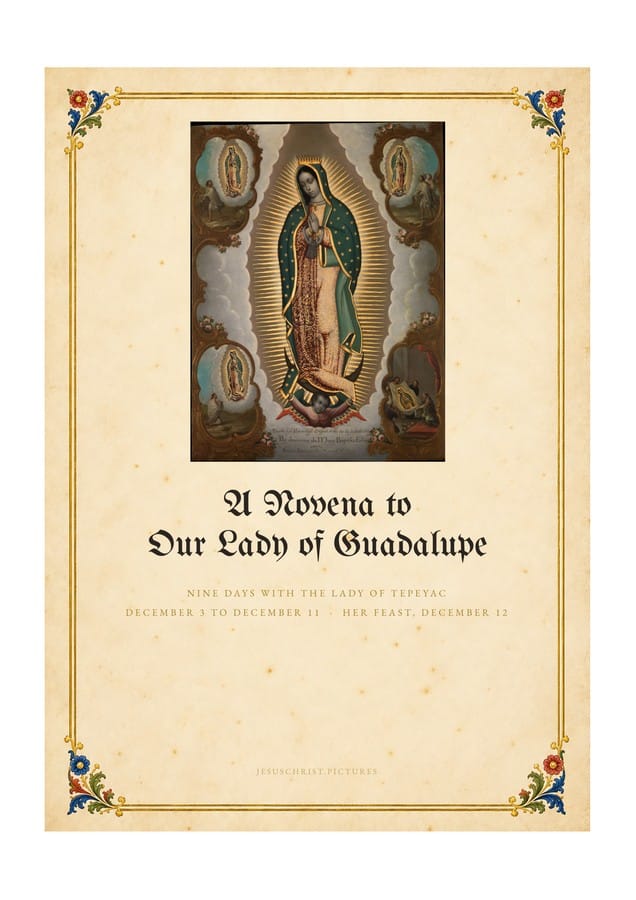
✦ A Novena to Our Lady of Guadalupe, Free Printable
Her feast is December 12, and the novena is prayed over the nine days before it, from December 3. It is a booklet you can print at home: eleven illuminated pages that follow the story told above, one painting and one short reading for each day, the prayer of the novena, and a line on every page to write your own intention.
Get it in the free printables library
PDF, eleven pages, US Letter or A4, with the prayer cards and the psalms. Or pray the nine days of the novena online.
Reading the Image: Symbolism and Catholic Meaning
- The star-covered mantle representing the heavens
- The crescent moon under her feet
- The angel supporting the Virgin
- The radiant sunburst surrounding Mary
- The black ribbon symbolizing motherhood
The sacred image of Our Lady of Guadalupe has a visual language that is both theological and tender. Mary stands in prayer, her hands folded, her gaze lowered, her posture calm and maternal. She is shown as a young woman, clothed in a rose-colored tunic and wrapped in a blue-green mantle sprinkled with stars. A radiant burst of light surrounds her, and she stands upon a crescent moon supported by an angel.

In Catholic interpretation, these elements speak with clarity. The sunburst suggests heavenly glory and divine favor. The stars on the mantle evoke Mary as Queen of Heaven, while the moon under her feet recalls Marian imagery from the Book of Revelation, long present in Christian art. The angel beneath her can be read as a sign that this is a heavenly visitation, a messenger-like support that places her between earth and the divine.
Other details often cited in devotional readings include the dark ribbon at her waist, frequently interpreted as a sign of pregnancy in certain cultural contexts, supporting the idea of Mary bearing Christ. The lowered eyes and folded hands emphasize humility and intercession. Together, these features create a Marian image that is not distant or severe, but compassionate and attentive.
For painters, the composition is unusually stable and recognizable. That stability made it ideal for reproduction. Artists could add narrative scenes around the central figure, frame her in ornate borders, place her within landscapes, or surround her with angels and saints, while keeping the core image intact. This balance between strict recognizability and creative variation is one reason Guadalupe became one of the most reproduced sacred images in Christian art.
Virgen de Guadalupe in Painting: From Devotion to Museum Collections
In the eighteenth century, New Spain saw a flourishing of religious painting, often created for churches, confraternities, and private devotion. Within this world, Guadalupe was not a secondary theme. She became a central icon, both spiritually and socially, shaping local Catholic identity. Painters produced works that range from straightforward copies to richly narrative compositions that depict the four apparitions and the unveiling of the miraculous image.
One of the most fascinating formats is the Guadalupe image surrounded by four small scenes, each illustrating an episode of the apparition tradition. This structure is not simply decorative. It is almost catechetical: a painted “story within the image” that teaches the faithful what the central icon means and how it entered history. Museums preserve several strong examples of this type, including a work by Nicolás Enríquez dated 1773 in the Metropolitan Museum of Art.

Other museums preserve Guadalupe paintings on copper, a medium prized for its smooth surface and jewel-like finish. The Denver Art Museum, for instance, holds a signed copper painting by Nicolás Enríquez made around 1740, combining the central image with narrative scenes and an emphasis on luminous detail.

We also find important examples linked to Miguel Cabrera, one of the most celebrated painters in New Spain. Museums attribute or connect Guadalupe images to Cabrera’s workshop or circle, reflecting both his artistic authority and the strong demand for Guadalupe paintings. The National Museum of Mexican Art presents a work attributed to or from the school of Miguel Cabrera, dated approximately 1740-1768.
Seen together, these museum-held works show how devotion shaped style. Guadalupe painting can be intimate or ceremonial, simple or ornate, but it nearly always seeks the same goal: to make Mary’s presence visible, prayerful, and protective within daily life.
Modern Virgen de Guadalupe llustrations: Folk Art Warmth and Medieval Gold
Even in the twentieth century, the image of the Virgen de Guadalupe continued to inspire artists far beyond Mexico. The Spanish painter Salvador Dalí created his own visionary interpretation in the late 1950s. In Dalí’s painting, the traditional Marian figure is transformed into a cosmic vision filled with floating forms, radiant spheres, and mystical symbolism. While far removed from the original tilma image, the work shows how the Guadalupe icon had become a universal symbol within Christian imagination.

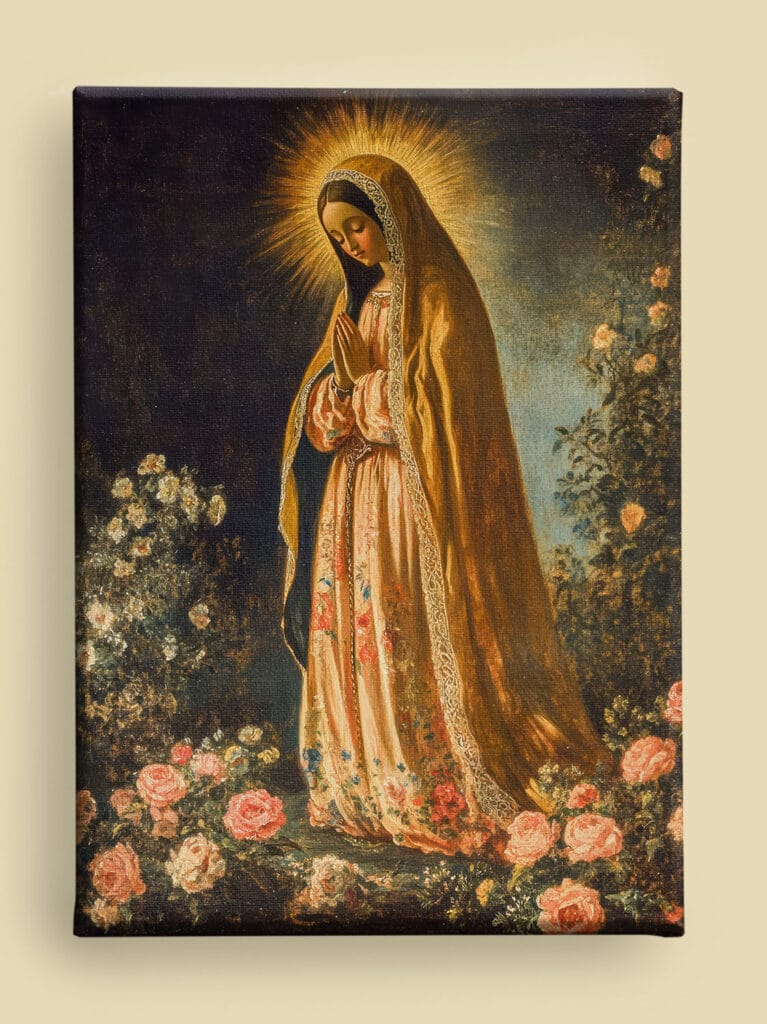
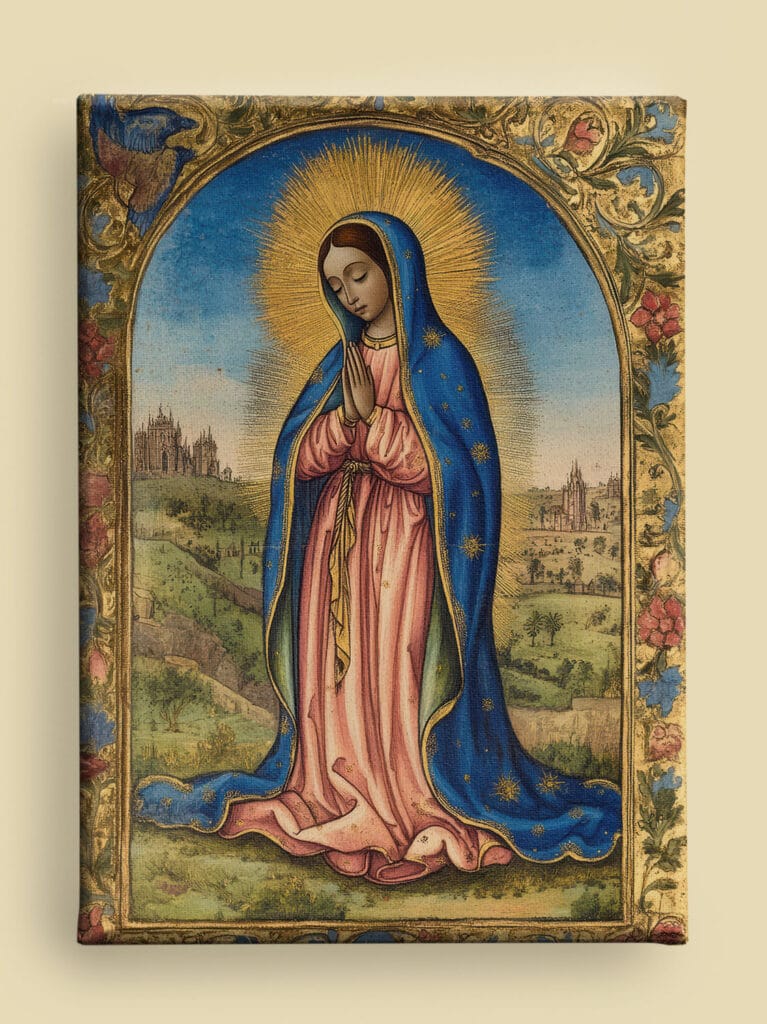
In contemporary Catholic homes, Guadalupe is often displayed not as a distant museum image, but as a lived devotion. That is why modern styles matter. Some faithful prefer a warm folk-art approach, echoing popular devotion in Mexico with rich earth tones, roses, and a welcoming sense of closeness. Others are drawn to a more historic sacred vocabulary: gilding, manuscript-like borders, and medieval-inspired ornament that recalls the beauty of devotional panels and illuminated prayer books.
On your site, you already have two strong visual directions that fit these needs:


Conclusion
The Virgen de Guadalupe holds a singular place in Catholic life and in the history of sacred images. Her apparition tradition at Tepeyac shaped devotion across the Americas, while her stable, recognizable iconography shaped painting itself, encouraging artists to reproduce the central figure and expand it with narrative scenes, angels, and ornate frames. For Catholic art lovers, Guadalupe is a powerful example of how faith and visual culture can strengthen one another: devotion creates images, images nourish devotion, and both become part of a living heritage that continues today .
Table of Key Guadalupe Artworks Mentioned
| Artwork | Artist | Date | Medium | Museum |
|---|---|---|---|---|
| Virgen de Guadalupe (Virgin of Guadalupe) | (Attrib. to or school of) Miguel Cabrera | ca. 1740-1768 | Painting | National Museum of Mexican Art |
| Virgin of Guadalupe (Virgen de Guadalupe) | Antonio and Manuel de Arellano | 18th century | Painting | LACMA |
| The Virgin of Guadalupe with the Four Apparitions | Nicolás Enríquez | 1773 | Oil on copper | The Metropolitan Museum of Art |
| Virgin of Guadalupe | Nicolás Enríquez | around 1740 | Painted on copper | Denver Art Museum |
| The Virgin of Guadalupe | Salvador Dalí | 1958-1959 | Oil on canvas | Private collection |
FAQ
Is Virgen de Guadalupe the same as the Virgin Mary?
Yes. “Virgen de Guadalupe” is a Marian title used for the Virgin Mary as venerated through the apparition tradition at Tepeyac in Mexico.
Where is the original Guadalupe image kept?
According to Catholic tradition and widely published descriptions, the tilma image is housed at the Basilica of Our Lady of Guadalupe in Mexico City.
Why do many paintings show four small scenes around Guadalupe?
Those scenes usually depict the apparitions to Saint Juan Diego and the unveiling of the image. This narrative framing served a devotional and teaching purpose in New Spain.
Are there museum-held Guadalupe paintings that can be verified?
Yes. Major museums hold documented works, including examples at The Met, LACMA, the Denver Art Museum, and the National Museum of Mexican Art.
Where can I buy a Virgen de Guadalupe painting on canvas?
You can buy a Virgen de Guadalupe painting on canvas at jesuschrist.pictures. Our Virgin Mary canvas collection includes Virgen de Guadalupe paintings available as high-quality canvas prints, ready to hang in your home or sacred space.