Symbolist Jesus Paintings and the Art of Spiritual Mystery
Introduction: The Symbolist Reimagining of Jesus
In the late 19th century, a wave of introspection swept through European art. Emerging from the ashes of Realism and the rise of industrial modernity, Symbolism turned away from the physical world to explore the spiritual, the dreamlike, and the mysterious. Rather than depict visible truths, Symbolist artists sought to express invisible realities, the soul, the divine, the psychological. Within this context, Jesus Christ became more than a historical figure or religious icon: He became a symbol of inner suffering, mystical love, and eternal longing.
While few artists within the Symbolist circle focused extensively on Jesus, the works that do exist are among the most haunting and powerful depictions of His presence in Western art. Instead of bloody realism or idealized serenity, Symbolist Jesus paintings offer metaphysical meditations. These works explore solitude, divine silence, and the mystery of redemption using color, form, and atmosphere to evoke emotion rather than explain theology.
This article uncovers five of the most evocative Symbolist Jesus paintings by artists like Gustave Moreau, Odilon Redon, and Arnold Böcklin. These masters turned their gaze inward, transforming biblical themes into deeply personal visions of spiritual searching. Their Jesus is both familiar and unknowable, earthly and divine, inviting viewers not to worship from afar, but to reflect deeply on suffering, hope, and the eternal.
To explore how these themes evolved across other styles, consider reading our articles on Gothic Jesus paintings and Baroque Jesus paintings.
Jesus in Symbolist Art: Themes and Mysticism
In Symbolist Jesus paintings, the focus shifts away from biblical narrative and towards symbolic presence. These images are not designed to retell the Gospels in a literal way. Instead, they capture the emotional resonance of Christ’s sacrifice, His divine mystery, and the quiet stillness of spiritual contemplation. The emphasis is on mystery, atmosphere, and the internal landscape of the soul.
Rather than dramatic gestures or detailed historical settings, these paintings present Jesus in luminous solitude, sometimes surrounded by gold, flowers, or shadowy landscapes. His gaze is often distant, His gestures meditative. The goal is not to depict an event, but to manifest an experience. Jesus becomes an archetype of suffering, redemption, and divine transcendence.
Symbolist painters often worked in muted palettes or shimmering jewel tones. They infused their canvases with allegorical references, light as grace, the garden as spiritual exile, the cross as cosmic symbol. Their use of space, often shallow or dreamlike, disorients in order to invite inward reflection. Unlike earlier depictions of Jesus that aimed to teach, Symbolist works invite one to feel.
In these paintings, Christ becomes a mirror for personal struggle, an icon for existential yearning. These themes would later influence modern movements like Expressionism and Surrealism. But in the Symbolist age, they offered a radical way of encountering divinity. Not through doctrine, but through artful, intuitive silence.
Key Symbolist Jesus Paintings and Their Interpretations
The following five paintings represent the most powerful and enduring depictions of Jesus Christ within the Symbolist movement. Each artist approached the subject with a distinct voice, using symbolic elements, moody atmosphere, and spiritual introspection to convey a Christ who speaks to the inner life rather than religious convention.
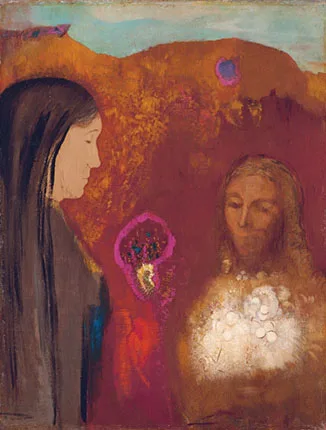
Odilon Redon – Christ and the Samaritan Woman (1890s)
Redon’s work is a luminous and dreamlike interpretation of the New Testament encounter between Jesus and the Samaritan woman at the well. With soft pastel tones and ethereal brushwork, Redon abandons realism in favor of emotional atmosphere. Christ appears radiant yet distant, a figure of quiet mystery and gentle invitation.
The background is abstract and weightless, evoking a mystical realm rather than earthly geography. This is not a literal retelling, but a vision of spiritual communion beyond words. Redon’s Christ does not command; he simply is a symbol of sacred presence and transcendent understanding. The piece is a quiet but potent example of how Symbolism transformed biblical scenes into emotional and metaphysical reflections.
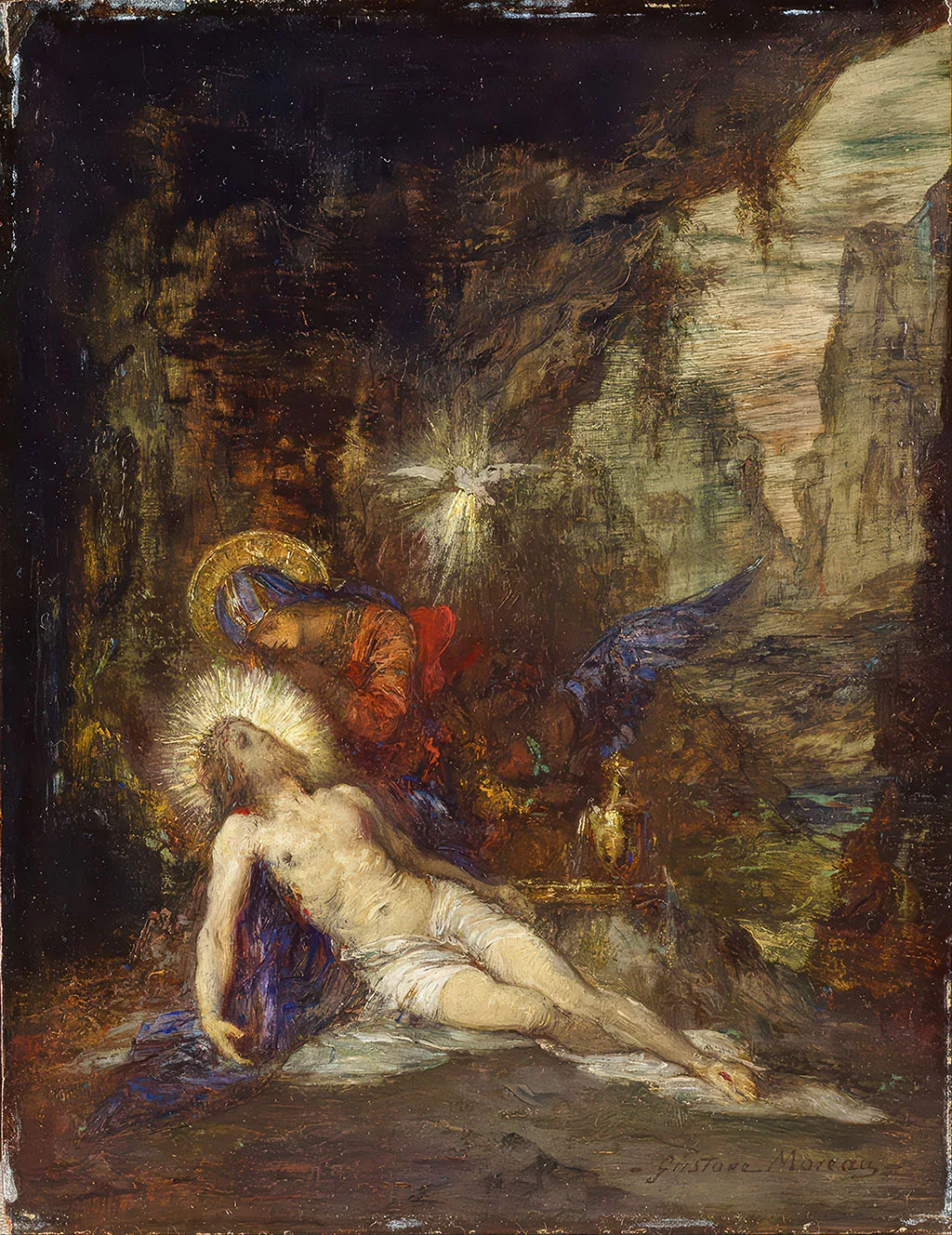
Gustave Moreau – Pietà (c. 1876)
Moreau’s *Pietà* is a masterpiece of mystical sorrow. The body of Christ, luminous and ethereal, lies in the Virgin’s lap, surrounded by jewel-toned ornamentation and otherworldly figures. Unlike traditional *Pietà* compositions, Moreau drenches the scene in Symbolist fantasy: halos glow like aureoles, textures shimmer, and the background dissolves into a dreamlike vision of suffering and divinity.
For Moreau, Christ was not just a historical figure but a universal symbol of spiritual agony and beauty. His *Pietà* does not seek realism, it seeks transcendence. The use of gold, the surreal forms, and the ecstatic expressions all elevate this moment into a timeless meditation on sacrifice and hope.
Moreau’s Christ is as much an icon of inner torment as He is a savior. The painting becomes a spiritual mirror, inviting the viewer to contemplate not just death, but the mystery behind it.
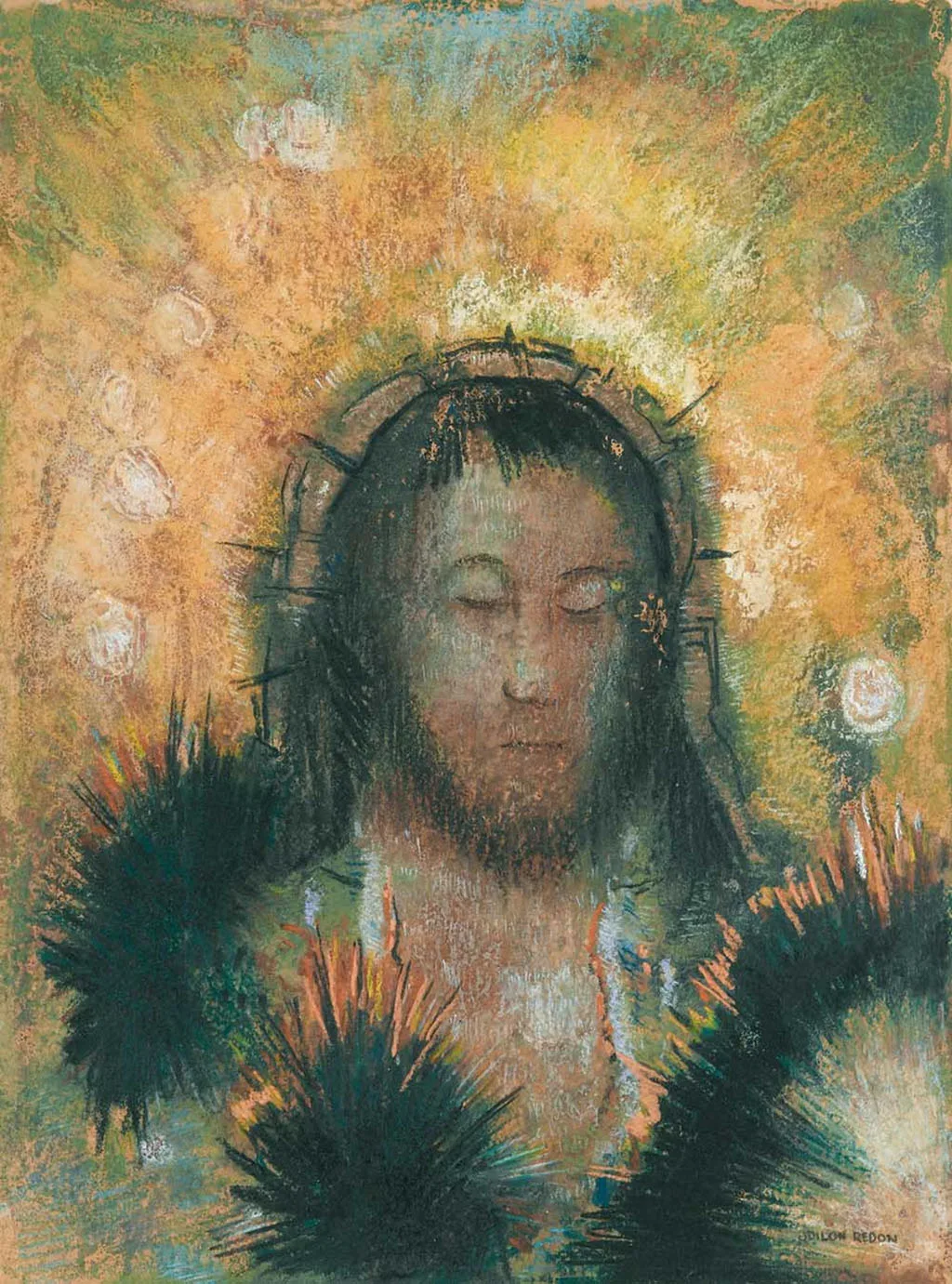
Odilon Redon – Head of Christ (c. 1895)
In Head of Christ, Redon isolates the face of Jesus, floating against a velvety dark background. His features are illuminated in soft gold, almost glowing from within. The eyes are downcast, serene, detached, evoking mystery, sorrow, and compassion. This Christ does not speak. He gazes inward, and invites the viewer to do the same.
Redon was deeply influenced by mysticism and spirituality, and this painting reflects his fascination with the divine as unknowable light. The lack of narrative or context transforms the face into an icon, a meditation on divine presence rather than a representation of a specific event. This work embodies Symbolism’s retreat from realism and its pursuit of inner, ineffable truth.
Jan Toorop – Christ Leading the Souls Past Sharp Rocks (1891)
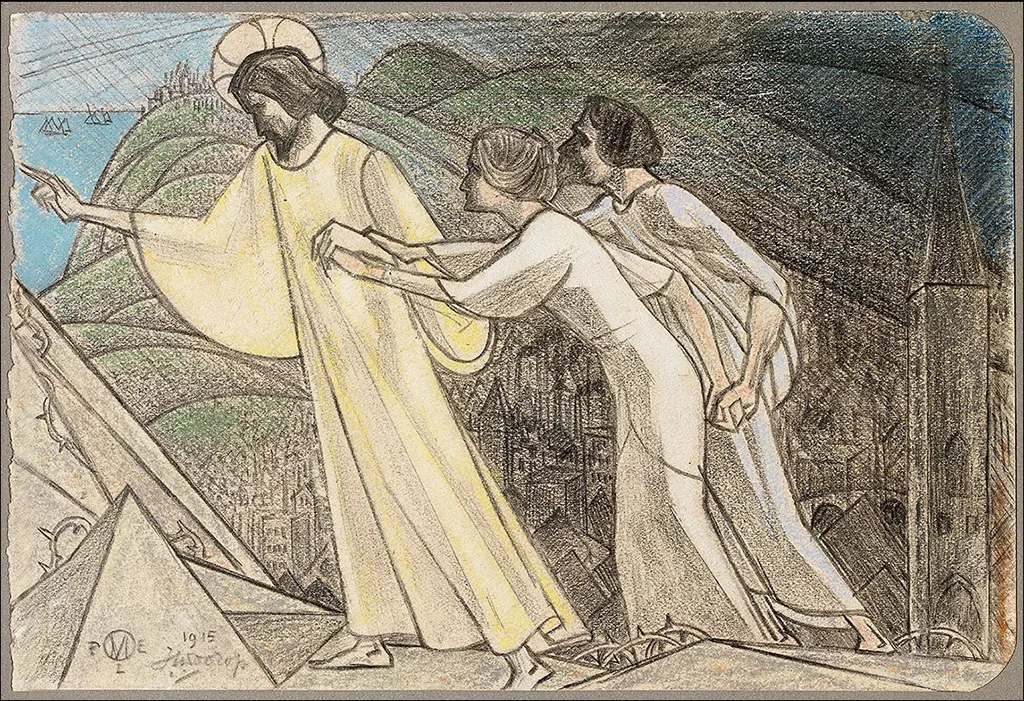
Jan Toorop’s haunting painting, *Christ Leading the Souls Past Sharp Rocks*, captures Jesus as a silent, radiant guide amidst a treacherous spiritual landscape. In this allegorical scene, Christ leads fragile, faceless souls through jagged, towering rock formations, symbols of suffering, doubt, or sin.
The painting evokes deep Symbolist themes: inner struggle, salvation, and transcendence. Christ is portrayed not in majesty but as an illuminated beacon, his presence calming the chaos around him. The souls are nearly transparent, reduced to spiritual essence, emphasizing their vulnerability and dependence on divine light.
Toorop’s style (fluid, visionary, and charged with metaphysical intensity) makes this one of the most poignant Symbolist depictions of Jesus. Here, salvation is not triumphant but intimate and mysterious, as Christ does not rescue, but accompanies.
This work remains a profound testament to Toorop’s deeply spiritual and symbolic interpretation of the Christian message.
Jan Toorop – The Worship of the Crucified Jesus (1895)
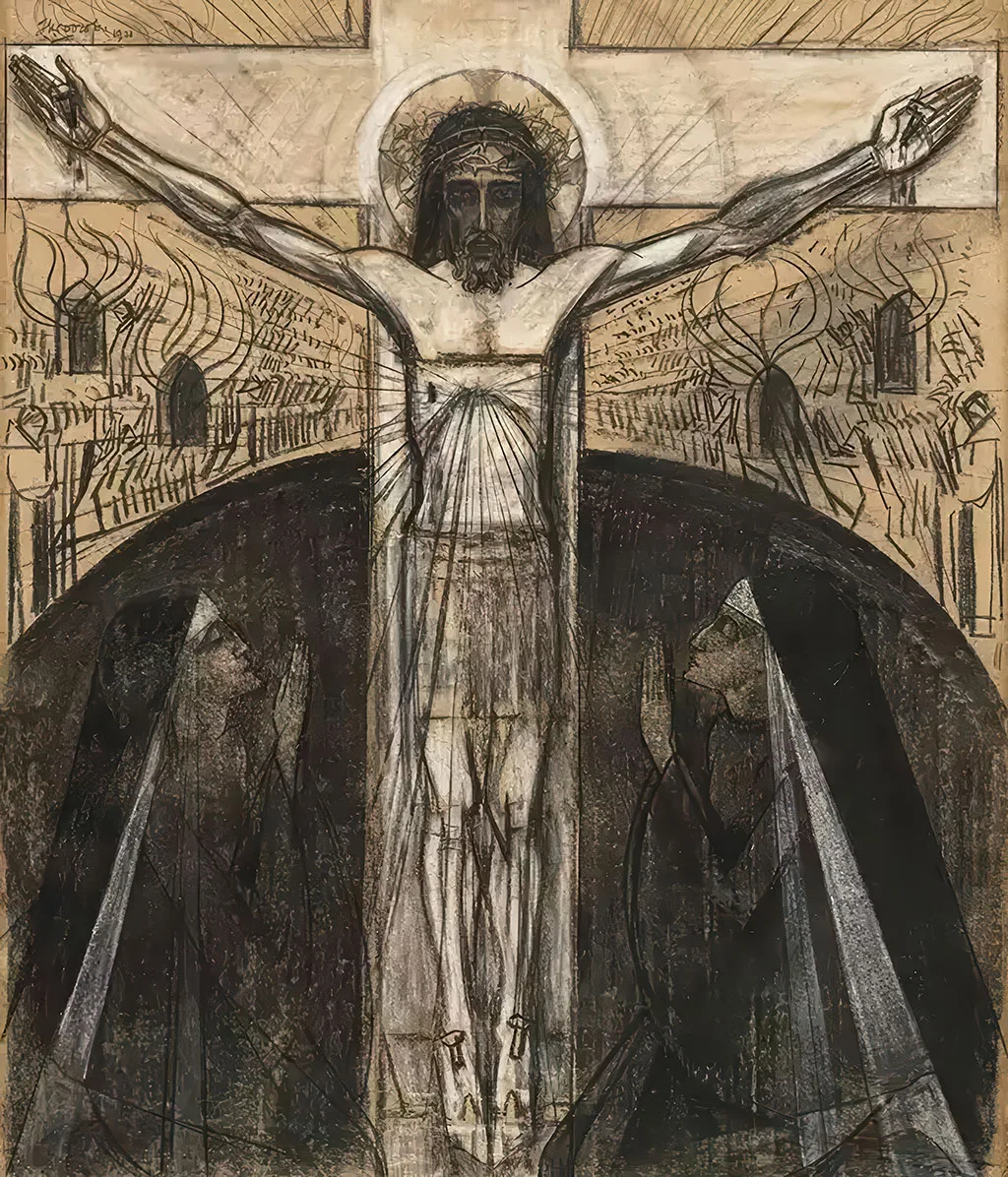
In *The Worship of the Crucified Jesus*, Jan Toorop delivers a visionary portrayal of devotion at the foot of the cross. The central figure of Christ is abstracted and monumental, towering above worshippers whose elongated forms kneel in reverence and anguish.
The Symbolist language is unmistakable, stylized lines, spiritual atmosphere, and emotional exaggeration dominate the composition. Rather than evoke historical realism, Toorop aims to capture the essence of worship and the mystery of redemption.
Light radiates from the cross in swirling, almost psychedelic forms, engulfing the worshippers in a transcendental glow. The scene suggests both personal spiritual experience and collective faith, conveyed through Toorop’s distinct blend of Art Nouveau elegance and Symbolist gravitas.
This painting remains a pinnacle of Symbolist Jesus imagery: intensely subjective, profoundly mystical, and visually unforgettable.
Each of these paintings reveals the Symbolist intent to reinterpret Christ not through realism or ecclesiastical tradition, but through emotional truth, psychological depth, and sacred symbolism. They elevate Jesus into a figure not only of religion, but of the soul: timeless, luminous, and infinitely evocative.
Conclusion
Symbolist Jesus paintings stand apart in the history of religious art. Rather than offer narrative clarity or theological exposition, they aim to draw the viewer into a realm of mystery, contemplation, and emotion. These artworks were not created to instruct; they were crafted to evoke, to give visual shape to the deepest longings, fears, and hopes of the soul.
Artists like Odilon Redon, Arnold Böcklin, Fernand Khnopff, Jan Toorop, and others saw Jesus not only as a divine figure, but as a profound symbol of human suffering, spiritual enlightenment, and eternal compassion. Their works remind us that faith is not always loud or clear. Sometimes, it’s soft and elusive : a flicker of light in shadow, a whisper of grace.
As we reflect on the Symbolist movement, we find Jesus presented not through doctrine, but through atmosphere and imagination. This deeply personal approach has influenced countless modern artists and still resonates with viewers seeking something beyond the surface, a moment of transcendence, a brush with the sacred.
To see how contemporary artists reinterpret Christ through modern styles and visual language, visit our Modern Jesus Art gallery.
Symbolist Jesus Paintings Featured in This Article
| Painting | Artist | Date | Medium | Location |
|---|---|---|---|---|
| Christ and the Samaritan Woman | Odilon Redon | 1890s | Pastel on paper | Metropolitan Museum of Art, New York |
| Pietà | Gustave Moreau | c. 1876 | Oil on canvas | Musée Gustave Moreau, Paris |
| Head of Christ | Odilon Redon | c. 1895 | Oil on paper | Art Institute of Chicago |
| Christ Leading the Souls Past Sharp Rocks | Jan Toorop | 1891 | Oil on canvas | Museum Boijmans Van Beuningen, Rotterdam |
| The Worship of the Crucified Jesus | Jan Toorop | 1895 | Oil on canvas | Kunstmuseum, The Hague |
Frequently Asked Questions
- What is Symbolist art?
Symbolist art was a late 19th-century movement that emphasized emotion, inner experience, and the spiritual world. It rejected realism and focused on symbols, dreams, and the unconscious. - How is Jesus depicted in Symbolist paintings?
In Symbolist paintings, Jesus is often shown not in literal biblical scenes but as a mystical, emotional figure. He appears serene, introspective, and surrounded by symbolic elements that express suffering, hope, and divinity. - Are Symbolist Jesus paintings part of Christian tradition?
While rooted in Christian themes, Symbolist depictions of Jesus often emphasize personal spirituality over doctrinal accuracy. They offer a more abstract, emotional approach to faith. - Where can I view Symbolist Jesus paintings?
Major museums such as the Metropolitan Museum of Art, the Art Institute of Chicago, the Musée d’Orsay, and the Kunsthaus Zürich house some notable examples. Many can also be explored through digital museum archives. - Who are the most famous Symbolist painters of Jesus?
Artists such as Odilon Redon, Arnold Böcklin, Fernand Khnopff, and Jan Toorop are among the most significant Symbolists who explored the figure of Jesus in their work. - How do Symbolist Jesus paintings differ from Baroque or Renaissance depictions?
Unlike Baroque and Renaissance art, which aimed for realistic representation and clear narrative, Symbolist art focuses on mood, abstraction, and inner emotion, often leaving room for interpretation. - Is Symbolist religious art still influential?
Yes. While not widely used in traditional church settings, Symbolist religious art has influenced modern spiritual and visionary art, especially in its focus on personal experience and symbolic meaning. - Where can I buy Symbolist Jesus paintings prints?
You can buy Symbolist Jesus paintings prints at jesuschrist.pictures: see the canvas reproduction in our shop, printed on museum-grade canvas and available in several sizes.