Petrus Christus Paintings and the Silent Beauty of Flemish Art
Petrus Christus is the great quiet successor of Jan van Eyck in the Bruges of the mid-fifteenth century. The Petrus Christus paintings that survive today, around thirty securely attributed panels, carry the dense observed precision of the early Flemish school into a slightly cooler, more diagrammatic visual register. He absorbed both the Van Eyck inheritance and the elongated grace of Rogier van der Weyden, and he is the first Northern painter to use linear perspective in a way that approaches the Italian Quattrocento.
This article gathers ten of his most important religious works, the panels that fill the great Flemish, German, and American collections with his unmistakable Bruges devotion.

From Baerle to the Bruges Guild
Petrus Christus was born around 1410, probably in Baerle in Brabant, the son of a painter of the same name. He is first documented in Bruges in 1444, when he was admitted to the citizenship of the city, and is believed to have worked first in the Van Eyck workshop and then independently after Jan van Eyck’s death in 1441. By the late 1440s he had become the leading painter of Bruges, working for the great patrician families of the city and for the Italian merchant communities of the harbour.
His career covers the second half of the fifteenth century, the transitional moment between the founding Flemish primitives and the next generation of Hans Memling. He died in 1475 or 1476 in Bruges, leaving a small but distinguished corpus that has shaped the modern understanding of mid-fifteenth century Flemish painting.
Mary with the Child, Saint Barbara and a Carthusian Monk
Painted around 1457, this small devotional panel shows the Virgin and Christ child enthroned in a Flemish bourgeois interior, with Saint Barbara holding the tower of her iconography and a Carthusian monk kneeling in adoration in the foreground. The composition is built on the early Flemish linear refinement, with the figures arranged in a calm triangular grouping.

The painting is at the Gemäldegalerie in Berlin.
Virgin and Child with Saints Jerome and Francis
This small panel of around 1457 presents the Virgin and Christ child flanked by Saint Jerome with his lion on one side and Saint Francis of Assisi with the stigmata on the other. Petrus Christus paints the composition with the calm linear refinement of his mature manner, in a deep architectural interior that opens onto a Flemish landscape.

The painting is at the Städel Museum in Frankfurt.
The Madonna of the Dry Tree
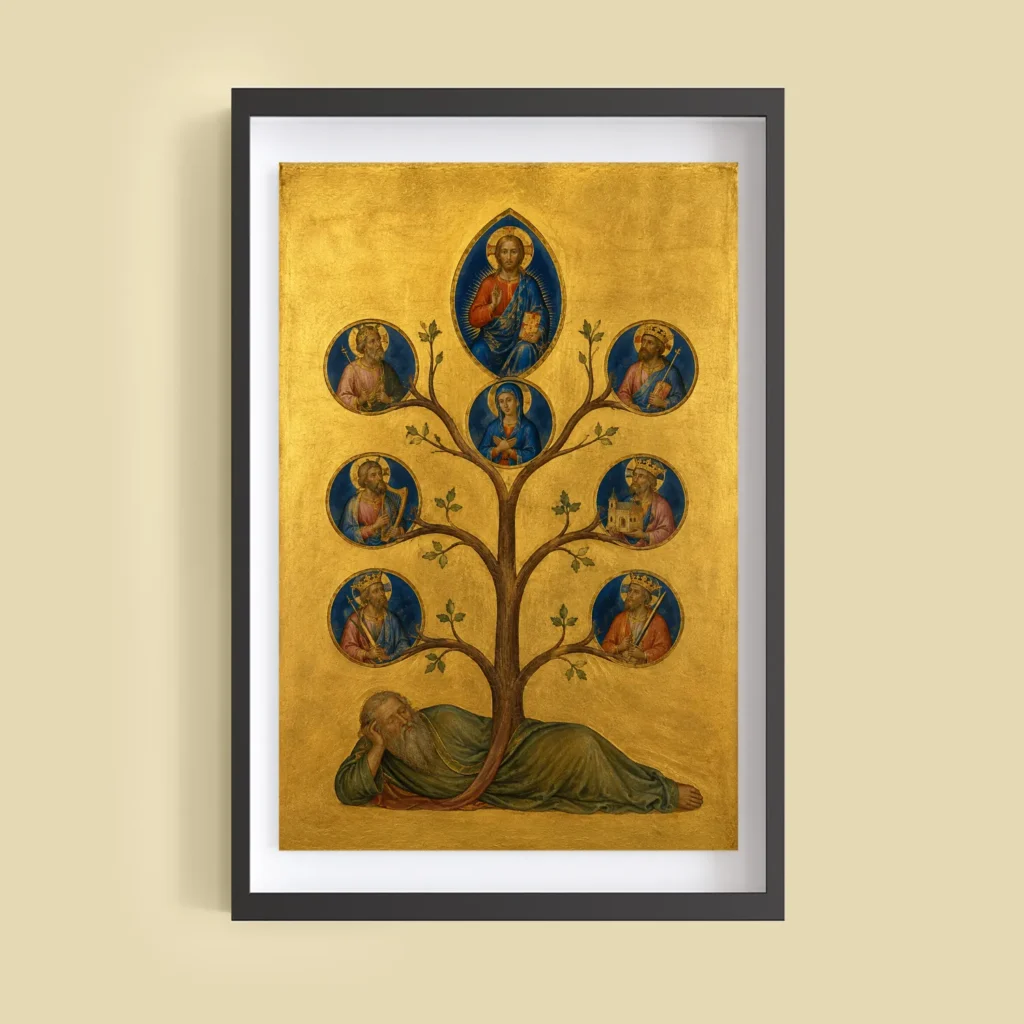
One of Petrus Christus’s most personally inventive panels, this small picture shows the Virgin and Christ child enthroned in a strange dry tree hung with the fifteen golden A’s that represent the fifteen Ave Marias of a single decade of the rosary. The iconography refers to the medieval idea of the Virgin as the new flowering of the dry tree of the Old Testament, the Tree of Jesse from which the Messiah was prophesied to spring.

The painting is at the Museo Thyssen-Bornemisza in Madrid.
The Annunciation
This great panel shows the Virgin in a Flemish bourgeois interior at the moment when the angel Gabriel appears to her with the divine message. Petrus Christus paints the scene with the same linear refinement as his Marian devotional panels, with the dove of the Holy Spirit descending in a beam of golden light from the upper left.

The painting is at the Germanisches Nationalmuseum in Nuremberg. For a wider survey, see our article on famous Annunciation paintings.
The Madonna
An intimate small panel of the Virgin and Christ child, this picture shows Mary holding her son against her shoulder in a calm Flemish interior. The composition is one of Petrus Christus’s most concentrated Marian devotional images, with the soft modelling of the two faces lit by a hushed silvery light against a deep ground.

The painting is at the Museum of Fine Arts in Budapest.
Lamentation of Christ (Vienna)
The body of Christ lies across the lap of the Virgin while the holy women and John the Evangelist weep around them. Petrus Christus paints the moment with the slight elongation of his mature style, with the figures arranged in a tight horizontal composition that recalls the Lamentations of Rogier van der Weyden.

The painting is at the Kunsthistorisches Museum in Vienna.
The Lamentation
A second smaller version of the same subject, this panel shows the body of Christ taken down from the cross in a more concentrated composition. The figures are reduced to the Virgin, John the Evangelist, and the body of Christ, with the same elongated grace as the Vienna version.

The painting is also at the Kunsthistorisches Museum in Vienna.
Head of Christ
This small devotional panel shows the face of Christ alone, the crown of thorns visible on his head, the eyes raised slightly upward in patient suffering. Petrus Christus paints the figure with the soft modelling of his mature manner and the silvery flesh tones that distinguish his late Bruges work.

The painting is at the Nationalmuseum in Stockholm.
Isabella of Portugal with Saint Elisabeth
This small panel from around 1457 shows the Duchess Isabella of Portugal, third wife of Philip the Good Duke of Burgundy, presented to the viewer by her patron saint Elisabeth of Hungary. The figure of the duchess is rendered with the same close observed portraiture as Petrus Christus’s other ducal portraits, while the saint behind her holds the open book of her devotion.

The painting is at the Groeningemuseum in Bruges.
Virgin and Child with Saints and Donor
This great altarpiece of around 1457 to 1467 shows the Virgin and Christ child enthroned in a deep Flemish interior, with a kneeling donor presented by Saint Anthony of Padua and Saint Jerome on either side. The composition is one of Petrus Christus’s most ambitious surviving works and shows the painter’s mature use of linear perspective.

The painting is at the Frick Collection in New York.
For more context on Petrus Christus’s Bruges world, see our articles on his immediate predecessor Jan van Eyck, on the great Brussels master Rogier van der Weyden, on his Bruges successor Hans Memling, and on the Leuven master Dieric Bouts.
Summary Table of Petrus Christus’s Religious Paintings
| Name | Artist | Date | Medium | Museum |
|---|---|---|---|---|
| Mary with the Child, Saint Barbara and a Carthusian Monk | Petrus Christus | c. 1457 | Oil on panel | Gemäldegalerie, Berlin |
| Virgin and Child with Saints Jerome and Francis | Petrus Christus | c. 1457 | Oil on panel | Städel Museum, Frankfurt |
| The Madonna of the Dry Tree | Petrus Christus | c. 1465 | Oil on panel | Museo Thyssen-Bornemisza, Madrid |
| The Annunciation | Petrus Christus | c. 1450 | Oil on panel | Germanisches Nationalmuseum, Nuremberg |
| The Madonna | Petrus Christus | c. 1460 | Oil on panel | Museum of Fine Arts, Budapest |
| Lamentation of Christ | Petrus Christus | c. 1455 | Oil on panel | Kunsthistorisches Museum, Vienna |
| The Lamentation | Petrus Christus | c. 1455 | Oil on panel | Kunsthistorisches Museum, Vienna |
| Head of Christ | Petrus Christus | c. 1460 | Oil on panel | Nationalmuseum, Stockholm |
| Isabella of Portugal with Saint Elisabeth | Petrus Christus | c. 1457 | Oil on panel | Groeningemuseum, Bruges |
| Virgin and Child with Saints and Donor | Petrus Christus | c. 1457 to 1467 | Oil on panel | Frick Collection, New York |
Conclusion
Petrus Christus is the painter who carried the Van Eyck Bruges tradition into the second half of the fifteenth century. His linear perspective, his calm Flemish interiors, and his soft Marian devotional panels formed the bridge between the founding Flemish primitives and the great late Bruges master Hans Memling. He died around 1475, leaving the city of Bruges fully prepared for the great late fifteenth century flowering of the Memling workshop and the early years of Gerard David.
Important Facts About Petrus Christus
- Petrus Christus was born around 1410, probably in Baerle in Brabant, the son of a painter of the same name, although the exact details of his early life remain debated.
- He is first documented in Bruges in 1444, when he was admitted to the citizenship of the city, and is believed to have worked first in the Van Eyck workshop and then independently after Jan van Eyck’s death in 1441.
- Petrus Christus is one of the central figures of the early Netherlandish school and is celebrated for being the first Northern painter to use linear perspective in a way that approaches the Italian Quattrocento.
- His most famous religious works are the Madonna of the Dry Tree at the Museo Thyssen-Bornemisza, the Virgin and Child with Saints and Donor at the Frick Collection, and the Madonna with Saint Barbara and the Carthusian at the Gemäldegalerie in Berlin.
- He died in 1475 or 1476 in Bruges, having served as the leading painter of the city after Van Eyck and before the rise of Memling, and his small surviving corpus is one of the most important bridges between the two great phases of fifteenth century Flemish religious painting.
Questions and Answers About Petrus Christus Paintings
What is Petrus Christus’s most famous painting?
The most often studied is the small Portrait of a Young Woman at the Gemäldegalerie in Berlin. Among his religious panels, the Madonna of the Dry Tree at the Museo Thyssen-Bornemisza and the great Virgin and Child with Saints and Donor at the Frick Collection are the most reproduced.
Where can I see Petrus Christus paintings today?
The Gemäldegalerie in Berlin, the Städel Museum in Frankfurt, the Museum of Fine Arts in Budapest, the Frick Collection in New York, and the Museo Thyssen-Bornemisza in Madrid all hold significant works. The Groeningemuseum in Bruges preserves the portrait of Isabella of Portugal.
What style is Petrus Christus associated with?
Petrus Christus is one of the central figures of the second generation of the early Netherlandish school. His mature style fuses the dense observed detail of Jan van Eyck with the elongated grace of Rogier van der Weyden, and he is the first Northern painter to use linear perspective in a way that approaches the Italian Quattrocento.
Was Petrus Christus a student of Jan van Eyck?
The documents are silent, but the closeness of his earliest style to Van Eyck’s late panels strongly suggests that he was working in the Van Eyck workshop in Bruges in the late 1430s, before becoming a master in his own right after Jan’s death in 1441. Several of his early paintings have been previously attributed to Van Eyck or to his workshop, which supports the close artistic connection.
What is the Madonna of the Dry Tree?
The composition is one of the most personally inventive of all of Petrus Christus’s panels. The Virgin and Christ child are enthroned inside a strange dry tree hung with fifteen golden letter A’s, representing the fifteen Ave Marias of a single decade of the rosary. The iconography refers to the medieval idea of the Virgin as the new flowering of the dry Tree of Jesse from which the Old Testament prophets had foretold the Messiah.
How does Petrus Christus compare with Hans Memling?
Petrus Christus was the leading Bruges painter from about 1444 to 1475, the period immediately before Memling’s rise in the same city. The two painters share the Bruges Flemish refinement, the calm Marian devotional images, and the careful linear perspective. But Petrus Christus is slightly cooler and more diagrammatic, while Memling’s mature manner is warmer, softer, and more lyrical. Petrus Christus’s career prepared the ground for the great Memling flowering of the 1470s and 1480s.
Where can I buy a canvas reproduction of a Petrus Christus painting?
The shop at jesuschrist.pictures offers museum-quality canvas reproductions of the great Christian paintings, and the collection keeps growing; it is the best place to look for a canvas reproduction of a Petrus Christus painting.