Saint Brigid of Kildare: The Saint, the Goddess and the Cross
Saint Brigid of Kildare is the only woman among the three patron saints of Ireland, and the only one about whom serious historians will not tell you plainly whether she existed. She has a birthplace, a death date, a cathedral, a cross woven in half the kitchens in Ireland every February, and since 2023 a national holiday. She also shares her name, her feast day and most of her attributes with a goddess. This page tells the life the medieval sources give her, sets out the goddess problem honestly, answers the question everyone now asks about whether she is still a saint at all, and looks at the three artists who gave her the face she has today.
The daughter of a slave
The traditional account puts her birth around 451 at Faughart in County Louth. Her father Dubthach was a chieftain of Leinster. Her mother Broicsech was his slave, a Christian, and she was sold to a druid while pregnant. Brigid was therefore born into slavery, and the earliest Lives make a point of it: she is the daughter of the house and the daughter of a bondwoman at the same time, which is exactly the position from which the stories about her make sense. Because every story about the girl Brigid is a story about giving away things that were not hers to give. She gives away her father’s food. She gives away the butter. She gives away the milk from the dairy she is supposed to be managing, and it is replaced. The pattern is so consistent that it reads less like biography than like a moral argument made in narrative form: what the household owns, the poor have a claim on. The best version is the sword. Dubthach, exasperated, loads her into his chariot and drives to the King of Leinster to sell her. While he is inside negotiating, a leper comes to the chariot, and Brigid gives him the only thing to hand, her father’s jewelled sword. Dubthach comes out, sees the empty scabbard, and explodes. The king asks Brigid why she did it. She says she would give away everything the king owned too, if the poor needed it. The king declines to buy her, on the grounds that her merit is higher than his.
The cloak on the Curragh
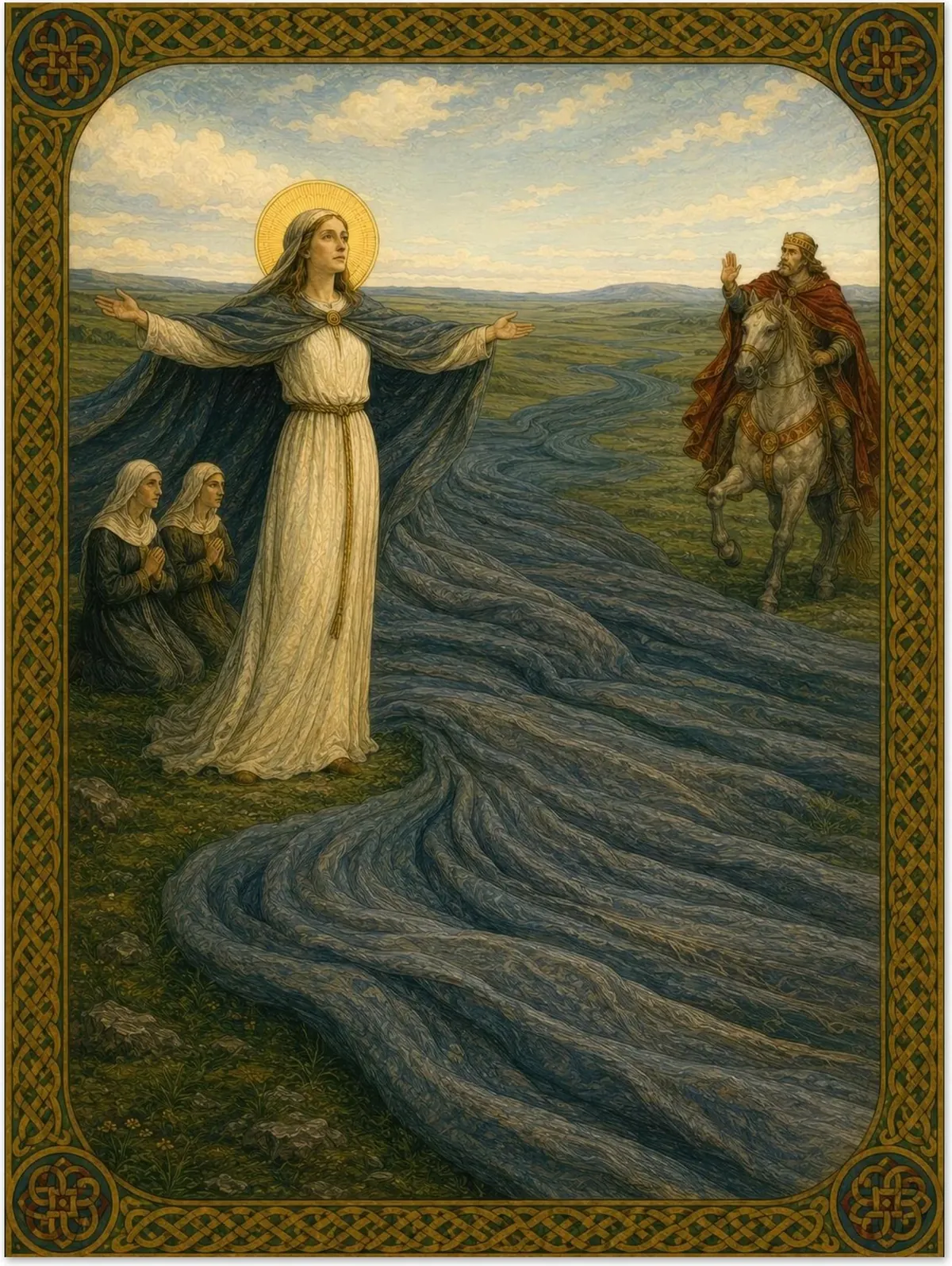
Grown, she took the veil and asked the King of Leinster for land to found a monastery. He refused. She asked for as much land as her cloak would cover. He laughed and agreed, and the cloak spread across the plain of the Curragh until he begged her to stop. She founded her house at Cill Dara, the church of the oak, around the year 480. It was a double monastery, men and women, and Brigid governed both. That arrangement was not unusual in early Ireland, but her authority within it evidently was: Cogitosus, writing her Life around 650, describes Kildare as a metropolitan church with jurisdiction over a wide territory, and its abbess as the head of all the abbesses of Ireland. There is also the consecration story. When Bishop Mel came to make her a nun, the text of the rite he read over her was, by accident or by the Spirit’s prompting depending on which manuscript you are reading, the rite for consecrating a bishop. Told that he had blundered, Mel replied that no power of his could take back what God had given. The medieval Irish church transmitted that story without embarrassment for centuries.
The fire at Kildare
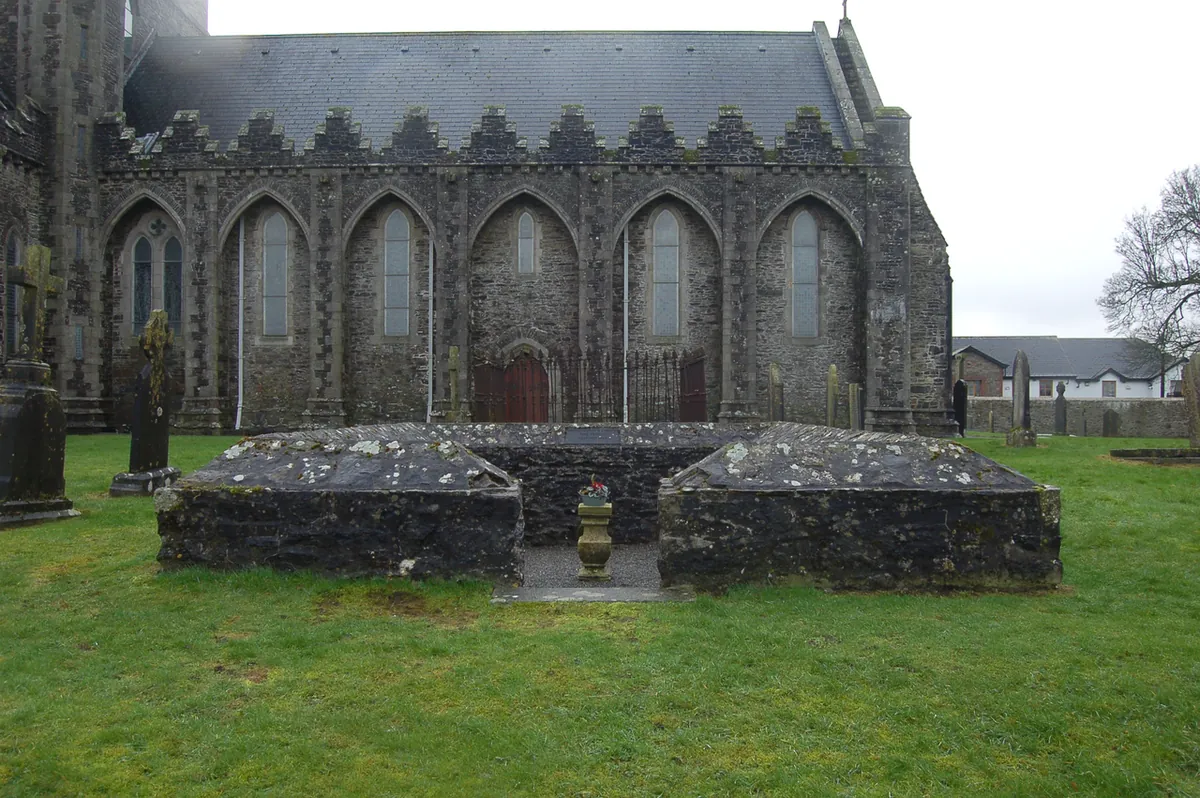
Inside the enclosure at Kildare a fire was kept burning and never allowed to go out. Nineteen nuns tended it in turn, one each night, and on the twentieth night the fire was left to Brigid herself, who kept it without human help. A hedge surrounded it that no man could cross. This is not a legend recorded only in pious books. Gerald of Wales, a Norman-Welsh cleric with no particular love of the Irish, visited in the 1180s and described the fire as a working institution, still burning after six hundred years, still enclosed, still tended by nuns. It was extinguished in 1540 at the dissolution of the monasteries. The foundations of the enclosure are still visible beside Saint Brigid’s Cathedral, and in 1993 the Brigidine Sisters relit the flame in Kildare, where it burns again.
The goddess problem
Here is the difficulty, stated plainly. There was a goddess called Brigid, or Brig, in pre-Christian Ireland: a daughter of the Dagda, associated with poetry, healing and smithcraft, and connected with Imbolc, the feast at the start of February that marks the first stirring of spring and the lactation of the ewes. Saint Brigid’s feast day is 1 February. Her monastery kept a perpetual fire. Her patronages include poets, healers, blacksmiths and dairy work. Her name is the goddess’s name. Historians divide into three camps, and it is worth knowing which is which. Some hold that the saint is the goddess, Christianised wholesale, and that no abbess of that name ever lived. Others hold that a real woman founded Kildare in the fifth century and that her cult then absorbed the older material wholesale, which is what cults do. A third group notes that we simply have no evidence either way: the earliest Life is Cogitosus, written around 650, more than a century after her supposed death, and it contains no verifiable historical detail at all. What can be said without argument is that Kildare was a major monastery with real land, real abbesses and a real archive, that Brigid was venerated as its founder from a very early date, and that the older material and the newer are now impossible to separate. Anyone who tells you the question is settled is picking a side.
Is she still a saint?
Yes. This question is now among the most searched things about her, and the answer is simpler than the rumour. In 1969 the Roman Catholic Church revised its general calendar and removed a number of feasts from the universal list, mostly of saints whose historical existence was doubtful or whose cult was purely local. Some names, Christopher and Philomena among them, became famous casualties. Brigid was affected only in the sense that her feast is not obligatory for the whole Church: she remains in the Roman Martyrology, she is still a patron saint of Ireland, and her feast is celebrated across the island every 1 February. Nobody has ever been decanonised. The Church has no procedure for it. What it does have is a calendar with limited room on it, and a periodic willingness to admit that a much-loved story may not be history. Brigid’s standing in Ireland, meanwhile, went the other way: since 2023 her feast day is a public holiday, the first in the state named for a woman.
The cross, and the cloth left on the hedge
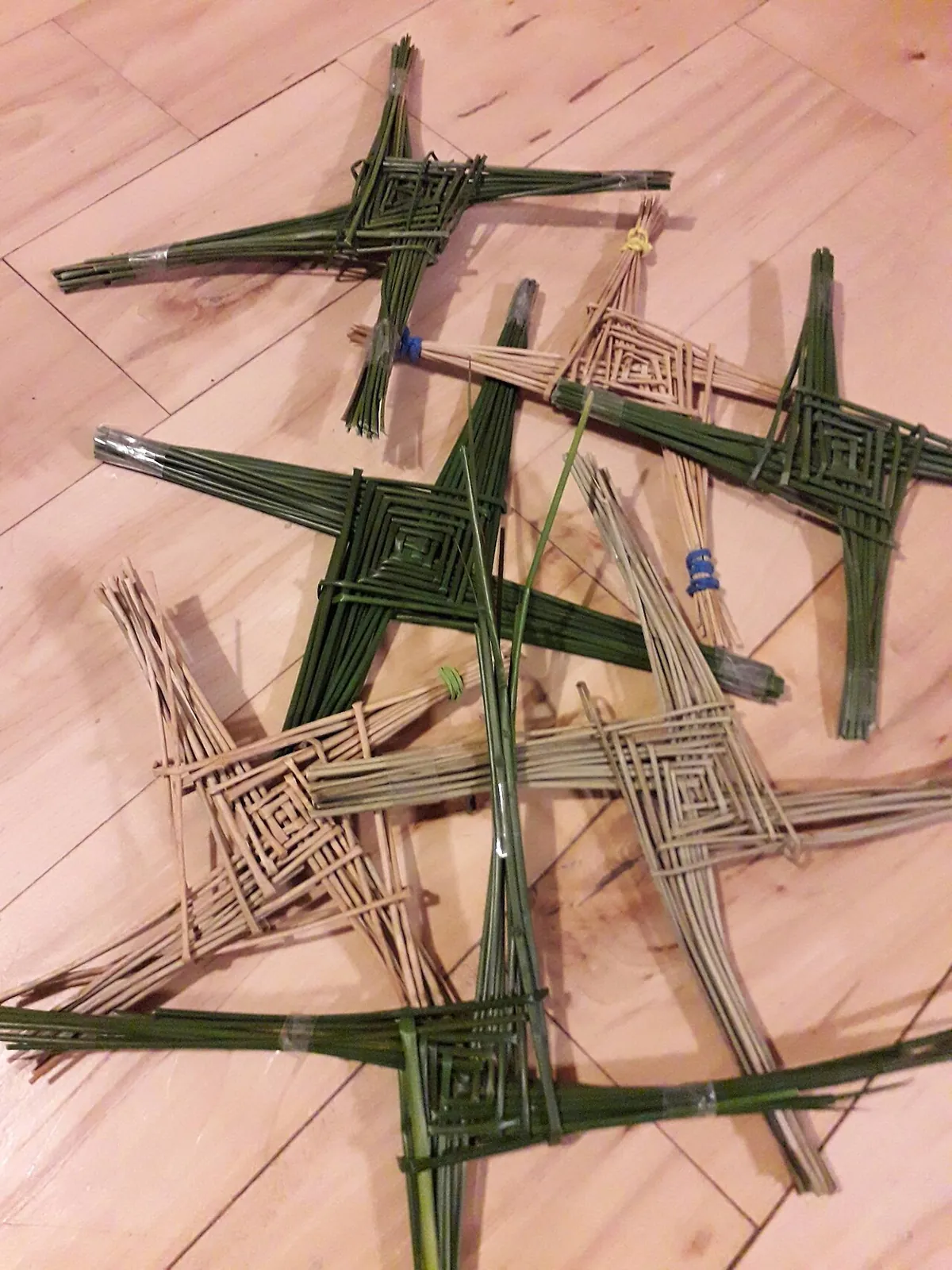
Two customs carry her name into ordinary houses. The Saint Brigid’s cross is woven from rushes pulled, not cut, on the eve of 1 February. Four arms, each a folded bundle, offset around a woven square centre. The story attached to it says Brigid wove the first one at the deathbed of a pagan chieftain, picking rushes off the floor to explain the crucifixion while he was dying, and that he asked for baptism before the end. The new cross goes up over the door or in the rafters; last year’s stays where it is, or is burned. In many houses you can date the crosses by colour, this year’s green, older ones faded to pale gold.
The second custom is the Brat Bride, the cloak of Brigid. A piece of cloth, often a scarf or a ribbon, is left outside on the windowsill or the hedge on the eve of her feast, in the belief that Brigid passes through the country that night and blesses what she touches. It is brought in the next morning and kept for the year, and it is used for healing: laid on a sore head, a sick animal, a woman in labour. The cloth is said to gain power each year it is left out. This is a live custom, not a museum piece.
How Brigid is painted
Brigid has better art than any other Irish saint, and all of it is modern. Ireland produced no painting of her in the Middle Ages, and the continent, which gave Patrick a baroque engraving, had almost no interest in her at all. What she got instead was the Celtic Revival, and it suited her. The first is John Duncan’s Saint Bride, painted in Edinburgh in 1913 and the best known image of any Irish saint. It illustrates a Hebridean legend rather than an Irish one: that Brigid was carried by angels across the sea to Bethlehem on the night of the Nativity, to be present at the birth and to hold the child. Duncan painted it in tempera to get the matte surface of a medieval panel, and covered the angels’ robes with miniature scenes from the life of Christ. There is a seal in the water and two gulls in the air.
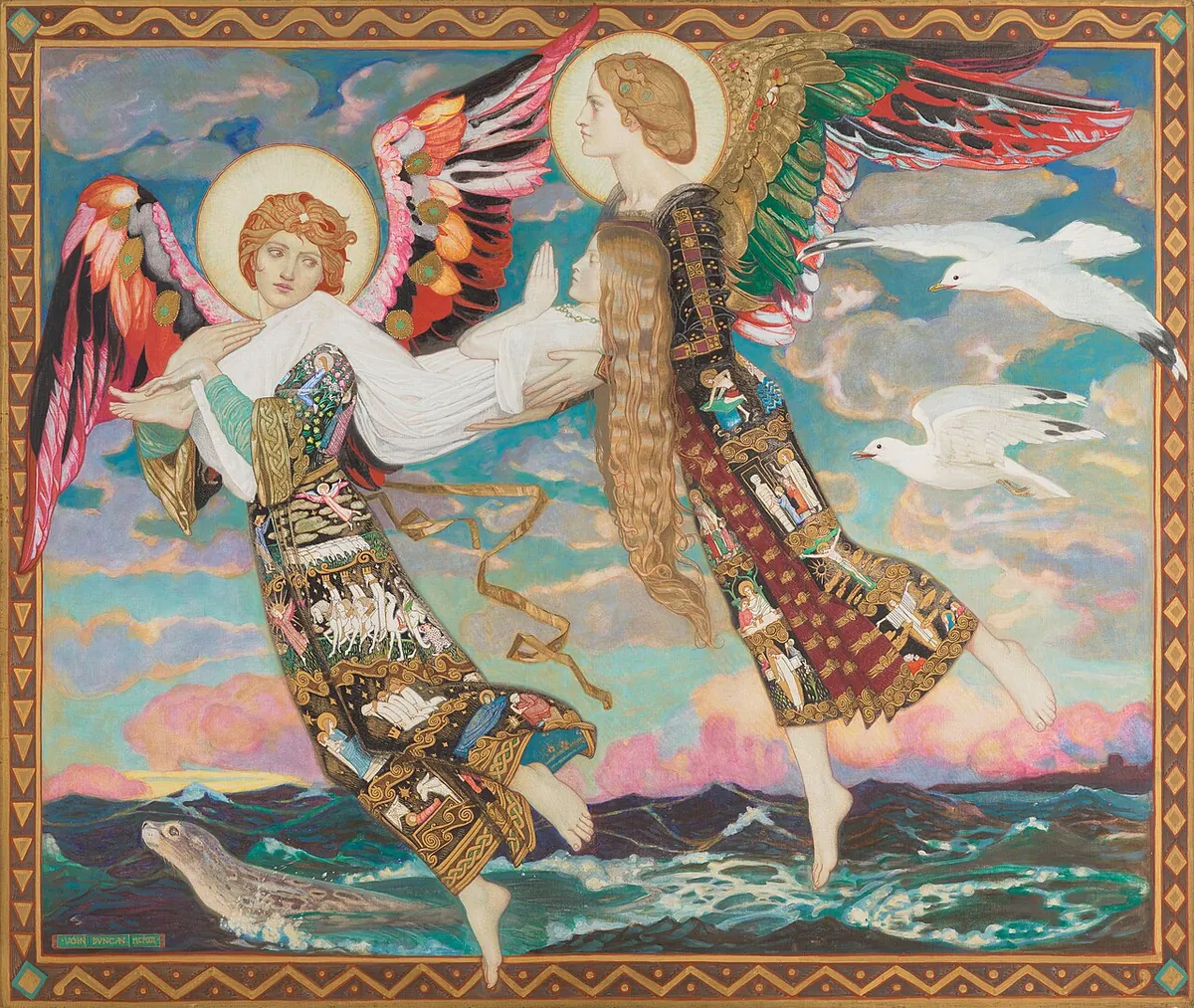
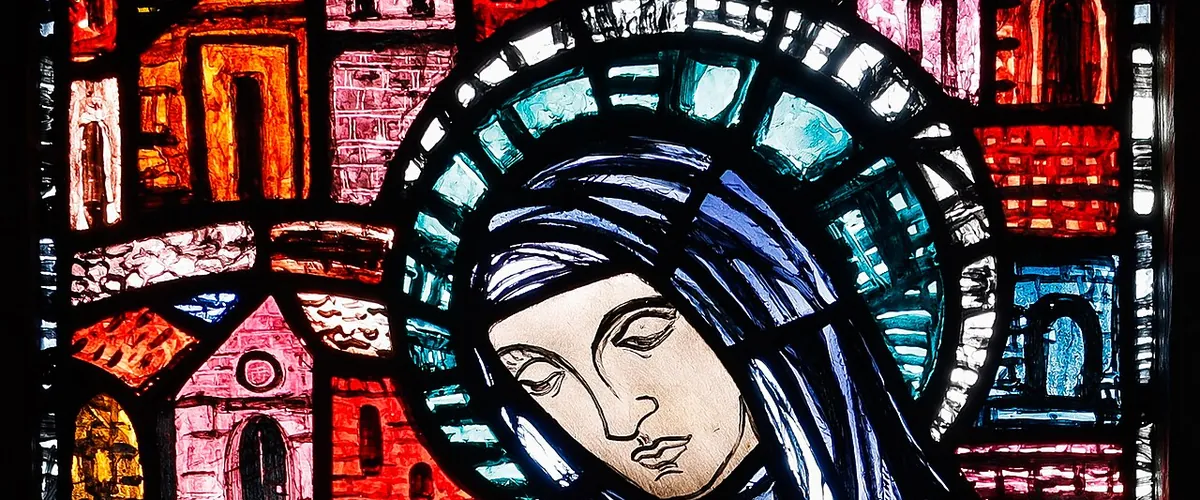
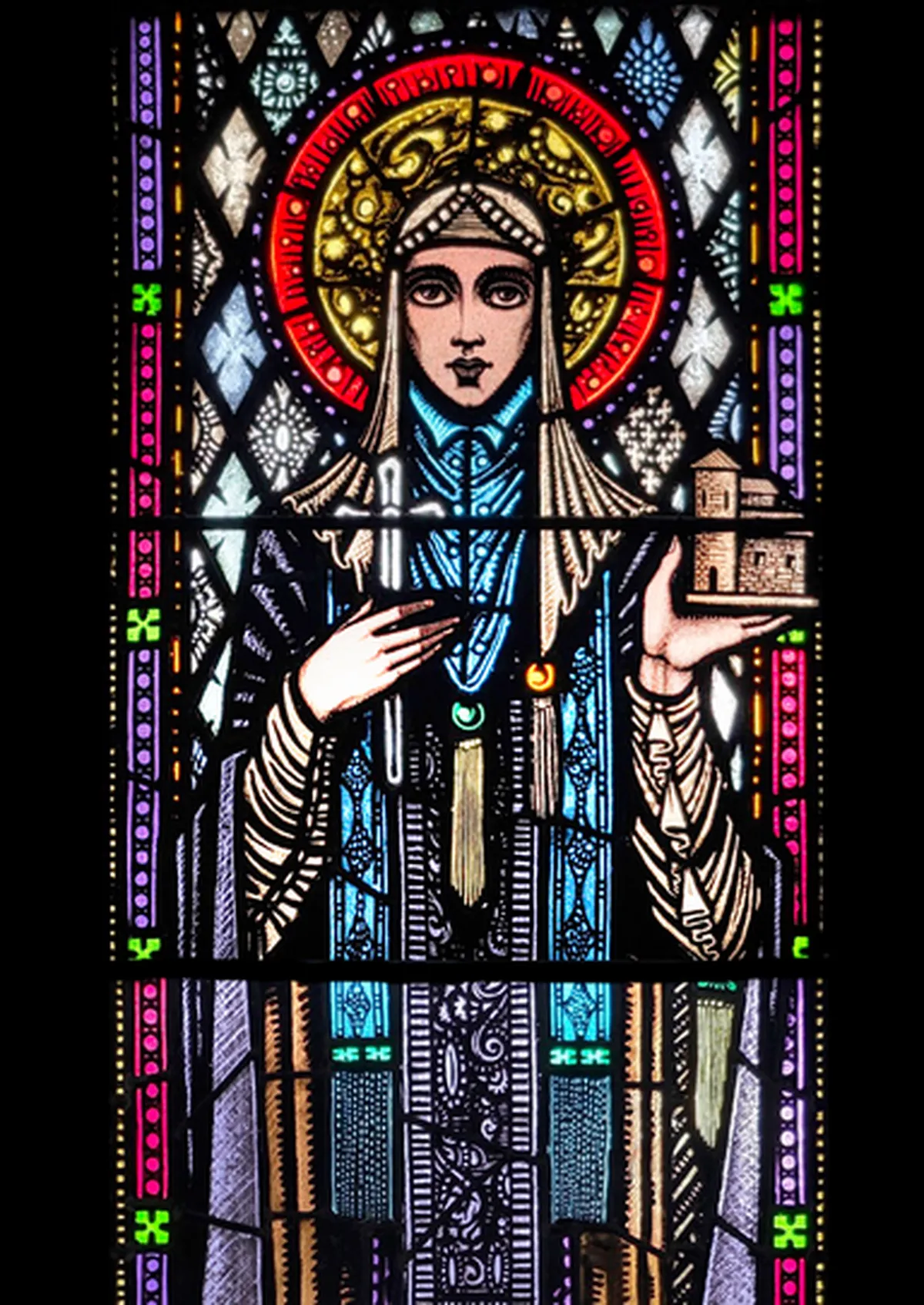
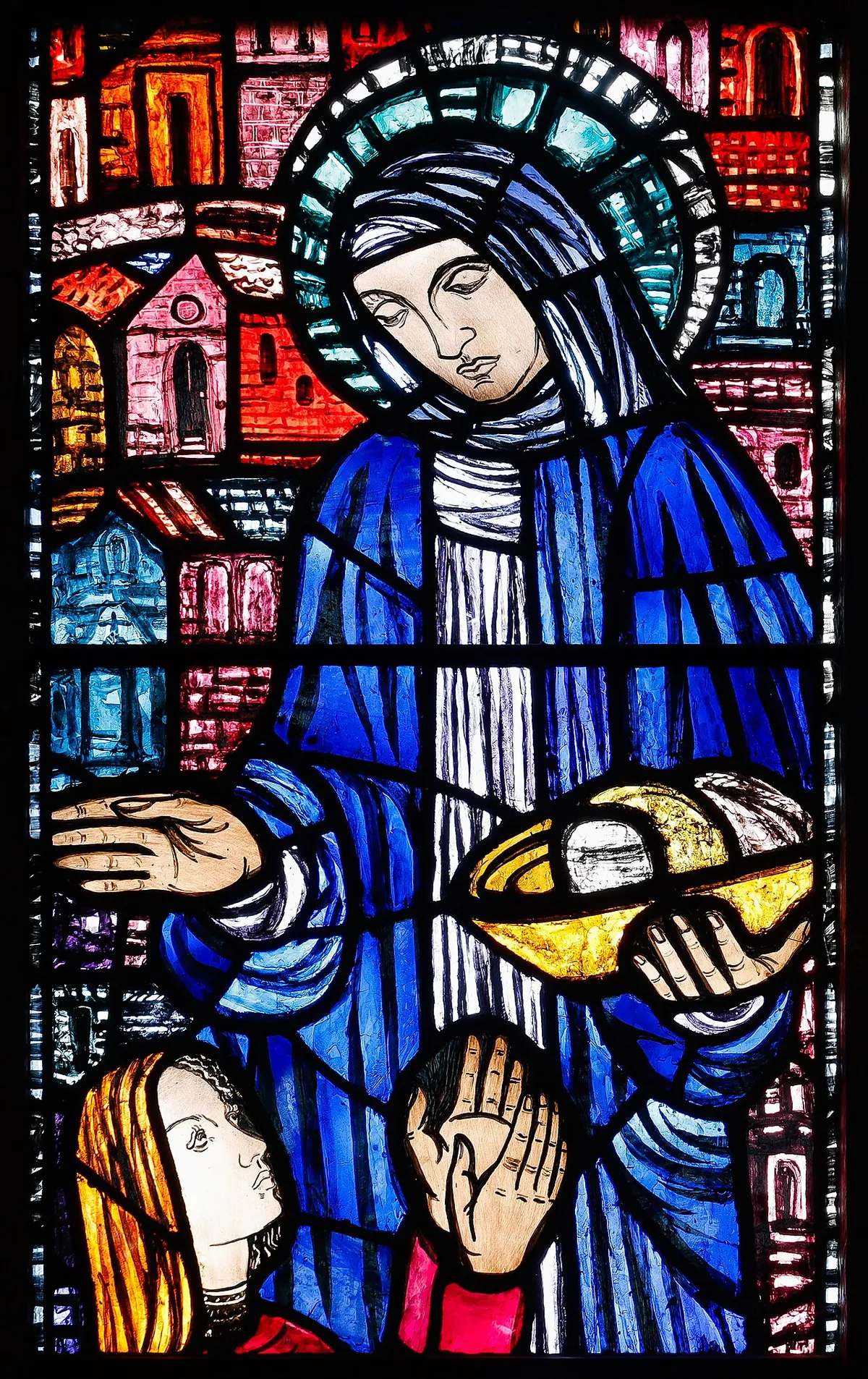
The second is Harry Clarke, the greatest artist ever to work in Irish glass, who gave her the window at Ballinrobe: a gold halo, a crozier, and the abbey of Kildare held in the palm of her hand like a toy. The third is Evie Hone, who made the Loughrea window in 1942 at An Tur Gloine, the Dublin workshop that changed Irish stained glass. Her Brigid is not a symbol. She is a working abbess in a blue cloak, distributing bread with both hands, with the roofs of her town behind her and a child sheltering in the folds of her cloak. Hone had studied with Braque and Gleizes in Paris, and it shows in the flattened planes and the heavy leading. It is the least sentimental Brigid ever made, and probably the truest. There is a fourth, and it was painted for this page. The one episode none of these three attempts is the cloak, and it is the story everyone in Ireland knows: Brigid asks the King of Leinster for as much land as her cloak will cover, he laughs and agrees, and the cloak keeps going until he begs her to stop. Here it is still going, a river of blue-grey wool pouring across the Curragh to the horizon, with the king reining back his white horse at the edge of the plain. It is a new work rather than a historical one, and it is offered as such.
Saint Brigid Paintings Featured in This Article
| Work | Artist | Date | Location |
|---|---|---|---|
| Saint Bride | John Duncan | 1913 | National Galleries of Scotland, Edinburgh |
| Saint Brigid, stained glass | Harry Clarke | 20th century | Saint Mary’s Church, Ballinrobe |
| Saint Brigid, stained glass | Evie Hone, An Tur Gloine | 1942 | Saint Brendan’s Cathedral, Loughrea |
Important facts about Saint Brigid
- She is Ireland’s only woman patron saint, alongside Patrick and Columba, and since 2023 her feast day on 1 February is a national holiday.
- She was born to a slave. Her mother Broicsech was a bondwoman sold to a druid; her father Dubthach was a chieftain of Leinster.
- Kildare was a double monastery, men and women, and Brigid governed both. Its abbess was regarded as the senior abbess in Ireland.
- The perpetual fire burned for a thousand years. Gerald of Wales saw it in the 1180s. It was put out in 1540 and relit in Kildare in 1993.
- She has never been decanonised. The 1969 calendar reform made her feast optional for the universal Church, nothing more.
- She is not Bridget of Sweden. That is a fourteenth century Swedish mystic, a different saint with a similar name and a feast on 23 July.
Brigid stands with the other eleven in 12 Irish Saints and the Art They Left Behind, where the Irish difficulty shows itself most plainly: the greatest of them were left almost no old art at all. She belongs too to the wider company of women the Church has put at the centre of its art, gathered here in Female Saints in Art. Another Irishwoman who left the island and did not come back, Saint Dymphna, has her own page. And for the same subject seen from a country whose saints had the whole Baroque to paint them, see our 15 Spanish Saints and the Painters Who Gave Them Their Faces.
Frequently asked questions about Saint Brigid
What is Saint Brigid known for?
Saint Brigid of Kildare is known for founding the double monastery at Kildare around 480 and governing both its women and its men, for the perpetual fire kept in her enclosure for a thousand years, and for a lifetime of giving away everything she could lay hands on. She is one of the three patron saints of Ireland and the only woman among them. The Saint Brigid’s cross, woven from rushes on the eve of her feast, carries her name into ordinary houses every year.
Is Saint Brigid no longer a saint?
She is still a saint. The confusion comes from the 1969 revision of the Roman calendar, which removed a number of feasts from the obligatory universal list. Brigid’s feast became optional for the worldwide Church, but she was never decanonised, she remains in the Roman Martyrology, and she is still a patron saint of Ireland. The Church has no procedure for removing a saint. Her feast on 1 February has been a public holiday in Ireland since 2023.
What do you pray to Saint Brigid for?
Brigid is invoked for babies and mothers in childbirth, for dairy farmers and cattle, for blacksmiths, poets, printers and scholars, for travellers, and for protection of the home. Those patronages are an unusually wide spread, and they overlap almost exactly with the domains of the pre-Christian goddess who shares her name, which is one of the reasons her origins are so debated.
Why do you leave a scarf out for Saint Brigid?
The cloth left outside on the eve of 1 February is called the Brat Bride, the cloak of Brigid. The custom holds that Brigid travels across Ireland that night and blesses whatever she passes, so a scarf or ribbon is put on the windowsill or the hedge, brought in the next morning, and kept for the year as a healing cloth. It is laid on the sick, on animals and on women in labour, and it is said to gain strength each year it is left out.
Was Saint Brigid a pagan goddess?
There was a goddess called Brigid in pre-Christian Ireland, associated with poetry, healing and smithcraft and connected to the February feast of Imbolc, and the saint shares her name, her feast day and most of her attributes. Historians are genuinely divided: some hold that the saint is the goddess Christianised and that no such abbess existed, others that a real woman founded Kildare and her cult absorbed the older material. The earliest life of Brigid was written around 650, more than a century after her supposed death, and contains nothing that can be verified.
Can you buy Saint Brigid art?
You can buy Saint Brigid art at jesuschrist.pictures, in our shop, as museum quality canvases and posters. Our catalogue covers the works reproduced on this page and the wider world of Christian painting they belong to, printed on demand and shipped worldwide. The shop is organised by subject and by period, and the saints have a section of their own.