St Dymphna: Patron Saint of Anxiety, Her Story and Her Art
Saint Dymphna is the patron saint of anxiety, depression and mental health, an Irish princess of the seventh century who was martyred by her own father at fifteen. Of all the saints of the calendar, she is the one people seek out when their mind will not rest, and her story explains why: she knew fear, flight and the collapse of the person who should have protected her, and her shrine became the site of one of the most remarkable experiments in compassion in European history.
That experiment, the town of Geel in Belgium, has cared for the mentally ill in its own family homes for seven hundred years. This article tells Dymphna’s story, explains how a martyred teenager became the patroness of troubled minds, reads her symbols in art, and ends with her feast day and her prayer. If you are here mainly for the prayers, our companion page gathers all the Saint Dymphna prayers and the 9-day novena.
Who Was Saint Dymphna?
Dymphna was born in Ireland in the seventh century, the daughter of a petty king named Damon and of a Christian queen of remarkable beauty and gentleness. Her mother raised her in the faith, and Dymphna was baptised and privately vowed her virginity to Christ while still a girl. Her father, most accounts say, remained pagan.
Everything we know of her comes from a life written in the thirteenth century by Pierre, a canon of the church of Saint Aubert at Cambrai, who recorded the oral tradition that had gathered around her relics at Geel. Historians treat the details with caution, as with most early medieval saints, but the core of the story, an Irish fugitive murdered by her father at Geel and venerated there since at least the thirteenth century, is exactly what the sources of the town preserve.
The Story: Flight to Geel and Martyrdom
When Dymphna was about fourteen, her mother died. King Damon’s grief unbalanced his mind. His counsellors urged him to remarry, and he agreed on one condition: the new bride must equal the dead queen in beauty. No such woman was found, until the king’s eye fell on the one person who resembled his wife completely, his own daughter.
Horrified by her father’s intentions, Dymphna fled. With her old confessor, the priest Gerebernus, and the court jester and his wife, she took ship for the continent, landed near Antwerp, and settled in the quiet forest hamlet of Geel, where the little group lived as hermits near a chapel of Saint Martin.
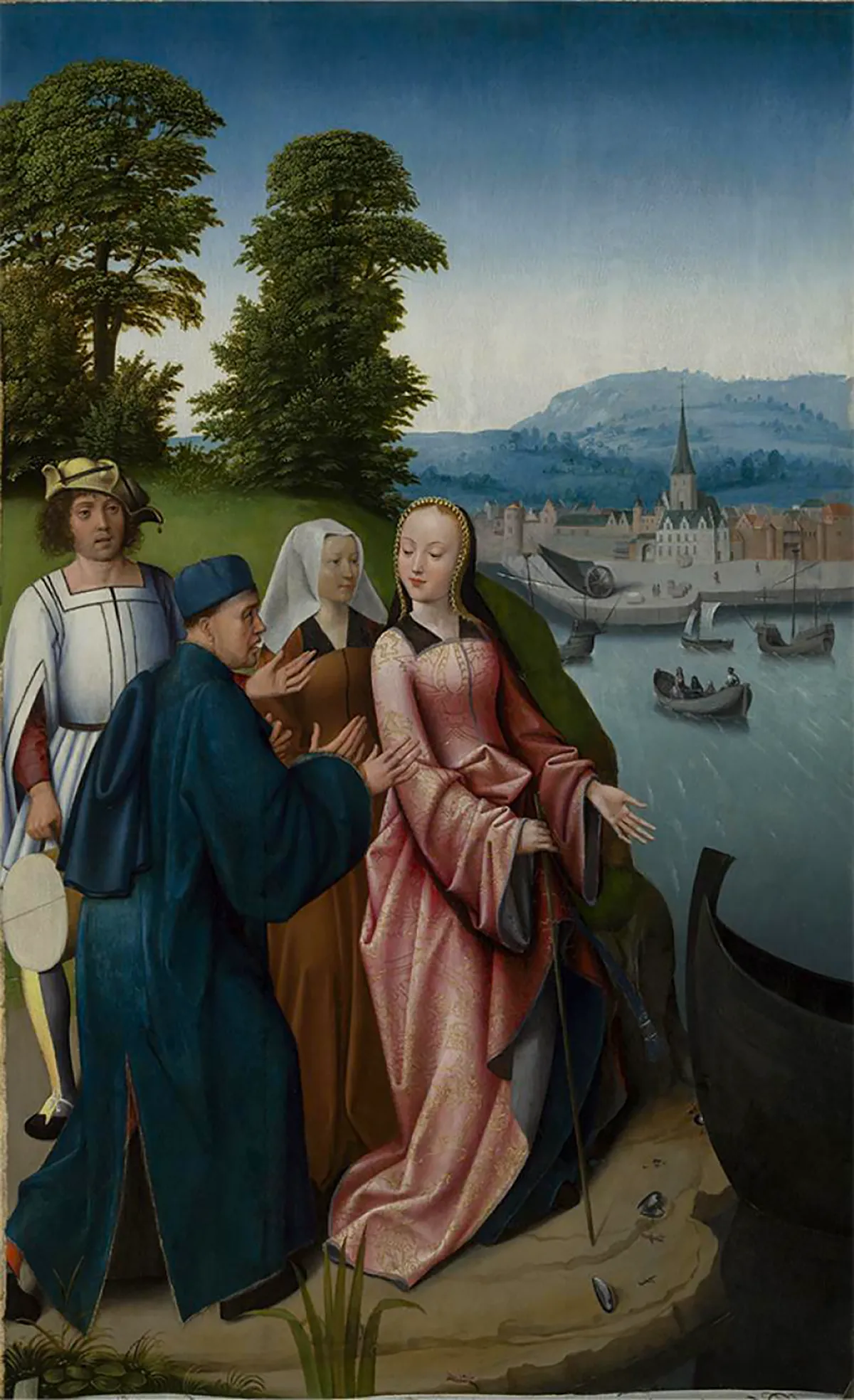
Damon pursued them. His agents traced the fugitives, tradition says, through the foreign coins they had spent on the road. The king crossed the sea, found his daughter, and once more demanded that she return with him as his bride. When she refused, his men struck down the elderly Gerebernus, and Damon, in a final fury, beheaded his own daughter with his sword. Dymphna was fifteen years old. The scene, and the whole of her life, was painted around 1505 by Goossen van der Weyden, grandson of the great Rogier, in the monumental Saint Dymphna Altarpiece commissioned by Tongerlo Abbey and now conserved by the Phoebus Foundation in Antwerp. If you want to see the grandfather’s genius, read our article on Rogier van der Weyden’s Descent from the Cross.
Why Is She the Patron Saint of Anxiety and Mental Health?
The bodies of Dymphna and Gerebernus were buried where they fell, and the graves soon drew pilgrims. From the thirteenth century onward, accounts multiply of sufferers from mental illness, then called lunatics and demoniacs, healed at her tomb. The Church built her a great sanctuary, and the sick came in such numbers that the canons added a sick room annex to lodge them.
Then something unique happened. When the sick room overflowed, the townspeople of Geel began taking the pilgrims into their own houses. The temporary arrangement became a way of life. For some seven centuries, and still today, the families of Geel have boarded psychiatric patients as ordinary members of the household, sharing meals, work and daily life, a system that peaked at nearly four thousand boarders in the 1930s and that psychiatry still studies as a model of community care. It is hard to name another place on earth where a martyred teenager’s memory produced seven hundred years of practical kindness.
That is the real answer to why Dymphna is the patroness of anxiety, depression, and every affliction of the mind: not only her own suffering, but what her town did with it. Her patronage extends to victims of abuse and incest, to runaways, to those with epilepsy and nervous disorders, and to the doctors, nurses and counsellors who care for them.
The Altarpiece: Goossen van der Weyden’s Life of St Dymphna
The most important images of St Dymphna are not devotional prints but a painted cycle, and it is barely known outside Belgium. Between 1503 and 1505 Goossen van der Weyden, grandson of the great Rogier, painted a series of panels telling her life for the abbey of Tongerlo, which had charge of the church at Geel. The panels are dispersed today between the Phoebus Foundation in Antwerp and other collections, and together they are the closest thing we have to a medieval film of her story: the baptism, the father’s proposal, the flight by ship, the search, the killing.
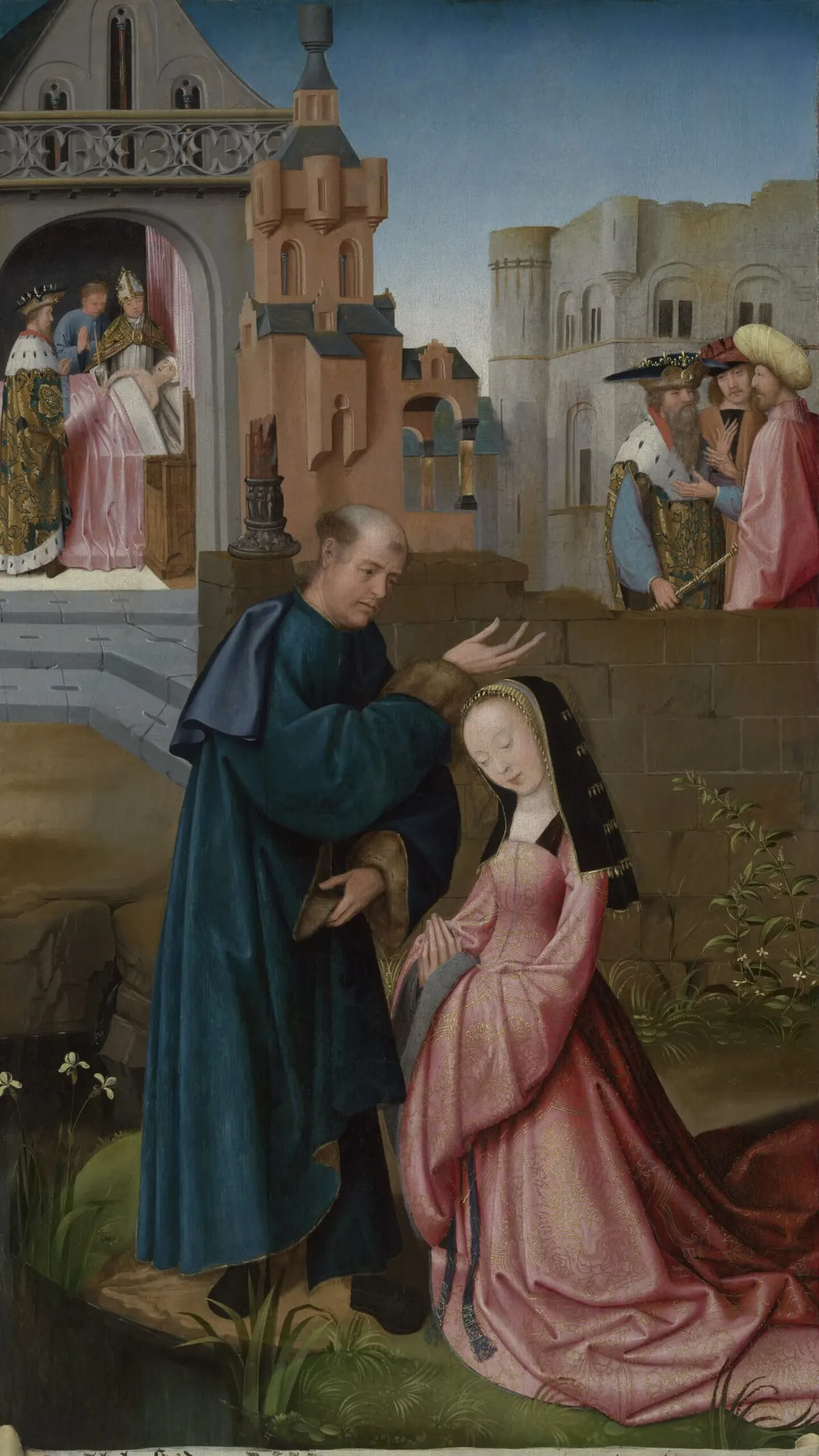
What makes the cycle remarkable is its ordinariness. Van der Weyden paints a Flemish town, Flemish clothes and Flemish weather, and sets the seventh century Irish princess in the middle of it, because that is how his patrons pictured her. The panel above shows Gerebernus baptising her as a child. He is the priest who would later flee with her across the sea and be killed beside her, and putting him at the opening of the cycle is the painter’s way of telling you how it ends.
The Martyrdom in Baroque Painting
A century and a half later the Flemish Baroque took up the same subject and did the opposite. Where van der Weyden is quiet and domestic, Godfried Maes stages the killing as a public catastrophe: soldiers, torchlight, bodies on the ground, and the martyr’s palm already coming down out of the clouds.
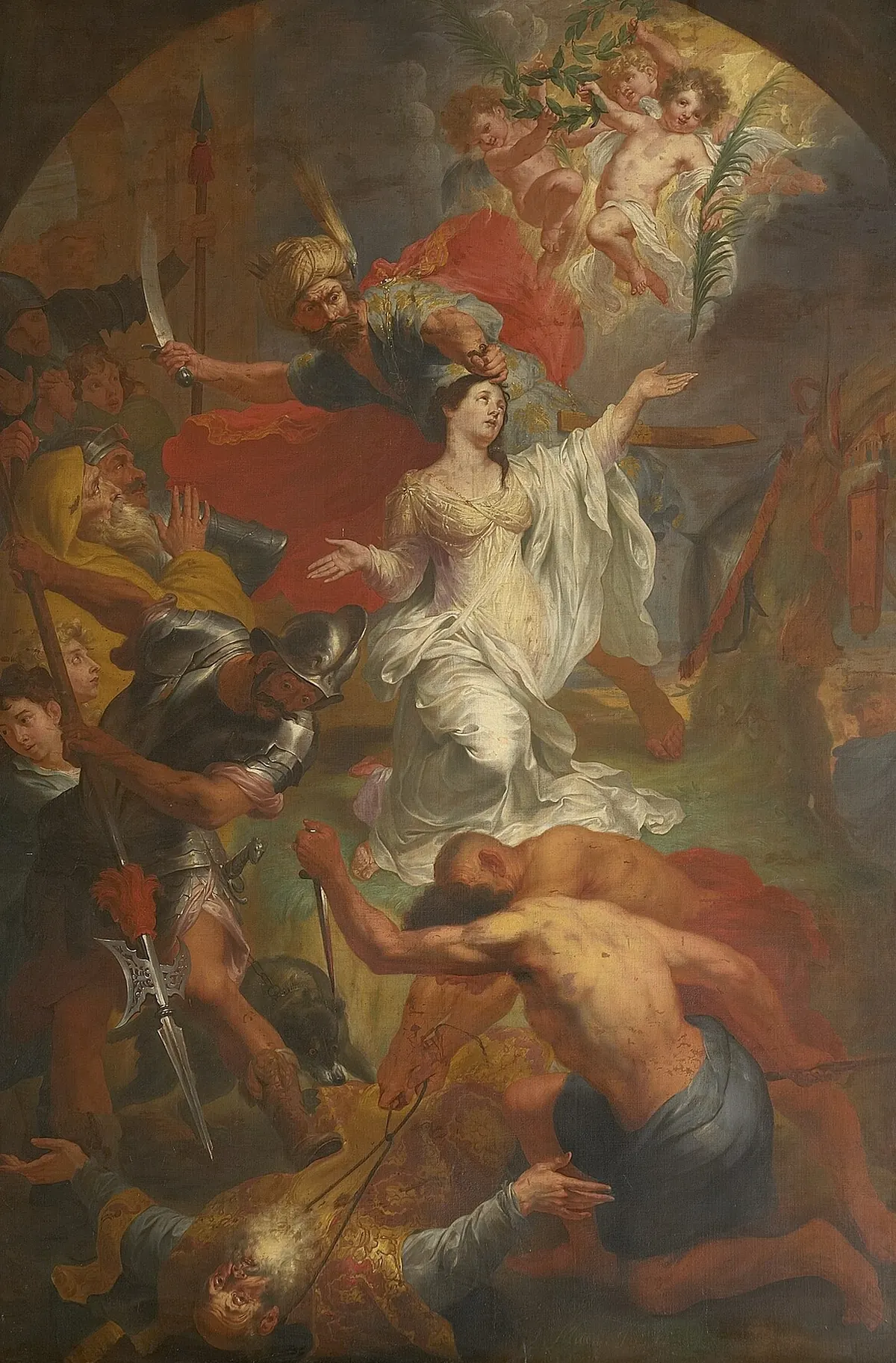
Both are true to something. The medieval cycle tells you what happened. The Baroque canvas tells you what the Church had come to feel about it, that a girl of fifteen murdered by her own father for refusing him was not a private tragedy but a public sign.
Symbols of Saint Dymphna in Art
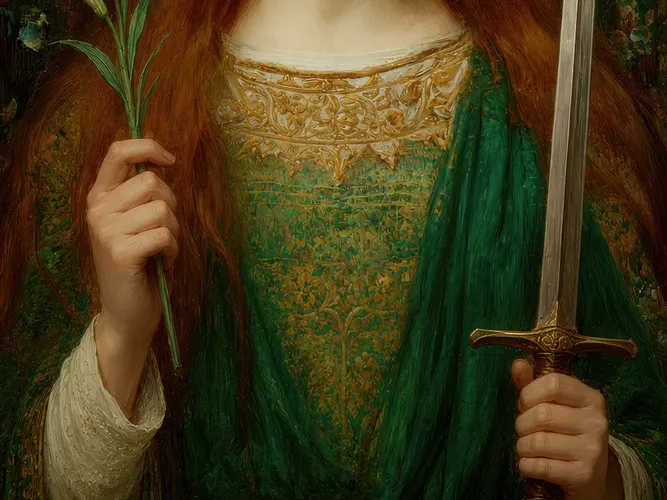
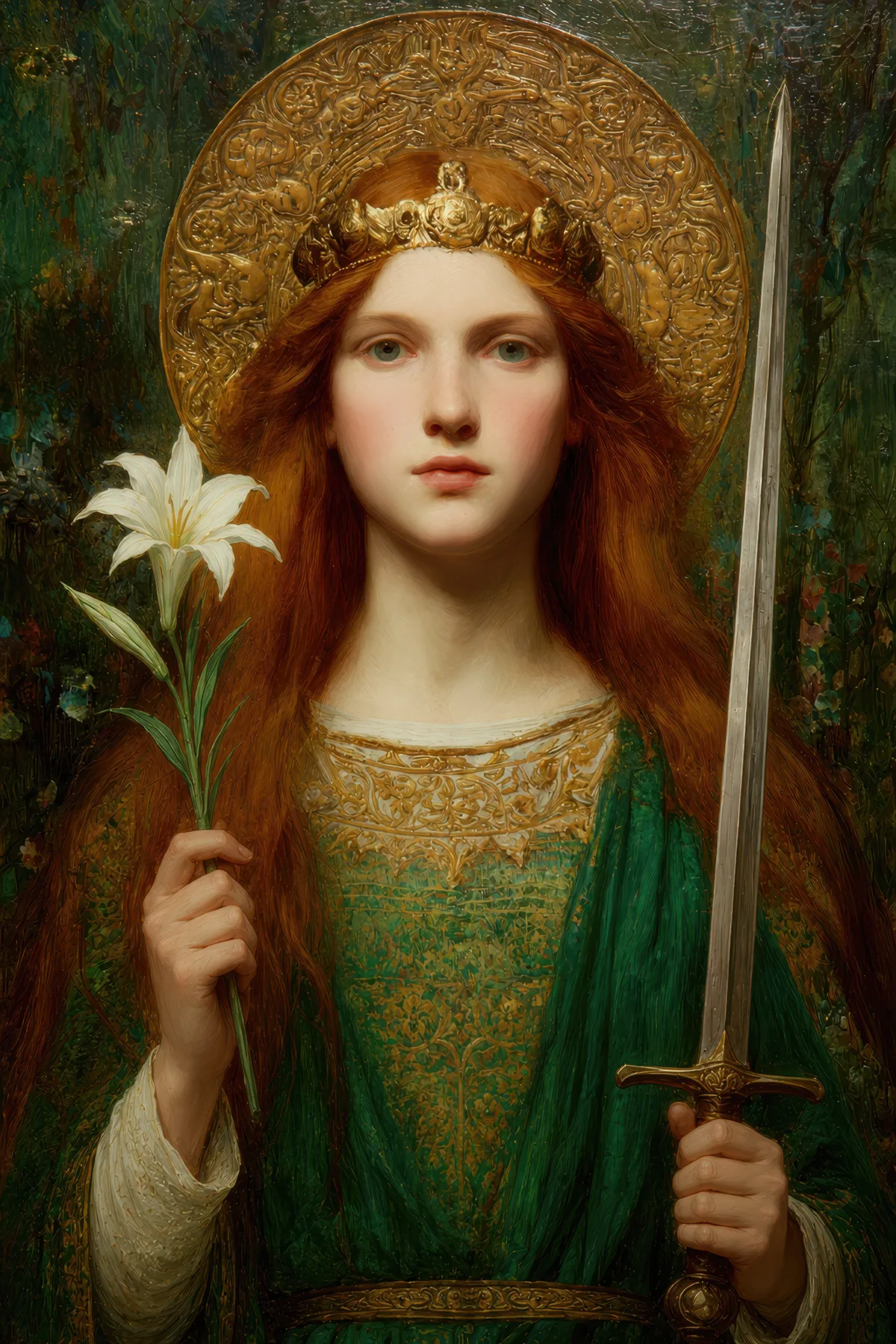
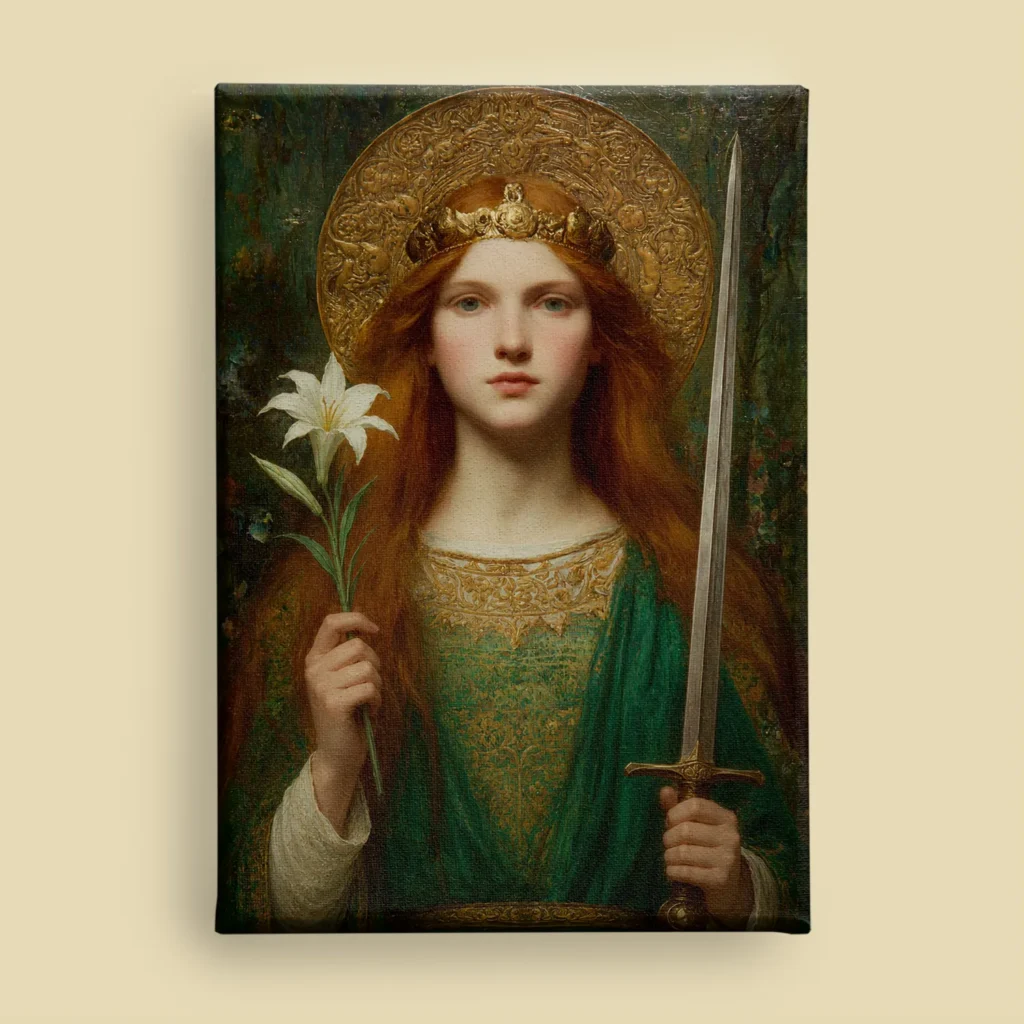
Painters and sculptors recognise Dymphna by a handful of attributes, all present in the painting that opens this article. The crown marks the king’s daughter. The white lily is the emblem of her purity, the answer to one of the questions most often asked about her images: the flower she holds is a lily, the same flower painters give to virgin saints and to the Annunciation. The sword is the instrument of her martyrdom, held calmly, the way martyrs hold the sign of their victory rather than their defeat. Older images add a chained demon at her feet, the medieval shorthand for mental illness overcome, and she often wears green, in Flemish tradition the colour of Ireland and of hope. She appears among the great virgin martyrs in our gallery of female saints in art.
Feast Day: May 15
Saint Dymphna’s feast is kept on May 15, in the heart of Mental Health Awareness Month, a coincidence of calendars that her devotees have gladly adopted. In Geel her relics rest in the church of Saint Dymphna, and the town still honours her with processions. In the United States, the National Shrine of Saint Dymphna in Massillon, Ohio, receives prayer requests from around the world. Her novena is traditionally prayed from May 7 to May 15, and at any season of need.
St Dymphna in the Orthodox Church
Dymphna died around the year 650, four centuries before the schism between East and West, which makes her a saint of the undivided Church. She is venerated in Orthodoxy as well as in the Roman calendar, and Orthodox icons of her have multiplied in the last twenty years, usually with the lily, sometimes with a book, her name written in Church Slavonic or Greek.
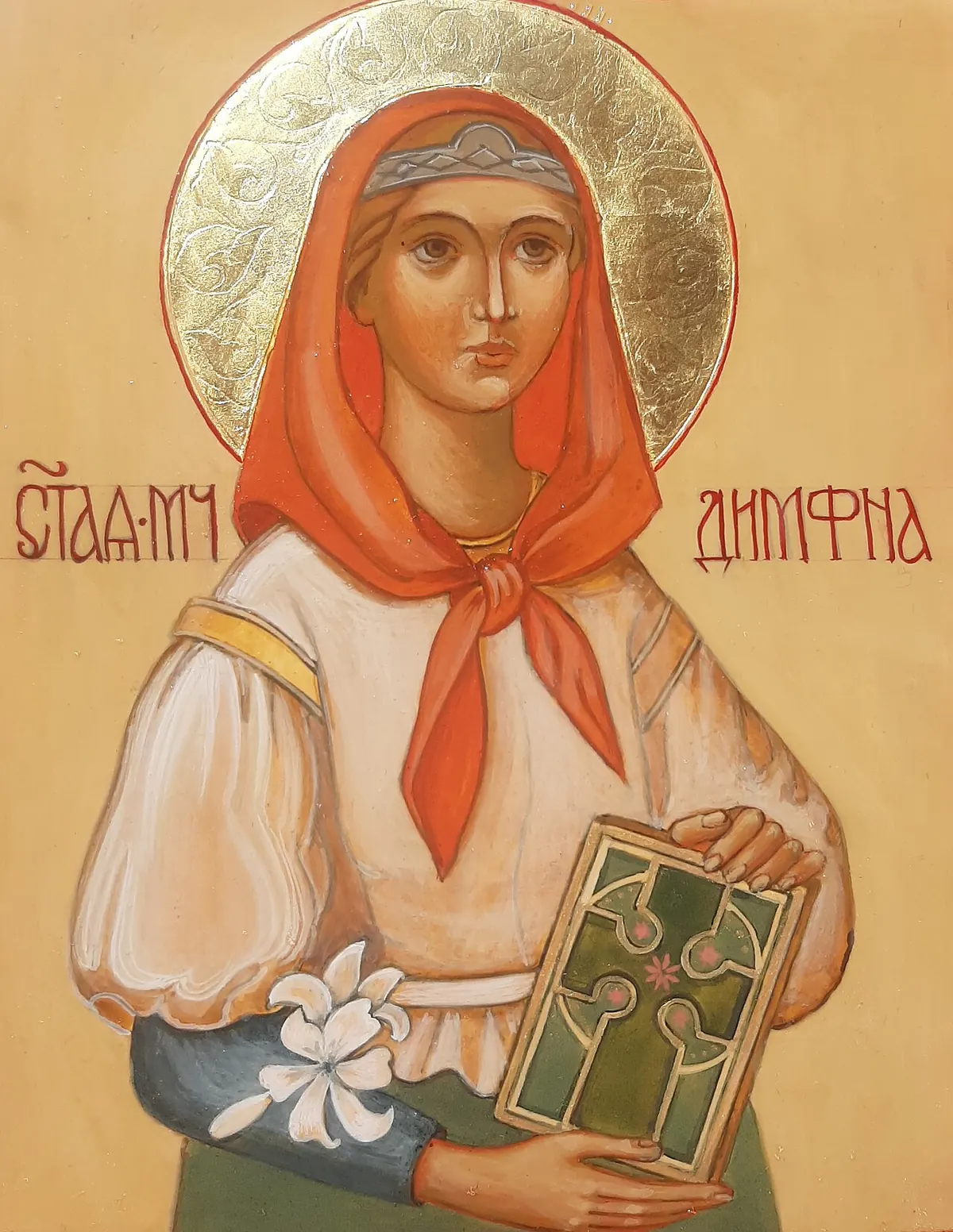
Her name travels: in Spanish speaking countries she is Santa Dimpna, in Dutch Sint-Dimpna, and in her own Irish Damhnait, which means something close to little fawn.
A Prayer to Saint Dymphna
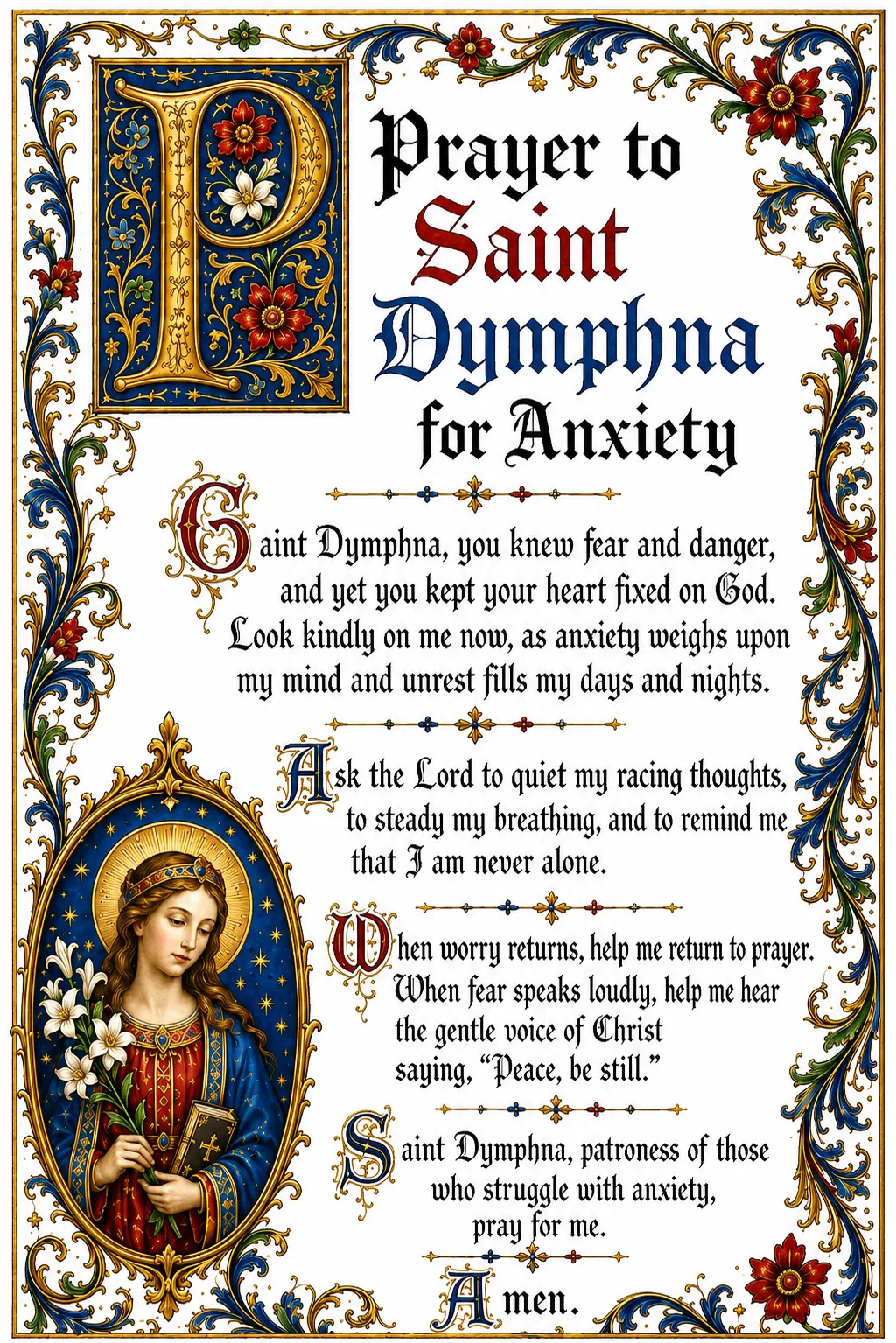
This prayer, written for those who struggle with anxiety, is the one on our printable prayer card and poster.
Saint Dymphna, you knew fear and danger, and yet you kept your heart fixed on God.
Look kindly on me now, as anxiety weighs upon my mind and unrest fills my days and nights.
Ask the Lord to quiet my racing thoughts, to steady my breathing, and to remind me that I am never alone.
When worry returns, help me return to prayer.
When fear speaks loudly, help me hear the gentle voice of Christ saying, “Peace, be still.”
Saint Dymphna, patroness of those who struggle with anxiety, pray for me. Amen.
For the traditional prayer, a prayer for a suffering loved one, and the complete nine day novena, see our page of Saint Dymphna prayers and novena.
Free printable prayer card:
These files are free for personal use, for your parish, or for catechism class.
✦ Free Christian & Catholic Printables
Love this one? Find it, and our complete collection of illuminated prayer cards and Scripture printables, ready to print, free, in one place.
Browse all free printables →
Conclusion
Saint Dymphna’s story begins in horror and ends in seven centuries of quiet mercy. A frightened girl who could not be saved became the saint who saves others from their fear, and a town at the end of her road learned to treat the most troubled minds as family. In an age that talks endlessly about mental health, the fifteen year old patroness of anxiety still has things to teach.
St Dymphna Paintings Featured in This Article
| Work | Artist | Date | Collection |
|---|---|---|---|
| Dymphna is baptised by Gerebernus | Goossen van der Weyden | 1503-1505 | The Phoebus Foundation, Antwerp |
| Dymphna and her companions take ship | Goossen van der Weyden | 1503-1505 | The Phoebus Foundation, Antwerp |
| The Martyrdom of Saint Dymphna | Godfried Maes | 17th century | Location not recorded |
| Orthodox icon of Saint Dymphna | Anonymous | contemporary | Location not recorded |
| Saint Dymphna with crown, lily and sword | Painted for jesuschrist.pictures | contemporary | Original work, not a historical painting |
Five Facts About Saint Dymphna
- Dymphna was a seventh century Irish princess, martyred at Geel in present-day Belgium by her own father when she was about fifteen.
- Her life was first written down around 1247 by Pierre, a canon of Cambrai, from the oral tradition preserved at her shrine.
- She is the patron saint of anxiety, depression and mental illness, and also of victims of abuse, runaways and those with epilepsy.
- The town of Geel has boarded psychiatric patients in private family homes for some seven hundred years, a system that peaked at nearly four thousand boarders.
- Her feast day is May 15, and the Saint Dymphna Altarpiece by Goossen van der Weyden, painted around 1505, tells her story in paint.
Frequently Asked Questions
What is Saint Dymphna known for?
Saint Dymphna is known as the patron saint of anxiety, depression and mental illness. She was a seventh century Irish princess who fled her deranged father and was martyred by him at Geel, in Belgium, at about fifteen. Healings reported at her tomb made Geel a place of pilgrimage for the mentally ill, and the town’s tradition of caring for patients in family homes made her patronage universal.
What do you pray to Saint Dymphna for?
The faithful pray to Saint Dymphna for relief from anxiety, panic, depression and every affliction of mind and nerves, for loved ones who are suffering mentally, for victims of abuse, and for the doctors, nurses, therapists and caregivers who look after them. Her intercession is also invoked against epilepsy and sleep disorders, and by runaways and those estranged from their families.
What was the miracle of Saint Dymphna?
No single miracle is attached to her canonisation, which predates the modern process. Her wonders are the centuries of healings reported at her tomb in Geel, beginning in the Middle Ages with sufferers described as lunatics and demoniacs who recovered their peace there. The enduring miracle, many would say, is Geel itself, where her shrine inspired seven hundred years of family care for the mentally ill.
What flower is Saint Dymphna holding?
The flower is a white lily, the traditional emblem of purity that painters give to virgin saints. Dymphna is almost always shown with the lily in one hand and the sword of her martyrdom in the other, wearing a crown as a king’s daughter, and sometimes with a chained demon at her feet, the old symbol of mental affliction overcome.
How do you pronounce Dymphna?
The usual English pronunciation is DIMF-nah, with a short i, and DIMP-nah is also heard. The name comes from the Irish Damhnait. In Geel, the Flemish form of her name is Dimpna, which is pronounced much the same way.
When is Saint Dymphna’s feast day?
Her feast day is May 15, which falls during Mental Health Awareness Month. Her novena is traditionally prayed from May 7 to May 15, and her relics are venerated in the church of Saint Dymphna in Geel, Belgium, and honoured at the National Shrine of Saint Dymphna in Massillon, Ohio.
Where can I see a statue of St Dymphna?
The main one stands in the church of Saint Dymphna at Geel, in Belgium, where her relics are kept and where the town has cared for the mentally ill in its own homes for seven centuries. There is a second at the psychiatric hospital of Geel, and the National Shrine of Saint Dymphna at Massillon, Ohio, has one in the United States. Statues of her are recognisable by the crown, the lily and the sword, and often by a chained demon at her feet.
Is St Dymphna venerated in the Orthodox Church?
Yes. She died around 650, four centuries before the schism between East and West, so she belongs to the undivided Church and is honoured in both traditions. Orthodox icons of her, usually showing the lily and a book with her name in Church Slavonic or Greek, have become much more common over the last twenty years, largely through the growth of Orthodox mental health ministries.
What is St Dymphna called in Spanish?
Santa Dimpna, and sometimes Santa Dimpna de Geel. In Dutch she is Sint-Dimpna, in French sainte Dymphne, and her original Irish name is Damhnait, which means roughly little fawn.
Where can I buy Saint Dymphna wall art?
You can buy Saint Dymphna wall art at jesuschrist.pictures: our original Saint Dymphna canvas shows the crowned princess with her lily and sword, and the same prayer for anxiety featured above is available as an illuminated prayer poster. Both are printed to gallery standard and ship ready to hang, and the printable prayer card remains free.