The Mystic Nativity and Botticelli’s Secret Prophecy
Mystic Nativity is the strangest and most personal religious painting by Sandro Botticelli, made around 1500 to 1501. On the surface it is a Nativity, the birth of Christ adored by Mary, Joseph, shepherds and kings. But Botticelli surrounds the scene with dancing angels and a vision of the end of the world, turning a Christmas image into a prophecy. The painting hangs in the National Gallery in London. The museum records its medium as oil on canvas.
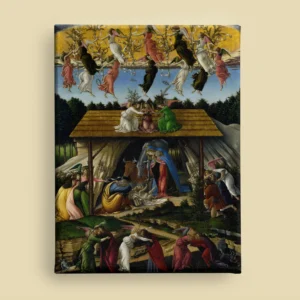
At the top, angels wheel in a ring against a dome of golden heaven, carrying crowns and olive branches. In the middle, three angels stand on the stable roof. At the bottom, more angels embrace men in a sign of peace, while tiny devils scurry away into cracks in the ground.
This is unlike any ordinary Nativity. Botticelli painted it in a time of crisis in Florence, and he added a Greek inscription across the top that ties the birth of Christ to the troubles of his own age and to the Book of Revelation.
It is also the only painting Botticelli ever signed. Readers can place it among the great Nativity paintings of Christian art.
The History of the Mystic Nativity
Botticelli painted the Mystic Nativity around 1500 to 1501, near the end of his life, in a Florence shaken by the rise and fall of the preacher Girolamo Savonarola. Savonarola had denounced the corruption and luxury of the city, and was burned at the stake in 1498. His fiery sermons on sin, judgment and renewal left a deep mark on the aging painter.

Across the top of the canvas Botticelli wrote, in Greek, that he made the picture during the troubles of Italy, linking it to the prophecies of the Book of Revelation. It is the only work he signed, a sign of how personal it was. More of the artist can be seen in our overview of Sandro Botticelli’s paintings.
The Nativity at the Center
At the heart of the painting is the birth itself. The Virgin Mary kneels in adoration over the Christ child, who lies on the ground before her. Joseph sits slumped nearby, and the ox and ass lean in from the dark of the stable.

This central group is calm and tender, painted in Botticelli’s flowing line and clear color. Around it press the shepherds and the three kings, led in by angels, all drawn toward the small, radiant child at the center of the whole vision.
The Dancing Angels
Above the stable opens a great dome of gold, and in it twelve angels dance in a ring, joined hand in hand. They wear robes of white, rose and green, and carry crowns and olive branches, the signs of victory and peace.

This circle of dancing angels is the most famous part of the painting. It turns the sky into heaven itself, breaking open above the humble stable. The movement is pure Botticelli, the same grace and rhythm he gave to his mythological figures, now lifted into worship.
The Angels on the Roof
On the thatched roof of the stable stand three more angels, robed again in white, rose and green. They hold an open book and seem to sing or read together, gazing down toward the child.

Their three colors are often read as the three theological virtues, faith, hope and charity. They form a quiet bridge between the dancing angels of heaven above and the holy family below, drawing the whole painting together from top to bottom.
Heaven Embracing Earth
At the very bottom of the canvas, three angels embrace three men, lifting them up in a gesture of reconciliation between heaven and humanity. Around their feet, small dark devils flee, scrambling into cracks in the ground or impaling themselves on their own weapons.

This is the most apocalyptic part of the scene. It shows the peace promised after the end of time, when evil is finally defeated and the saved are gathered into the embrace of angels. The birth of Christ, for Botticelli, is the beginning of that final victory.
A Painting for the End of Time
The deepest meaning of the Mystic Nativity lies in its joining of two moments, the first coming of Christ at Bethlehem and his second coming at the end of the world. The Greek inscription, the fleeing devils and the embracing angels all point beyond Christmas to the Last Things.
Painted in an age of war, plague and religious turmoil, the picture is Botticelli’s prayer for peace. He looks at the chaos of his own time and answers it with a vision of the birth that will, in the end, set all things right.
Conclusion
In the Mystic Nativity, Sandro Botticelli wove together the manger and the apocalypse, tenderness and terror, into one shimmering image. The dancing angels, the singing trio on the roof, and the embrace of heaven and earth make it far more than a Christmas scene.
It is the only painting he ever signed, the testament of an old master in a frightening age, and it still hangs in London as one of the most haunting visions of hope in all of Renaissance art.
Artwork Information
| Artwork | Artist | Date | Medium | Current Location |
|---|---|---|---|---|
| Mystic Nativity | Sandro Botticelli | c. 1500 to 1501 | Oil on canvas | National Gallery, London |
Five Facts About the Mystic Nativity
- Mystic Nativity is an oil on canvas by Sandro Botticelli, kept in the National Gallery in London.
- It was painted around 1500 to 1501, near the end of the artist’s life.
- It is the only painting Botticelli ever signed, with a Greek inscription across the top.
- The inscription links the birth of Christ to the troubles of Italy and the prophecies of the Book of Revelation.
- It shows angels dancing in a ring of golden heaven and embracing men below, while devils flee into the earth.
FAQ
What does Botticelli’s Mystic Nativity depict?
It shows the birth of Christ, with the Virgin, Joseph, shepherds and kings, but surrounded by a vision of the end of the world. Mystic Nativity joins the first coming of Christ with his second coming.
Why is it called the Mystic Nativity?
The name is modern. It was given because of the painting’s unusual, mysterious iconography, the dancing angels, the apocalyptic inscription and the fleeing devils, which set it apart from an ordinary Nativity.
What does the Greek inscription mean?
In it Botticelli says he painted the work during the troubles of Italy, and links the scene to the prophecies of the Book of Revelation. It also serves as his signature, the only one he ever added to a painting.
How was the painting shaped by Savonarola?
Botticelli worked in a Florence deeply marked by the preacher Girolamo Savonarola, who warned of sin and judgment before his execution in 1498. His sermons helped inspire the painting’s apocalyptic mood and its hope for renewal.
Is the Mystic Nativity Botticelli’s only signed work?
Yes. Of all his paintings, the Mystic Nativity is the only one he is known to have signed, through the Greek inscription at the top.
Where is the Mystic Nativity today?
It is in the National Gallery in London.
Where can I buy Botticelli’s Mystic Nativity as a canvas print?
You can buy Botticelli’s Mystic Nativity as a canvas print at jesuschrist.pictures. The canvas reproduction is in our shop, printed on premium canvas and shipped worldwide.