The Fallen Angel by Alexandre Cabanel: Lucifer’s Tears
The Fallen Angel (in French, L’Ange dechu) is one of the most haunting religious paintings of the nineteenth century, made by the French artist Alexandre Cabanel in 1847, when he was only twenty-four years old. It shows Lucifer, the angel cast out of heaven, lying on the ground in defeat while a band of angels flies joyfully through the sky above. The painting is held at the Musee Fabre in Montpellier. Its medium is oil on canvas.
The whole drama is carried by a single glance. Lucifer hides most of his face behind his crossed arms, but his eyes burn over the top of them, red-rimmed and full of resentment, and a single tear runs down his cheek. It is a look of grief, anger, and wounded pride all at once, and it is what has made the picture famous.
Cabanel would go on to become the most celebrated academic painter of the Second Empire, the favourite of the Salon and of Napoleon III. Readers who want to see more of his work can also read our article on Alexandre Cabanel’s paintings.
The History of Cabanel’s The Fallen Angel
Cabanel painted The Fallen Angel in 1847 while living in Rome. Trained at the Ecole des Beaux-Arts in Paris, he had competed for the Prix de Rome, the great prize that sent the most promising young French painters to the Villa Medici for several years of study at state expense. Each year these scholarship holders were required to send a work back to Paris, an envoi de Rome, to prove how their art was advancing. The Fallen Angel was one such submission.
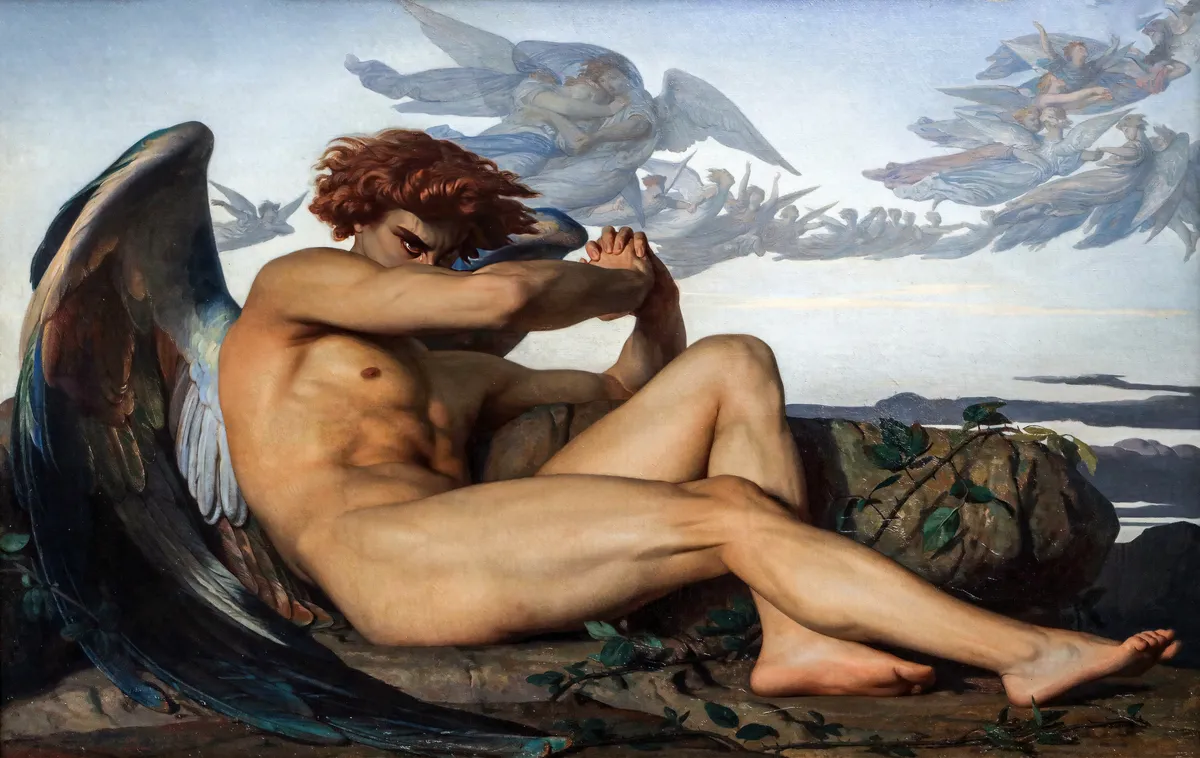

The jury of the Academy was not pleased. The figure was thought too sensual and the expression too unsettling for a religious subject, and the painting was criticised rather than praised. Cabanel set it aside, and it was only much later recognised as one of his finest and most original works. Today it is the single picture most people connect with his name, far better known than the polished mythologies that made him rich and famous in his own lifetime.
The Eyes and the Tear
The heart of the painting is the face, half hidden behind the crossed arms. Lucifer presses his arms against his mouth, as if holding back a cry, and stares out over them with a fixed, furious glare. The whites of his eyes are flushed with red, and a single tear slides down toward his arm.
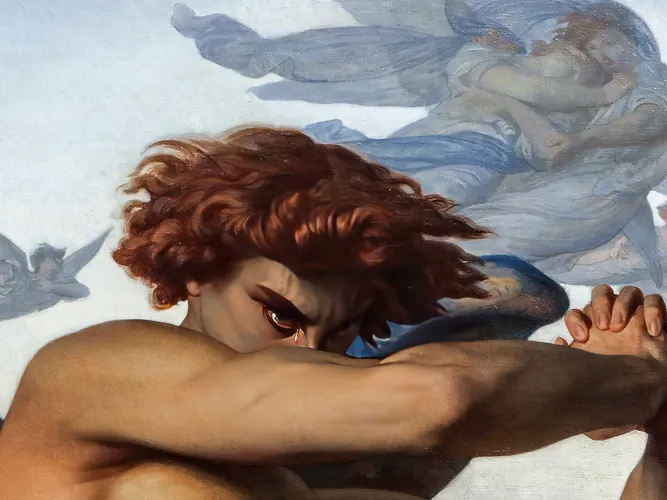
This is one of the most studied details in nineteenth-century painting. The look is not simple sadness. It mixes envy, rage, and grief, the expression of a being who has lost everything and refuses to repent. Cabanel gives the Devil not horns and claws but the beauty of a young man and the bitterness of the proud.
The Dark Wing
Behind the figure rises a great wing, folded against the rocky ground. Once the wing of an angel of light, it is now painted in deep blacks, shot through with cold flashes of blue and green like the feathers of a crow or a peacock.
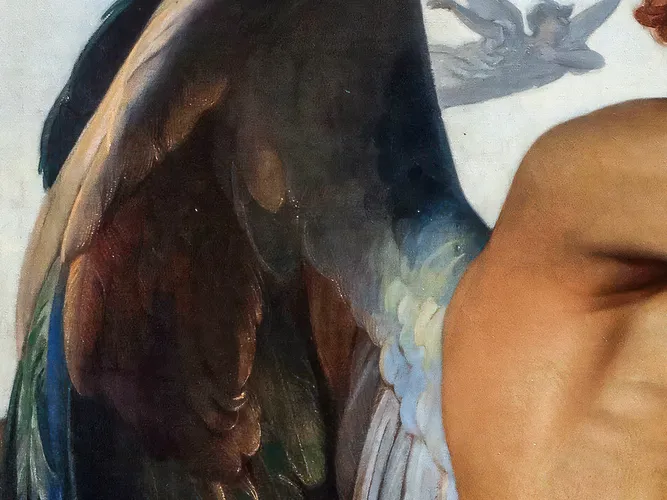
The wing is a quiet reminder of what Lucifer was before his fall. Its dark, oily colours set off the pale flesh of the body and mark him as a creature of the night, no longer of heaven. Cabanel paints it with the same care he gives to the muscles of the figure, turning a single feathered shape into a sign of ruin.
The Rejoicing Angels
High in the sky, a long band of angels streams across the blue, their robes and wings caught up in the wind. They fly free and joyful, lifted up in the light, the exact opposite of the heavy body pinned to the earth below.
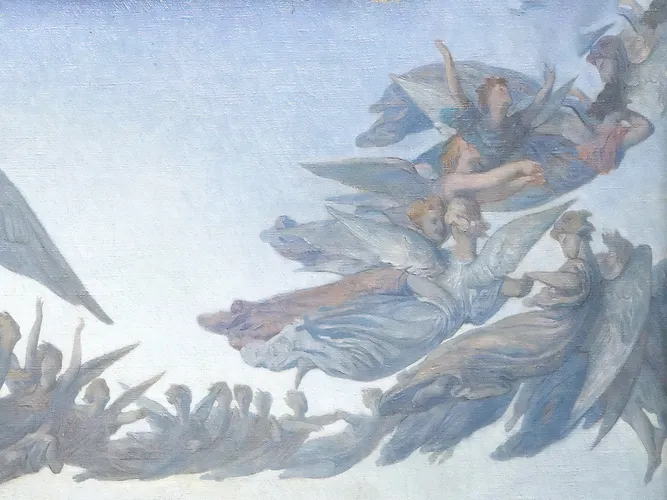
These are the angels who remained faithful, rejoicing in the glory of God. Their distant, happy flight is what Lucifer can no longer share, and it sharpens his grief. The contrast between the bright crowd above and the lonely figure below gives the painting its whole meaning in a single image.
Beauty, Pride and the Fall
What shocked Cabanel’s first viewers, and what still draws people to the picture, is that the Devil is beautiful. The body is that of a young athlete, modelled on classical sculpture, and the face is the face of a fallen prince rather than a monster.
That beauty is the point. The painting is about pride, the sin that turned the highest of the angels against God. By making Lucifer handsome and sympathetic, Cabanel asks the viewer to feel the tragedy of the fall from within, not simply to condemn it from outside.
The Salon and the Art World of Paris
To understand why a single rejection mattered so much, it helps to picture the art world Cabanel was trying to enter. In nineteenth-century Paris the official Salon was the centre of everything. Held by the Academy of Fine Arts, at first in the Louvre and later in the vast Palais de l’Industrie, it was a yearly exhibition that drew tens of thousands of visitors. A success there could make a young painter’s career overnight, while a refusal could leave him invisible.
The path to that hall was strict. A student trained at the Ecole des Beaux-Arts, learned to draw from casts and from the live model, competed for prizes, and if he was very fortunate won the Prix de Rome and his years at the Villa Medici. The Academy decided what counted as serious art, and grand religious, historical, and mythological subjects stood at the top of that order. The Fallen Angel was Cabanel’s bid to prove himself within exactly this system.
In the end the system rewarded him completely. Cabanel became one of the most powerful figures of the Salon, a member of the Institut, a sought-after teacher, and a favourite of the court of Napoleon III, who bought his Birth of Venus in 1863. He sat on the juries that shaped French taste for a generation, in the very years when younger painters such as Manet and the Impressionists were beginning to push against the Salon’s authority. The bruised young man’s painting from Rome and the establishment grandee were, in the end, the same artist.
Conclusion
In The Fallen Angel Cabanel took an old subject, the rebellion and ruin of Lucifer, and reduced it to a single unforgettable look. The crossed arms, the burning eyes, the tear, the dark wing, and the joyful angels above tell the whole story without a word.
Rejected by the Academy in its own day, it has become Cabanel’s most loved work, and one of the most striking images of the fallen angel in all of Western art.
Artwork Information
| Artwork | Artist | Date | Medium | Dimensions | Current Location |
|---|---|---|---|---|---|
| The Fallen Angel (L’Ange dechu) | Alexandre Cabanel | 1847 | Oil on canvas | 120.5 x 196.5 cm | Musee Fabre, Montpellier |
Five Facts About The Fallen Angel
- The Fallen Angel is an oil on canvas painted by Alexandre Cabanel in 1847.
- Cabanel was only twenty-four when he painted it, while studying in Rome.
- It depicts Lucifer after his fall from heaven, with crossed arms, glaring eyes, and a single tear.
- The Academy disapproved of it at first, finding the figure too sensual and the mood too unsettling.
- It measures about 120.5 by 196.5 centimetres and is held at the Musee Fabre in Montpellier.
FAQ
What does The Fallen Angel by Cabanel show?
It shows Lucifer, the angel cast out of heaven, lying naked on the ground in defeat. He hides his face behind his crossed arms, glares out with red-rimmed eyes, and sheds a single tear, while a band of faithful angels flies joyfully through the sky above him.
Why did Cabanel paint The Fallen Angel?
He painted it in 1847 as a student work, sent from Rome to the French Academy as proof of his progress. He chose the dramatic subject of Lucifer’s fall to display his command of the human figure and of strong emotion, though the Academy disapproved of the result.
How old was Alexandre Cabanel when he painted The Fallen Angel?
He was twenty-four years old. Cabanel was born in 1823 and painted the work in 1847 during his time studying in Rome.
What do the eyes and the tear mean?
The eyes, flushed with red and fixed in a furious glare, express envy and wounded pride, while the single tear shows grief over what has been lost. Together they capture the mix of rage and sorrow of a being who has fallen and will not repent.
Who owns The Fallen Angel now?
It is held at the Musee Fabre in Montpellier, in the south of France.
When was The Fallen Angel painted?
It was painted in 1847, early in Cabanel’s career and long before he became the leading academic painter of the Second Empire.
Who painted The Fallen Angel?
It was painted by Alexandre Cabanel (1823 to 1889), a French academic painter best known for his Salon portraits and mythological scenes, of which this early religious work is now the most famous.
How much are Cabanel’s paintings worth?
The Fallen Angel belongs to the Musee Fabre and is not for sale. Cabanel’s works that do reach the market range widely, from modest sums for drawings and minor studies to several hundred thousand dollars or more for important Salon paintings, depending on size, subject, and condition.
Where can I buy a reproduction of the Fallen Angel by Alexandre Cabanel?
You can buy a reproduction of the Fallen Angel by Alexandre Cabanel at jesuschrist.pictures. The canvas reproduction is in our shop, printed on premium canvas and shipped worldwide.


