De Profundis Prayer: Psalm 130, the Catholic Prayer for the Dead
Out of the depths I have cried to thee, O Lord. For centuries this has been the prayer Catholics say for their dead: at the graveside, at the evening bell, through the whole month of November. It is Psalm 130, known by its first two words in Latin, De Profundis, and it is only eight verses long.
At first sight it is not a prayer about death at all. It is the cry of someone at the bottom of something, who waits for God the way a night watchman waits for the morning. That is exactly why the Church gave it to the dead, and to those who mourn them. Here is the full prayer as Catholics pray it, the psalm in the King James Version and in Latin, how to pray it for the faithful departed, and a free printable card.

The De Profundis Prayer for the Dead (Full Text)
This is the Douay-Rheims translation of the psalm, which Catholic Bibles number Psalm 129, followed by the verse and response that make it a prayer for the dead:
Out of the depths I have cried to thee, O Lord:
Lord, hear my voice.
Let thy ears be attentive to the voice of my supplication.
If thou, O Lord, wilt mark iniquities: Lord, who shall stand it.
For with thee there is merciful forgiveness:
and by reason of thy law, I have waited for thee, O Lord.
My soul hath relied on his word: my soul hath hoped in the Lord.
From the morning watch even until night, let Israel hope in the Lord.
Because with the Lord there is mercy: and with him plentiful redemption.
And he shall redeem Israel from all his iniquities.V. Eternal rest grant unto them, O Lord.
R. And let perpetual light shine upon them.
V. May they rest in peace. R. Amen.
When the prayer is said for one person, the ending becomes “grant unto him” or “grant unto her”, and “may he rest in peace” or “may she rest in peace”.
Psalm 130 in the King James Version
Protestant Bibles and most modern translations number it Psalm 130. This is the King James text, the one on our printable card:
Out of the depths have I cried unto thee, O LORD.
Lord, hear my voice: let thine ears be attentive to the voice of my supplications.
If thou, LORD, shouldest mark iniquities, O Lord, who shall stand?
But there is forgiveness with thee, that thou mayest be feared.
I wait for the LORD, my soul doth wait, and in his word do I hope.
My soul waiteth for the Lord more than they that watch for the morning:
I say, more than they that watch for the morning.
Let Israel hope in the LORD: for with the LORD there is mercy,
and with him is plenteous redemption.
And he shall redeem Israel from all his iniquities.
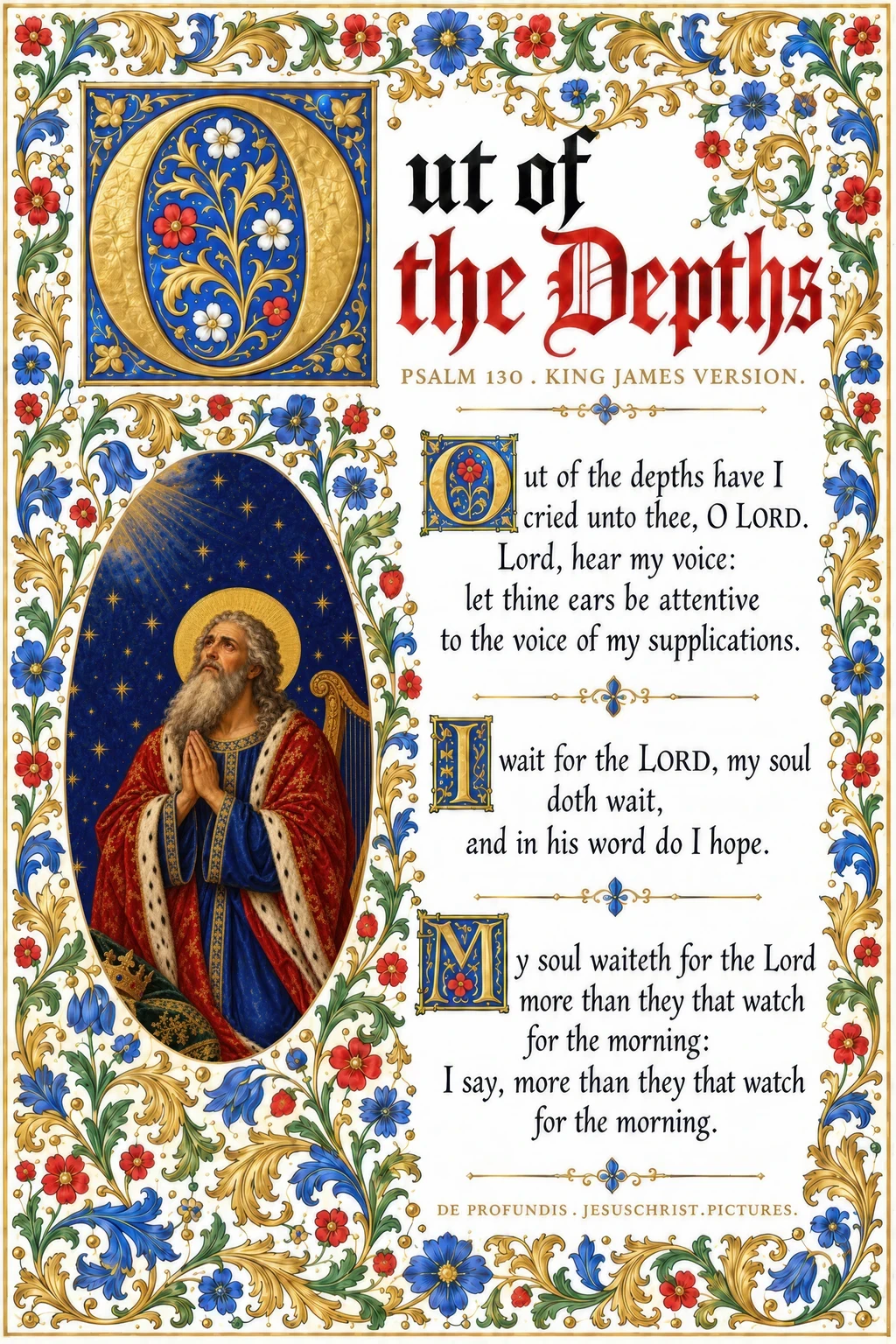
Free printable De Profundis prayer card:
- Prayer card, PDF, US Letter
- Prayer card, PDF, A4
- Pocket prayer cards, 4 per sheet, PDF
- High resolution image, JPG
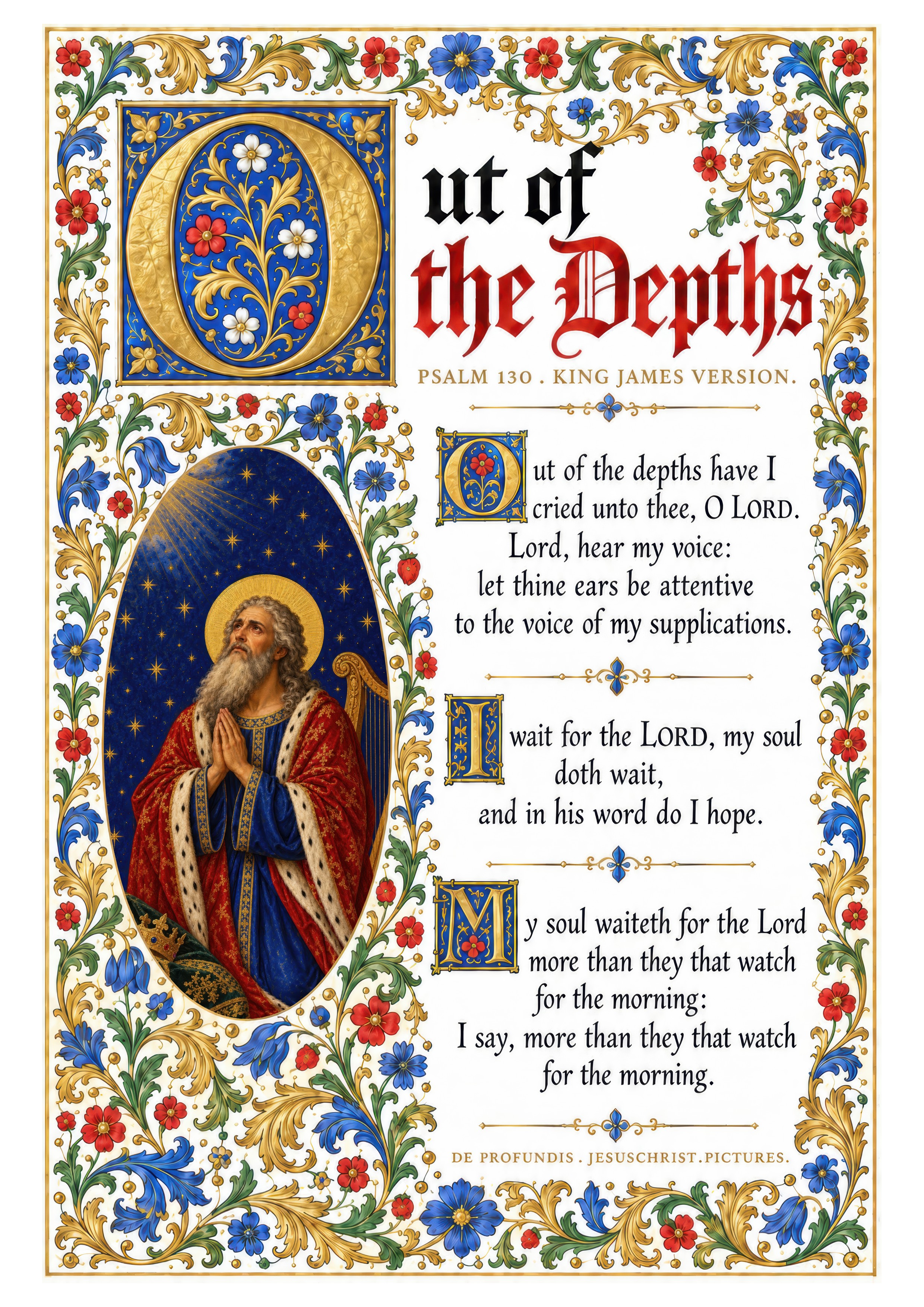
The card carries verses 1 and 2, the cry, and verses 5 and 6, the waiting, around King David at prayer. It is free for personal use, for your parish, or to hand out at a funeral.
✦ Memorial & Funeral Prayer Cards
For a funeral, a memorial Mass or the anniversary of a death, our four memorial cards leave a space to write by hand the name of the person you are praying for. All free to print.
See the memorial cards →How to Pray the De Profundis for the Dead
There is no fixed ritual. The simplest custom is to name the person, pray the psalm slowly, and close with the Eternal Rest in place of the Glory Be. Catholics have always prayed it:
- at the graveside, at a wake, or on the anniversary of a death;
- every day in November, the month the Church sets aside for the dead, and above all on All Souls’ Day, November 2;
- in the evening. In many Catholic parishes a bell once rang after the evening Angelus to call the faithful to say the De Profundis for the dead.
It can also be prayed for yourself. Before it was a prayer for the dead, it was the prayer of anyone who has reached the bottom, and the Church still counts it among the seven penitential psalms.
Where the De Profundis Comes From
Psalm 130 is one of the fifteen Songs of Ascents, Psalms 120 to 134, short psalms sung by pilgrims going up to Jerusalem for the feasts. Its author is not named.
Christian tradition placed it among the seven penitential psalms, the psalms of repentance prayed especially in Lent, where it is the sixth. The Church also set it in the Office of the Dead, the prayer for the departed that medieval books of hours copied and illuminated, where it is sung at Vespers. From there it passed into every Catholic custom around death: funerals, wakes, the month of November.
Why a psalm about waiting? Because the prayer of the Church for the dead is a prayer of hope, not of mourning alone. The psalm ends on plenteous redemption, and the souls it is prayed for are waiting, as the psalm says, more than they that watch for the morning.
Why King David?
The psalm does not name its author, but the whole psalter was prayed under the name of David, and the books of hours illustrate the penitential psalms with one image: the king on his knees, his crown laid aside. It is the David of Psalm 51, who has sinned, has been found out, and prays anyway.
Our card follows that tradition. David looks up to the first light of dawn, the morning the psalm waits for. His crown is on the ground beside him and his harp behind him: the king and the singer both set down, and only the man praying is left.
The Latin Text: De Profundis Clamavi
This is the psalm in the Latin Vulgate, as it was sung in the Office of the Dead, with the Latin ending:
De profundis clamavi ad te, Domine;
Domine, exaudi vocem meam.
Fiant aures tuae intendentes in vocem deprecationis meae.
Si iniquitates observaveris, Domine, Domine, quis sustinebit?
Quia apud te propitiatio est; et propter legem tuam sustinui te, Domine.
Sustinuit anima mea in verbo ejus; speravit anima mea in Domino.
A custodia matutina usque ad noctem, speret Israel in Domino;
quia apud Dominum misericordia, et copiosa apud eum redemptio.
Et ipse redimet Israel ex omnibus iniquitatibus ejus.Requiem aeternam dona eis, Domine, et lux perpetua luceat eis.
Requiescant in pace. Amen.
Frequently Asked Questions
What does De Profundis mean?
It is Latin for “out of the depths”, the first words of the psalm. The phrase is also the title of the long letter Oscar Wilde wrote in prison in 1897, which borrowed the psalm’s opening.
Is it Psalm 130 or Psalm 129?
Both: it is the same psalm. The Hebrew numbering, used by the King James Version and most modern Bibles, makes it Psalm 130. The Greek and Latin Bibles, and the Douay-Rheims that follows them, join Psalms 9 and 10 into one and make it Psalm 129.
Why is the De Profundis prayed for the dead?
Because the Church placed it in the Office of the Dead, and because it is a prayer of trust in mercy. It asks God not to mark iniquities, and ends with the promise that he shall redeem Israel from all of them. Prayed for the dead, it asks that mercy for them.
When should you pray the De Profundis?
At any time, for anyone who has died. It is traditional every day in November, on All Souls’ Day, on the anniversary of a death, and at a funeral or a wake.